Sarah Friar is a respected leader in the tech industry, currently serving as the Chief Financial Officer of OpenAI. She is widely known for her previous executive roles as the CEO of Nextdoor and the CFO of Square, as well as her position on the board of directors for Walmart.
On Leadership and Management
- On the essence of leadership: "To make everyone else be their best self, to do the best work of their lives: that's what I view my job as." [1]
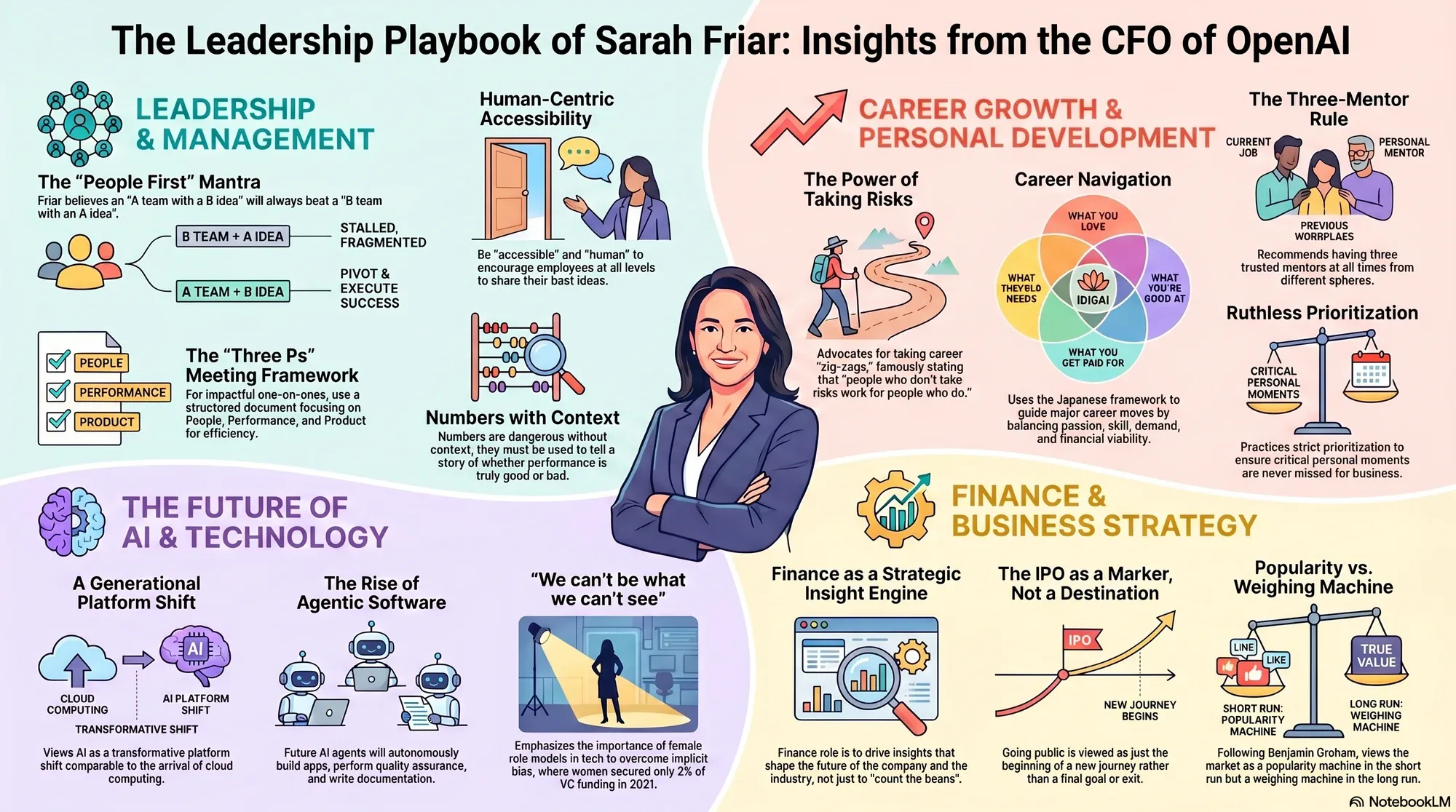
- On her leadership mantra: "So, if you ask me what is my leadership mantra, it is people first. Because I fundamentally believe that if you get the right people and you really let them fly...then the A team with the B idea will always beat the B team with the A idea." [2]
- On fostering ownership: "In companies, you don't want just the product team thinking about the product; the finance team thinking about finance... You want everyone all the time feeling like they're an owner, and they can have a point of view on any part of the company." [2]
- On approachability: "I want you to see me as a human... when people see you as very accessible, they will come and tell you their best ideas. And I totally believe that great ideas come from everywhere." [2]
- On building trust: "Trust is built on open and honest communication." [3]
- On the importance of numbers in leadership: "Numbers are critical in leadership. Friar says she's never met a number she didn't like. People in general still aren't good enough with numbers. 'For example, if we have 10 new neighbors on our platform, is that good? Bad? Numbers without context are dangerous.'" [4]
- On hiring philosophy: "Your hiring philosophies will evolve as your company grows. The people are the thing that will add the most value to the company over time." [4]
- On hiring for mission: "Hire for Mission Alignment, Not Just Skills. In one of her interviews, Friar mentioned that the best team members are those who align deeply with Nextdoor's mission." [3]
- On effective meetings: Friar utilizes a "Three Ps" document for one-on-one meetings, covering people, performance, and product to ensure meetings are efficient and impactful. [4]
- On leading through tough times: "From the outside it might look like Square was straight up and into the right. Square was like Swiss cheese. There was always something that was falling apart, not working... you needed people that could get through the really tough times, that were those leaders who always found positivity and led people not just with their heads, but with their hearts." [5]
- On Protecting a Research-First Culture: Preserve a research organization's distinctiveness deliberately: design the environment around researchers, keep the talent bar high, and make the institution's priorities explicit rather than letting ordinary corporate habits take over. — T. Rowe Price — The Long View: OpenAI
- On Lean Teams With Wider Reach: Use AI to widen what a small team can handle, but keep people accountable for judgment, trust, and the relationships that determine whether important work succeeds. — OpenAI Forum — The Future of Finance
- On Leading Through Fast-Moving Technology: When a new tool creates anxiety, replace distance with direct use: try it, ask questions, and let hands-on understanding turn fear into operating judgment. — OpenAI Forum — The Future of Finance
On Community
- On the power of community: "It also taught me that community doesn't just happen to you, it happens because of you." [5]
- On the impact of local connections: "Knowing six neighbors is all you need to prevent social isolation. It's good for your health." [6]
- On building platforms for good: "I think what is really special about Nextdoor is that you really see how much people want to help each other in the bigger picture." [4]
- On the purpose of Nextdoor: "to cultivate a kinder world where everyone has a neighborhood to rely on." [7]
- On a "we" society: "Everyone has a role to play. We should be a very “we” society, not an “I” society." [1]
- On Trust as Infrastructure: Treat public trust as part of the infrastructure supply chain, alongside chips, power, land, and permits; capacity cannot scale durably if the communities hosting it feel decisions are being imposed on them. — All-In Podcast — OpenAI CFO Sarah Friar
- On Sharing the Local Return: Large infrastructure projects should produce visible value for their host communities through jobs, tax revenue, education, and protection from shifted utility costs. — All-In Podcast — OpenAI CFO Sarah Friar
On Career and Personal Growth
- On taking career risks: "People who don't take risks work for people who do." (This quote is widely attributed to her).
- On embracing zig-zags in your career: "I guess the arc is take risks. You think that you have to keep doing these things to build expertise, and that somehow if you zag, it's going to be all these risks you're going to take. It's so it's all in your head like absolutely all in your head." [8]
- On passion and expertise: "Don't get caught up in the money that coincides with high expertise and leaves you with low passion. Remember that the place where high passion and expertise meet is your zone." [4]
- On having the confidence to move on: "I kept staying; I don't know if my life would have been different, but I wish I had the confidence to jump sooner." [4]
- On the Japanese concept of Ikigai: She uses this framework—what you love, what the world needs, what you're good at, and what you can get paid for—to guide her career decisions. [1][8]
- On taking breaks: "It's okay to jump off the treadmill sometimes... It's okay to pull back to rest, recover and then lean back in again. Your career will be long." [4]
- On continuous learning: She advocates for learning both inside and outside the classroom and values the diverse learning experiences from working in both large and small companies. [5][9]
- On networking: "Always be keeping your network warm, nurtured, and loved. Ask for advice, ask for help." [6]
- On mentorship: "Have at least three mentors you trust at every point in your career. One at your current job, one from a prior work environment, and one close, personal mentor." [4]
- A quote to live by: "Walk on air despite your better judgment." - A quote from her favorite Irish poet, Seamus Heaney, that she embraces. [2]
- On Learning the Craft Before Claiming the Title: If you want an executive role, first work for an excellent practitioner and learn the tools, operating rhythms, and unglamorous responsibilities that outsiders rarely see. — OpenAI Forum — The Future of Finance
- On Titles Versus Operational Reality: Do not choose a role for how its title looks from the outside; get close enough to the operation to understand the actual work and whether it fits you. — OpenAI Forum — The Future of Finance
- On a Durable Career Stack: Build a career around curiosity to explore, adaptability to keep changing, and kindness to make the people around you stronger; technical skills will evolve faster than those qualities. — OpenAI Forum — The Future of Finance
On Company Culture and Values
- On creating a positive work culture: It starts with what is important to you and is built one person at a time. [2][8]
- On speaking up: "You also want people to feel that they can speak up no matter what there's going to be no consequence." [8]
- On building resilience: Resilience requires diverse perspectives, scenario-planning, and considering unforeseen consequences. [10]
- On the importance of authenticity: "The courage that it takes to stand up for what you believe in, even when it's against the grain, is hard, but when you do it, you tend to attract really like-minded people who tend to have that grit to come with you because they're really inspired by your authenticity." [5]
- On focus and discipline: "Focus and discipline are particularly important in a business like Nextdoor, where you could probably do anything because most things have a local spin to them." [7]
- On Encoding Mission in the Structure: If a company must balance commercial scale with a public mission, reflect that tension in its governance and investor base instead of relying on slogans to survive hard decisions. — T. Rowe Price — The Long View: OpenAI
- On Building the Next Generation of Talent: A high talent bar is more sustainable when paired with a deliberate development pipeline that gives emerging people a path to become tomorrow's exceptional contributors. — T. Rowe Price — The Long View: OpenAI
On Finance and Business Strategy
- On the role of a finance team: "Our job is not to count the beans. we are here to drive insights that ultimately shape the future of this company maybe even this whole. industry." [11]
- On going public: "An IPO is not a destination — it's a marker on a journey... going public is just the beginning of another very interesting part of your journey." [12]
- On market fluctuations: "In the short run, the market's a popularity machine. In the long run, it's a weighing machine." [5]
- On balancing profitability and impact: Friar's approach avoids a "hyper-focus on revenue alone" and instead balances it with positive community impact. [3]
- On Creating Capital Optionality: The CFO's job is to keep multiple financing paths open; an IPO is one capital-raising mechanism and milestone, not the objective that should dictate the company's strategy. — All-In Podcast — OpenAI CFO Sarah Friar
- On Funding Ahead of Scarcity: When scarce infrastructure constrains future demand, secure compute and capital before the demand is fully visible; waiting for certainty can leave growth trapped behind the supply curve. — All-In Podcast — OpenAI CFO Sarah Friar
- On Mapping the Full Constraint Chain: Capital planning for AI must follow every choke point, not just chips: energy, land, power, regulation, racks, memory, specialized talent, and community trust can each set the system's true capacity. — All-In Podcast — OpenAI CFO Sarah Friar
- On Measuring Useful Intelligence per Dollar: Judge AI economics by the value of successful work against its full production cost, including retries, human review, rework, and reliability—not by seats, tokens, or sticker price alone. — OpenAI — A Scorecard for the AI Age
- On Gross Margin Before Vanity Scale: Choose the metric closest to economic value creation—often gross margin—because payment volume, gross revenue, or usage can rise while concealing weak unit economics. — T. Rowe Price — The Long View: OpenAI
On Technology and Innovation
- On the potential of AI: "I am not PhD level in biology, physics, math, coding, and so on. So, it might already have surpassed Sarah.” Not might. It has for sure." [13]
- On AI's transformative power: She views AI as a platform shift akin to the advent of cloud computing. [14]
- On deploying AI: "I don't think there is a CEO, a business leader in the world that doesn't right now know that they need to deploy AI into their business and not feel like they're behind." [13]
- On the future of AI agents: "The agentic software engineer will not just augment current software engineers in the workforce. It can literally build an app for you — and not only build it, but also do its own quality assurance, bug testing, and documentation." [15]
- On AI and innovation: "Professors and academics are finding that models are coming out with novel things in their field." [15]
- On One Intelligence Layer, Many Interfaces: A shared intelligence foundation can serve consumer, developer, coding, and enterprise products; improvements in the common layer then compound across data, personalization, efficiency, and every interface. — All-In Podcast — OpenAI CFO Sarah Friar
- On Rejecting the Consumer-Enterprise Binary: Do not force a platform into a false choice between consumers and enterprises when the same underlying capability can create different forms of value for both. — All-In Podcast — OpenAI CFO Sarah Friar
- On Free Access as Product Discovery: A useful free tier can advance the mission and let people experience a new capability before asking them for deeper commitment, turning access into both education and adoption. — T. Rowe Price — The Long View: OpenAI
- On Moving Finance From Assembly to Judgment: Use agents to absorb the mechanical work of finding, reconciling, and formatting financial information so the team can concentrate on what changed, whether controls are wrong, and what action comes next. — OpenAI — A Scorecard for the AI Age
On Women in Tech and Empowerment
- On the challenges for women: "There's still a lot of inherent implicit bias in the system... Female founders secured only 2% of venture capital in the United States in 2021." [7]
- On advice for female entrepreneurs: "Know your numbers... You have to be able to stand in front of an investor and explain how your business works and how it's going to work in the future." [16]
- On being a role model: "We can't be what we can't see." [16]
- On overcoming the need for perfection: "My advice to others who find themselves stuck on the perfection track is to start with small steps. Go have a walk in the park in the middle of the day." [6]
- On being set free from a rigid path: After being passed over for a promotion, her husband told her, "They set you free," which she says led her to a different and more fulfilling life path. [6]
Other Notable Learnings
- On having a purpose: "With my life, I want to work on things that can have a societal impact and not just be in business for cold, hard dollars." [7]
- On staying curious: "Stay curious--that is such a beautiful thing in life." [1]
- On the compounding effect of passion and intellect: "When you can put passion and your intellect together... it's so sustaining. Even when you're exhausted... you can somehow bounce out of bed the next day and go straight back after it." [17]
- On balancing priorities: She advocates for ruthless prioritization, especially between work and family, to ensure important personal moments are not missed. [16]
- On social media's impact: "What I don't like about technology is how much it is driving social isolation, loneliness and polarisation." [16]
- On Building an Ecosystem for a System-Scale Problem: When an ambition exceeds the capacity of any single company or country, make ecosystem formation part of the strategy: suppliers, infrastructure builders, governments, financiers, and customers must rise together. — T. Rowe Price — The Long View: OpenAI
Learn more:
- Sarah Friar, CEO of Nextdoor, and Board Member of Walmart and Slack Shares the Importance of Community and Integrity - Object
- Sarah Friar, MBA '00, On How To Make Strategic Career Risks
- Top 10 LESSONS from Sarah Friar, CEO of Nextdoor, to OPTIMIZE Your Business Leadership by 2025 - Fe/male Switch
- 12 Leadership Lessons from Nextdoor CEO Sarah Friar - Entrepreneur
- Sarah Friar: Career lessons on community, conviction, and capital from Nextdoor's CEO
- Nextdoor CEO Sarah Friar's career advice for someone who has been passed over for promotion - Fast Company
- Nextdoor's CEO Sarah Friar Is Opening Doors for Smaller Businesses - Time Magazine
- Sarah Friar, CEO of Nextdoor - YouTube
- Extreme Preparation, Mental Health, and Finding a Mentor | Sarah Friar
- What resilience means to Nextdoor CEO Sarah Friar | McKinsey
- The Power of Roles and Impactful Career Moves with Sarah Friar - YouTube
- OpenAI CFO Sarah Friar discusses AI development, IPOs and Musk's 'lawfare'
- OpenAI CFO Sarah Friar on the race to build artificial general intelligence - Goldman Sachs
- OpenAI CFO Sarah Friar - FYI - For Your Innovation - Apple Podcasts
- OpenAI's Sarah Friar on the investment needed to advance AI | Goldman Sachs
- A View from the Top with Sarah Friar, the CEO using 'tech for good' | The Independent
- Instigators of Change | Why Nextdoor CEO Sarah Friar Took A Big Career Risk - YouTube
- OpenAI CFO Sarah Friar on the All-In Podcast
- The Long View: OpenAI
- OpenAI's CFO Presents the Future of Finance
- A Scorecard for the AI Age