Saumil Mehta is Global President of Ticketmaster. He previously served as Chief Product Officer at Square (now Block) and founded LocBox. His work offers lessons on product strategy, organizational design, scaling teams, and leading without formal authority.
On Leadership and Influence
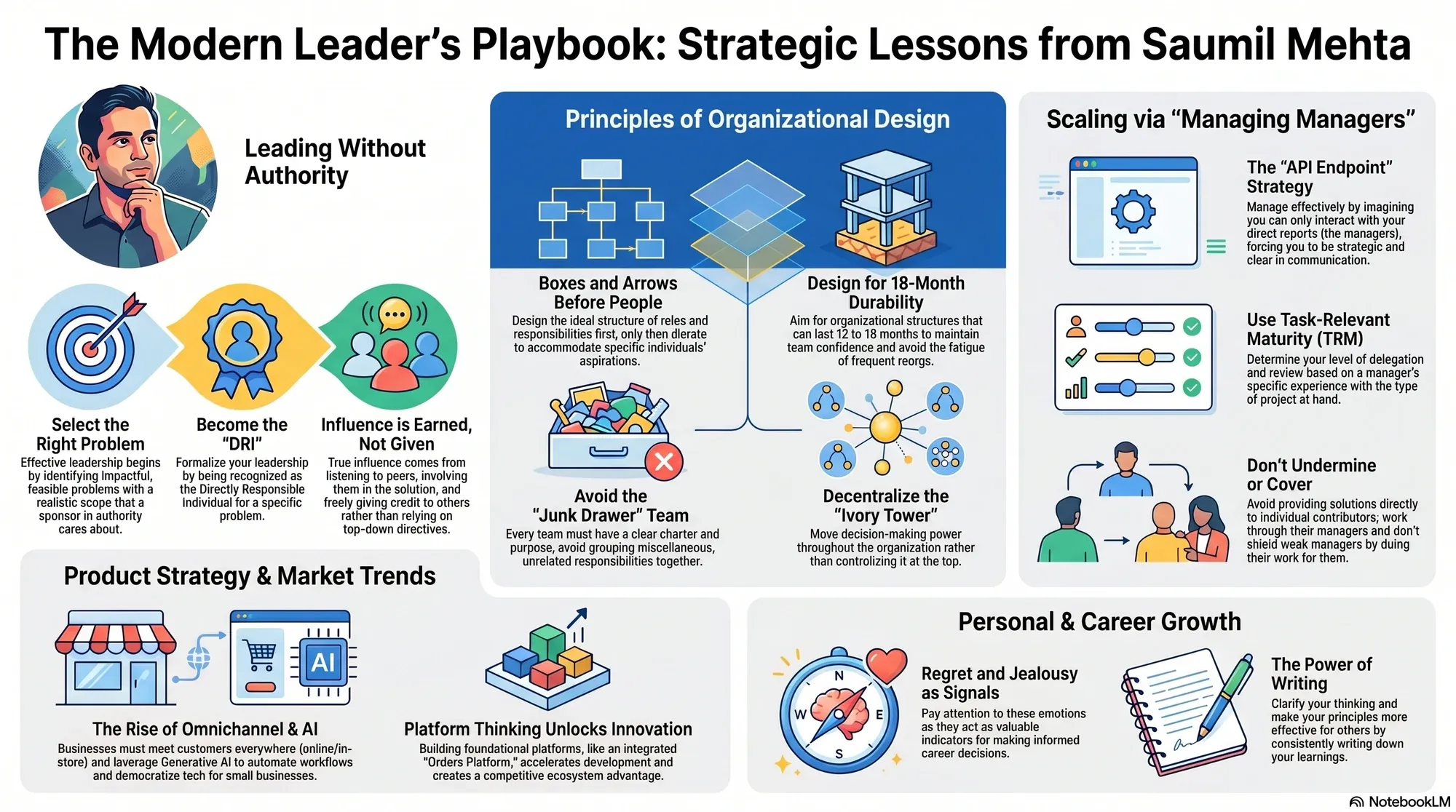
- On leading without authority: The initial step to effective leadership without direct authority is to select the right problem to address. [1]
- Problem selection criteria: A problem worth tackling should be impactful, feasible to solve, and have a realistic scope. [1]
- The power of a sponsor: To gain traction, identify a person in a position of authority who is also invested in the problem you aim to solve. [1]
- Becoming the DRI: A crucial step in leading without authority is to be formally recognized as the Directly Responsible Individual (DRI) for a specific problem. [1]
- Influence is earned, not given: True influence is built by understanding and involving peers in the problem-solving process, not by relying on top-down directives. [1]
- The importance of listening: Before asserting your own views, it is critical to listen to your peers and understand their perspectives. [1]
- Give credit freely: To build influence for future endeavors, it's essential to acknowledge the contributions of everyone on the team, no matter how small. [2]
- Authenticity builds trust: Candidates, employees, and investors can detect inauthenticity from a distance. Being genuine is a highly underrated skill for a leader. [3]
- Embrace your leadership style: Mehta acknowledges his own style as "profane, verbose, snarky and hands-on," emphasizing the importance of self-awareness and authenticity. [3]
- Vulnerability is a strength: Being open about challenges and not having all the answers can be a powerful tool for a leader. [3]
On Organizational Design and Reorgs
- Org design as a tool: Think of organizational design as one of several tools in your management toolbox to drive change and progress. [4]
- Clarity of goals is paramount: The first principle of a successful reorganization is to have absolute clarity on the goals and the problems you are trying to solve. [4][5]
- Separate design from people initially: When designing a new organizational structure, start with boxes and arrows representing roles and responsibilities, not with people's names. [5]
- Iterate with human considerations: After establishing the ideal structure, you can then iterate to accommodate the aspirations and considerations of the individuals on your team. [5]
- Every team needs a charter: In a well-designed organization, every team should have a clear purpose and reason for being. Avoid creating a "junk drawer" for miscellaneous responsibilities. [5]
- Design for durability: Aim for an organizational structure that can last for at least 12 to 18 months to avoid the loss of confidence that comes with frequent changes. [5]
- Communication is key: Poor communication can undermine a well-planned reorg. Be intentional and thorough in explaining the "why" behind the changes. [4][5]
- Decentralize decision-making: Strive for a decentralized organization where decisions are made throughout the organization, not just from an "ivory tower." [6]
- Embrace trade-offs: Every organizational design has benefits and downsides. Acknowledge the downsides you are willing to tolerate for the sake of the upsides. [7]
- GM-led structure: At Square, a General Manager-led structure with P&L ownership for specific products allows for single-threaded leadership and focus. [4]
- On restructuring for stronger priorities: When an organization needs sharper priorities, flatten layers, consolidate ownership, and direct more energy toward a smaller set of initiatives. — Music Business Worldwide: Ticketmaster Restructuring Report
On Managing Managers and Scaling Teams
- Managing managers is a different skill set: The transition from managing individual contributors to managing managers requires a new set of skills and a shift in perspective. [8]
- The "API endpoint" thought experiment: To effectively manage managers, imagine you can only interact with your direct reports (the managers) and not the individual contributors. This forces you to be clear and strategic in your communication. [6]
- Don't undermine your managers: When interacting with individual contributors, avoid providing immediate solutions or strong opinions. Instead, listen, ask questions, and work through the manager. [9]
- Don't cover for a weak manager: Shielding a struggling manager and doing their work for them will not solve the underlying performance issues and can make the situation worse. [6]
- Task-Relevant Maturity (TRM): Use a team member's experience with a specific type of project to determine the level of delegation and review required. [9]
- Look one level up when a manager struggles: Often, the root cause of a manager's struggles lies with their own manager (the "skip lead"). [6]
- The importance of skip-level leaders: Effective "skip leads" are crucial for scaling organizations across different products, countries, and revenue streams. [8]
- Hiring is a critical leadership function: As a leader, you are responsible for hiring the right people and coaching them to succeed. [8]
- Provide clear expectations: Setting clear expectations for your managers is fundamental to their success and the success of their teams. [9]
- Patience and pattern matching: Becoming an expert at managing managers takes time and the ability to recognize recurring patterns. [8]
- On knowing when to hire the first PM: Hire the first product manager when an hour of the founder's tactical product work is worth less than that same hour spent on go-to-market or broader company building. — First Round Review: When to Hire Your First PM
- On adjusting PM hiring for AI-driven output: As AI accelerates engineering and design output, startups may need their first product manager sooner because faster shipping creates more decisions and coordination work. — First Round Review: When to Hire Your First PM
On Product and Strategy
- Mirror the customer lifecycle: Even as the world changes, the fundamental customer lifecycle of awareness, consideration, conversion, and retention remains the same. [10][11]
- Invest in omnichannel: Businesses need to meet customers wherever they are, whether it's online, in-store, or through mobile platforms. [10]
- The blurring lines of commerce: The distinction between retail, restaurant, and services is becoming increasingly blurry, leading to the rise of mixed-use businesses. [11]
- Hyper-personalization is key: To attract and retain customers, businesses need to move towards hyper-personalized experiences. [11]
- The rise of self-use gift cards: A surprising trend is the significant number of gift cards being purchased for personal use, indicating a shift in consumer behavior. [11]
- The move towards a cashless society: The pandemic accelerated the trend of businesses going cashless, a shift that is likely to continue. [11]
- AI for operational efficiency: Generative AI can help businesses of all sizes automate operations and speed up workflows. [12]
- Democratizing technology: Square's goal is to make powerful technologies like generative AI accessible to all businesses, not just large corporations. [11][12]
- The power of an ecosystem: An integrated ecosystem of products and services provides a significant competitive advantage. [6]
- Platform thinking unlocks innovation: Building a foundational platform, like Square's Orders Platform, can accelerate product development and unlock new capabilities. [7]
- On making user experiences more intuitive: Improve a consumer experience by making it smarter and more intuitive, helping people connect more easily with the experiences they value. — Music Business Worldwide: Global President Announcement
- On treating AI as a foundational utility: Treat AI as a new utility, comparable to electricity: infrastructure that changes consumer behavior, organizational operations, and eventually society itself. — Pollstar: Ticketmaster AI Keynote
- On building layered defenses against marketplace abuse: Fight marketplace abuse with layered defenses: use AI against bots and add identity-verification steps to deter human scalpers. — Pollstar: Ticketmaster AI Keynote
On Personal Growth and Career
- Pay attention to regret and jealousy: These emotions can be valuable signals that help you make more informed decisions about your future. [11]
- Embrace the journey: Mehta's personal story, from an immigrant student to a GM at a major tech company, highlights the importance of perseverance and embracing the unexpected turns in one's career. [3]
- Continuous learning: Even after years of experience, there is always more to learn and refine as a leader and manager. [8]
- The value of writing: Writing down your learnings and principles can help you clarify your thinking and make it more effective for yourself and others. [4]
- From startup to big company: The transition from a small startup to a large corporation requires a shift in mindset and an appreciation for the different ways of working. [9]
- Access and visibility in large companies: Contrary to popular belief, it is possible to have good access to leadership and information in a large company. [9]
- The double-edged sword of abundance: While large companies offer more resources, this can sometimes lead to a small amount of waste that adds up across the organization. [9]
- Reconciling with different paths: It's important to be open to different career paths and not be dogmatic about working only in startups or large companies. [9]
- Finding your voice as a leader: It can take time for first-time founders and new leaders to overcome impostor syndrome and find an authentic leadership style. [3]
- The impact of your work: Mehta emphasizes the importance of being conscious of the contributions we make to the world through our work. [10]
Learn more:
- Saumil Mehta's Guide to Effective Leadership Without Authority - SOFX Report
- Advertising Mediums and CPO - B2B Marketing Zone
- From Alien to American, from Jail Cell to General Manager | by Saumil Mehta - Medium
- An org-design masterclass from a Square GM | Saumil Mehta - First Round Review
- 5 principles of effective re-orgs (Saumil Mehta, GM at Square) - YouTube
- Five principles for successfully managing managers - Lenny's Newsletter
- An org-design masterclass from a Square GM | Saumil Mehta - YouTube
- Five principles for successfully managing managers - YouTube
- SaaSxAI Weekly Vol.154(5/19〜5/25のSaaSトピック):「モチベーションの正しい見つけ方」「ミドルマネジメントをうまく機能させる5大原則」 など
- Saumil Mehta - Medium
- Square's Saumil Mehta Talks Building A Relationship With Post-COVID-19 Customer | #Next1000 Summit
- Recap: Square Unboxed 2024