Scott Adams (1957–2026) created the Dilbert comic strip and wrote books about success, failure, persuasion, and clear thinking. Drawing on sixteen years in corporate jobs and three decades of daily cartooning, he developed practical ideas about systems, talent stacks, feedback, energy, and creative iteration. These lessons focus on the durable working principles in his interviews and writing while acknowledging the complicated public legacy that followed his later political commentary.
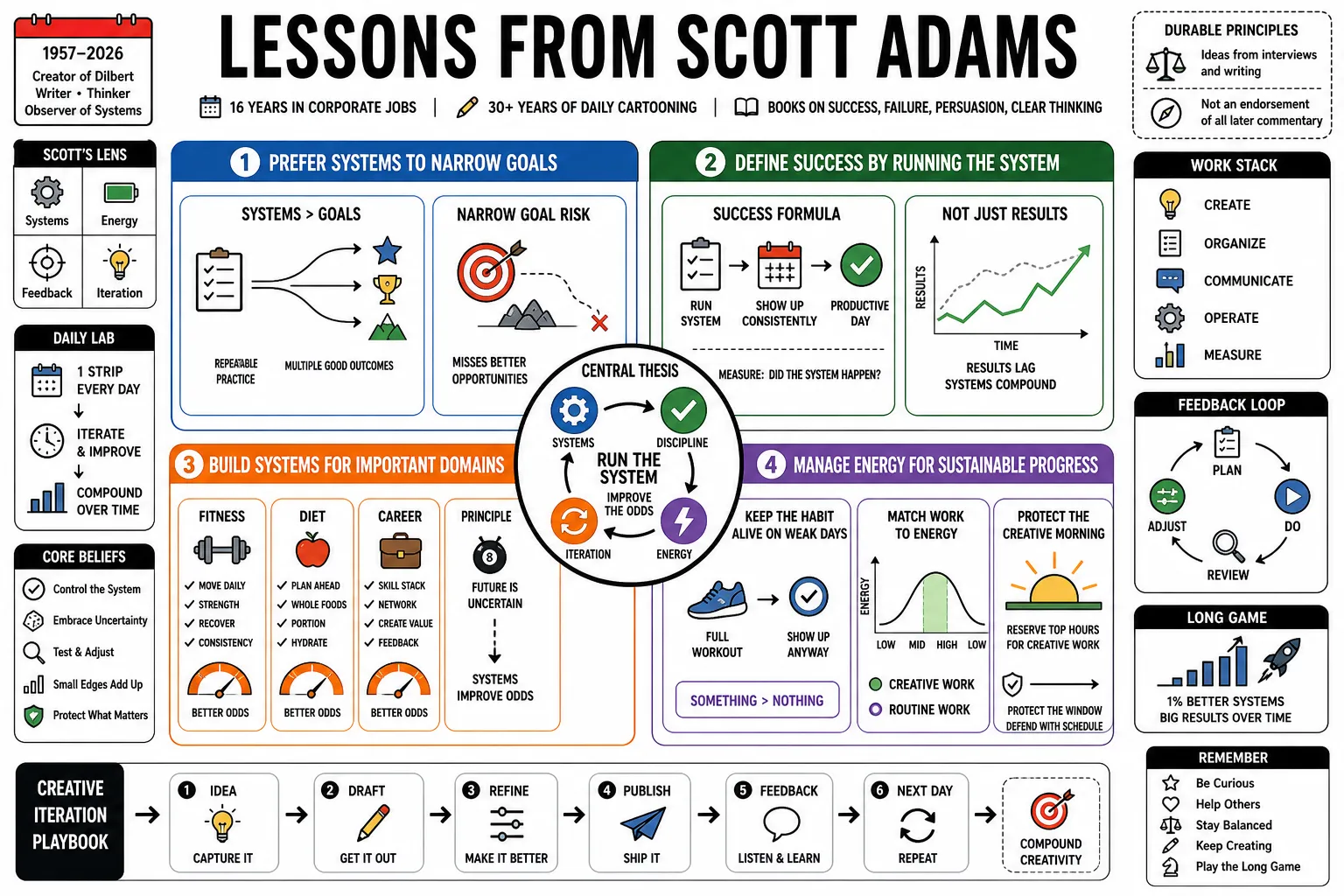
Systems, Energy, and Sustainable Progress
- On Prefer Systems to Narrow Goals: A recurring practice can improve the odds of success across several possible outcomes, while a narrow goal can hide better opportunities that emerge along the way. — Reference: What Got You There — Scott Adams Transcript
- On Define Success by Running the System: A productive day can be measured by whether the intended practice happened, not only by whether a distant result arrived. — Reference: What Got You There — Scott Adams Transcript
- On Build Systems for Important Domains: Fitness, diet, and career each benefit from repeatable behaviors that move a person toward better odds without pretending the future is predictable. — Reference: What Got You There — Scott Adams Transcript
- On Keep the Habit Alive on Weak Days: Showing up can preserve a habit even when the body signals that a full workout would be counterproductive. — Reference: What Got You There — Scott Adams Transcript
- On Match Work to Energy: Schedule creative work for high-energy periods and routine tasks for the hours when imagination and concentration naturally decline. — Reference: What Got You There — Scott Adams Transcript
- On Protect the Creative Morning: Knowing when the mind is most inventive makes it possible to reserve that window for the work that benefits most from it. — Reference: What Got You There — Scott Adams Transcript
- On Remove Friction Continually: Small efficiency improvements compound until the core job takes less time and leaves room for new projects. — Reference: What Got You There — Scott Adams Transcript
- On Design Physical Work for Efficiency: When effort is repeated every day, better technique and fewer wasted motions matter as much as raw exertion. — Reference: What Got You There — Scott Adams Transcript
Talent Stacks, Failure, and Managed Luck
- On Combine Complementary Skills: Several mutually reinforcing abilities can create a rare professional profile even when none is world-class by itself. — Reference: Hoover Institution — How to Fail at Almost Everything
- On Choose Skills That Reinforce One Another: The value of a talent stack comes from fit: speaking supports writing, business knowledge supports satire, and promotion supports creation. — Reference: Hoover Institution — How to Fail at Almost Everything
- On Treat the Talent Stack as a System: Regularly adding useful adjacent skills raises the odds of success across many possible careers rather than betting everything on one outcome. — Reference: Hoover Institution — How to Fail at Almost Everything
- On Move Toward Dense Opportunity: Luck becomes more manageable when you place yourself near people, activity, money, and ideas rather than waiting passively for opportunity. — Reference: What Got You There — Scott Adams Transcript
- On Create More Surface Area for Luck: Action, interaction, mistakes, and new relationships expose a person to more useful collisions with the environment. — Reference: What Got You There — Scott Adams Transcript
- On Learn in Public: Doing imperfect work where knowledgeable people can see it attracts specific correction that private preparation cannot provide. — Reference: What Got You There — Scott Adams Transcript
- On Use Failure to Expand Options: A struggling product can justify experiments that an established product would consider too risky, because the downside is already bounded. — Reference: What Got You There — Scott Adams Transcript
Audience, Product, and Creative Craft
- On Let the Audience Reveal the Product: Creators begin with a hypothesis, but repeated audience behavior often identifies the version of the work that people actually value. — Reference: What Got You There — Scott Adams Transcript
- On Follow Consistent Feedback: Dilbert became a workplace strip after readers repeatedly asked for more office material; convergent feedback was more useful than artistic guesswork. — Reference: What Got You There — Scott Adams Transcript
- On Build a Direct Customer Channel: Without a channel to the audience, a creator is separated from demand by layers of intermediaries and has little basis for improving the product. — Reference: What Got You There — Scott Adams Transcript
- On Distrust Polite Feedback: Friends and family often protect feelings, so observed audience behavior and unsolicited responses provide a stronger signal than encouragement. — Reference: What Got You There — Scott Adams Transcript
- On Start from a Recognizable Problem: A creative premise travels farther when more than one person recognizes the situation from lived experience. — Reference: What Got You There — Scott Adams Transcript
- On Keep a Kernel of Truth: Effective satire begins with something familiar, then adds exaggeration, hyperbole, surprise, and sharper language through iteration. — Reference: What Got You There — Scott Adams Transcript
- On Demand a Physical Response: Creative work is stronger when it makes people laugh, share, save, or otherwise move beyond passive acknowledgment. — Reference: What Got You There — Scott Adams Transcript
- On Draft Quickly and Rewrite: For long-form work, getting weak ideas onto the page quickly creates material that can be tested and improved through repeated rewriting. — Reference: What Got You There — Scott Adams Transcript
Judgment, Ego, and Clear Thinking
- On Test Ideas for Pull: A project worth pursuing often creates energy of its own; if the idea remains inert after a page or two, abandoning it can be rational. — Reference: What Got You There — Scott Adams Transcript
- On Use Ego as an Adjustable Tool: Confidence should rise enough to take an unfamiliar challenge and fall enough to hear criticism without defending identity. — Reference: What Got You There — Scott Adams Transcript
- On Do Not Let Ego Block Experiments: Protecting status can prevent the very risks and failures that generate learning and new opportunities. — Reference: What Got You There — Scott Adams Transcript
- On Separate the Artist from the Customer: When the audience provided a clearer signal, Adams learned to set aside personal preference and redesign the work around customer value. — Reference: What Got You There — Scott Adams Transcript
- On Compare Competing Information Silos: Sampling sources with opposing incentives can expose where a claim is shared evidence and where it is merely partisan interpretation. — Reference: What Got You There — Scott Adams Transcript
- On Simplify Without Losing the Mechanism: A complicated idea becomes actionable when it can be compressed into a rule people can remember, discuss, and compare with experience. — Reference: What Got You There — Scott Adams Transcript
- On Borrow Models from Several Fields: Basic concepts from economics, psychology, science, engineering, and history reduce blind spots that remain invisible inside one discipline. — Reference: What Got You There — Scott Adams Transcript
Meaning, Resilience, and Legacy
- On Believe Circumstances Can Be Changed: Successful people tend to see at least their corner of the world as alterable through action instead of treating outside events as a complete verdict on their future. — Reference: What Got You There — Scott Adams Transcript
- On Practice Embarrassment Resistance: Repeatedly surviving awkward public mistakes can turn shame tolerance into a useful learned skill. — Reference: What Got You There — Scott Adams Transcript
- On Reframe Old Pain: Changing the story attached to past trauma can convert it from a permanent weakness into evidence of resilience and strength. — Reference: Four Minute Books — Reframe Your Brain Summary
- On Find Meaning Through Contribution: After the end of his marriage, Adams described redirecting his search for meaning toward work intended to benefit a broader public. — Reference: MEAWW — Scott Adams Final Message and Meaning
- On Use a Final Decision Rule Honestly: Near death, Adams framed accepting Christianity as a risk-reward decision while acknowledging that belief itself remained unresolved for him. — Reference: NBC News — Scott Adams Obituary
- On Make Usefulness the Legacy: His final message asked readers who benefited from his work to pay it forward, be useful, and continue the contribution beyond him. — Reference: National Catholic Register — Scott Adams Final Message