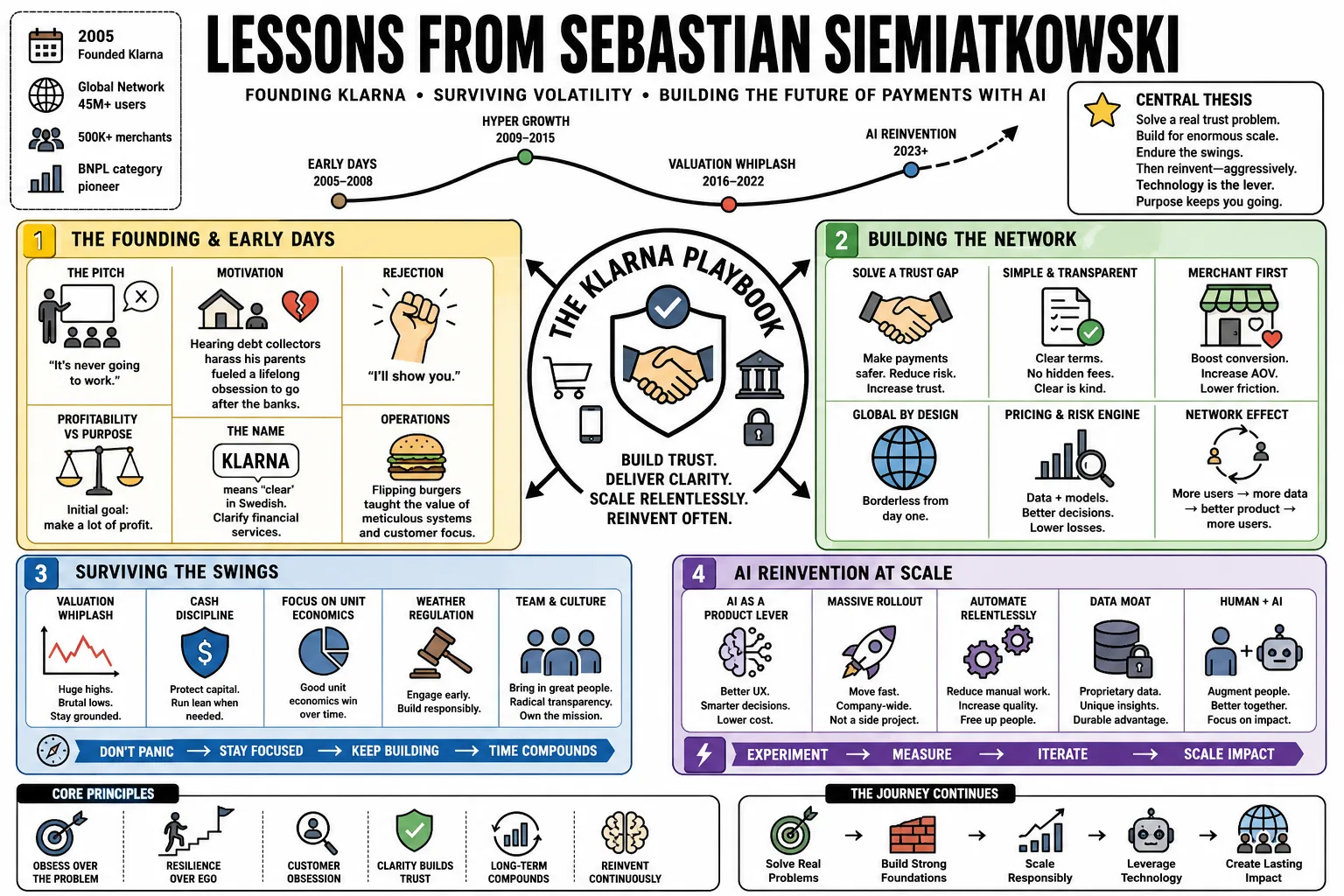
Lessons from Sebastian Siemiatkowski
Sebastian Siemiatkowski co-founded Klarna in 2005 to solve a basic trust problem in early e-commerce, laying the groundwork for the Buy Now, Pay Later industry. After surviving brutal valuation swings, he is now pushing a massive corporate AI rollout. This explores his approach to building, surviving, and radically restructuring a global financial network.
Part 1: The Founding & Early Days
- On The Pitch: "Pitching Klarna at the Stockholm School of Economics meant getting used to hearing 'It's never going to work.'" — Source: [TechNYC]
- On Motivation: "Hearing debt collectors harass his parents fueled a lifelong obsession to go after the banks." — Source: [Bloomberg]
- On Rejection: "The reaction to early failure wasn't to give up and go home, but to curl up his fist and say 'I'll show you.'" — Source: [Bloomberg]
- On Profitability vs Purpose: "Klarna wasn't started as a corporate social responsibility bank; the initial goal was simply to make a lot of profit." — Source: [Bloomberg]
- On the Name: "The name 'Klarna' means 'clear' in Swedish, representing a desire to clarify the entire financial services world." — Source: [Bloomberg]
- On Operations: "Flipping burgers at Burger King revealed how meticulously restaurant chains engineer their processes, a lesson applied to fintech." — Source: [TechNYC]
- On Early Product Market Fit: "The core product initially bought receivables from merchants to solve a direct trust gap between online buyers and sellers." — Source: [Acquired]
- On Tenacity: "Building Klarna required immense tenacity, holding onto the core idea over a 19-year journey rather than seeking a quick exit." — Source: [Acquired]
- On Inspiration: "Reading Richard Branson's book about Virgin at age 14 planted the seed for building an unconventional business." — Source: [Acquired]
Part 2: Product Strategy & The Evolution of SaaS
- On Software Commodities: "SaaS is dead because the cost of creating software is trending toward zero due to AI." — Source: [Taskade]
- On Value: "The future of product value lies in proprietary data and consumer trust, rather than the software interface alone." — Source: [Taskade]
- On Switching Costs: "The traditional switching cost moat is evaporating as agentic AI will allow customers to migrate entire data models with a single click." — Source: [20VC]
- On The Consumer Pivot: "Klarna made a massive strategic pivot in 2015, shifting from a merchant-facing payment tool to a consumer-facing shopping assistant." — Source: [Acquired]
- On Financial Assistants: "The future of financial services is a digital AI-powered assistant that actively works on behalf of the customer." — Source: [Klarna AI Interview Search]
- On Proactive Value: "A true product will recognize when you are overpaying on a mortgage and automatically renegotiate it for you." — Source: [Klarna AI Interview Search]
- On Friction: "The product interface must focus on removing friction entirely, a concept embedded deeply in the app's user interface." — Source: [Klarna]
- On Moats: "Defensibility in the AI era relies on having a massive portfolio of users who trust you with their data, rather than a superficial interface." — Source: [Acquired]
- On the Innovator's Dilemma: "Companies heavily reliant on revolving fees find it incredibly difficult to pivot to business models that are actually better for the consumer." — Source: [Acquired]
Part 3: The AI Transformation & Automation
- On Headcount Reduction: "AI is allowing Klarna to drastically reduce its workforce, projecting a drop from 7,000 employees to under 2,000 by 2030." — Source: [Business Insider]
- On AI Efficiency: "In its first month, Klarna’s AI assistant handled 2.3 million conversations, performing the equivalent work of 700 full-time human agents." — Source: [Fast Company]
- On Resolution Times: "Implementing LLMs dropped the average customer service inquiry resolution time from 14 minutes to just 2 minutes." — Source: [OpenAI]
- On Customer Satisfaction: "Despite shifting two-thirds of support chats to automation, customer satisfaction scores remained on par with human agents." — Source: [OpenAI]
- On Financial Impact: "The implementation of the AI assistant is projected to drive a $40 million profit improvement annually." — Source: [OpenAI]
- On Multilingual Support: "AI enables immediate operation in 23 markets and over 35 languages, vastly improving service for expat communities." — Source: [Fast Company]
- On The Pitch to Sam Altman: "To secure the OpenAI partnership, he flew to San Francisco and pitched Klarna as a high-stakes, European fintech guinea pig." — Source: [Klarna AI Interview Search]
- On Internal Adoption: "He mandated company-wide AI experimentation, even deploying a ChatGPT-based robot to conduct internal employee interviews." — Source: [Sequoia Training Data]
- On AI Strategy Acceleration: "Klarna is actively accelerating its AI push from basic support to complex, multi-layered assistance." — Source: [Big Technology]
- On Premium Human Support: "While AI handles routine tasks, human agents are now reserved for providing a premium service for highly complex or sensitive cases." — Source: [Big Technology]
Part 4: Marketing, Brand & Smoooth Design
- On Pink Branding: "Choosing a bright pink visual identity was a deliberate move to stand out from the blue and green logos that traditionally signal banking stability." — Source: [The Industry Fashion]
- On Brand as a Moat: "In a world where Apple and Google enter payments, distinct brand and design are the primary ways for a fintech to compete." — Source: [The Industry Fashion]
- On The Snoop Dogg Partnership: "Partnering with Snoop Dogg, rebranded as Smoooth Dogg, was designed to challenge the status quo of traditional banking." — Source: [Internet Retailing]
- On Celebrity Investors: "Bringing on Snoop Dogg as a minor shareholder integrated pop culture directly into the financial cap table." — Source: [Klarna]
- On Smoooth Design: "The concept of Smoooth with three 'o's dictates both the marketing tone and the frictionless design philosophy of the app." — Source: [Internet Retailing]
- On Quirky Marketing: "Using surreal, high-production imagery like a fish sliding down a slide helps evoke the literal feeling of a smooth transaction." — Source: [Notion]
- On Target Demographics: "The lifestyle and fashion-oriented branding was specifically crafted to appeal to Millennial and Gen Z shoppers." — Source: [The Industry Fashion]
- On Opulence: "The pink branding was meant to feel opulent and bold, moving away from the gray and dull aesthetic of old finance." — Source: [The Industry Fashion]
- On Consumer Identity: "The goal was to transform Klarna from a backend payment processor into a household consumer brand that people actually recognize." — Source: [Internet Retailing]
Part 5: Disrupting the Banking Industry
- On Bank Competition: "The traditional banking industry is one of the least competitive and highest-bar-of-entry sectors in the world." — Source: [Klarna AI Interview Search]
- On Legacy Systems: "Fintechs have a massive structural advantage over legacy institutions that are burdened with outdated, inflexible systems." — Source: [CFA UK]
- On Retail Banking Profits: "Increased customer mobility will inevitably drive consumers to lower-cost providers, significantly reducing retail banking profits." — Source: [CFA UK]
- On Credit Cards: "Traditional credit cards push credit limits into your face, which is an inherently unhealthier concept than clear installments." — Source: [CFA UK]
- On Installments: "The installment model is healthier because it provides clarity and fixed terms, unlike the debt trap of revolving credit." — Source: [CFA UK]
- On The Next Decade: "By the end of this decade, there will be a massive change in the overall infrastructure of retail banking." — Source: [Bloomberg]
- On Financial Clarity: "The entire financial services world needs to be made clear, moving away from hidden fees and complex terms." — Source: [Bloomberg]
- On Threatening Adyen: "He famously told the CEO of Adyen that he had to sell his business to Klarna or get run over, illustrating early aggressive ambition." — Source: [Acquired]
- On Profit Margins: "Traditional banks have enjoyed outsized profit margins simply because of inertia, ignoring the need for superior customer service." — Source: [CFA UK]
- On Banking Disruption: "True disruption requires a fundamental realignment of incentives alongside better technology." — Source: [Klarna AI Interview Search]
Part 6: Leadership & The Sports Team Mentality
- On Leadership Philosophy: "The best leaders shift from founder mode to serve others mode, driven by a desire to serve employees and customers." — Source: [Klarna AI Interview Search]
- On Being Too Nice: "Early on, he struggled with being too nice and had to learn the balance between empathy and the willingness to say no." — Source: [Klarna AI Interview Search]
- On The Sports Team Model: "A company should be viewed as a professional sports team, where you perform a specific role to win, rather than a family." — Source: [Klarna AI Interview Search]
- On The Champions League: "If you prioritize being nice over performance, you aren't playing in the Champions League; you're just playing with friends." — Source: [Klarna AI Interview Search]
- On Technical Management: "As a non-technical founder, he learned to manage engineers by having them literally show him how they fix a bug." — Source: [Inc]
- On Product Rhythm: "To build a tech giant, a CEO must deeply understand the rhythm of product development, even without writing the code." — Source: [Inc]
- On Self-Doubt: "Self-doubt is extremely healthy if it represents a continuous effort to question whether you are doing the right thing." — Source: [20VC]
- On Boardroom Dynamics: "Enduring the painful Sequoia boardroom drama in 2024 was a necessary period of alignment for the company's long-term path." — Source: [Sequoia Training Data]
- On Managing What You Don't Know: "Watching an engineer do the actual work provides vastly more insight into their competence than any verbal interview." — Source: [Inc]
- On Internal Growth: "Fostering an environment that promotes young internal talent is often more effective than constantly relying on external senior hires." — Source: [Klarna AI Interview Search]
Part 7: Hiring, Talent & Culture
- On Hiring Generalists: "In the AI era, companies should hire generalists who can code, design, and understand product simultaneously." — Source: [Taskade]
- On The End of Grunt Work: "With AI handling the implementation grunt work, talent must focus on strategy, taste, and broad product vision." — Source: [Taskade]
- On Sales vs Engineering: "Early Klarna was overly sales-driven; balancing that with a strong engineering culture was an essential scaling lesson." — Source: [Inc]
- On Scale: "Once you find a methodology that identifies great talent, the ultimate test of leadership is figuring out how to apply it at scale." — Source: [20VC]
- On Greatness: "Whatever role you occupy within the company, the only mandate is to strive to be a great one." — Source: [20VC]
- On LLM Creativity: "LLMs work towards the average, but true creativity requires recognizing a totally new way to combine things that breaks the mold." — Source: [Sequoia Training Data]
- On Data Quality: "If you feed your data models and your culture with bad inputs, you are inevitably going to get bad results." — Source: [Sequoia Training Data]
- On Doing More With Less: "The modern workforce model proves that a company can maintain the same high output with a fraction of the historical headcount." — Source: [Business Insider]
- On Global Context: "Operating from Sweden provided a small country cousin perspective that required working harder to prove the company's global worth." — Source: [Klarna AI Interview Search]
Part 8: Grit, Survival & Personal Philosophy
- On The Down Round: "Raising capital at an 85% valuation drop was a necessary step for survival and a testament to the underlying business strength." — Source: [The Guardian]
- On Market Drops: "Securing funding during the steepest global stock market drop in fifty years proved the resilience of the core model." — Source: [The Guardian]
- On The Hardest Day: "Laying off 10% of the workforce via a video message in 2022 was the hardest professional day to date." — Source: [Sifted]
- On The Rocky Ride: "Getting a very rocky ride is a gift, because failure and crisis teach lessons that a perfectly smooth path never could." — Source: [Sifted]
- On Growth vs Profit: "The AI era proves that profitability and high growth are no longer mutually exclusive concepts." — Source: [20VC]
- On Survival: "True survival meant abandoning the growth-at-all-costs mindset and returning to the profitable operational discipline of the early years." — Source: [The Guardian]
- On Silicon Valley vs Europe: "He often felt like the outsider from Sweden, using that underdog status to outwork established Silicon Valley giants." — Source: [Klarna AI Interview Search]
- On Profitability Mindset: "Shifting the company from massive losses to quarterly profit required a brutal, unyielding focus on fundamental unit economics." — Source: [The Guardian]
- On The IPO Path: "Navigating the boom, the bust, and the AI-driven recovery built the precise organizational grit required for public market scrutiny." — Source: [The Guardian]