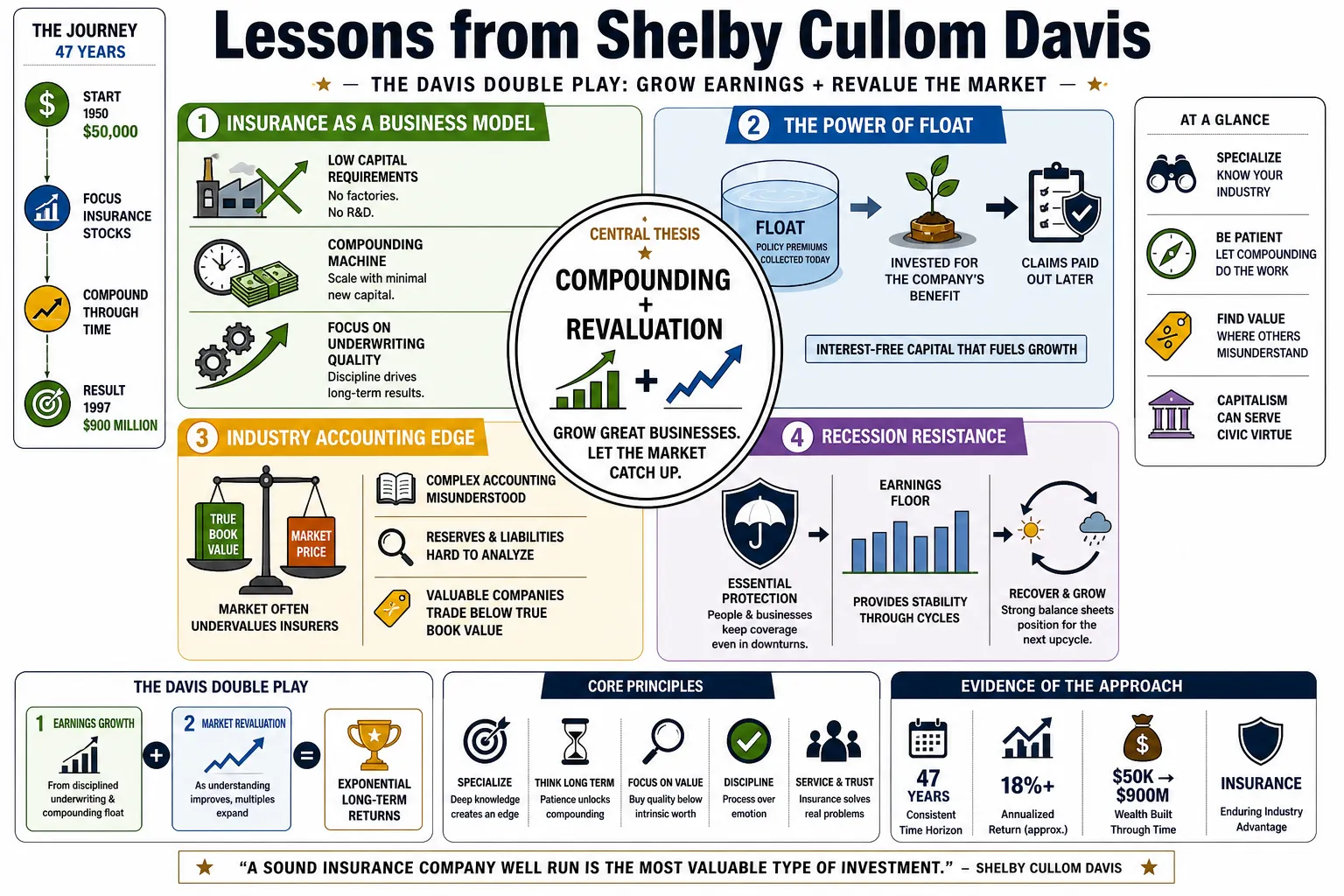
Shelby Cullom Davis was an insurance analyst and diplomat who turned an initial $50,000 investment into a $900 million fortune by specializing in "boring" insurance stocks. He is primarily known for the "Davis Double Play," a strategy that combined earnings growth with market revaluation to generate exponential returns over 47 years. This profile outlines his focus on compounding, his industry-specific insights, and his views on the relationship between capitalism and civic virtue.
Part 1: The Insurance Specialization
- On Insurance as a Business Model: "Insurance companies are compounding machines because they don’t require massive capital expenditures on factories or research to grow." — Source: Wealth Morning
- On the Value of Float: "The float acts as interest-free capital that the company can invest for its own benefit before claims are paid out." — Source: Wealth Morning
- On Recession Resistance: "People and businesses must maintain insurance coverage even in down markets, providing a floor for earnings during economic contractions." — Source: Novel Investor
- On "Boring" Businesses: "The best investments are often found in industries that are considered unexciting and are consequently ignored by the broader market." — Source: Wealth Morning
- On Asset Productivity: "An insurer's float can be invested in stocks and bonds, allowing the company to earn money on two fronts simultaneously: underwriting and investing." — Source: Wealth Morning
- On Obsolescence: "I prefer industries like insurance because they do not face the constant threat of rapid technological obsolescence." — Source: Wealth Morning
- On Underwriting Discipline: "The most valuable insurers are those that prioritize underwriting profits over simply growing their volume of premiums." — Source: Wealth Morning
Part 2: The Davis Double Play
- On the Core Strategy: "The Double Play involves buying a company with growing earnings at a low P/E multiple and waiting for both to expand." — Source: Davis Funds
- On P/E as Market Sentiment: "A low Price-to-Earnings ratio often reflects market neglect rather than a lack of business quality." — Source: Hedge Fund Alpha
- On the Math of Success: "If earnings double and the P/E multiple triples, the stock price increases sixfold, creating wealth far beyond the earnings growth alone." — Source: Wealth Morning
- On Multiple Expansion: "You want the market to eventually recognize what you already know; that recognition is what drives the expansion of the P/E multiple." — Source: Novel Investor
- On Growth at a Reasonable Price: "Avoid 'dud' companies that are cheap for a reason, but also refuse to overpay for 'glamour' stocks that are priced for perfection." — Source: Substack
- On Moderate Growth: "I prefer moderately priced companies with steady, moderate growth over high-flyers that are susceptible to sharp reversals." — Source: Substack
- On the Earnings Engine: "Earnings are the ultimate driver of stock prices; without them, multiple expansion is just speculation." — Source: Substack
- On Entry Points: "Buying a stock at 4x or 5x earnings provides a massive margin of safety compared to buying at 20x." — Source: Wealth Morning
- On Patience for Revaluation: "The market may take years to revalue a stock, but the compounding of earnings protects you while you wait for the multiple to expand." — Source: Novel Investor
Part 3: Market Cycles and Time Horizons
- On Bear Market Opportunity: "You make most of your money in a bear market, you just don't realize it at the time." — Source: Davis Funds
- On Crisis Inevitability: "History provides a crucial insight regarding market crises: they are inevitable, painful and ultimately surmountable." — Source: Davis Funds
- On the Long Term: "Stocks are risky over one to five years but are nearly certain winners over ten to fifteen years." — Source: Substack
- On Ignoring Noise: "Market fluctuations are just noise; the only thing that matters in the end is the long-term compounding of capital." — Source: Wealth Morning
- On Surviving the Crash: "The secret to wealth is not just picking winners, but having the stomach to hold them through the inevitable periods of market panic." — Source: Novel Investor
- On Bonds vs. Equities: "Bonds are for lenders, but stocks are for owners. Mass wealth is built through ownership, not lending." — Source: Substack
- On Compounding Seeds: "Every market downturn is a chance to plant more seeds for the next great harvest." — Source: Wealth Morning
- On Historical Perspective: "If you study history, you realize that the world has survived far worse crises than the one currently making headlines." — Source: Davis Funds
- On Market Timing: "Do not try to time the market; instead, focus on being in the market with the right companies at the right price." — Source: Substack
Part 4: Investment Psychology and Discipline
- On Greed and Fear: "Invest for the long haul. Don't get too greedy and don't get too scared." — Source: Sreeni
- On Superior Management: "Our best bear protection is buying companies with first-class management and powerful franchises." — Source: Davis Funds
- On Concentration: "Diversification is a process used to find good ideas, but concentration is the outcome once you find great ones." — Source: Morningstar Australia
- On Value vs. Trends: "Focus on value, because most investors focus on outlooks and trends." — Source: Wealth Morning
- On Betting on People: "Always bet on superior management; a great manager can navigate a difficult industry better than a poor manager in a great one." — Source: Wealth Morning
- On Sensible Leverage: "Margin can accelerate compounding if used on stable, undervalued companies, but it is a tool for the disciplined, not the reckless." — Source: Novel Investor
- On Intellectual Vigor: "Economic success depends on intellectual vigor, self-discipline, and self-reliance." — Source: American Swiss Foundation
- On Franchise Power: "A powerful franchise provides a margin of safety that balance sheets alone cannot show." — Source: Davis Funds
- On Greed in Downturns: "The time to be most aggressive is when everyone else is paralyzed by fear." — Source: Substack
Part 5: Frugality and the Value of a Dollar
- On the $1,000 Hot Dog: "If you invest that dollar wisely, by the time you reach my age it will be worth $1,024. Are you so hungry you need to eat a $1,000 hot dog?" — Source: Hedge Fund Alpha
- On Lost Opportunity Cost: "Every dollar spent on a luxury today is a thousand dollars stolen from your future self." — Source: Novel Investor
- On Seed Capital: "View every dollar saved not as a restriction, but as a seed for future compounding." — Source: Substack
- On Writing on Envelopes: "Waste is a sin against the future; I save even the backs of used envelopes to jot down my notes." — Source: Morningstar Australia
- On Personal Discipline: "Frugality is the foundation of wealth, as it provides the surplus capital required to take advantage of market opportunities." — Source: Novel Investor
- On Cheap Hotels: "Why pay for a palace when you are only there to sleep? The money saved belongs in the compounding machine." — Source: Novel Investor
- On Old Tennis Balls: "If a tennis ball still bounces, it is still a tennis ball. There is no need to buy new ones just for the sake of novelty." — Source: Biography Nuts
- On the Moral Aspect of Savings: "Self-discipline in spending is a reflection of self-discipline in thought and action." — Source: InfluenceWatch
- On Starting Small: "You don't need a million dollars to start; you need a few thousand and the discipline not to spend them." — Source: Wealth Morning
- On Long-term Wealth: "Wealth is not what you spend; wealth is what you have the discipline to keep and grow." — Source: Novel Investor
Part 6: Regulatory and Industry Insights
- On the Superintendent Role: Davis's earlier service as New York's First Deputy Superintendent of Insurance gave him direct insight into how insurance companies actually operated before he became an investor. — Source: Grokipedia
- On Capitalism as Solution: "Capitalism is the solution to recovery, not the cause of the depression." — Source: American Swiss Foundation
- On Government Overreach: "Economic stagnation in the 1930s was exacerbated by government policies that discouraged private investment." — Source: American Swiss Foundation
- On Investor Confidence: "The lack of confidence among business leaders is often a direct result of shifting and unpredictable regulatory landscapes." — Source: American Swiss Foundation
- On the Individual Engine: "The American economy's health depends on the incentivization of the individual as the primary engine of prosperity." — Source: American Swiss Foundation
- On Character and Virtue: "Capitalism is a system that fosters character and civic virtue through the pursuit of productive work." — Source: American Swiss Foundation
- On Self-Reliance: "Self-reliance is the most important trait a citizen can have for the long-term survival of a free society." — Source: American Swiss Foundation
- On Economic Advising: "Working as an economic advisor taught me that political decisions have direct, often unintended, consequences for the capital markets." — Source: American Swiss Foundation
Part 7: Diplomacy and International Finance
- On the Banking Secrecy Mission: "I was chosen as Ambassador specifically to look into Swiss banking secrecy and get a treaty with them." — Source: ADST Oral History
- On the Mafia Connection: "It was very important to stop the Mafia from sending illegal money to Swiss banks to buy into legitimate enterprises." — Source: ADST Oral History
- On Swiss Resistance: "The Swiss at first didn't want the secrecy touched; they used to say, 'Why don't you catch your own crooks?'" — Source: ADST Oral History
- On the Judicial Assistance Treaty: "The crowning achievement of my tenure was getting the first Judicial Assistance Treaty signed between the U.S. and Switzerland." — Source: ADST Oral History
- On Origins of Secrecy: "Swiss banking secrecy was not a medieval tradition, but a response to Hitler’s attempt to seize the assets of German citizens." — Source: ADST Oral History
- On Global Vision: "When U.S. insurance stocks became expensive, I looked to Japan, where companies like Tokio Marine were trading at a fraction of their value." — Source: Get Abstract
- On Cultural Fluency: "A Ph.D. from Geneva and a knowledge of the language were essential tools for effective diplomacy in a neutral country." — Source: American Swiss Foundation
- On Social Diplomacy: "Entertaining frequently was not just a social duty; it was the primary way we gathered intelligence on the Swiss population's views." — Source: ADST Oral History
- On Charlie Chaplin’s Return: "Suggesting that the U.S. welcome back Charlie Chaplin was a move to heal domestic wounds through public relations." — Source: ADST Oral History
- On the Foreign Service: "A career in the Foreign Service is a wonderful thing, though a background in business provides a unique perspective to it." — Source: ADST Oral History
Part 8: Civic Virtue and National Philosophy
- On the Fragility of Nations: "The average span of the world's great civilizations has been 200 years; this cycle of decline is not inevitable, it depends on us." — Source: InfluenceWatch
- On National Morality: "The foundation of national governance is personal morality; without it, the laws themselves become hollow." — Source: InfluenceWatch
- On the Pillars of Freedom: "Self-discipline, self-reliance, respect for law, and respect for private property are the four essential traits for a free society." — Source: American Swiss Foundation
- On the Public Good: "An unselfish concern for the public good must pervade our individual pursuit of success." — Source: InfluenceWatch
- On the American Oath: "We must mutually pledge our lives, our fortunes, and our sacred honor to support the principles of our founding." — Source: InfluenceWatch
- On Education and Tradition: "The unique bond between alumni and their university is based on shared traditions and a homogenous background of interests." — Source: Media Matters
- On University Character: "Drastic shifts in the makeup of a student body can vitiate the long-term spirit and substance of the institution." — Source: Media Matters
- On Philanthropic Phases: "Life should be viewed in three phases: learning in the early years, earning in the middle years, and returning to society in the later years." — Source: Novel Investor
- On the Duty to Lead: "Success brings a moral obligation to contribute to the intellectual and political defense of the systems that made that success possible." — Source: InfluenceWatch