Shiping Tang is a highly influential Chinese social scientist and Distinguished Professor at Fudan University, uniquely known for bridging the natural and social sciences. With a background in molecular biology, he introduced the Social Evolutionary Paradigm to international relations, fundamentally reshaping how we understand institutional change and state behavior. His award-winning work provides a rigorous framework for navigating global geopolitics, economic development, and the evolving international order.
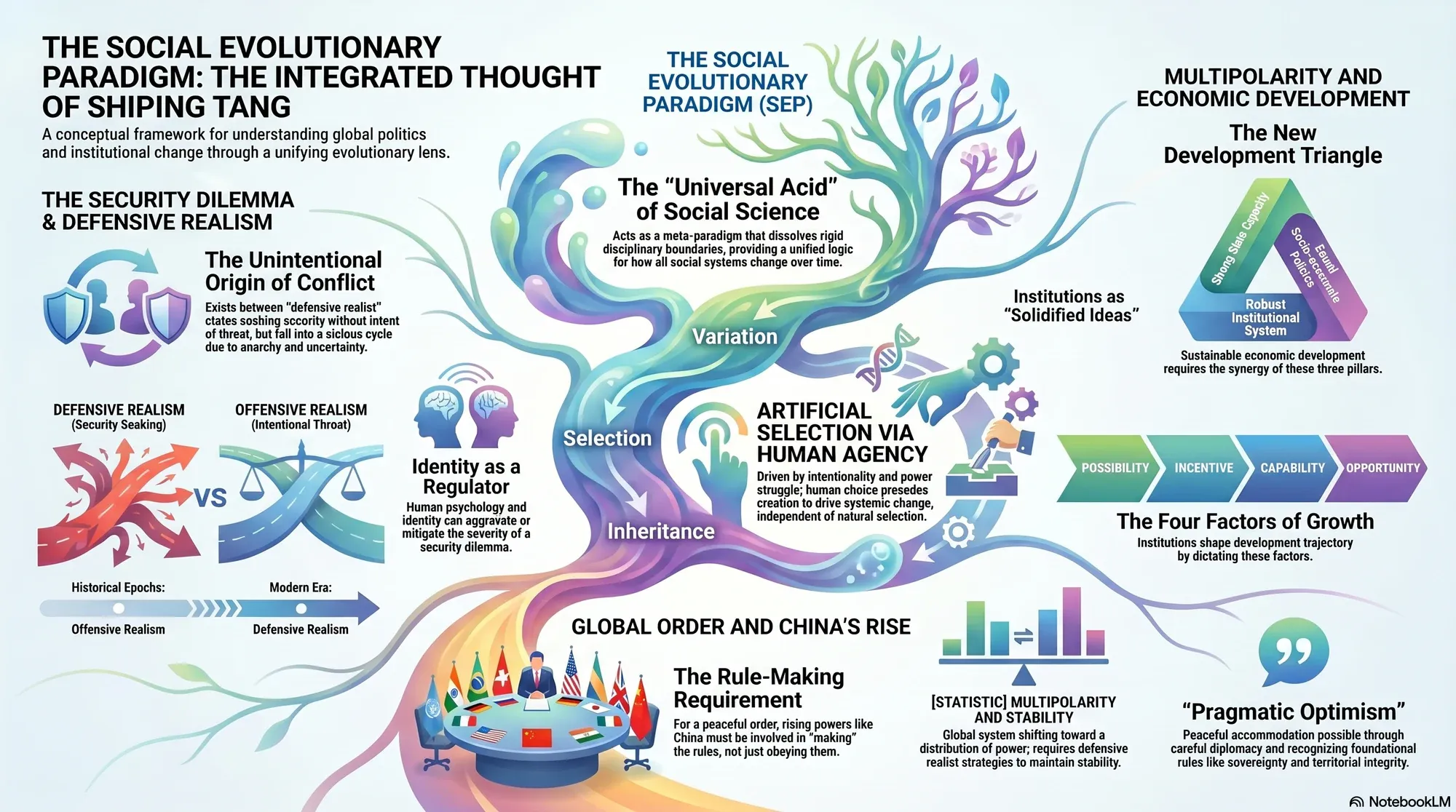
Part 1: The Social Evolutionary Paradigm (SEP)
- On the Ultimate Paradigm: "SEP is the ultimate paradigm of social sciences, subsuming foundational paradigms in social sciences into a coherent whole." — Source: [On Social Evolution]
- On the Evolutionary Nature of Society: "Because human society is an evolutionary system, any non-evolutionary approach is intrinsically incapable of shedding light on the evolution of the system." — Source: [On Social Evolution]
- On Artificial Selection: "Artificial selection can operate independently from natural selection, in addition to working together with natural selection, to drive social evolution." — Source: [On Social Evolution]
- On Resolving Paradigm Debates: "Mainstream IR theories, especially realism and liberalism, are appropriate to different phases of history. It is therefore pointless to pit them against each other as rival paradigms for the same periods of history." — Source: [The Social Evolution of International Politics]
- On the Universal Acid: "The evolutionary approach is 'a universal acid' that dissolves everything, breaking down the rigid boundaries between disciplines by providing a unified logic of how systems change." — Source: [The Social Evolution of International Politics]
- On Ideational vs. Material Forces: "Our world is made of both material forces and ideational forces and they interact with each other to shape our world, although material forces hold ontological priority over ideational forces." — Source: [On Social Evolution]
- On Systemic Evolution: "The international system is a social evolutionary process, not just a static structure." — Source: [The Social Evolution of International Politics]
- On Mechanism of Social Evolution: "The central idea is that the evolution of human society can be explained by a simple mechanism: variation–selection–inheritance and selection–variation–inheritance." — Source: [On Social Evolution]
- On Selection Preceding Variation: "Unlike biological evolution, in social evolution, selection can precede variation because humans can decide on a goal before creating the means to achieve it." — Source: [On Social Evolution]
- On Historical Epochs: "Offensive realism and defensive realism are appropriate grand theories of international politics for two different historical epochs." — Source: [The Social Evolution of International Politics]
Part 2: Defensive Realism and State Intentions
- On State Intentions: "Defensive realist states do not threaten each other intentionally, and offensive realist states do." — Source: [A Theory of Security Strategy for Our Time]
- On Conflictual Politics: "Because a defensive realist state does not seek security by intentionally decreasing others' security, international politics is not completely conflictual despite being fundamentally conflictual." — Source: [A Theory of Security Strategy for Our Time]
- On Rethinking Dichotomies: "I have proposed that we replace the loose and often ill-informed dichotomies of status quo state/security-seeker versus revisionist state/power-seeker with the more rigorous dichotomy of defensive realist state versus offensive realist state." — Source: [A Theory of Security Strategy for Our Time]
- On Human Psychology: "By arguing that defensive realism does rely on structure to drive conflicts, I do not necessarily agree that structure alone can drive international conflicts. Human psychology is indispensable." — Source: [A Theory of Security Strategy for Our Time]
- On Capturing Reality: "Replacing a lack of malign intentions with illusory incompatibility is invalid... whether a concept is fitting for determining a situation must foremost be determined by whether it can accurately capture the essence of the situation." — Source: [A Theory of Security Strategy for Our Time]
- On True Evolution: "International politics has always been an evolutionary system and it has evolved from an offensive realism world to a defensive realism world." — Source: [The Social Evolution of International Politics]
- On Giving Darwin His Due: "The science of international politics must be a genuine evolutionary science and students of international politics must 'give Darwin his due'." — Source: [The Social Evolution of International Politics]
- On Conflicts of Interest: "Conflict of interest is not actual (violent) conflict. Conflict of interest merely means there is some divergence between two states' interests." — Source: [A Theory of Security Strategy for Our Time]
- On Violent Conflict: "Actual violent conflict means that the two states are actively engaged in war or the threat of war." — Source: [A Theory of Security Strategy for Our Time]
- On Consolidating the Status Quo: "The aim of a defensive realist state is not to overthrow the existing status quo, but rather to consolidate it by making others too frightened to challenge it." — Source: [A Theory of Security Strategy for Our Time]
Part 3: The Security Dilemma and Anarchy
- On the Definition of Security Dilemma: "Under a condition of anarchy, two states are defensive realist states—that is, they do not intend to threaten each other's security. The two states, however, cannot be sure of each other's present or future intentions." — Source: [The Security Dilemma: A Conceptual Analysis]
- On Fear and Power: "Because both believe that power is a means toward security, both seek to accumulate more and more power." — Source: [The Security Dilemma: A Conceptual Analysis]
- On Unintentionality: "The security dilemma is unintentional in origin: a genuine security dilemma can exist only between two defensive realist states that merely want security without intending to threaten the other." — Source: [The Security Dilemma: A Conceptual Analysis]
- On Anarchy as the Source: "The ultimate source of the security dilemma is the anarchic nature of international politics." — Source: [The Security Dilemma: A Conceptual Analysis]
- On Uncertainty and Fear: "Under anarchy, states cannot be certain about each other's present and future intentions. As a result, states tend to fear each other." — Source: [The Security Dilemma: A Conceptual Analysis]
- On the Vicious Cycle: "The interaction of these measures and countermeasures tends to reinforce their fears and uncertainties about each other's intentions, leading to a vicious cycle." — Source: [The Security Dilemma: A Conceptual Analysis]
- On Self-Defeating Behavior: "States' means of self-help—trying to escape from the security dilemma by accumulating more and more power—generates a cycle of power competition that may not increase their security at all, becoming self-defeating and even tragic." — Source: [The Security Dilemma: A Conceptual Analysis]
- On Regulating the Dilemma: "Identity can act as a 'psychological regulator' which regulates the severity of the security dilemma." — Source: [The Security Dilemma and Ethnic Conflict]
- On Escaping the Dilemma: "Understanding the true nature of the security dilemma is crucial for states to avoid unnecessary conflict and recognize that security can be maintained through cooperation and restraint." — Source: [A Theory of Security Strategy for Our Time]
Part 4: Institutional Change and Evolution
- On Ideas and Power: "Because institutional change is essentially a process of selecting a few ideas out of many and solidifying them into institutions, competition of ideas and struggle for power to make rules are often at the heart of institutional change." — Source: [A General Theory of Institutional Change]
- On Defining Institutions: "Institutions are solidified ideas that have been selected and backed by power." — Source: [A General Theory of Institutional Change]
- On Artificial Variation: "The process of selecting a few ideas out of many and solidifying them into institutions can be understood with the central mechanism of social evolution, artificial variation–selection–inheritance." — Source: [A General Theory of Institutional Change]
- On Human Agency in Change: "Unlike biological evolution, social evolution is driven by human agency, intentionality, and the struggle for power to make rules." — Source: [A General Theory of Institutional Change]
- On Synthesizing Conflict and Harmony: "Drawing from a diverse literature, this book develops a general theory of institutional change, based on a social evolutionary synthesis of the conflict approach and the harmony approach." — Source: [A General Theory of Institutional Change]
- On Dual Nature of Institutions: "Institutions can be both solutions to collective action problems and tools for one group to dominate another. A general theory must account for both." — Source: [A General Theory of Institutional Change]
- On the Specter of Institutions: "A specter has been wandering in the social sciences since the beginning of human inquiries... This specter has been variously called the institution, or only rules and norms, and the specter's larger embodiment order and structure." — Source: [A General Theory of Institutional Change]
- On Creating Social Order: "An institution is an ideational entity that creates social order out of chaos." — Source: [A General Theory of Institutional Change]
- On Selection Criteria: "Ideas are selected based on their perceived utility for cooperation or their benefit to powerful actors in conflict." — Source: [A General Theory of Institutional Change]
- On Power and Rules: "Power is the ability to make the rules and ensure an idea becomes the dominant institution." — Source: [A General Theory of Institutional Change]
Part 5: The Institutional Foundation of Economic Development
- On the New Development Triangle: "Economic development requires a New Development Triangle: state capacity, a robust institutional system, and sound socio-economic policies." — Source: [The Institutional Foundation of Economic Development]
- On State Capacity: "State capacity is fundamentally the ability of the state to get things done, which serves as a pillar for development." — Source: [The Institutional Foundation of Economic Development]
- On Democracy and Growth: "Democracy may not be a necessary condition for jumping-start the initial economic development... but it may be very important for innovation once the economy reaches a certain stage." — Source: [In Pursuit of Development Podcast]
- On Possibility and Incentive: "Institutions shape development through four key factors: Possibility, Incentive, Capability, and Opportunity." — Source: [The Institutional Foundation of Economic Development]
- On Robust Foundations: "For sustained growth, a state needs a robust institutional foundation that includes political hierarchy, property rights, and social mobility." — Source: [The Institutional Foundation of Economic Development]
- On Peace as a Prerequisite: "Peace is a fundamental prerequisite for economic development, and regionalism often acts as a critical stabilizer." — Source: [The Institutional Foundation of Economic Development]
- On Systemic Accounts: "We need a systemic account of how institutions shape development, moving beyond isolated variables to understand the whole ecosystem." — Source: [The Institutional Foundation of Economic Development]
- On the Global South: "Developing countries must focus on state capacity and institutional design rather than blindly importing models from the West." — Source: [Decoding Development Lecture Series]
- On Socioeconomic Policies: "Good policies are necessary but insufficient; they must be underpinned by an institutional system capable of executing them." — Source: [The Institutional Foundation of Economic Development]
Part 6: China's Rise and International Order
- On Rule-Making: "If the U.S. wants China to obey most, if not all, of the rules, but does not see any role for China to make some of these rules, then the only reason for China to obey would be China's weakness." — Source: [China and the Future International Order(s)]
- On the Liberal Order: "The current 'liberal' international order is primarily liberal in an economic sense, not a political one, and can accommodate an illiberal rising power." — Source: [China and the Future International Order(s)]
- On Foundational Rules: "China can integrate into the order provided it follows foundational rules like sovereignty and territorial integrity." — Source: [China and the Future International Order(s)]
- On U.S.-China Relations: "If the U.S. treats China’s attempts to shape rules as a 'contest of honor' rather than a negotiation over material interests, conflict becomes much more likely." — Source: [Pekingnology Substack]
- On Pragmatic Optimism: "I maintain a pragmatic optimist view of China's role in the world, believing that a peaceful accommodation is possible through careful diplomacy." — Source: [The East is Read Substack]
- On Global IR: "As the discipline of international relations evolves, we must embrace a 'Global IR' that diversifies perspectives and includes voices from the Global South." — Source: [ISA Vice-Presidential Address]
- On the New Landscape: "The new landscape of international political economy is marked by geopolitical upheaval, fundamentally altering how the Global South navigates development." — Source: [The New Landscape of International Political Economy]
- On Multipolarity: "We are moving towards a system where power is distributed differently, requiring a defensive realist strategy to maintain stability." — Source: [A Theory of Security Strategy for Our Time]
- On Ukraine's Implications: "The Russia-Ukraine conflict serves as a stark reminder of the consequences of abandoning defensive realist principles in favor of offensive expansionism." — Source: [Ukraine as a Solution Commentary]
Part 7: System vs. Structure in Social Science
- On the Agent-Structure Debate: "Focusing solely on 'structure' is too narrow. We need a systemic approach that includes agents, structures, and their dynamic interactions." — Source: [International System, not International Structure]
- On Systemic Over Structural: "Structure alone cannot explain the complexity and evolution of international politics; the system as a whole must be the unit of analysis." — Source: [International System, not International Structure]
- On Dynamic Interactions: "A true understanding of social phenomena requires examining the continuous, dynamic interactions between agents and their structural environment." — Source: [International System, not International Structure]
- On Evolutionary Changes: "Because systems evolve, structures are not permanent. They are historically contingent artifacts of past interactions." — Source: [The Social Evolution of International Politics]
- On the Flaws of Neorealism: "Kenneth Waltz's neorealism provides a snapshot of a particular epoch, but fails to capture the evolutionary trajectory of the international system." — Source: [Social Evolution of International Politics: From Mearsheimer to Jervis]
- On Constructivism: "While Alexander Wendt correctly identified that anarchy is what states make of it, he lacked a robust evolutionary mechanism to explain how that making actually happens over time." — Source: [The Social Evolution of International Politics]
- On Emergent Properties: "Systems exhibit emergent properties that cannot be deduced simply by looking at the capabilities of individual states." — Source: [International System, not International Structure]
- On Bridging the Gap: "The Social Evolutionary Paradigm bridges the gap between agent and structure by showing how actions over time calcify into structural constraints, which then shape future actions." — Source: [On Social Evolution]
- On Scientific Rigor: "By moving from structure to system, we align the study of international relations more closely with the natural sciences and complex systems theory." — Source: [International System, not International Structure]
Part 8: The Philosophy of Social Sciences and Methodology
- On Epistemological Foundations: "To advance social science, we must build on solid ontological and epistemological foundations that recognize the reality of social evolution." — Source: [On Social Evolution]
- On Biology to Sociology: "My background in molecular biology informed my belief that the mechanisms of evolution—variation, selection, inheritance—are universally applicable to complex systems." — Source: [The IR Interview Series]
- On Methodological Pluralism: "We must employ methodological pluralism, using whatever tools—computational, historical, or theoretical—are necessary to uncover the mechanisms of change." — Source: [On Social Evolution]
- On the Limits of Rational Choice: "Rational choice theory assumes static preferences, but in an evolutionary system, preferences themselves are selected and inherited over time." — Source: [A General Theory of Institutional Change]
- On Historical Sociology: "Historical sociology is essential because we cannot test evolutionary theories in a laboratory; history is our only empirical record of systemic change." — Source: [The Social Evolution of International Politics]
- On Trans-disciplinary Research: "True breakthroughs occur at the intersection of disciplines; bridging institutional economics, political science, and evolutionary biology is necessary to grasp human society." — Source: [On Social Evolution]
- On Pragmatism in Theory: "Theories should not be judged solely on their logical elegance, but on their pragmatic ability to solve empirical puzzles and explain historical transformations." — Source: [On Social Evolution]
- On Constructing Frameworks: "A good theoretical framework acts as a scaffolding, allowing researchers to place isolated facts into a meaningful, coherent narrative." — Source: [A General Theory of Institutional Change]
- On the Future of IR: "The future of international relations theory lies in moving beyond static, ahistorical models towards dynamic, evolutionary paradigms that reflect the true complexity of the human experience." — Source: [The Social Evolution of International Politics]