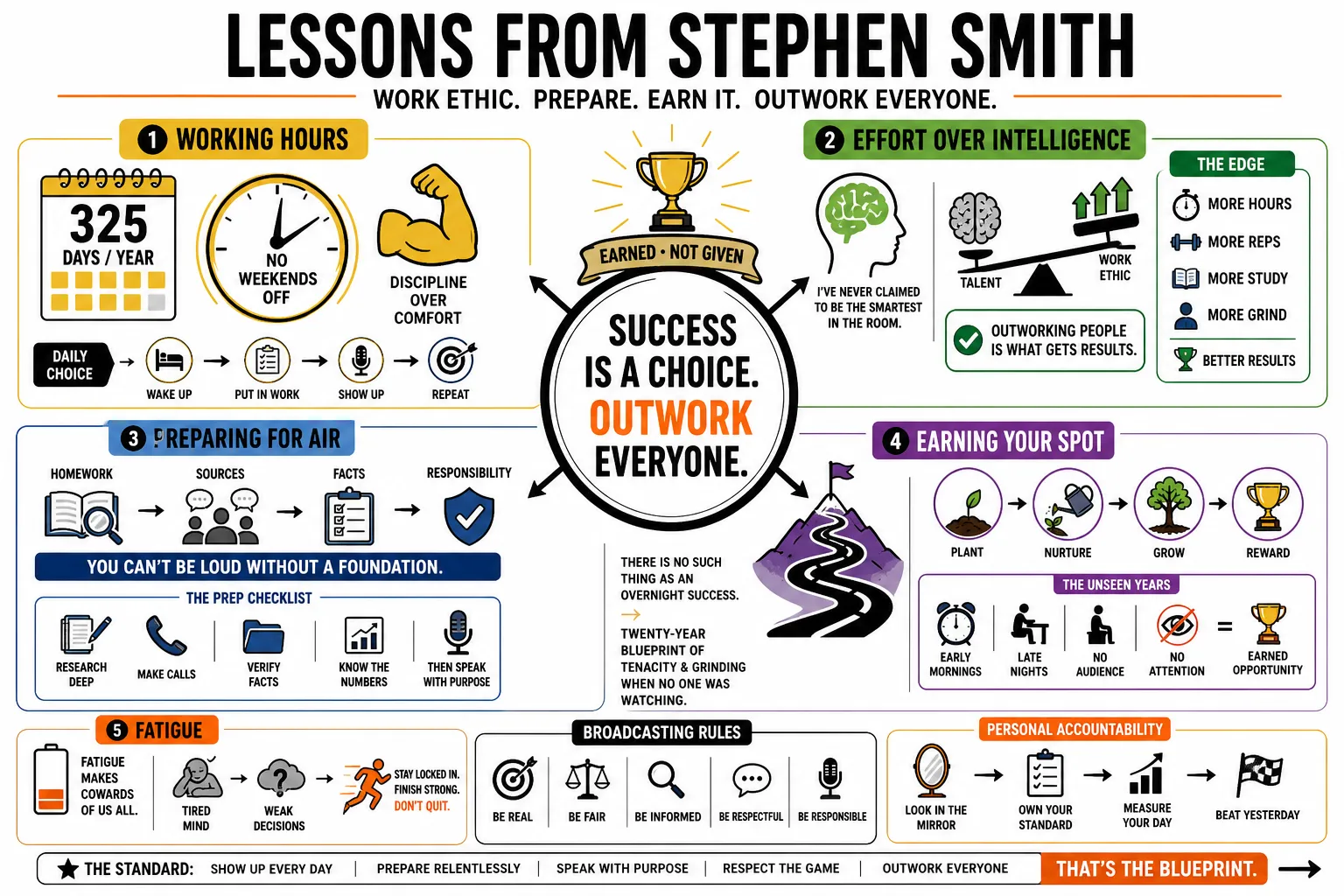
Lessons from Stephen Smith
Stephen A. Smith popularized the sports debate format, turning his unfiltered opinions on ESPN's First Take into a massive independent business. Drawn from his memoir Straight Shooter and decades on live television, this profile breaks down his strict rules for broadcasting and personal accountability.
Part 1: The Foundations of Work Ethic
- On Working Hours: "Work ethic isn't a gift; it is a choice. You can decide to work 325 days a year while everyone else takes weekends off." — Source: [Straight Shooter Memoir]
- On Effort Over Intelligence: "I've never claimed to be the smartest person in the room. My signature is my work ethic, because outworking people is what actually gets results." — Source: [The Pivot Podcast]
- On Preparing for Air: "You have to do the homework. You can't be loud without a foundation; you have to cultivate sources, gather facts, and be responsible as a journalist before you open your mouth." — Source: [GQ Magazine Profile]
- On Earning Your Spot: "There is no such thing as an overnight success. What looks like sudden fame is usually the result of a twenty-year blueprint of tenacity and grinding when no one was watching." — Source: [The Stephen A. Smith Show]
- On Fatigue: "Fatigue makes cowards of us all. When you get tired, you start making excuses, taking shortcuts, and settling for less than your best." — Source: [First Take Broadcast]
- On Going Where Others Don't: "To stand out as a reporter, I went to the locker rooms and sources the other guys ignored. If you follow the pack, you end up with the same story as the pack." — Source: [Straight Shooter Memoir]
- On Being Indispensable: "Your primary goal in any professional environment should be to make yourself completely un-expendable. You want them to panic at the thought of you leaving." — Source: [Podcast P with Paul George]
- On The 330-Day Rule: "I operate on four hours of sleep and work nearly every day of the year. While talent is a baseline, sheer volume of output is what separates the great from the good." — Source: [The Howard Stern Interview]
- On Resting: "A setback is a pause, never a full stop. You rest when you have to, but you never stop moving forward entirely." — Source: [Straight Shooter Memoir]
- On Discipline: "Stay off the weed. It is a direct metaphor for avoiding any unnecessary distractions that put your career and your money in jeopardy." — Source: [First Take Broadcast]
Part 2: Radical Accountability
- On Blaming Others: "You are not blameless here. No matter how unfair a situation seems, you have to look in the mirror and identify your own role in the mess." — Source: [Straight Shooter Memoir]
- On Quitting: "When you quit on a goal, you aren't simply letting yourself down. You are actively betraying the people who spent their time and resources believing in you." — Source: [The Pivot Podcast]
- On Owning Mistakes: "Take away the power of your critics by admitting your errors immediately. If you own the mistake before they can use it against you, they have nothing to say." — Source: [The Stephen A. Smith Show]
- On Making Excuses: "Excuses do not deposit money into your bank account. Nobody cares why you couldn't get the job done; they only care that it isn't done." — Source: [Breakfast Club Interview]
- On The 2009 Firing: "Getting let go by ESPN was the most humbling experience of my life. It forced me to look at my own arrogance and realize I had brought the situation upon myself." — Source: [GQ Magazine Profile]
- On Standards: "You absolutely do not have the right to hold somebody else accountable to a standard that you refuse to apply to yourself." — Source: [First Take Broadcast]
- On Self-Evaluation: "You have to audit yourself constantly. Ask yourself what you are doing wrong before you ask what management is doing wrong." — Source: [Podcast P with Paul George]
- On Keeping Your Word: "Integrity starts with keeping your damn word. When you say you are going to deliver something, you deliver it, no matter how hard it gets." — Source: [Straight Shooter Memoir]
- On Moving On: "Once you accept responsibility for a failure, you are free. The weight of making excuses is much heavier than the sting of admitting you were wrong." — Source: [The Howard Stern Interview]
- On Victimhood: "Playing the victim is a useless strategy. The market does not reward victims; it rewards producers." — Source: [The Stephen A. Smith Show]
Part 3: Overcoming Adversity and Failure
- On Failing: "There is no such thing as failure as long as you are learning. You either succeed, or you get an education on what not to do next time." — Source: [Straight Shooter Memoir]
- On Hitting Rock Bottom: "Rock bottom is highly educational. When you have nothing left to lose, you are finally open to learning the things you were too arrogant to listen to before." — Source: [The Pivot Podcast]
- On Using Pain: "When people tell you that you aren't smart enough or good enough, use that pain. Let it elevate your focus and determination to prove them entirely wrong." — Source: [GQ Magazine Profile]
- On Roadblocks: "Obstacles like poverty or learning disabilities are not excuses to fail; they are the forge where you build your capacity to survive anything." — Source: [Straight Shooter Memoir]
- On Naysayers: "Call me whatever you want, say whatever you want about my style. Just make sure you don't forget to read my resume." — Source: [First Take Broadcast]
- On Getting Back Up: "I failed today, but I will succeed tomorrow. The only permanent mistake is deciding not to get out of bed the next morning." — Source: [Breakfast Club Interview]
- On Proving People Wrong: "My greatest source of motivation has always been the people who predicted my downfall. I wake up every day looking to make liars out of them." — Source: [The Stephen A. Smith Show]
- On Rebuilding: "When I was out of television, I didn't sulk. I spent two years learning the business of production so I could come back stronger and more dangerous than before." — Source: [Podcast P with Paul George]
- On Unfairness: "The world is not fair, and nobody is coming to save you. Accept that reality early, and you will stop wasting time waiting for a rescue." — Source: [Straight Shooter Memoir]
- On Self-Reliance: "The hard work starts right now, and you have to rely entirely on yourself. If you expect a handout, you will be waiting for the rest of your life." — Source: [The Howard Stern Interview]
Part 4: The Business of Media
- On Audience Engagement: "Do literally anything but bore the audience or lie to them. If you can keep them entertained and tell them the truth, you will always have a job." — Source: [Straight Shooter Memoir]
- On Debate: "I don't leave things open for interpretation. When I speak on television, I say exactly what I mean so there is no confusion about where I stand." — Source: [First Take Broadcast]
- On Impact: "It is insufficient to simply do the job efficiently. You have to create an impact that makes the audience remember you long after the broadcast is over." — Source: [GQ Magazine Profile]
- On Television Production: "You cannot be a talking head alone. You need to understand camera angles, segment pacing, and what the producers need to keep the ratings high." — Source: [The Stephen A. Smith Show]
- On The 'I Don't Care' Factor: "Amateurs try to make the audience agree with them. Professionals just need the audience to believe that they believe what they are saying." — Source: [The Pivot Podcast]
- On Being a Draw: "You want to be the reason people turn the channel on. If you are a placeholder filling airtime, the network will replace you the second it gets cheaper to do so." — Source: [Breakfast Club Interview]
- On Authenticity on Air: "The guy you see on television is no character. It is simply the loudest, most commentary-driven version of who I actually am." — Source: [Podcast P with Paul George]
- On Preparation: "I don't read off a prompter for my opinions. I do the reading the night before so that when the red light goes on, I am speaking from the gut." — Source: [Straight Shooter Memoir]
- On The Media Machine: "Broadcasting is a business of numbers. If your segments don't rate, your opinions do not matter to the executives signing the checks." — Source: [The Howard Stern Interview]
Part 5: Building a Personal Brand
- On Being a Known Quantity: "A brand is a promise of consistency. If you present yourself the exact same way every day, the audience learns to trust your brand." — Source: [Straight Shooter Memoir]
- On Changing for Others: "If you act like an amoeba and constantly change your personality to fit the room, no one will ever know who you actually are." — Source: [The Pivot Podcast]
- On People Pleasing: "How can you possibly find your own voice when you are entirely consumed with trying to please other people instead of being yourself?" — Source: [GQ Magazine Profile]
- On Independence: "You have to view yourself as a media entrepreneur, completely separate from a talent contract. I built my own production company so my brand is never reliant on one employer." — Source: [The Stephen A. Smith Show]
- On Trust: "When somebody pays you or tunes in to watch you, they are investing trust in your brand. You have to honor that by delivering a high-end performance every time." — Source: [Podcast P with Paul George]
- On Public Opinion: "I do not give two cents what anybody thinks of me personally. My job is to be factual, substantive, and legitimate, avoiding any urge to win a popularity contest." — Source: [First Take Broadcast]
- On Uniqueness: "You have to position yourself so that nobody else can be exactly like you. If you are easily replicable, your brand has zero long-term value." — Source: [Straight Shooter Memoir]
- On Handling Criticism: "If they are talking about you, you are winning. Silence and indifference are the only real threats to a personal brand." — Source: [Breakfast Club Interview]
- On Building a Platform: "Don't wait for a network to give you a microphone. In the modern era, you build your own podcast and your own audience, forcing the networks to come to you." — Source: [The Howard Stern Interview]
Part 6: Money and Value
- On The First Rule of Business: "If you are in the world of business, that means you are in the business of making money. Stop being shy or apologetic about wanting to be paid." — Source: [Straight Shooter Memoir]
- On Daily Goals: "I wake up every day with two questions: How do I make my boss more money, and how do I get some of it for myself?" — Source: [The Pivot Podcast]
- On Proving Value: "You have to help build the brand before you build your wallet. Establish yourself as a massive profit center, and then ask for your cut." — Source: [The Stephen A. Smith Show]
- On Knowing Your Worth: "Do not come cheap. Once you know exactly how much revenue you bring in, make sure the organization invests as much in you as possible." — Source: [GQ Magazine Profile]
- On Contract Negotiations: "When it is time to negotiate, I don't ask for favors. I bring the ratings data and the revenue numbers, and I let the math do the talking for me." — Source: [Podcast P with Paul George]
- On Being the Best Value: "You can be the highest-paid person in an organization and still be the best value if you are generating three times what they are paying you." — Source: [First Take Broadcast]
- On The Reality of Free: "Everything is about money because nothing in this world is free. If you pretend you don't care about money, your employer will gladly keep it all." — Source: [Straight Shooter Memoir]
- On Creating Options: "The person who is willing to walk away always controls the negotiation. Build outside revenue streams so you never have to accept a bad deal." — Source: [Breakfast Club Interview]
- On Compensation: "Your paycheck is a direct reflection of how hard you are to replace. If you want a bigger check, become harder to replace." — Source: [The Howard Stern Interview]
Part 7: Fearlessness and Authenticity
- On Fearlessness: "Confidence is great, but fearlessness is better. Fearlessness is the willingness to execute your plan even when you know you might fall flat on your face." — Source: [Straight Shooter Memoir]
- On Living Your Truth: "Make sure it is always easier for others to live with your truth than it is for you to have to live with your own lies." — Source: [The Pivot Podcast]
- On Speaking Up: "If you have a microphone, you have an obligation to use it. Do not hold back your actual opinion because it might make someone in management uncomfortable." — Source: [GQ Magazine Profile]
- On Taking Hits: "When you are fearless, you will take hits. People will write articles about you and call you names. You have to develop armor thick enough to ignore it." — Source: [The Stephen A. Smith Show]
- On Authenticity: "I am the exact same person off-camera as I am on-camera, maintained at a slightly lower volume. You cannot fake a personality for twenty years." — Source: [Podcast P with Paul George]
- On Confrontation: "Do not run from a difficult conversation. Look people in the eye, state your case directly, and let the chips fall exactly where they may." — Source: [First Take Broadcast]
- On Defying Expectations: "Society has a box it wants to put you in based on where you came from. Fearlessness is kicking the sides of that box out and building your own house." — Source: [Straight Shooter Memoir]
- On Being Disliked: "I am perfectly fine with people not liking me. I am not in the business of making friends; I am in the business of stating the facts as I see them." — Source: [Breakfast Club Interview]
- On Boldness: "Hesitation kills momentum. If you believe in a take, you have to deliver it with your chest, removing any hint of an apology." — Source: [The Howard Stern Interview]
Part 8: Family and Perspective
- On His Mother's Influence: "Everything I have achieved is because of Janet Smith. Watching her work herself to the bone to protect her family set the standard I measure myself against." — Source: [Straight Shooter Memoir]
- On True Success: "Fame and television ratings are nice, but they do not love you back. True success is being able to provide security and opportunity for your family." — Source: [The Pivot Podcast]
- On Time: "After my battle with COVID-19, I realized my cardinal sin was assuming tomorrow was guaranteed. Time is the only resource you cannot negotiate for more of." — Source: [GQ Magazine Profile]
- On Fatherhood: "I work relentlessly to make sure my daughters have the choices I never had. The hardest lesson is realizing that money cannot replace the time you miss." — Source: [The Stephen A. Smith Show]
- On Giving Back: "When you make it out of a tough environment, your responsibility is to leave a trail so the people coming up behind you know the path is real." — Source: [Podcast P with Paul George]
- On His Father: "Growing up with a father who didn't support us taught me exactly what kind of man I refused to be. Even negative examples offer a valuable education." — Source: [Straight Shooter Memoir]
- On Legacy: "I refuse to be remembered as a guy who yelled on television. I want to be remembered as a businessman who mastered the game on his own terms." — Source: [First Take Broadcast]
- On Humility: "You can be arrogant about your skills, but you must remain humble about your blessings. Never forget where you came from or the people who helped you survive it." — Source: [Breakfast Club Interview]
- On The Final Goal: "At the end of the day, you are winning even when you don't realize it, simply because you are still standing and still striving to make things happen." — Source: [The Howard Stern Interview]