Steven Schwartz is the CEO and co-founder of Whop, a marketplace for internet businesses and digital products. He advocates for "agentic income," the idea that people should leave the traditional 9-to-5 to build careers around their specific skills. This profile covers what he learned from testing early side hustles and scaling a startup in the creator economy.
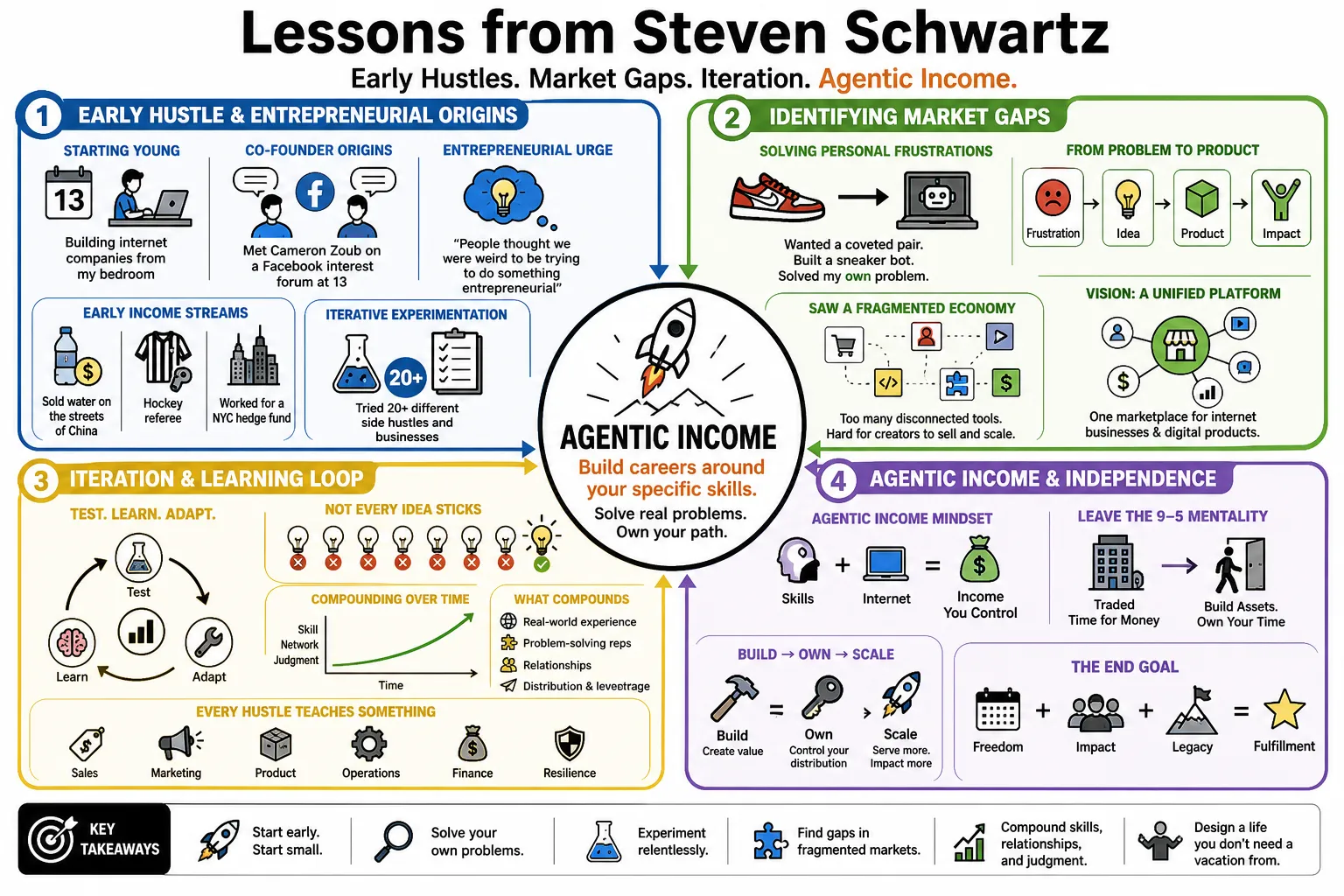
Part 1: Early Hustle and Entrepreneurial Origins
- On starting young: He began building internet companies, creating iOS applications, and selling digital products from his bedroom at the age of 13. — Reference: Steven - Whop
- On finding a co-founder: He met his co-founder Cameron Zoub on a Facebook interest forum when he was 13, and they started a business selling software for buying rare sneakers. — Reference: Optimistic Founders
- On embracing the entrepreneurial urge: "When we were growing up, people thought we were weird to be trying to do something entrepreneurial" — Source: Optimistic Founders
- On finding early income streams: Before finishing high school, he had already sold water on the streets of China, worked as a hockey referee, and worked for a New York City hedge fund. — Reference: The Financial Express
- On iterative experimentation: He tried over 20 different side hustles and business ventures before eventually starting Whop. — Reference: Apple Podcasts
Part 2: Identifying Market Gaps
- On solving personal frustrations: The inspiration for his sneaker bot business came from a personal desire to secure a coveted pair of sneakers, teaching him that innovation could solve his own problems. — Reference: Starter Story
- On recognizing market fragmentation: His experience selling sneaker software exposed him to a highly fragmented internet economy, sparking the idea for a unified platform where people could sell products and build communities. — Reference: The Financial Express
- On eliminating marketplace friction: He identified that the software resale landscape was riddled with scams and inefficiencies, highlighting the need for a trustworthy and secure marketplace. — Reference: Starter Story
- On the power of niche audiences: Instead of catering to a broad, generalized audience, Whop focuses on helping creators and entrepreneurs find smaller, highly specific groups of customers. — Reference: The Financial Express
Part 3: Building and Iterating the Product
- On speed of execution: The initial version of Whop was built in under three months, utilizing Discord's social features to quickly facilitate sales while minimizing fraud. — Reference: Starter Story
- On learning from failure: He nearly quit Whop after just three months, but his history of multiple failed ventures taught him to use setbacks as crucial learning opportunities. — Reference: Starter Story
- On adapting to feedback: He and his team prioritized user feedback, continuously evolving platform features like dispute resolution and engagement tools to stay relevant. — Reference: Starter Story
- On taking action over perfection: He believes the biggest mistake aspiring entrepreneurs make is waiting until they feel completely ready before they start building. — Reference: Apple Podcasts
- On utilizing mentorship: Getting guidance from experienced advisors like Peter Thiel was pivotal in helping him navigate early pitfalls and optimize the platform. — Reference: Starter Story
Part 4: The Future of Work and Agentic Income
- On redefining careers: He believes too many people view work as something they simply have to endure, rather than something they can genuinely enjoy. — Reference: The Financial Express
- On agentic income: The next era of work will move away from traditional 9-to-5 roles and toward models where individuals operate with full agency over how they earn a living. — Reference: Apple Podcasts
- On the future of daily work: "The future’s gonna look like everyone is complete of their own agency, and [are] spending their days doing the work that they find way more fun than what they’re doing today." — Source: The Financial Express
- On shaping tomorrow's economy: His ultimate goal is not just facilitating online sales, but empowering a new generation of digital entrepreneurs to build successful businesses that shape the future economy. — Reference: The Platform Empowering A New Generation of Digital Entrepreneurs
Part 5: Growth and Go-to-Market Strategy
- On organic growth: Authentic word-of-mouth recommendations from satisfied users became a powerful, cost-effective driver for acquiring new customers. — Reference: Starter Story
- On leveraging influencers: Partnering with major influencers added credibility and trust, utilizing their established social capital to drive significant traffic to the platform. — Reference: Starter Story
- On capturing search intent: Using smart SEO strategies and content marketing allowed his team to attract users who were already actively searching for digital business tools. — Reference: Starter Story
- On diversifying platforms: He advises creators to avoid relying solely on one platform for their business and audience to better protect their income streams. — Reference: Apple Podcasts
- On team culture: Fostering a passionate, energetic team with shared values in Brooklyn provided the collaborative environment needed to fuel the company's rapid growth. — Reference: Starter Story
Part 6: Empowering the Creator Economy
- On providing infrastructure: Whop was designed as a single platform for creating, hosting, and selling, handling backend operations so creators can focus entirely on their ideas. — Reference: The Platform Empowering A New Generation of Digital Entrepreneurs
- On transforming passions into careers: The platform enables users to turn niche hobbies, such as sports betting software and remote sales coaching, into full-time, lucrative businesses. — Reference: The Financial Express
- On scaling through support: By providing personalized support and account management guidance, he helps successful sellers scale their operations more effectively. — Reference: The Platform Empowering A New Generation of Digital Entrepreneurs
- On legitimizing digital goods: A core goal for the company is to further legitimize digital products so that tens of millions of people can comfortably participate in the marketplace. — Reference: The Platform Empowering A New Generation of Digital Entrepreneurs
Part 7: Developer Efficiency and Open Source
- On open-sourcing internal tools: Whop open-sourced internal packages like Next App Middleware and Turbo Module to give back to the developer community and help others streamline their deployments. — Reference: Streamlining Codebase and Deployment
- On simplifying middleware: He helped release Next App Middleware to allow developers to place middleware code inside the app directory in a route style, bypassing manual path configurations. — Reference: Streamlining Codebase and Deployment
- On keeping codebases lean: To maintain efficiency as they grew, his team built Unimported Action, a tool that automatically detects and removes unused packages and dependencies. — Reference: Streamlining Codebase and Deployment
- On automating deployments: They created Turbo Module to automate npm package publishing and dependency management, saving time and preventing deployment errors. — Reference: Streamlining Codebase and Deployment
Part 8: Early Professional Experience
- On diverse perspectives: Growing up with military parents and moving between places like China, Honolulu, and Chicago gave him a broad perspective before entering business. — Reference: The Financial Express
- On early corporate exposure: He interned at Accenture in Singapore, where he built chatbots for shipping companies and gained enterprise programming experience. — Reference: The Financial Express
- On academic background: He studied at New York University's Stern School of Business, launching Whop in 2021 during the same year he graduated. — Reference: The Financial Express
Part 9: Experimentation, Platform Ambition, and Culture
- On building range before finding the winner: Across eight years, he and his co-founders built marketplaces, consumer apps, games, social networks, software businesses, and service agencies before Whop became the breakout company. — Reference: Fortune
- On treating failure as part of the process: Running more than 20 side businesses taught him that some experiments will work and others will not; the practical response is to keep testing rather than expect certainty. — Reference: Fortune
- On seeing infrastructure inside a market gap: He noticed that software buyers and sellers on Reddit lacked customer support, reviews, and streamlined payments, turning a fragmented market into a concrete product brief. — Reference: Fortune
- On starting before confidence arrives: His advice to aspiring founders is to begin building rather than waiting for proof that an idea will work, because action is the prerequisite for learning whether it can. — Reference: Fortune
- On playing the long game: Guidance from Tinder co-founder Justin Mateen reinforced that company building is a marathon in which patience and perseverance matter more than expecting immediate results. — Reference: Fortune
- On making the mission measurable: He set a five-year ambition for Whop to help one million people earn at least $2,000 a month, translating a broad creator-economy vision into a concrete income target. — Reference: Fortune
- On separating online income from isolated work: He sees no contradiction between helping people earn online and building an in-person company; Whop's own team uses a shared Brooklyn office to preserve collaboration and human interaction. — Reference: Fortune
- On following sellers into adjacent products: When Whop sellers wanted to offer more than desktop software, the company rebuilt the platform to support a wider range of digital products rather than forcing the original use case. — Reference: Whop 3.0
- On using integrations to lower the technical barrier: Adding Discord and Telegram gave sellers ready-made distribution channels, allowing them to deliver more value without needing to write software themselves. — Reference: Whop 3.0
- On turning a product into an ecosystem: Opening Whop's app store to third-party developers expanded the platform from a fixed set of internal templates into infrastructure that can serve many niche markets. — Reference: Whop 3.0
- On making platform capabilities composable: Whop's developer kit exposes authentication, profiles, company information, and payment methods through reusable components so developers can build richer apps faster. — Reference: Whop 3.0
Part 10: Financial Infrastructure, Operating Cadence, and AI Commerce
- On keeping earnings in motion: Whop is building around the full path money takes after a sale, so sellers can save, invest, spend, or deploy their earnings without repeatedly withdrawing to a bank and moving funds into separate services. — Reference: Forbes
- On choosing financial partners for operating leverage: The Tether relationship offers more than capital: Whop gains access to global payment infrastructure and operators who have built an unusually profitable financial business at scale. — Reference: Forbes
- On designing finance around utility: His fintech thesis starts with what users actually want from money—fast, inexpensive access and useful ways to deploy it—rather than expecting them to care about the underlying crypto architecture. — Reference: Forbes
- On changing the revenue model when infrastructure becomes the product: Whop reduced its marketplace fee from 30% to zero and shifted its economic bet toward payment processing and financial services, aligning revenue with the rails sellers use rather than access to the marketplace itself. — Reference: Forbes
- On reading adoption before scaling promotion: Whop's Treasury product reached 3% of users within a week while still in beta and without marketing, giving the team an early behavioral signal before committing to a broader launch. — Reference: Forbes
- On pairing short plans with a long horizon: He plans around aggressive three-month roadmaps and a roughly five-year direction, avoiding detailed forecasts for the uncertain middle while still giving the team a clear execution cadence. — Reference: The Casey Adams Show
- On changing how feedback is used as a company scales: Early teams searching for product-market fit should respond closely to customers, but a mature platform must eventually choose among conflicting requests instead of trying to satisfy every user simultaneously. — Reference: The Casey Adams Show
- On earning product judgment through context: He treats good prioritization less as a fixed framework and more as the result of sustained curiosity—using the product, studying data, and talking directly with customers until tradeoffs become legible. — Reference: The Casey Adams Show
- On preserving founder density as the company grows: With most of the team having previously built companies, Whop uses founder experience and targeted acquisitions to maintain high agency, customer empathy, and hands-on ownership at scale. — Reference: The Casey Adams Show
- On making fundraising follow proof: Whop has generally raised after investors approached the company, reinforcing his view that founders should bring real product traction and results to the table before treating capital raising as the main objective. — Reference: The Casey Adams Show
- On turning observed behavior into a market: Content Rewards emerged after Whop saw businesses repeatedly use a general bounty app to pay for social posts; the team formalized that behavior into a structured, performance-based market for distribution work. — Reference: The Casey Adams Show
- On giving AI agents an operating surface: Whop's command-line interface lets AI agents launch products, manage subscriptions, check sales, run ad campaigns, and move money through the same end-to-end API used by developers. — Reference: SiliconANGLE
- On separating business capability from coding ability: By translating complex commerce operations into simple commands, the CLI gives nontechnical owners access to infrastructure that previously required an engineering team. — Reference: SiliconANGLE