Lessons from Stuart Hoegner
Stuart Hoegner spent over a decade as General Counsel for Tether and Bitfinex, managing the legal reality behind the world’s most traded stablecoin. He regularly defended Tether's reserve backing against government investigations as cryptocurrency drew heavier regulatory scrutiny. This collection covers his views on compliance, stablecoin mechanics, and the practical friction between decentralized technology and traditional banking.
Part 1: The Transition from Gaming to Crypto
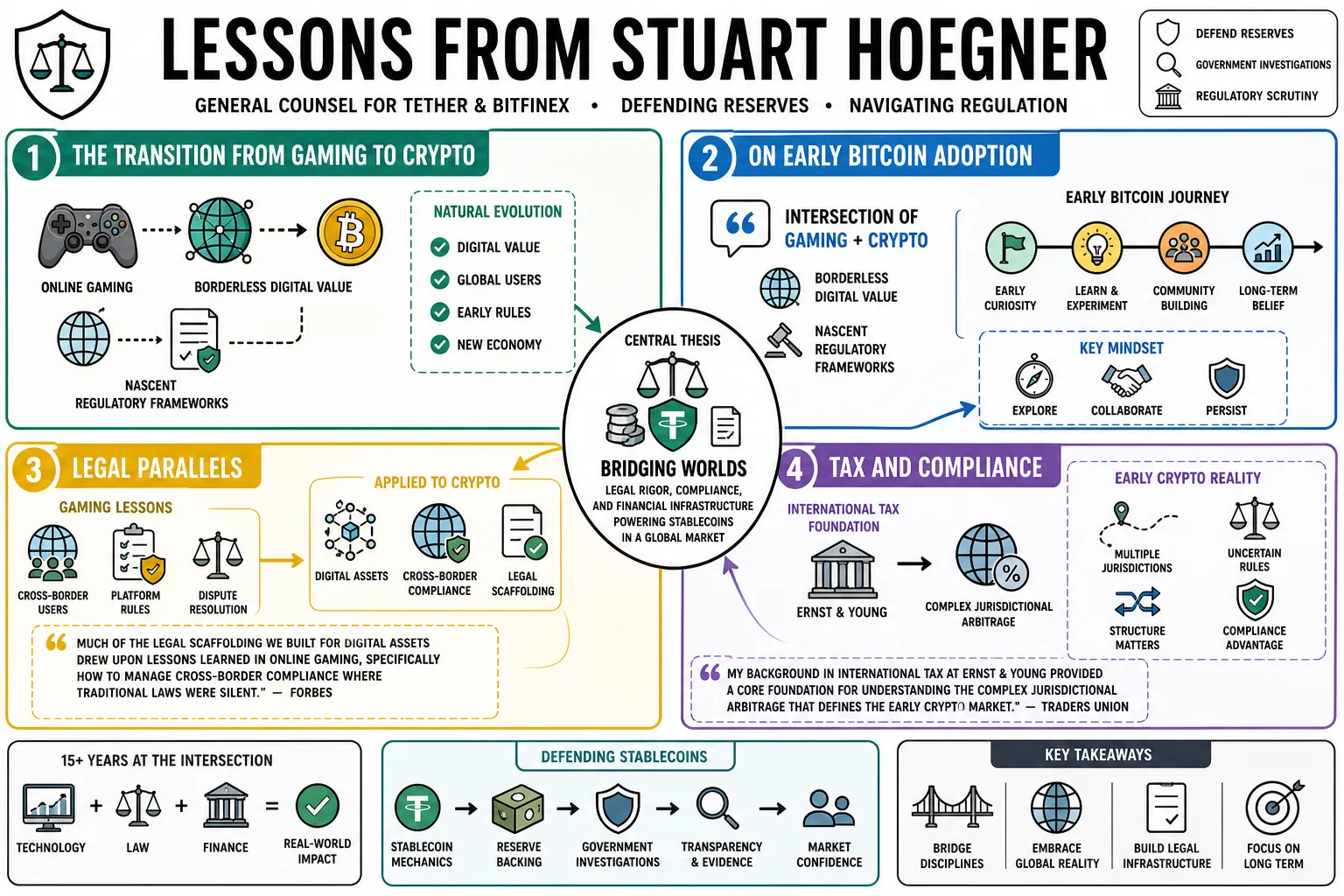
- On Early Bitcoin Adoption: "The intersection of online gaming and early cryptocurrency was a natural evolution because both industries required navigating borderless digital value and nascent regulatory frameworks." — Source: Bitfinex Blog
- On Legal Parallels: "Much of the legal scaffolding we built for digital assets drew upon lessons learned in online gaming, specifically how to manage cross-border compliance where traditional laws were silent." — Source: Forbes
- On Tax and Compliance: "My background in international tax at Ernst & Young provided a core foundation for understanding the complex jurisdictional arbitrage that defines the early crypto market." — Source: Traders Union
- On Defending Borderless Finance: "The challenges faced by early online poker platforms were a precursor to the resistance decentralized finance faces today." — Source: Reddit Discussions
- On First Movers: "Being an early legal adopter meant writing the rules in real-time, often looking for analogies in existing tax and property law." — Source: Binance Insights
- On Risk Management: "In both gaming and crypto, the fundamental legal task is distinguishing between legitimate technological innovation and regulatory evasion." — Source: The Block
- On the @bitcoinlawyer Persona: "Using the @bitcoinlawyer handle in 2011 was less about marketing and more about planting a flag in a legal frontier that few traditional practitioners took seriously." — Source: PANews
- On Early Industry Skepticism: "Mainstream legal practices initially viewed Bitcoin with deep suspicion, much like the early days of online gambling." — Source: Crypto Times
- On Structural Similarities: "The operational challenges of running an offshore exchange are fundamentally similar to operating an international gaming platform." — Source: Bitfinex Leadership
Part 2: Stablecoin Reserves and Backing
- On the 74 Percent Backing Figure: "Tether had cash and cash equivalents on hand representing approximately 74 percent of the current outstanding tethers at the time of the 2019 affidavit." — Source: Bitcoin.com
- On Defining Full Backing: "Tethers were and are 100 percent backed by reserves. The loan to Bitfinex is still good backing." — Source: What Bitcoin Did Podcast
- On the Reserve Portfolio: "Our portfolio contains international commercial paper, overwhelmingly rated A2 or better." — Source: CNBC TechCheck
- On Reserve Evolution: "We have continuously improved the quality of our reserves, aggressively reducing commercial paper and increasing our holdings in U.S. Treasuries." — Source: Tether Blog
- On One-to-One Backing: "Every single USDT in circulation is backed one-to-one with our reserves, ensuring the stability the market relies upon." — Source: CoinGeek
- On the Bitfinex Loan: "The misconception that USDT is not fully backed stems from a sworn affidavit which has been taken out of context. The loan's share of the USDT reserves has since shrunk to 2.5 percent." — Source: What Bitcoin Did Podcast
- On Liquidity versus Solvency: "There is a fundamental difference between liquidity and solvency, and our reserve composition is designed to guarantee both under extreme market stress." — Source: DPL Surveillance
- On Cash Equivalents: "The definition of cash equivalents is a standard accounting principle, and our application of it aligns with global financial practices." — Source: Podcast Republic
- On Bank Backing versus Tether Backing: "Fractional reserve banking is the standard for traditional finance, but stablecoins are held to a higher standard of one-to-one reserve backing." — Source: Hidden Forces Podcast
- On Fear and Doubt: "The persistent fear, uncertainty, and doubt regarding our reserves consistently ignores the mathematical reality of our portfolio." — Source: Bitfinex Blog
Part 3: Transparency, Audits, and Market Trust
- On the Audit Timeline: "We are working toward a full audit within months, but the process of educating traditional accounting firms on digital assets is time-consuming." — Source: CNBC TechCheck
- On Big Four Auditors: "We are not convinced that trust is necessarily vested in one country or another, or strictly limited to the Big Four accounting firms." — Source: CoinGeek
- On Attestations versus Audits: "Our quarterly attestations, conducted by independent accounting firms, prove once and for all that Tether is fully backed." — Source: Tether Blog
- On Market Verification: "We believe in providing information and understanding for our customers to make informed choices, and then we let the market speak for itself. And spoken it has." — Source: Tether Transparency Response
- On Trust through Utility: "USDT's popularity and daily volume are sufficient evidence of the market's faith in Tether's dealings and solvency." — Source: What Bitcoin Did Podcast
- On Financial Disclosure: "We provide a level of transparency into our reserve breakdown that far exceeds what is required of traditional corporate entities." — Source: The Block
- On the Purpose of Transparency: "Transparency is about building the infrastructural trust required for a global digital economy, rather than merely satisfying critics." — Source: Binance Insights
- On Continuous Improvement: "Our transparency initiatives are an evolving standard. We continuously look for ways to provide clearer, more frequent data to our users." — Source: Bitfinex Blog
- On Critic Motivation: "Many demands for transparency come from legacy players threatened by product efficiency rather than from users who actually rely on the network." — Source: Crypto Times
- On Operational Privacy: "There is a balance to strike between providing public attestations and protecting the proprietary operational security of our banking relationships." — Source: Forbes
Part 4: Dealing with Regulators and Law Enforcement
- On Educating Regulators: "A significant portion of my role involved simply explaining the underlying mechanics of blockchain technology to regulators who were encountering it for the first time." — Source: The Law of Bitcoin
- On the CFTC Settlements: "Settlements with the CFTC were strategic decisions to resolve legacy issues and allow the company to focus on building the future of finance." — Source: Bitfinex Blog
- On Jurisdictional Overreach: "We frequently pushed back against regulatory actions that attempted to apply domestic financial laws to borderless, decentralized protocols." — Source: CoinGeek
- On Law Enforcement Cooperation: "We have proactively assisted law enforcement globally in freezing and recovering illicit funds, demonstrating our commitment to a safe ecosystem." — Source: Tether Blog
- On Bespoke Regulation: "We need clear, bespoke crypto regulations rather than attempts to forcefully fit digital assets into legacy financial laws." — Source: Tether/Bitfinex Podcast Transcript
- On Regulatory Friction: "Compliance adds significant operational costs, but it ultimately provides the credibility the industry needs to scale globally." — Source: Traders Union
- On Proactive Engagement: "Engaging with regulators before a crisis hits is the only way to build the mutual understanding necessary for sensible policy." — Source: Binance Insights
- On the NYAG Relationship: "Our engagement with the New York Attorney General’s office ultimately established clear boundaries for our operations despite being adversarial at times." — Source: The Block
- On Freezing Assets: "The ability to freeze assets at the contract level is a powerful tool for compliance, but it must be used judiciously and strictly in accordance with legal orders." — Source: Reddit Discussions
Part 5: Compliance, KYC, and AML
- On the Importance of AML: "Rigorous Anti-Money Laundering standards are the baseline requirement for any digital asset firm that wants to survive long-term." — Source: Bitfinex Blog
- On KYC Implementation: "Implementing strict Know Your Customer procedures across a global and decentralized user base is a massive technical and legal undertaking." — Source: The Block
- On Keeping Bad Actors Out: "Legitimate exchanges should welcome rules that prevent the proceeds of crime from entering the ecosystem." — Source: Forbes
- On Privacy versus Compliance: "The tension between financial privacy and AML compliance is the defining legal challenge of the cryptocurrency era." — Source: Traders Union
- On Transaction Monitoring: "Blockchain analytics provide a level of transaction tracing that traditional fiat systems could never achieve, fundamentally changing AML enforcement." — Source: CoinGeek
- On Compliance Costs: "The financial burden of maintaining global compliance programs is a primary driver of consolidation among cryptocurrency exchanges." — Source: Podcast Republic
- On Global Standards: "The lack of harmonized global compliance standards creates regulatory arbitrage, which ultimately harms the industry’s reputation." — Source: The Law of Bitcoin
- On Institutional Onboarding: "Institutional capital will only flow into systems that can demonstrably prove their AML frameworks meet or exceed legacy banking standards." — Source: Binance Insights
- On the Role of General Counsel: "The modern General Counsel in crypto focuses on designing technical systems that enforce compliance at the code level rather than pursuing traditional litigation." — Source: Crypto Times
Part 6: Navigating the NYAG Investigation
- On the Initial Injunction: "The initial injunction sought by the NYAG was based on a misunderstanding of how the Bitfinex and Tether corporate structures supported liquidity." — Source: Bitcoin.com
- On the 2021 Settlement: "The settlement with the NYAG allowed us to put this matter behind us and focus entirely on our business and our customers." — Source: The Block
- On Admitting No Wrongdoing: "It is a matter of public record that the settlement contained no admission of wrongdoing regarding the manipulation of cryptocurrency prices." — Source: Bitfinex Blog
- On the Document Production: "We produced over 2.5 million pages of documents to the NYAG, demonstrating a level of cooperation that contradicts the narrative of a secretive company." — Source: Forbes
- On the Crypto Capital Corp Loss: "The situation with Crypto Capital was a sophisticated fraud perpetrated against us, not an intentional commingling of funds by our management." — Source: What Bitcoin Did Podcast
- On Preserving Operations: "Throughout the entire NYAG investigation, neither Bitfinex nor Tether ever paused operations or failed to process a customer withdrawal." — Source: CoinGeek
- On State versus Federal Regulation: "The NYAG action highlighted the fragmented nature of US crypto regulation, where state attorneys general can act as defacto national regulators." — Source: NYAG Bitfinex/Tether Settlement
- On the Reporting Requirements: "The mandatory quarterly reporting established by the NYAG settlement essentially formalized the transparency initiatives we were already implementing." — Source: The Block
- On the Market Reaction: "The market’s muted reaction to the NYAG settlement proved that users had already priced in the regulatory friction." — Source: Traders Union
Part 7: Legal Architecture and The Law of Bitcoin
- On the Need for Legal Scholarship: "When we wrote The Law of Bitcoin in 2015, the goal was to provide judges and practitioners a basic framework for understanding a completely novel asset class." — Source: The Law of Bitcoin
- On Property Law: "The most profound legal question early on was simply determining whether a digital token constituted property under existing commercial codes." — Source: Forbes
- On Smart Contracts: "Code is not law. Law is law. Smart contracts are simply automated agreements that must still operate within the bounds of human legal systems." — Source: Traders Union
- On Taxation of Digital Assets: "Applying legacy capital gains tax structures to micro-transactions on a blockchain creates an unworkable compliance burden for the average user." — Source: Binance Insights
- On the Howey Test: "Relying on a 1946 Supreme Court case about citrus groves to regulate decentralized software networks is legally insufficient and stifles innovation." — Source: CoinGeek
- On Open Source Liability: "Holding the authors of open-source code legally liable for how third parties deploy that code threatens the foundation of software development." — Source: The Block
- On Decentralization as a Defense: "Decentralization is not a magic word that grants immunity from securities laws, because the economic reality of the network is what matters." — Source: Crypto Times
- On Contractual Relationships: "The Terms of Service for an exchange are the ultimate arbiter of risk allocation between the platform and the user." — Source: Bitfinex Blog
- On the Evolution of Crypto Law: "Crypto law has shifted from theoretical debates about the nature of money to practical litigation over bankruptcy, custody, and reserve backing." — Source: Bitfinex Leadership
Part 8: Legacy, De-Risking, and the Future of Crypto
- On De-Risking by Banks: "The systemic de-risking by traditional banks, where they refuse service to crypto firms regardless of compliance, is the greatest existential threat to the industry." — Source: Finance Feeds
- On the MiCA Framework: "The EU’s Markets in Crypto-Assets regulation is a watershed moment, but strict mandates such as holding 60 percent of reserves in banks could introduce new systemic risks." — Source: Daily Coin
- On the Role of Stablecoins: "Stablecoins are the bridge between the analog financial system and the digital future, serving as the settlement layer for the internet." — Source: Tether Blog
- On the Future of Fiat: "Cryptocurrency will not replace sovereign fiat overnight, but stablecoins are rapidly becoming the preferred medium for global dollar demand." — Source: What Bitcoin Did Podcast
- On Building During Crises: "The defining characteristic of Tether and Bitfinex has been the ability to continue shipping products and scaling operations while under intense legal pressure." — Source: Tether/Bitfinex Podcast Transcript
- On the Next Decade: "The legal battles of the next ten years will center around privacy, the right to self-custody, and the integration of stablecoins into central bank frameworks." — Source: Forbes
- On His Retirement: "Navigating Tether and Bitfinex through complex regulatory environments has been the defining challenge of my career, and the foundation is now set for the next phase of growth." — Source: The Block
- On Surviving the Bear Markets: "Legal and compliance teams are tested during bull runs, but they earn their keep by ensuring survival during the bear markets." — Source: Traders Union
- On Global Financial Access: "The true value of our work is seen in emerging markets, where a dollar-backed stablecoin provides a lifeline against hyperinflation." — Source: Binance Insights
- On the Legacy of Tether: "Regardless of the noise, history will view Tether as the mechanism that provided the liquidity necessary for the entire cryptocurrency industry to scale." — Source: Crypto Times