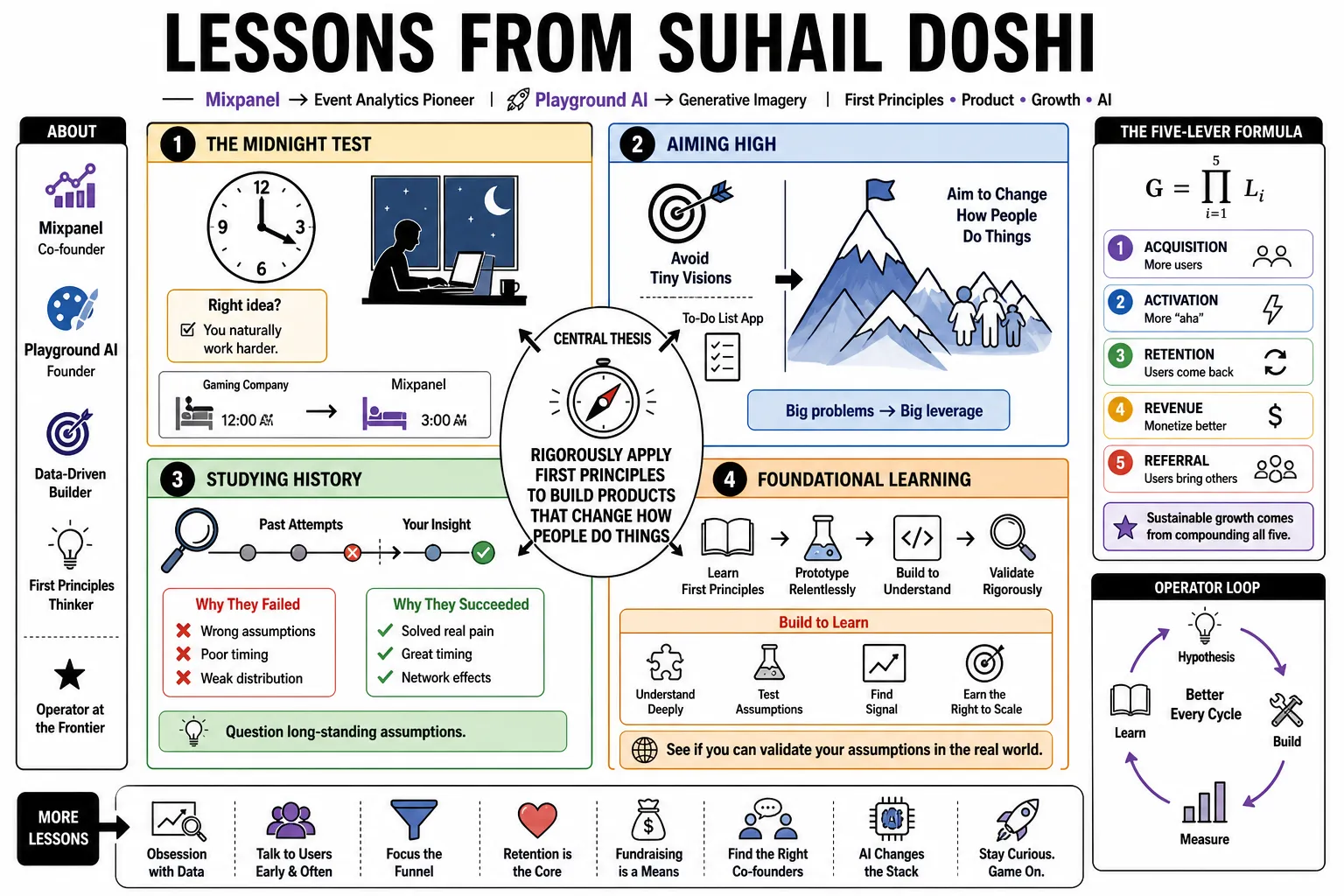
Suhail Doshi is the co-founder of Mixpanel, an analytics platform that popularized event-based user tracking, and the founder of Playground AI, an image generation company. He is known for applying a rigorous, first-principles approach to product growth, famously reducing startup success down to a five-lever mathematical formula. This collection organizes his direct advice on early-stage retention, the realities of fundraising, and the technical shift toward generative AI.
Part 1: Finding the Idea & Getting Started
- On the Midnight Test: "You know you have found the right idea when you naturally start working harder. Working on a gaming company, I went to bed at midnight; building Mixpanel, I stayed up until 3 AM because I was genuinely excited." — Source: [Billion Success]
- On Aiming High: "Avoid tiny visions like building a to-do list app. Instead, aim to change the way people fundamentally do things." — Source: [Billion Success]
- On Studying History: "Research the history of your market. Understanding why previous players failed or succeeded helps you identify long-standing assumptions." — Source: [Medium]
- On Foundational Learning: "Prototype and learn the technology from first principles. Actually see if you can validate your assumptions. This step makes you honest instead of overconfident." — Source: [SKMurphy]
- On Identifying Core Features: "If you look at the history of a market, you will notice critical features that took others a decade to realize. Start there." — Source: [Medium]
- On Explaining the Vision: "Spend time figuring out how to explain your product to prospects. If they do not 'get it', it is far more likely that your pitch sucks than that they are unimaginative." — Source: [SKMurphy]
- On Launching: "Perfect is the enemy of good. Make a decision and realize that you can probably course correct later." — Source: [Fast Company]
- On Competitive Cloning: "If your competitor made something your customers love, understand why and build it yourself." — Source: [Fast Company]
Part 2: The Growth Formula & Retention
- On First Principles of Growth: "In the first 24 months, you likely only need to answer: Is my product easy to understand? Is it easy to get started? Are people coming back?" — Source: [SKMurphy]
- On Misplaced Priorities: "Even 1,000-person companies fail because they ignore the basics. If people are not coming back, no amount of clever marketing will save the company." — Source: [Insider Story]
- On Providing Immediate Value: "If you do not get step one right by making the product easy to understand, you do not have a chance at any of the subsequent steps." — Source: [SKMurphy]
- On Doing Customer Support: "In the early days, do customer support yourself. It will help you build an amazing intuition about your customers that cannot be outsourced." — Source: [SKMurphy]
- On Growth vs Retention: "If you have poor customer retention, no amount of clever marketing can compensate." — Source: [SKMurphy]
- On the Value Lever: "Value means the people who do the core thing the product was made for. If they never reach this step, signups are meaningless." — Source: [Startup Archive]
- On Measuring True Engagement: "Retention is the only metric that matters in the beginning. If they do not return, you do not have product-market fit." — Source: [Fast Company]
Part 3: Fundraising Realities
- On the One Yes Rule: "You will face constant rejection. You only need one investor to say yes to survive." — Source: [MENAbytes]
- On the Pitch Deck: "Your pitch deck should not tell the story; you should. The deck is just supporting material. Investors are looking for your commitment and depth of knowledge." — Source: [Business Insider]
- On the True Drivers of Investment: "Investors care about two things: the team and whether the idea is personally interesting to them. The only exception that overrides everything else is an incredible growth rate." — Source: [MENAbytes]
- On Advice Over Capital: "When you need money, first ask for advice. This builds a relationship and gets investors invested in your vision before you ask for their capital." — Source: [Fast Company]
- On Valuation Traps: "Do not use valuation as a measuring stick for success. Raising too much at too high a valuation can lock you into a preferred money stack that you cannot realistically exceed." — Source: [Business Insider]
- On Avoiding Exaggeration: "Smart investors can sniff the BS. Do not make graphs look exponential with only six months of data." — Source: [MENAbytes]
- On Forecasting: "Do not project five-year growth targets that are purely speculative. Present facts." — Source: [Business Insider]
- On Premature Celebration: "I advise against fundraising parties. Wait to celebrate until the company is actually cash-flow positive." — Source: [MENAbytes]
- On Ignoring Investor Rejection: "Investors often know your market less than you do. Do not let their 'no' discourage your vision." — Source: [MENAbytes]
- On Raising What You Need: "Raise only what is required to hit your next milestone. Having too much capital removes the constraint that forces hard choices." — Source: [Business Insider]
Part 4: Building & Iterating on Product
- On Narrow Focus: "Stay laser-focused on solving a narrow set of problems. Tackle no more than three to four major issues at once." — Source: [SKMurphy]
- On Never-Ending Iteration: "Iterating on your initial user experience will be a never-ending process. You will do this forever, especially as the product changes." — Source: [SKMurphy]
- On Trusting Intuition: "The truth is, you will use your gut a lot because you lack data. To compensate: talk to customers, meet people who will play devil's advocate, and understand the technology deeply." — Source: [SKMurphy]
- On Early Product Testing: "Before scaling, verify that the core loop actually delivers the promised value to a small set of users." — Source: [SKMurphy]
- On Finding the Truth: "As a company grows, discovering the truth becomes harder. Constantly ask for actual facts rather than people's opinions to guide decision-making." — Source: [Medium]
- On Apple's Standard: "Apple is the greatest institution in the world. They have proven users know what good design looks like and feels like." — Source: [Substack]
- On Making Interfaces Accessible: "Our goal is to help people make graphics like a pro without being one. There is a whole swath of humanity that has no idea how to use Photoshop and no time to do tutorials." — Source: [Substack]
- On Hardware Constraints: "Much of the web is bound by the single-core performance of JavaScript. Understand the physical limits of the systems you build upon." — Source: [Buttondown]
Part 5: The Future of AI & Pixels
- On Pixels vs Text: "Many companies are going after language. We are going after the domain and modality of pixels. We are trying to make a large language image model." — Source: [Substack]
- On the AI Research Pace: "AI research takes ten times longer than building a web app." — Source: [Substack]
- On AI Art: "I do think AI art is art. People just feel threatened because there is a new thing that makes them feel obsolete." — Source: [Substack]
- On the Ultimate Vision: "The long term goal is to build something that can generate, edit, and understand pixels simultaneously." — Source: [Cognitive Revolution]
- On Current AI Hacks: "To me, current image pipelines are just hacks. We are ensembling narrow models, similar to where deep learning and language were three or four years ago." — Source: [Substack]
Part 6: Hiring & "Down For The Cause" Culture
- On 'DFTC': "We look for people who are Down For The Cause. We are all in to do whatever is needed. If you are not DFTC, you are not the right fit." — Source: [Fast Company]
- On the Janitorial Work: "Good founders give the awesome stuff to their team and take on the basic tasks no one else wants to do. We are the founders and the janitors." — Source: [Fast Company]
- On the First Five Hires: "The first five people on any team will define that team's culture for years. Protect the foundation." — Source: [Fast Company]
- On Pacing Headcount: "Advocate for gradual growth and a 'hire slow, fire fast' mentality. Do not let headcount become a vanity metric." — Source: [Fast Company]
- On Testing Candidates Out of Office: "Spend time with candidates in informal settings to see their true personality and how they interact with others outside of a structured Q&A." — Source: [Fast Company]
- On Respecting Applicants: "Always respond to every applicant. If someone takes the time to apply personally, the company should take the time to reply." — Source: [Fast Company]
- On the Over-Employed Trend: "Founders must sniff out BS. There is a trend of individuals who ace technical interviews and then work at multiple startups simultaneously, delivering zero results." — Source: [LiveMint]
- On Founder-Led Hiring: "Founders must maintain a tight grip on hiring quality. Many candidates can talk a good game but fail to execute in a high-pressure startup environment." — Source: [LiveMint]
- On Doing the Job First: "Do not hire for a role until you have tried to do it yourself. This builds the intuition needed to evaluate candidates effectively." — Source: [Fast Company]
Part 7: Leadership & Scaling as a Founder
- On Giving Up Control: "As a company scales, a founder must consciously give up control and build a team that can fulfill the mission without them." — Source: [Medium]
- On Coaching: "I strongly advocate for getting a CEO coach and doing 360 reviews. It highlights blind spots you naturally develop." — Source: [Medium]
- On Self-Improvement Focus: "Focus on only two to three personal improvements each year. Be transparent with the company about them to build trust." — Source: [Medium]
- On Managing vs Building: "I preferred building Mixpanel to running it. Learning to manage requires a complete shift in how you measure your daily output." — Source: [Medium]
- On Making Hard Choices: "If you do not consciously hand off tasks, you will not scale, and the quality of everything the company produces will suffer." — Source: [Medium]
- On Overcoming Failure: "I failed at five startups before Mixpanel succeeded. Persistence is not just about trying again, but changing the approach." — Source: [Fast Company]
- On Building Intuition: "Intuition in leadership is built through painful trial and error. You cannot inherit it from reading a blog post." — Source: [Medium]
- On Seeking Truth: "As the CEO, you must cut through the noise of what people want you to hear and hunt for the actual data." — Source: [Medium]
- On Protecting the Mission: "The first people you hire are not just members of your team, they are the foundation of your company." — Source: [Fast Company]
Part 8: The Courage to Pivot & Kill Darlings
- On the 10x Rule: "A 2x gain is not enough to change mass-market behavior. To displace a dominant incumbent, a product needs to be 5x to 10x better." — Source: [Buttondown]
- On Unit Economics: "You can build an okay business that power users love, but if the unit economics require a high subscription price, it will not be a mass-market changing company." — Source: [Buttondown]
- On Fighting Hardware: "The headwinds of the semiconductor industry mean local chips get faster and more efficient. Do not build a streaming business that fights against local hardware improvements." — Source: [Buttondown]
- On Recognizing a Shift: "I realized AI was having its mobile moment when I spent my late nights mapping out the AI market in Apple Notes instead of thinking about browser features." — Source: [Substack]
- On Founder-Market Fit: "You have to follow where your natural obsession leads. For me, that meant abandoning a browser for generative models." — Source: [Substack]
- On Avoiding Pivot Hell: "Do not stay in pivot hell trying to force a failing model to work. Go all-in on a new direction where you see a clear path to a 10x product." — Source: [Substack]
- On Transparency During a Pivot: "Shutting down a project requires transparency with investors and the team about why the original vision is no longer the best use of their time and capital." — Source: [Substack]