Taiichi Ohno (1912–1990) is the father of the Toyota Production System (TPS), which later evolved into Lean Manufacturing.[1] His philosophy centered on the relentless elimination of waste (muda), respect for people, and the pursuit of truth through direct observation (Genchi Genbutsu).
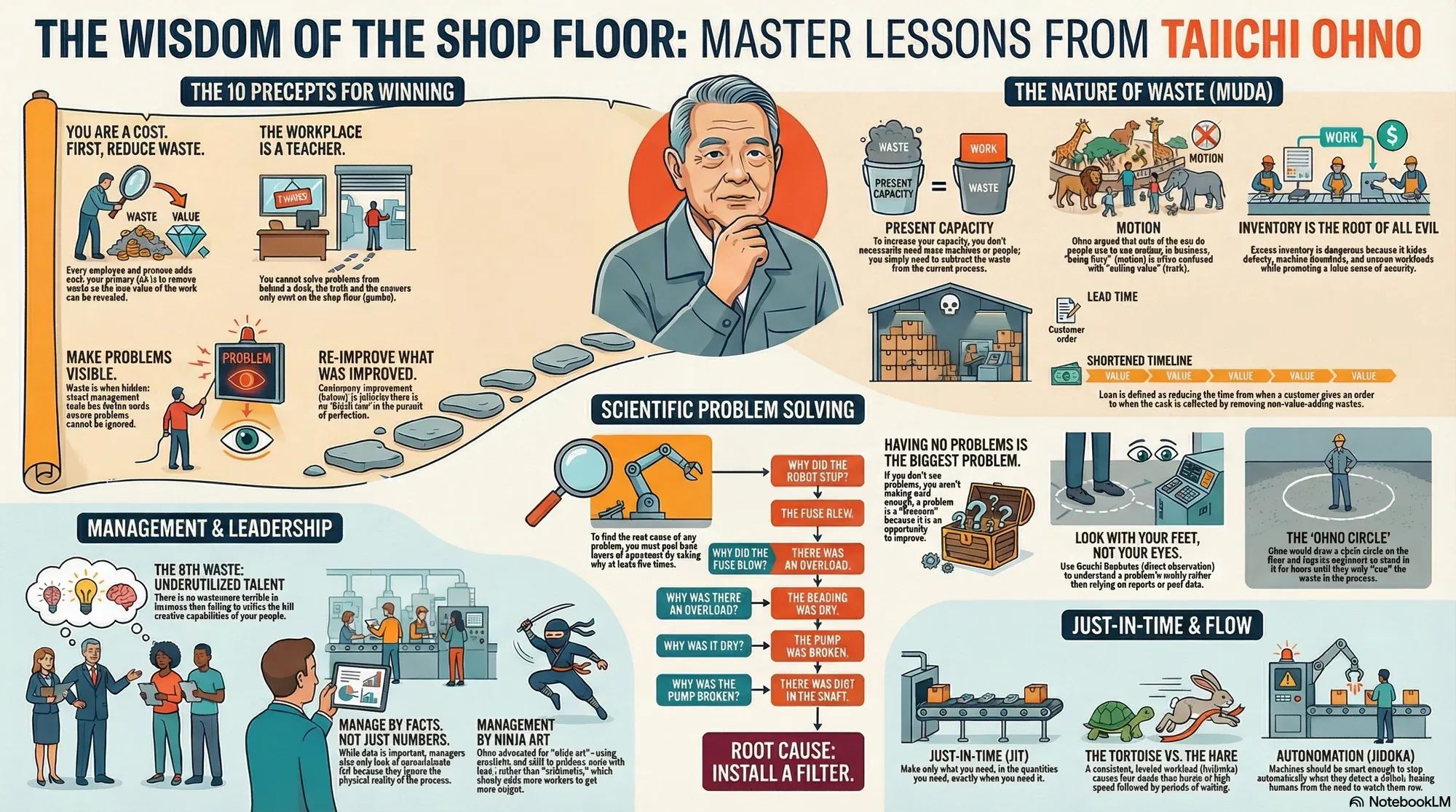
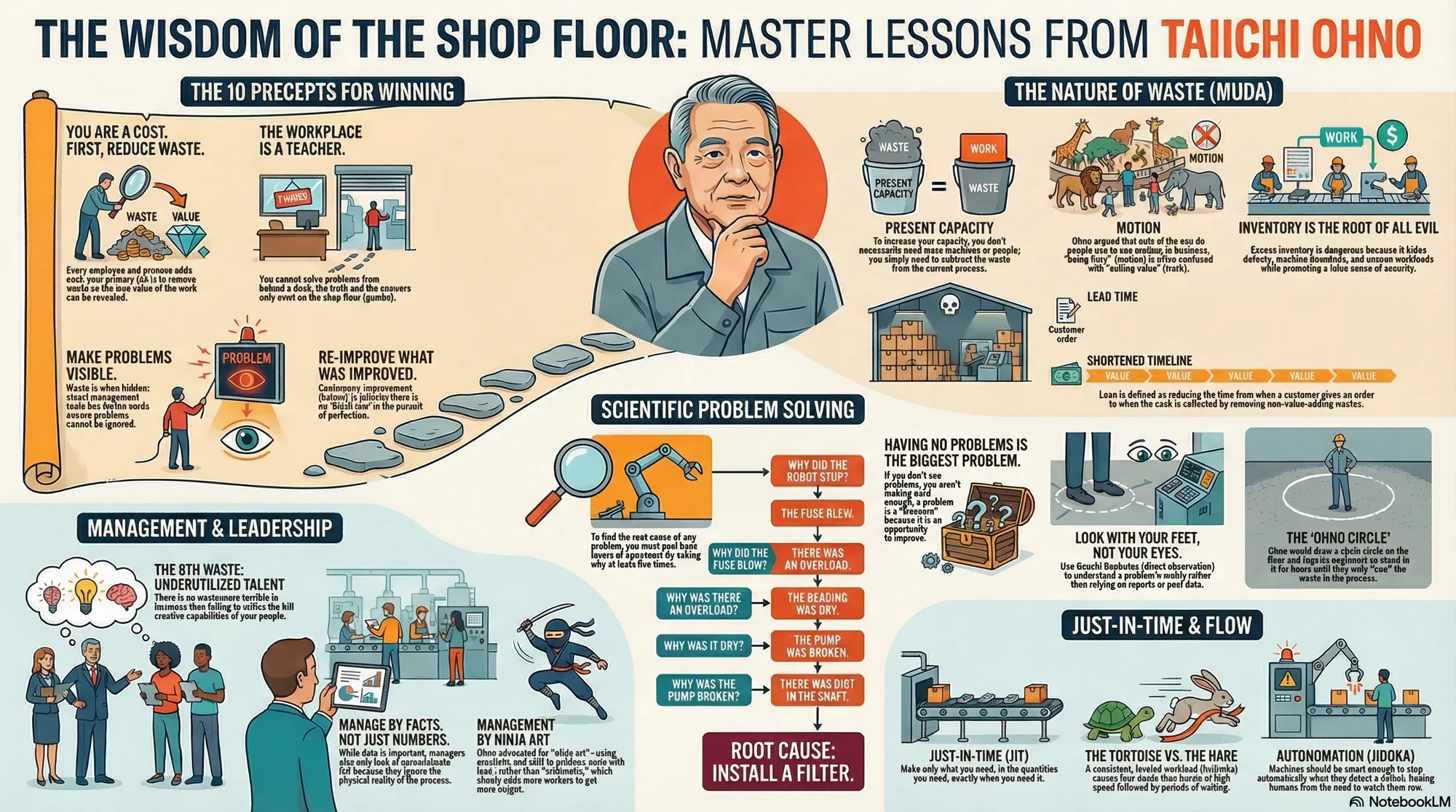
I. The 10 Precepts of Taiichi Ohno
These are often cited as Ohno's personal rules for thinking and acting to win.
- "You are a cost.[2][3][4][5] First reduce waste."
- Learning: Every employee and process adds cost; your primary job is to remove the waste so value can shine through.
- "First say, 'I can do it.' And try before everything."
- Learning: A mindset of "it can't be done" is the biggest barrier to innovation.
- "The workplace is a teacher. You can find answers only in the workplace."
- Learning: You cannot solve problems from a desk; the truth lies on the shop floor (gemba).
- "Do anything immediately. Starting something right now is the only way to win."
- Learning: Speed of action matters more than a perfect plan delayed.
- "Once you start something, persevere with it. Do not give up until you finish it."
- Learning: Half-measures and abandoned projects create waste.
- "Explain difficult things in an easy-to-understand manner. Repeat things that are easy to understand."
- Learning: Communication must be simple to be effective.
- "Waste is hidden. Do not hide it. Make problems visible."
- Learning: Visual management (like Andon cords) is critical so problems cannot be ignored.
- "Valueless motions are equal to shortening one's life."
- Learning: Wasting a worker's time on non-value-added tasks is disrespectful to their humanity.
- "Re-improve what was improved for further improvement."
- Learning: Kaizen (continuous improvement) is infinite; there is no "finish line."
- "Wisdom is given equally to everybody. The point is whether one can exercise it."
- Learning: Everyone has the capacity to solve problems, but few are disciplined enough to do so constantly.
II. On Waste (Muda) & Efficiency
- Ohno illustrated the difference with a bear pacing in a zoo cage: on its own, the movement is meaningless animal motion, but because people pay to watch it, that motion draws visitors to gather in front of the cage -- work is motion that creates value for someone, not motion alone. [23]
- "Costs do not exist to be calculated. Costs exist to be reduced." [25]
- "The more inventory a company has, the less likely they will have what they need."
- Learning: High inventory hides problems and promotes a false sense of security.
- Ohno described the whole of Toyota's work this way: looking at the timeline from the moment a customer places an order to the point cash is collected, then working to shorten that timeline by attacking waste in the processes along it. [26]
- "Why not make the work easier and more interesting so that people do not have to sweat?"
- Learning: The goal of efficiency is not to work people harder, but to remove the burden of useless struggle.
- "We are doomed to failure without a daily destruction of our various preconceptions."
- Learning: To improve, you must be willing to destroy your old way of thinking every single day.
- "There is no waste in business more terrible than underutilizing the capabilities of people."
- Learning: Often called the "8th Waste" (non-utilized talent).
- "To implement the Toyota Production System in your own business, there must be a total understanding of waste. Unless all sources of waste are detected and crushed, success will always be just a dream."
- "Present capacity = Work + Waste."
- Learning: To increase capacity, you don't need more machines/people; you just need to subtract the waste.
- "Inventory is the root of all evil."
- Learning: Excess inventory hides defects, machine downtime, and uneven workloads.
III. On Problem Solving & The "5 Whys"
- "Having no problems is the biggest problem of all."
- Learning: If you don't see problems, you aren't looking hard enough, or you are hiding them.
- Ohno taught that the root cause of a problem is usually hidden behind layers of symptoms, and encouraged his staff to keep asking why until they reached it -- famously demonstrated with a welding robot that stopped mid-operation, traced back through a blown fuse, an overloaded circuit, and insufficient lubrication to its true root cause. [20]
- "Data is of course important in manufacturing, but I place the greatest emphasis on facts."
- Learning: Data is a report of the past; facts are what you see happening right now on the floor.
- "Don’t look with your eyes, look with your feet."
- Learning: You must physically go to the problem (Genchi Genbutsu) to understand it.
- Ohno writes that if you realize something you've said is wrong, you need to admit it -- otherwise your subordinates and others in the workplace will stop following you. [22]
- "A problem is a treasure."
- Learning: Problems are opportunities to improve; we should welcome them.
- "Did it get made or did you make it?"
- Learning: Ohno would ask this when he saw overproduction. If "it got made" without a specific order, you have lost control of the process.
IV. On Standards & Kaizen
- "Where there is no standard, there can be no improvement."
- Learning: You cannot improve a process if it changes every time you do it. Stabilize first, then improve.
- "Standards should not be forced down from above but rather set by the production workers themselves."
- Learning: Standard work is only effective if those doing the work own it.
- "Something is wrong if workers do not look around each day, find things that are tedious or boring, and then rewrite the procedures. Even last month's manual should be out of date." [24]
- "Progress cannot be generated when we are satisfied with existing situations."
- "The Toyota style is not to create results by working hard. It is a system that says there is no limit to people's creativity."
- Learning: Lean relies on "brain" not "brawn."
- "People don't go to Toyota to 'work', they go there to 'think'."
V. On Management & Leadership
- "When you go out into the workplace, you should be looking for things that you can do for your people there. You've got no business in the workplace if you're just there to be there."
- Learning: The manager's role is to support the worker, not just supervise.
- "Don't give orders. Give instructions and then listen."
- "People who can't understand numbers are useless. The gemba where numbers are not visible is also bad. However, people who only look at the numbers are the worst of all." [21]
- "If you are acting like a mother to your workers, you are preventing them from growing."
- Context: Ohno was known for not giving answers immediately, forcing his managers to think for themselves.
- "The superior person is the one who can accomplish the target with the existing equipment."
- Learning: Don't ask for new machines; use your creativity to make the current ones work better.
- "Your costs will eat up all your profit if you don't watch out, so don't hire more people."
- Learning: Adding headcount should be the last resort, not the first solution.
- "If you want to understand the creator, understand the creation."
- Learning: A messy, chaotic factory floor reflects a messy, chaotic management mind.
VI. On Just-in-Time & Flow
- "Make only what you need, in the quantities you need, when you need it."
- Learning: The definition of Just-In-Time (JIT).
- Ohno made the point with a tortoise and a hare: the slower but consistent tortoise causes less waste and is much more desirable than the speedy hare that races ahead and then stops occasionally to doze -- the Toyota Production System, he said, can be realized only when all the workers become tortoises. [27]
- "Just-in-Time means that in a process that flows, the right parts needed in assembly reach the assembly line at the time they are needed."
- "Information sent to production should be timed exactly. It is not economical to provide more information than we need."
- Learning: Kanban (cards/signals) are a way to limit information so you don't overproduce.
- "Automation with a human touch." (Autonomation / Jidoka)
- Learning: Machines should be smart enough to stop when they detect a defect, so humans don't have to watch them run.
VII. Key Anecdotes & Principles
- "The Ohno Circle"
- Concept: Ohno would draw a chalk circle on the floor and make an engineer stand in it for hours to observe the process.
- Quote: "Watch the process and tell me what you see."
- Learning: We often look but do not see. Deep observation is required to see waste.
- "Management by Ninja Art"
- Concept: Ohno joked that management needs "ninja art" (creativity/skill) to produce more with less, rather than "arithmetic" (simply adding more workers to get more output).
- "Don't think with your head, think with your hands."
- Learning: You learn by doing (prototyping/trying), not by theorizing in a conference room.
- "Kanban is a way to achieve Just-in-Time."
- Learning: Kanban is not the strategy; it is just a tool to manage the flow.
- Ohno wrote that a half-hearted introduction of kanban brings a hundred harms and not a single gain -- improvement, he said, is eternal and infinite. [28]
Sources & Further Reading
- Book: Toyota Production System: Beyond Large-Scale Production by Taiichi Ohno (Productivity Press, 1988). Link to Publisher/Amazon
- Book: Workplace Management by Taiichi Ohno (Gemba Press, 2007). Link to Publisher/Amazon
- Book: The Birth of Lean by Koichi Shimokawa and Takahiro Fujimoto (Includes interviews with Ohno). Link to Lean Enterprise Institute
- Article: "Taiichi Ohno's 10 Precepts" via Gemba Academy or Curious Cat Management.
Sources
- leansixsigmadefinition.com
- internalresourcelibrary.org
- medium.com
- opscombinator.com
- opscombinator.com
- biz-pi.com
- quotefancy.com
- gembaacademy.com
- davemolinari.com
- davemolinari.com
- thekua.com
- management-quotes.net
- markhneedham.com
- majik.io
- wikipedia.org
- 6sigma.com
- goodreads.com
- jflinch.com
- 6sigma.com
- Ask 'why' five times about every matter — Toyota Motor Asia Pacific
- Toyota's Top Engineer on How to Develop Thinking People, Jon Miller / Gemba Academy
- Taiichi Ohno's Workplace Management (1988 English trans.), archive.org
- Taiichi Ohno's Workplace Management (1988 English trans.), archive.org
- Taiichi Ohno's Workplace Management (1988 English trans.), archive.org
- The Truth About Costs: Taiichi Ohno's Two Approaches to Budgeting, The Plant Manager
- Placing a Popular Taiichi Ohno Quote in Context, Jon Miller / Gemba Academy
- A Tortoise and a Hare Get Into a Potato Sack..., Jon Miller / Gemba Academy
- Toyota Production System: Beyond Large Scale Production -- book review, Jon Jagger's blog