Lessons from Ted Seides
Ted Seides is an investor, author, and host of the Capital Allocators podcast, where he interviews institutional investors. He is known for his time at the Yale Investments Office under David Swensen and a ten-year bet with Warren Buffett on hedge funds versus the S&P 500. This collection outlines his frameworks for interviewing, selecting managers, and allocating capital.
Part 1: The Warren Buffett Bet
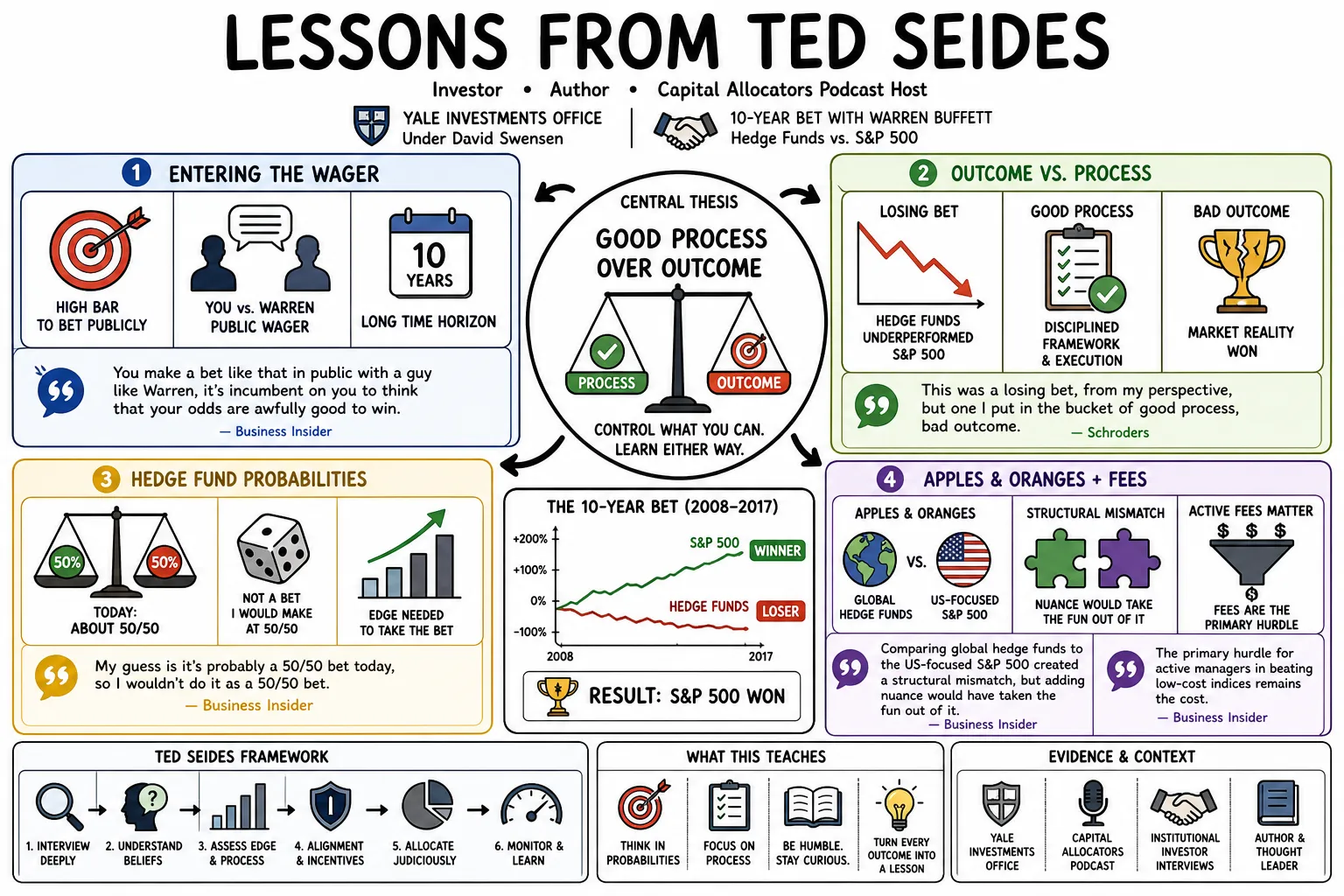
- On Entering the Wager: "You make a bet like that in public with a guy like Warren, it's incumbent on you to think that your odds are awfully good to win." — Source: Business Insider
- On Outcome vs. Process: "This was a losing bet, from my perspective, but one I put in the bucket of good process, bad outcome." — Source: Schroders
- On Hedge Fund Probabilities: "My guess is it's probably a 50/50 bet today, so I wouldn't do it as a 50/50 bet." — Source: Business Insider
- On Apples and Oranges: "Comparing global hedge funds to the US-focused S&P 500 created a structural mismatch, but adding nuance would have taken the fun out of it." — Source: Business Insider
- On Active Management Fees: "The primary hurdle for active managers in beating low-cost indices remains the compounding drag of standard fee structures over a decade." — Source: Ritholtz Wealth Management
- On Changing Market Conditions: "Limiting an assessment of returns only to market conditions in the moment fails to consider the wide range of possibilities of what might happen in the future." — Source: Capital Allocators
- On the Index Fund Advantage: "Buffett correctly identified that in a persistent bull market driven by large-cap equities, the unhedged, low-cost index will almost mathematically win out." — Source: Advisor Perspectives
- On the Value of Hedging: "Hedge funds are designed to protect capital during downturns, a feature that goes largely unrewarded when assessing a strict ten-year bull market window." — Source: Capital Allocators
- On Public Scrutiny: "Taking the other side of a trade against the greatest investor of all time forces you to deeply interrogate your own thesis." — Source: The Money Maze Podcast
- On Historical Context: "The exact same portfolio of hedge funds outperformed the S&P 500 in the previous market cycle; the timing of the start date dictated much of the result." — Source: Capital Allocators
Part 2: Interviewing and Asking Questions
- On the Purpose of Questions: "The goal of an interview is to create a space where the other person can reveal how they think, rather than showing how much you know." — Source: Capital Allocators Book
- On Preparation: "Prepare enough so you don't ask basic questions, but remain open enough to follow a conversational flow rather than a strict script." — Source: GetAbstract
- On Listening: "Active listening requires resisting the urge to formulate your next question while the guest is still answering the current one." — Source: Capital Allocators Podcast
- On Open-Ended Inquiries: "Questions starting with 'how' and 'what' naturally yield richer, more revealing answers than those requiring a simple yes or no." — Source: Capital Allocators Book
- On Silence: "Allowing for a few seconds of silence after an answer often prompts the speaker to share their most profound insights unprompted." — Source: Capital Allocators Podcast
- On Follow-Up Questions: "The magic of an interview usually lies in the second or third follow-up question, rather than the initial prompt." — Source: Capital Allocators Book
- On Ego in Interviews: "Checking your ego at the door is essential; the conversation must center entirely on the guest's expertise and experience." — Source: Capital Allocators Podcast
- On Curiosity: "Genuine curiosity cannot be faked; it is the fundamental driver that turns a rigid interrogation into an engaging conversation." — Source: Capital Allocators Book
- On Structuring a Conversation: "Start with the guest's background and formative experiences before diving into complex professional philosophies to establish necessary context." — Source: Capital Allocators Podcast
- On the Value of Podcasting: "Hosting hundreds of conversations has been the ultimate compounding vehicle for building both a network and a personal knowledge base." — Source: Capital Allocators Podcast
Part 3: Manager Selection and Due Diligence
- On Identifying Skill: "The skill of capital allocation lies in identifying the investment that fits best with the allocator's strategy and constraints, rather than simply finding any good asset." — Source: ShareVault
- On Manager Edge: "You must clearly define what structural or behavioral advantage a manager possesses that prevents their alpha from being arbitraged away." — Source: Capital Allocators Book
- On Track Records: "Past performance is a starting point for due diligence, but understanding the specific environment that generated those returns is what actually matters." — Source: Rational Reminder
- On Character: "Over a long-term partnership, the integrity and character of the manager will dictate outcomes alongside their analytical horsepower." — Source: Capital Allocators Book
- On Reference Checking: "The most valuable insights from reference calls often come from what is omitted or glossed over, rather than what is explicitly praised." — Source: Capital Allocators Podcast
- On Alignment of Interests: "Ensure that the manager's personal wealth is heavily invested alongside your capital to guarantee they feel the pain of drawdowns." — Source: Capital Allocators Book
- On Team Turnover: "High turnover at the analyst level is often a leading indicator of cultural issues that will eventually bleed into investment performance." — Source: Capital Allocators Podcast
- On Strategy Drift: "Managers who stray from their stated circle of competence during periods of underperformance pose the greatest risk to an allocator's portfolio." — Source: Capital Allocators Book
- On Institutional Constraints: "Many top-performing managers eventually grow their asset base to a size where their original, nimble strategy is no longer mathematically executable." — Source: Capital Allocators Podcast
- On Red Flags: "A lack of transparency during the due diligence phase is rarely corrected after the capital has been committed." — Source: Capital Allocators Book
Part 4: Leadership and Team Dynamics
- On the CIO Role: "Being a successful Chief Investment Officer requires mastering the soft skills of team leadership alongside the hard skills of portfolio construction." — Source: Pan Macmillan
- On Vision: "A leader must clearly define the organization's overarching philosophy so that individual team members can make autonomous decisions aligned with that goal." — Source: Everand
- On Hiring: "Recruit for intellectual humility and curiosity rather than pedigree; you can teach technical skills, but you cannot teach someone to care." — Source: Capital Allocators Book
- On Fostering Talent: "The best allocators create an apprenticeship culture where junior analysts are given meaningful responsibility and the psychological safety to make mistakes." — Source: Capital Allocators Podcast
- On Communication: "Consistent, transparent communication with stakeholders and investment committees is the only way to survive the inevitable periods of underperformance." — Source: Capital Allocators Book
- On Diversity of Thought: "Building a team of individuals with identical backgrounds yields a fragile portfolio; cognitive diversity is a structural requirement for managing complex risks." — Source: Capital Allocators Podcast
- On Delegation: "A CIO's time is their most scarce resource; failing to delegate lower-value tasks is a failure of portfolio management." — Source: Capital Allocators Book
- On Motivation: "Financial incentives matter, but enduring teams are bound together by a shared belief in the institution's underlying mission." — Source: Capital Allocators Podcast
- On Mentorship: "The profound influence of figures like David Swensen stems from their willingness to act as lifelong teachers to their teams." — Source: Advisor Analyst
Part 5: Decision Making and Process
- On the Investment Process: "Elite investors achieve success through rigorous process and extreme discipline, rather than relying on a secret formula or flashes of genius." — Source: Pan Macmillan
- On Updating Priors: "The ability to change your mind when presented with contradictory evidence is the most difficult, yet essential, cognitive skill in investing." — Source: Everand
- On Base Rates: "Before making a forecast about a specific investment, you must first understand the historical base rate of success for that particular asset class or strategy." — Source: Capital Allocators Book
- On Committee Dynamics: "Investment committees function best when roles are clearly defined and the group focuses on governance rather than granular stock selection." — Source: Capital Allocators Podcast
- On Post-Mortems: "Analyzing why a decision went wrong is valuable, but dissecting why a successful investment worked out is equally important to avoid confusing luck with skill." — Source: Capital Allocators Book
- On Checklists: "Using standardized checklists during due diligence prevents the emotional bias of a compelling narrative from overriding fundamental requirements." — Source: Capital Allocators Podcast
- On Managing Biases: "You cannot eliminate cognitive biases, but you can design institutional processes that mitigate their impact on the final portfolio." — Source: Capital Allocators Book
- On the Value of Time: "Delaying a decision to gather marginally more data often destroys more value than it creates; action requires acting on imperfect information." — Source: Capital Allocators Podcast
- On Technology: "Adopting data analytics and modern risk measurement tools allows allocators to refine their judgment, but it does not replace the need for qualitative assessment." — Source: Everand
Part 6: Private Equity and Alternative Assets
- On Private Equity Realities: "Anyone who thinks that nothing lasts forever has never invested in a bad private equity fund." — Source: PIMCO
- On Illiquidity Premiums: "Investors must demand a tangible premium for locking up capital in private markets to compensate for the inability to pivot during crises." — Source: Private Equity Deals Book
- On Value Creation: "The most successful private equity firms have transitioned from relying on financial engineering to driving genuine operational improvements within their portfolio companies." — Source: Capital Allocators Podcast
- On Deal Sourcing: "Proprietary deal flow is largely a myth; the true advantage lies in being the buyer of choice due to speed, certainty, and sector expertise." — Source: Private Equity Deals Book
- On Manager Selection in PE: "Because of the compounding nature of private markets, dispersion between top and bottom quartile managers is drastically wider than in public equities." — Source: Capital Allocators Book
- On Co-investments: "Co-investing alongside GPs offers fee mitigation, but it requires the allocator to possess the internal resources to execute rapid, high-conviction underwriting." — Source: Capital Allocators Podcast
- On the J-Curve: "Institutions must prepare their boards for the inevitable early markdowns in private funds before the underlying assets have time to mature and generate cash flow." — Source: Private Equity Deals Book
- On Niche Strategies: "As mega-funds gather record assets, the most compelling inefficiencies are often found in the lower-middle market or highly specialized sector funds." — Source: Capital Allocators Podcast
- On Alignment in PE: "Carefully evaluating how carry is distributed among the GP team provides a clear window into the firm's long-term succession planning and stability." — Source: Private Equity Deals Book
Part 7: Asset Allocation Strategy
- On the Yale Model: "David Swensen's approach proved that heavily diversifying into alternative, illiquid assets can generate superior risk-adjusted returns for institutions with perpetual time horizons." — Source: Advisor Analyst
- On Time Horizons: "Great capital allocators do not chase short-term gains; they make deliberate decisions that prioritize long-term sustainability and compounding." — Source: ShareVault
- On Rebalancing: "Strict rebalancing policies force institutions to trim their winners and buy into distressed markets, systematically enforcing a contrarian discipline." — Source: Capital Allocators Book
- On Defining Constraints: "Every allocator must deeply understand their institution's unique liquidity needs, spending rate, and risk tolerance before designing the portfolio." — Source: Capital Allocators Podcast
- On the Food Chain: "The investment ecosystem operates as a food chain: entrepreneurs create, money managers produce, and allocators commit the capital." — Source: Annie Duke's Blog
- On Factor Investing: "Understanding the underlying factors driving returns—like value, momentum, or quality—is essential to prevent unintentionally doubling up on specific risks across different managers." — Source: Capital Allocators Book
- On Market Timing: "Tactical asset allocation is notoriously difficult; strategic, long-term asset allocation is the primary driver of institutional returns over decades." — Source: Capital Allocators Podcast
- On Natural Habitats: "Investors should focus their capital on the natural habitat where their structural advantages align with market inefficiencies." — Source: Everand
- On Cash Drag: "Holding excess cash as a safety buffer can quietly erode long-term purchasing power in an inflationary environment." — Source: Capital Allocators Book
Part 8: The Business of Investing
- On the Hedge Fund Paradox: "There is a profound disconnect between the theoretical value of active risk management and the practical difficulty of delivering consistent net-of-fee outperformance." — Source: The Money Maze Podcast
- On Fee Structures: "The traditional two-and-twenty model often rewards managers for simply accumulating assets rather than generating true, uncorrelated alpha." — Source: Ritholtz Wealth Management
- On Asset Gathering: "When a firm prioritizes marketing and asset gathering over investment research, the interests of the allocator and the manager fundamentally diverge." — Source: Capital Allocators Podcast
- On Scale as an Enemy: "In many investment strategies, size is the anchor of performance; the larger a fund grows, the harder it becomes to execute the original thesis." — Source: Capital Allocators Book
- On Institutional Sales: "The institutional sales process is fundamentally about building trust over years, rather than pitching a product over a single meeting." — Source: Capital Allocators Podcast
- On Founder Transitions: "The transition of power from a charismatic founder to the next generation of leadership is the most vulnerable period in any investment firm's lifecycle." — Source: Capital Allocators Book
- On Compounding Relationships: "In the business of capital allocation, your reputation and the network of trust you build will compound just as powerfully as your capital." — Source: Capital Allocators Podcast
- On Humility: "The market is a ruthless mechanism for exposing arrogance; long-term survival in this industry requires an abiding sense of intellectual humility." — Source: Capital Allocators Book
- On the Ultimate Goal: "The purpose of institutional investing is to fund the endowments, foundations, and pensions that support society's most important work, rather than merely generating returns." — Source: Capital Allocators