On Learning and Understanding
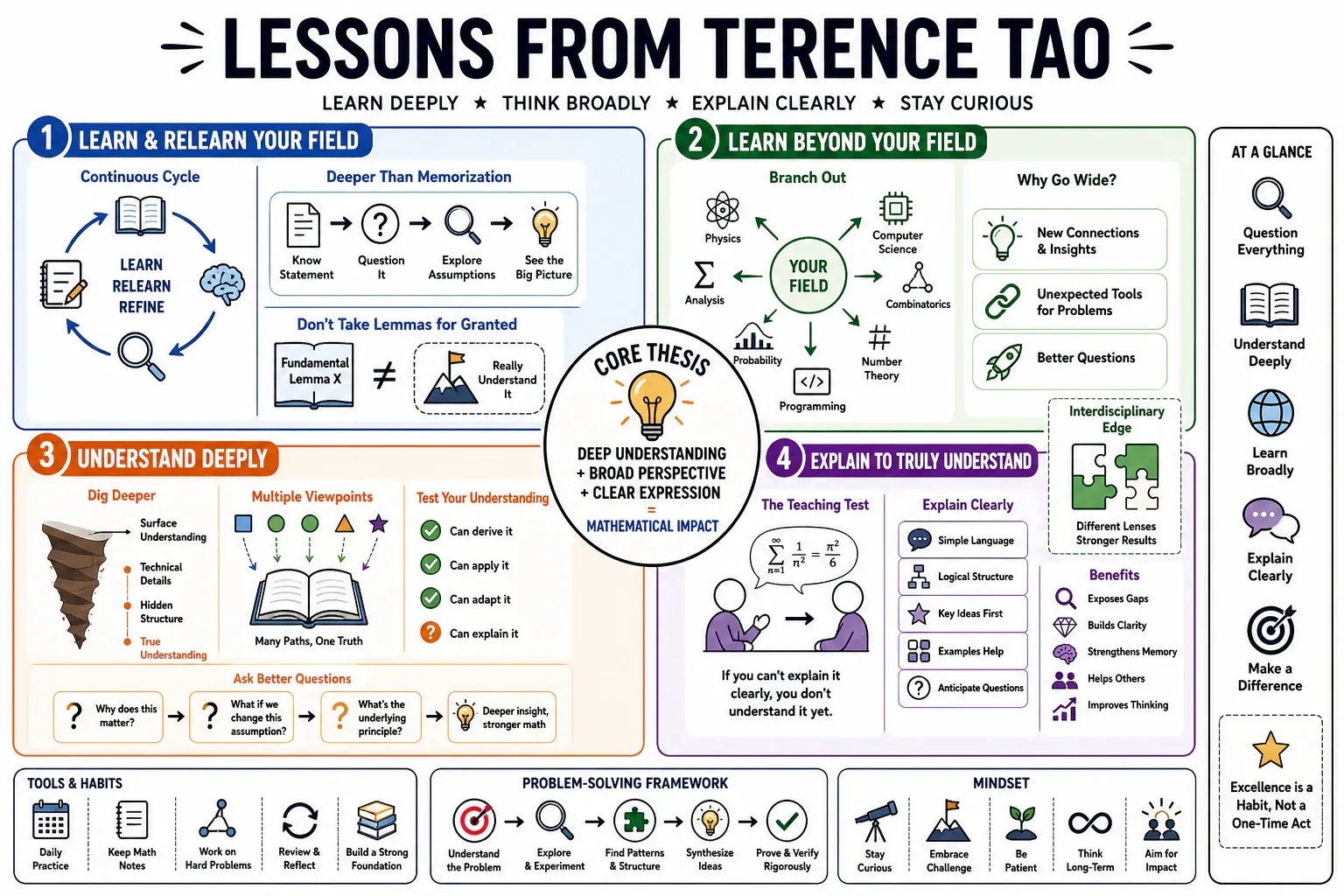
- "Learn and relearn your field, but don't be afraid to learn things outside your field."
Learning: This advice emphasizes the importance of continuous learning, not just within one's specialty but also in broader areas to foster new connections and insights.
Sources: Terence Tao — Learn and relearn your field ↗ [Outside your field] - "Just because you know a statement and proof of Fundamental Lemma X, you shouldn't take that lemma for granted; instead, you should dig deeper until you really understand what the lemma is all about."
Learning: True understanding goes beyond memorization. It involves questioning, exploring alternative proofs, understanding hypotheses, and seeing the bigger picture.
Source: Terence Tao — Learn and relearn your field ↗ - Tao suggests that if you cannot explain a solution to a classmate, that is a sign you may not fully understand it.
Learning: The ability to teach a concept is a powerful test of one's own comprehension. It forces clarity and exposes gaps in understanding.
Source: Terence Tao — Solving mathematical problems. ↗ - "Ask yourself dumb questions – and answer them!"
Learning: Simple or "dumb" questions can often lead to the most profound insights by challenging foundational assumptions and revealing a deeper structure.
Source: Terence Tao — Ask yourself dumb questions—and answer them ↗ - Tao emphasizes that solving problems is an essential part of really learning mathematics.
Learning: Passive learning is insufficient in mathematics. Active problem-solving and engagement are crucial for building genuine understanding.
Source: Terence Tao — Solving mathematical problems. ↗ - "It is particularly useful to lecture on your field, or write lecture notes or other expository material, even if it is just for your own personal use."
Learning: The act of organizing and presenting information for others is a powerful tool for deepening one's own knowledge.
Source: Terence Tao — Learn and relearn your field ↗ - "Don't expect to understand 100% of any given talk, especially if it is in a field you are not familiar with; as long as you learn something, the effort is not wasted."
Learning: Attending talks outside one's immediate area of expertise is valuable for exposure to new ideas, even if comprehension is partial.
Source: Terence Tao — Attend talks and conferences. ↗
On Problem Solving
- Tao compares solving a hard problem to climbing a cliff: tools and speed help, but choosing a good route and seeing the larger picture are essential.
Learning: Break down large, intimidating problems into smaller, manageable steps. Progress is made incrementally.
Source: UCLA Newsroom — Terence Tao, “Mozart of Math,” is first UCLA math professor to win Fields Medal. ↗ - "It can often be profitable to try a technique on a problem even if you know in advance that it cannot possibly solve the problem completely."
Learning: Partial progress is valuable. Applying a technique, even if it fails to provide a full solution, can yield significant insights and pave the way for a complete solution.
Source: Terence Tao — On the importance of partial progress. ↗ - For Tao, problem solving is an important part of mathematics, supported by knowledge, experience, patience, and hard work.
Learning: This quote emphasizes that the core of mathematics lies in the methodology and creative process of problem-solving, not just the final results.
Source: Terence Tao — Solving mathematical problems. ↗ - Tao advises researchers to remain flexible about changing direction and patient through long periods without visible progress.
Learning: Research requires the ability to adapt to unexpected turns and the patience to persevere through long periods without major breakthroughs.
Sources: Terence Tao — Be flexible ↗ [Be patient] - Tao recommends being sceptical of your own work and willing to discard ideas that do not survive scrutiny.
Learning: Critical self-evaluation is essential. It's important to be willing to discard ideas or approaches that are not working.
Sources: Terence Tao — Be sceptical of your own work ↗ [Use the wastebasket] - "What's really interesting are the problems just at the boundary between what we can do relatively easily and what are hopeless."
Learning: The most fruitful problems are often those that are challenging but not impossible, where existing techniques can be pushed to their limits.
Source: Lex Fridman Podcast — Terence Tao transcript ↗ - "By moving the inessential components of a problem, you can focus on what's really going on."
Learning: Abstraction is a key mathematical tool for simplifying problems to their core essence.
Source: MasterClass — Terence Tao’s 5 Tips for Mathematical Problem-Solving. ↗
On Talent, Hard Work, and Genius
- "Talent is important, but how one develops and nurtures it is even more so."
Learning: Innate ability is only one part of the equation. Consistent effort, good habits, and a supportive environment are crucial for realizing one's potential.
Source: Terence Tao — Does one have to be a genius to do maths? ↗ - Tao rejects the idea that mathematical success requires being a genius; he emphasizes hard work, communication, education, and persistence.
Learning: Success in mathematics is more about hard work, persistence, and collaboration than a mythical "genius gene."
Source: Terence Tao — Does one have to be a genius to do maths? ↗ - "Mathematical breakthroughs are not powered solely (or even primarily) by 'Eureka' moments of genius, but are in fact largely a product of hard work."
Learning: The romanticized image of sudden inspiration is misleading. Real progress comes from sustained effort and dedication.
Source: Terence Tao — Work hard ↗ - "Relying on intelligence alone to pull things off at the last minute may work for a while, but, generally speaking, at the graduate level or higher it doesn't."
Learning: Advanced mathematics requires deep, systematic work that cannot be accomplished through last-minute bursts of intelligence.
Source: Terence Tao — Work hard ↗ - Tao says he has no magical ability; he works by comparing a problem with prior experience, trying strategies, and playing with it until he understands what is happening.
Learning: Demystifying his own process, he emphasizes a methodical and playful approach over any supernatural talent.
Source: UCLA Newsroom — Terence Tao, “Mozart of Math,” is first UCLA math professor to win Fields Medal. ↗ - "In some cases, an abundance of raw talent may end up (somewhat perversely) to actually be harmful for one's long-term mathematical development."
Learning: If solutions come too easily, one might not develop the resilience and work ethic needed for more challenging problems later on.
Source: Terence Tao — Does one have to be a genius to do maths? ↗
On Career and Collaboration
- "Don't base career decisions on glamour or fame."
Learning: Choose a path based on genuine interest and enjoyment of the work, rather than external validation or prestige.
Source: Terence Tao — Don’t base career decisions on glamour or fame ↗ - Sustained mathematical work requires both hard work and genuine enjoyment of the subject.
Learning: Intrinsic motivation and enjoyment are key to sustaining the effort required for a successful career in a demanding field.
Sources: Terence Tao — Work hard. ↗ [Enjoy your work] - "Collaboration is very important for me, as it allows me to learn about other fields, and, conversely, to share what I have learned about my own fields with others."
Learning: Collaboration is a powerful way to broaden one's knowledge, gain new perspectives, and make work more enjoyable.
Source: Clay Mathematics Institute — Interview with Research Fellow Terence Tao. ↗ - "Don't prematurely obsess on a single 'big problem' or 'big theory'."
Learning: It's important to build a broad base of knowledge and work on a variety of problems rather than fixating on a single, high-stakes goal too early.
Source: Terence Tao — Don’t prematurely obsess on a single big problem or big theory ↗ - Tao recommends writing down useful arguments and making mathematical work available so it can be recovered, checked, and shared.
Learning: Sharing your work, even in preliminary stages, is crucial for getting feedback and contributing to the mathematical community.
Sources: Terence Tao — Write down what you’ve done ↗ [Make your work available] - "The objective in mathematics is not to obtain the highest ranking... instead, it is to increase understanding of mathematics (both for yourself, and for your colleagues and students)."
Learning: The goal of a mathematical career should be about contribution and understanding, not competition.
Source: Terence Tao — Does one have to be a genius to do maths? ↗
On Mindset and Philosophy
- "I tend to view mathematics as a unified subject and am particularly happy when I get the opportunity to work on a project that involves several fields at once."
Learning: Seeing the interconnectedness of different mathematical areas can lead to novel and powerful results.
Source: Clay Mathematics Institute — Interview with Research Fellow Terence Tao. ↗ - Tao explains that mathematicians can change a problem’s assumptions or rules to expose what truly matters.
Learning: Mathematics offers a unique freedom to explore abstract structures and create new worlds governed by consistent rules.
Source: Lex Fridman Podcast — Terence Tao transcript ↗ - "Ultimately you should follow advice not because someone tells you to, but because it was something that you already knew you should be doing."
Learning: Good advice resonates with one's own intuition and self-awareness.
Source: American Mathematical Society — An Interview with Terence Tao. ↗ - "I think the most important thing for developing an interest in mathematics is to have the ability and the freedom to play with mathematics."
Learning: A playful and experimental approach is essential for fostering a love for mathematics.
Source: Oxford University Press — Interview with Terence Tao. ↗ - "Education is a complex, multifaceted, and painstaking process, and being gifted does not make this less so."
Learning: Giftedness does not provide a shortcut through the challenges of education; it requires careful and nuanced support.
Source: Terence Tao — Advice on gifted education. ↗ - "Infinity absorbs a lot of sins."
Learning: A colloquial way of saying that the concept of infinity can simplify many mathematical problems by abstracting away complexities that arise with finite, bounded quantities.
Source: Lex Fridman Podcast — Terence Tao transcript ↗ - Tao describes science as an interaction between reality, observations of reality, and models of how reality works.
Learning: A concise description of the scientific process, highlighting the interplay between reality, observation, and theoretical modeling.
Source: Lex Fridman Podcast — Terence Tao transcript ↗ - "There is a certain way in which mathematicians approach problems. We abstract them. We break them up into pieces. We make analogies. We try to find connections with other problems."
Learning: A summary of the core strategies of mathematical thinking.
Source: MasterClass — Terence Tao’s 5 Tips for Mathematical Problem-Solving. ↗ - On difficult problems, progress depends partly on recognizing and ruling out techniques that cannot work.
Learning: A significant part of mathematical work involves efficiently discarding unproductive lines of inquiry.
Source: Lex Fridman Podcast — Terence Tao transcript ↗ - "It would be very pleasant if one could just dream up the grand ideas and let some 'lesser mortals' fill in the details, but, trust me, it doesn't work like that at all in mathematics."
Learning: Emphasizing that even the most brilliant ideas in mathematics require rigorous and detailed execution by the originator.
Source: Terence Tao — Work hard ↗ - "I tend to have several things to work on at any given time; when I get stuck on one of them... I write up how far I managed to get, and turn attention to something else."
Learning: A practical strategy for managing frustration and maintaining productivity by rotating between different projects.
Source: American Mathematical Society — An Interview with Terence Tao. ↗ - Tao says that a problem he feels he should be able to solve can continue to gnaw at him.
Learning: Highlighting the internal drive and curiosity that fuels his continuous learning.
Source: UCLA Newsroom — Terence Tao, “Mozart of Math,” is first UCLA math professor to win Fields Medal. ↗ - "It's not just about finding you know taking a technique that is going to work and applying it but you you need to not take the techniques that don't work."
Learning: Efficiency in research comes from experience in recognizing which approaches are likely to be dead ends.
Source: Lex Fridman Podcast — Terence Tao transcript ↗ - "I remember having this vague idea that what mathematicians did was that some authority, someone, gave them problems to solve, and they just sort of solved them."
Learning: Reflecting on the common misconception of what a career in mathematics entails, contrasting it with the reality of self-directed research.
Source: The New York Times — Journeys to the Distant Fields of Prime. ↗
Learn more:
- Terence Tao: Career advice index
- Terence Tao: Learn and relearn your field
- Lex Fridman Podcast: Terence Tao transcript
- Terence Tao: Does one have to be a genius to do maths?
- Terence Tao: Work hard
- MasterClass: Terence Tao’s 5 Tips for Mathematical Problem-Solving
- Clay Mathematics Institute: Interview with Terence Tao