Tim Urban is the writer and illustrator behind Wait But Why and the author of What's Our Problem? A Self-Help Book for Societies. He uses long-form essays, diagrams, and stick figures to make difficult ideas memorable without flattening their complexity. These lessons cover procrastination, planning, independent thought, social approval, political tribalism, media, and the finite shape of a human life.
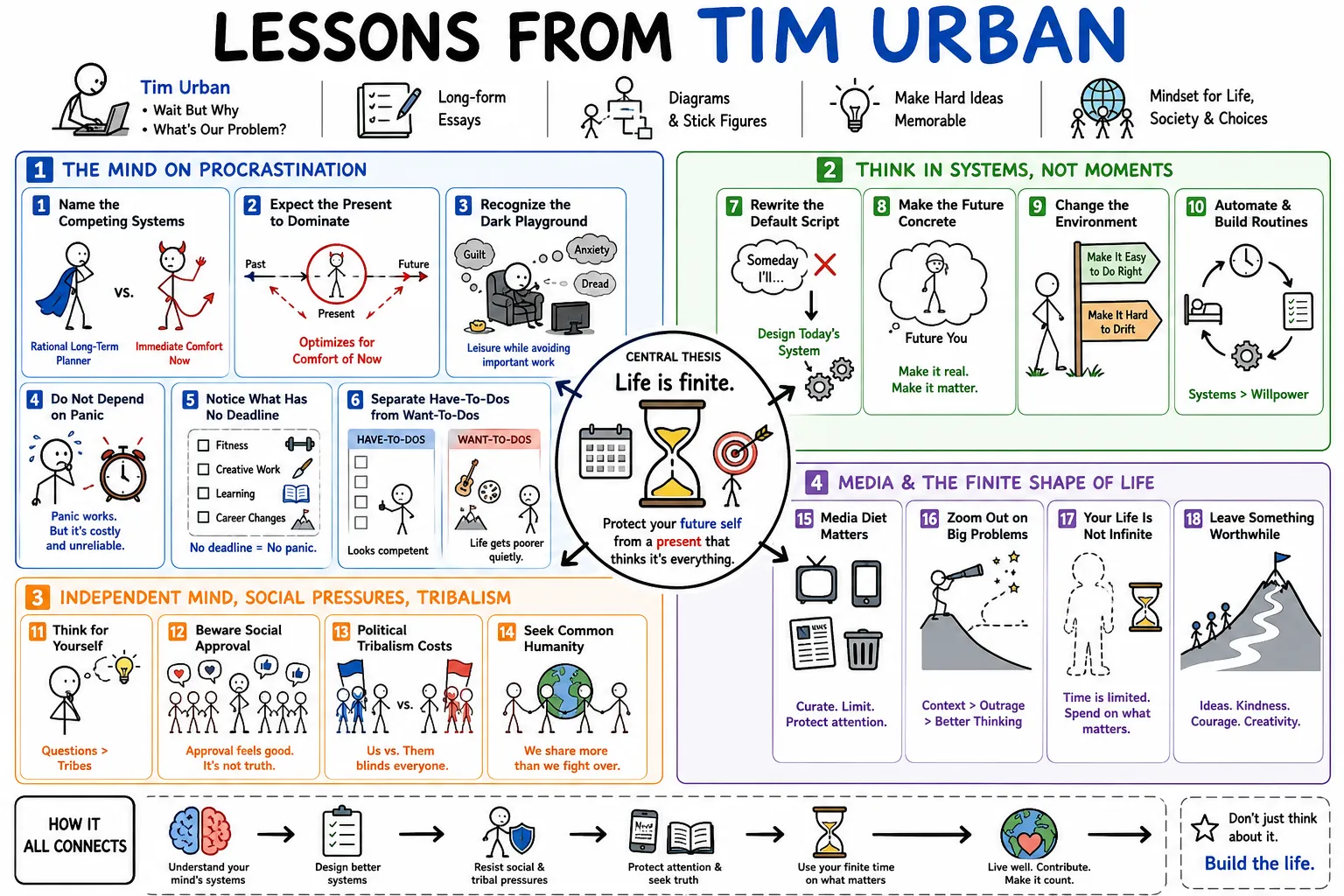
Procrastination and the Mind
- On Name the Competing Systems: Procrastination becomes easier to understand when rational long-term judgment is separated from the impulse that seeks immediate ease and pleasure. — Reference: Wait But Why — Why Procrastinators Procrastinate
- On Expect the Present to Dominate: The immediate-gratification system discounts the past and future and optimizes only for the comfort of the current moment. — Reference: Wait But Why — Why Procrastinators Procrastinate
- On Recognize the Dark Playground: Leisure taken while avoiding important work is contaminated by guilt, anxiety, dread, and the awareness that it has not been earned. — Reference: Wait But Why — Why Procrastinators Procrastinate
- On Do Not Depend on Panic: Deadlines can activate enough fear to force action, but panic is a costly and unreliable operating system. — Reference: Wait But Why — Why Procrastinators Procrastinate
- On Notice What Has No Deadline: Personal goals often remain undone because fitness, creative work, learning, and career changes rarely summon an external panic response. — Reference: Wait But Why — Why Procrastinators Procrastinate
- On Separate Have-To-Dos from Want-To-Dos: A person can appear competent at mandatory work while quietly abandoning the self-directed projects that would make life richer. — Reference: Wait But Why — Why Procrastinators Procrastinate
- On Rewrite the Storyline: Procrastination persists partly because repeated failure hardens into a self-fulfilling identity about what kind of action is possible. — Reference: Wait But Why — How to Beat Procrastination
- On Treat Low Confidence as a Root Cause: Weak attempts at self-control often reflect low confidence built from years of expecting the same defeat. — Reference: Wait But Why — How to Beat Procrastination
Planning, Priorities, and Execution
- On Plan Toward One Winner: A long list is not a plan until rigorous prioritization identifies the first item that matters most. — Reference: Wait But Why — How to Beat Procrastination
- On Protect Importance from Urgency: Urgent but low-value tasks can become a respectable-looking excuse for postponing the work most connected to happiness. — Reference: Wait But Why — How to Beat Procrastination
- On Remove Vagueness Before Starting: A project becomes less aversive when research turns an unclear ambition into a specific sequence with known steps and durations. — Reference: Wait But Why — How to Beat Procrastination
- On Reduce Achievement to Bricks: Large accomplishments are the distant view of many ordinary units of progress completed one after another. — Reference: Wait But Why — How to Beat Procrastination
- On Schedule the Brick: A project becomes executable when its smallest unit of progress occupies a real, protected slot on the calendar. — Reference: Wait But Why — How to Beat Procrastination
- On Win the Critical Entrance: The decisive struggle is often crossing from intention into the first moments of actual work. — Reference: Wait But Why — How to Beat Procrastination
- On Build Earned Leisure: Rest becomes satisfying when it follows meaningful work instead of competing with it. — Reference: Wait But Why — How to Beat Procrastination
- On Do Not Delegate to Future You: The imagined future self has no special discipline; when the future arrives, the same present-day incentives remain. — Reference: Wait But Why — The Procrastination Matrix
Time, Work, and a Finite Life
- On Spend Time in Quadrant Two: Important work without an urgent deadline is where people grow and build the outcomes they are proudest of. — Reference: Wait But Why — The Procrastination Matrix
- On Do Not Mistake Escape for Passion: An activity can feel absorbing mainly because it avoids the important task; moving it into the important category may reveal the illusion. — Reference: Wait But Why — The Procrastination Matrix
- On See Life as a Finite Grid: Representing life in weeks turns an abstract lifespan into a visible and unmistakably limited resource. — Reference: Wait But Why — Your Life in Weeks
- On Treat Weeks as Precious: A lifetime contains only a small personal allotment of weeks, so each one deserves conscious use. — Reference: Wait But Why — Your Life in Weeks
- On Balance Present and Future: A good week can be enjoyable now, improve later weeks, or accomplish both; persistent sacrifice without an endpoint is also a warning sign. — Reference: Wait But Why — Your Life in Weeks
- On Minimize Neither Weeks: Weeks that provide neither present fulfillment nor future value can reveal a misaligned career, relationship, or pattern of avoidance. — Reference: Wait But Why — Your Life in Weeks
- On Reflect Before a Rut Hardens: Continual reflection and self-awareness help expose unconscious patterns before they consume many irreplaceable weeks. — Reference: Wait But Why — Your Life in Weeks
Social Approval and the Authentic Voice
- On See Social Fear as Old Hardware: The need for tribal acceptance once protected survival, but modern life still inherits the fear after its original conditions have changed. — Reference: Wait But Why — Taming the Mammoth
- On Notice the Cost of Approval: Fear of disapproval can redirect careers, relationships, creative risks, and everyday choices away from what a person actually wants. — Reference: Wait But Why — Taming the Mammoth
- On Identify Puppet Masters: A person or group becomes a puppet master when their approval silently controls opinions, moral judgment, or major decisions. — Reference: Wait But Why — Taming the Mammoth
- On Recover the Authentic Voice: The authentic voice develops a nuanced moral code through experience, reflection, compassion, and integrity rather than simple social conformity. — Reference: Wait But Why — Taming the Mammoth
- On Gather Outside Information, Decide Inside: External evidence should inform a decision without replacing the internal responsibility to choose. — Reference: Wait But Why — Taming the Mammoth
- On Find Where Fear Concentrates: The places most associated with shame, embarrassment, and avoidance often reveal where social approval has taken control. — Reference: Wait But Why — Taming the Mammoth
- On Carve Out Sacred Decisions: Life partners, careers, and parenting choices should remain protected domains where authentic judgment outranks social pressure. — Reference: Wait But Why — Taming the Mammoth
Independent Thought and Idea Prisons
- On Test for Changed Minds: A person who cannot name a significant belief they have revised may be protecting an identity instead of investigating reality. — Reference: SOLVED with Mark Manson — Tim Urban Transcript
- On Avoid Noun Prisons: A political label becomes a prison when adopting it requires accepting an entire package of group beliefs. — Reference: SOLVED with Mark Manson — Tim Urban Transcript
- On Keep Ideas Separate from Identity: When beliefs define the self, challenging an idea feels like an attack and independent thought becomes harder. — Reference: SOLVED with Mark Manson — Tim Urban Transcript
- On Run the Other-Team Test: Judge a political action by asking how it would feel if the opposing group did the same thing. — Reference: SOLVED with Mark Manson — Tim Urban Transcript
- On Watch for Sports-Team Reasoning: Partisanship distorts judgment when people excuse a foul by their own side that they would condemn from an opponent. — Reference: SOLVED with Mark Manson — Tim Urban Transcript
- On Make Ideas Work for You: High-rung thinking treats ideas as revisable tools in a search for truth rather than masters that dictate conclusions. — Reference: Jordan Harbinger — Tim Urban on What's Our Problem?
- On Treat Disagreement as Information: A disagreement can signal that another person has evidence worth hearing or simply holds a mistaken model; it need not create an enemy. — Reference: Jordan Harbinger — Tim Urban on What's Our Problem?
Society, Media, and Better Discourse
- On Prefer Idea Labs to Echo Chambers: Healthy cultures let people test competing claims and improve them, while echo chambers reward loyalty to protected conclusions. — Reference: Jordan Harbinger — Tim Urban on What's Our Problem?
- On Separate Decency from Agreement: How respectfully people treat one another should not depend on whether their views match. — Reference: Conversation Culture — Tim Urban's Idea Lab
- On Expect a Dark Valley After New Media: Transformative media can pass from euphoria into social chaos before norms, institutions, and safeguards catch up. — Reference: Jordan Harbinger — Tim Urban on What's Our Problem?
- On Follow the Incentive System: Tribal media often prioritizes clicks and identity reinforcement when accuracy no longer receives the strongest reward. — Reference: Jordan Harbinger — Tim Urban on What's Our Problem?
- On Do Not Blame Only Bad Actors: Destructive information systems can emerge from changed incentives even when no participant sees themselves as malicious. — Reference: Jordan Harbinger — Tim Urban on What's Our Problem?