Venkatesh Rao is a writer and consultant on technology, culture, organizations, and complex systems. His body of work includes the now-archived Ribbonfarm, the active Contraptions newsletter, Tempo, The Gervais Principle, and Breaking Smart. Across those projects, he builds original frameworks for organizational power, technological change, culture, decision-making, and the evolving internet.
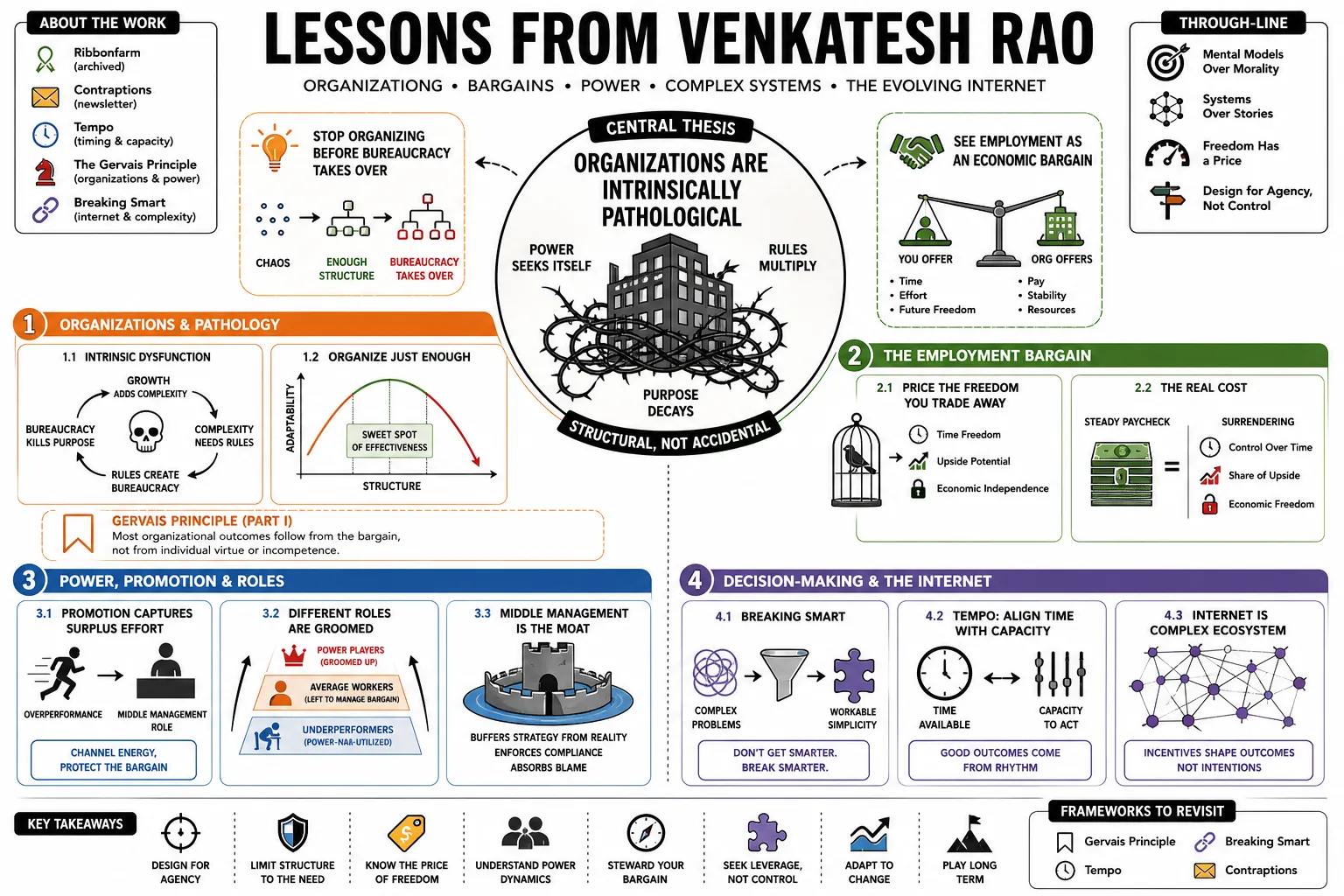
Organizations, Bargains, and Power
- On Organizations Are Intrinsically Pathological: Rao treats organizational dysfunction as structural rather than as an accidental deviation from an otherwise perfect design. — Reference: Ribbonfarm — The Gervais Principle, Part I
- On Stop Organizing Before Bureaucracy Takes Over: The practical aim is to organize only enough to prevent chaos, then leave room for individual agency and adaptation. — Reference: Ribbonfarm — The Gervais Principle, Part I
- On See Employment as an Economic Bargain: Rao's Loser category describes people who exchange long-term economic freedom for short-term stability, not people who are socially unsuccessful. — Reference: Ribbonfarm — The Gervais Principle, Part I
- On Price the Freedom You Trade Away: A steady paycheck can conceal the cost of surrendering control over time, upside, and economic independence. — Reference: Ribbonfarm — The Gervais Principle, Part I
- On Promotion Can Capture Surplus Effort: The Gervais Principle frames promotion into middle management as a way to harness overperformance without changing the underlying bargain. — Reference: Ribbonfarm — The Gervais Principle, Part I
- On Organizations Groom Different Roles: Underperformers who understand power may be groomed upward, while average workers are left to manage their own bargain. — Reference: Ribbonfarm — The Gervais Principle, Part I
- On Middle Management Controls the Reaction: As a company grows, a managerial layer converts explosive founder energy into a controlled organizational process. — Reference: Ribbonfarm — The Gervais Principle, Part I
- On Expect Lifecycle Decay: When value reaches diminishing returns and informed actors exit, the remaining organization can harden into a brittle shell. — Reference: Ribbonfarm — The Gervais Principle, Part I
- On Creative Destruction Happens Above the Firm: Job changes, acquisitions, layoffs, reorganizations, and startup formation create a Darwinian environment across organizations even when individual firms become rigid. — Reference: Ribbonfarm — The Gervais Principle, Part I
- On Learn the Four Organizational Languages: Working an organization requires recognizing Posturetalk, Powertalk, Babytalk, and Gametalk, not merely understanding its formal chart. — Reference: Ribbonfarm — The Gervais Principle, Part II
- On Powertalk Changes the Balance: Powertalk is the in-group language of actors who recognize power and negotiate it directly. — Reference: Ribbonfarm — The Gervais Principle, Part II
- On Posturetalk Performs the Official Story: Posturetalk is used by people who treat the organization's stated narratives as the shared reality. — Reference: Ribbonfarm — The Gervais Principle, Part II
- On Babytalk Maintains the Performance: Others may answer official narratives in a language designed to sound compliant to those who believe them. — Reference: Ribbonfarm — The Gervais Principle, Part II
- On Gametalk Lives Among Peers: Workers with similar bargains develop an in-group language for the interpersonal games surrounding organizational life. — Reference: Ribbonfarm — The Gervais Principle, Part II
- On Consequential Speech Moves Power: What distinguishes power-aware communication is that each exchange can shift the relationship between the speakers. — Reference: Ribbonfarm — The Gervais Principle, Part II
Development, Strengths, and Adaptation
- On Strengths Can Arrest Development: Growth can stall around an early strength when a person keeps repeating what already earns recognition. — Reference: Ribbonfarm — The Gervais Principle, Part III
- On Watch for Strength-Based Addiction: A strength becomes limiting when the surrounding reward system turns it into an identity that must be defended. — Reference: Ribbonfarm — The Gervais Principle, Part III
- On Mediocrity Can Preserve Range: People without an extreme talent or weakness may develop faster because fewer rewards lock them into one narrow pattern. — Reference: Ribbonfarm — The Gervais Principle, Part III
- On Social Rewards Can Freeze a Persona: Overperformance may be sustained by an environment that rewards one strength so reliably that further development becomes threatening. — Reference: Ribbonfarm — The Gervais Principle, Part III
- On Use Mediocrity as Protection from Addiction: Being merely adequate can leave a person freer to continue learning than being celebrated for a single defining gift. — Reference: Ribbonfarm — The Gervais Principle, Part III
Culture and Premium Mediocrity
- On Notice Superfluous Premium Features: Premium mediocrity adds decorative signals of status without materially improving the underlying experience. — Reference: Ribbonfarm — The Premium Mediocre Life of Maya Millennial
- On Separate Display from Experience: A product may be optimized to look impressive in public while tasting or working no better in private. — Reference: Ribbonfarm — The Premium Mediocre Life of Maya Millennial
- On Look for the Irrelevant Upgrade: The signature move is a cheap peripheral enhancement attached to an essentially ordinary core. — Reference: Ribbonfarm — The Premium Mediocre Life of Maya Millennial
- On Consumers Often Know the Game: The buyer can recognize that an offering is mediocre at its core and still choose it for the small premium signal around the edges. — Reference: Ribbonfarm — The Premium Mediocre Life of Maya Millennial
- On See Premium Mediocrity as Transitional: Rao reads the phenomenon as a cultural bridge between exhausted industrial modernity and an immature digital abundance. — Reference: Ribbonfarm — The Premium Mediocre Life of Maya Millennial
The Dead Forest and the Changing Internet
- On Silence Can Dissolve a Public: A public sphere loses coherence when enough meaningful conversation moves into private, causally disconnected spaces. — Reference: Contraptions — Dead Forest Theory
- On Do Not Blame AI for an Earlier Collapse: AI arrived after the living public internet had already begun fragmenting and is inheriting that transition rather than causing it. — Reference: Contraptions — Dead Forest Theory
- On Visibility Is Not Public Life: Online attention can continue circulating even after the medium stops creating common knowledge among strangers. — Reference: Contraptions — Dead Forest Theory
- On Zombie Publics Radiate Outward: Highly visible publics can possess little interior depth because they are optimized for outward performance rather than inward development. — Reference: Contraptions — Dead Forest Theory
- On AI Recycles the Fossil Public: Language models draw their ambient intelligence from the archived residue of conversations that have since moved beyond public reach. — Reference: Contraptions — Dead Forest Theory
- On The Archive Can Become Terminal: As both archival and carnival modes wind down, the inherited internet risks becoming a static record rather than a living public sphere. — Reference: Contraptions — Dead Forest Theory
Cognitive Farmsteading and Living Text
- On Expect Ideas to Be Precommodified: Shared AI systems can lead many people to the same insight at once, erasing the old advantage of being first to name a trend. — Reference: Contraptions — Cognitive Farmsteading
- On The Gradient for Ideas Can Disappear: When discovery becomes simultaneous, ideas no longer flow predictably from a small center toward a broader periphery. — Reference: Contraptions — Cognitive Farmsteading
- On AI Enables Intellectual Rural Domesticity: AI can support productive intellectual life outside the dense social infrastructure that historically made cities the center of thought. — Reference: Contraptions — Cognitive Farmsteading
- On Urban Thought Trades Originality for Leverage: Dense intellectual milieus create collaborative energy but can extract a price in independence and originality. — Reference: Contraptions — Cognitive Farmsteading
- On Rebuild Human Collaboration Around AI: As more production happens with AI, the remaining human relationships in an intellectual life will be fewer, different, and increasingly AI-mediated. — Reference: Contraptions — Cognitive Farmsteading
- On Generated Text's Message Is Liveness: Rao argues that the defining property of generated language is its potential to behave as a live medium. — Reference: Contraptions — Writing Liveness
- On Words Can Embody Agency: Generated language introduces the possibility that text can act rather than remain a passive record of a past authorial act. — Reference: Contraptions — Writing Liveness
- On Living Text Responds: Text becomes live when it can reshape or regenerate itself in response to its environment and the reader's actions. — Reference: Contraptions — Writing Liveness
- On Use Frameworks as Coworking Spaces: A framework can be more useful as a shared place for thinking together than as a rigid theory demanding assent. — Reference: Contraptions — The World Machines Project
- On Let Projects Become Collaborative: A loose reading framework can turn into a collective project when participants use it to generate and connect their own interpretations. — Reference: Contraptions — The World Machines Project
Coordination, Sovereignty, and Strategic Capacity
- On Differentiate Coordination: Coordination should expand where it creates new surplus, deepen where strategic capacity matters, and remain global only where indispensability justifies it. — Reference: Contraptions — A Tale of Two Theories of Coordination
- On Reject the Globalism-or-Autarky Binary: Rao expects neither frictionless globalism nor total self-sufficiency, but a layered architecture between the two. — Reference: Contraptions — A Tale of Two Theories of Coordination
- On Build Thick Sovereignty: Strategic resilience requires domestic depth in critical systems while retaining a thinner shared global foundation. — Reference: Contraptions — A Tale of Two Theories of Coordination
- On Preserve Irreversible Shared Systems: Global systems should remain where dismantling them would destroy more value than localization could create. — Reference: Contraptions — A Tale of Two Theories of Coordination
- On Coordinate Intelligently, Not Maximally: The winning architecture is not the one that coordinates the most activity, but the one that matches each layer to the right scale and purpose. — Reference: Contraptions — A Tale of Two Theories of Coordination