William B. Irvine is an author and emeritus professor of philosophy at Wright State University, recognized for his role in the modern resurgence of Stoicism. His books include A Guide to the Good Life, The Stoic Challenge, and the 2026 How to Think More and Better. Across those projects and his recent essays, Irvine treats philosophy as a practical discipline for managing desire, adversity, belief, and attention.
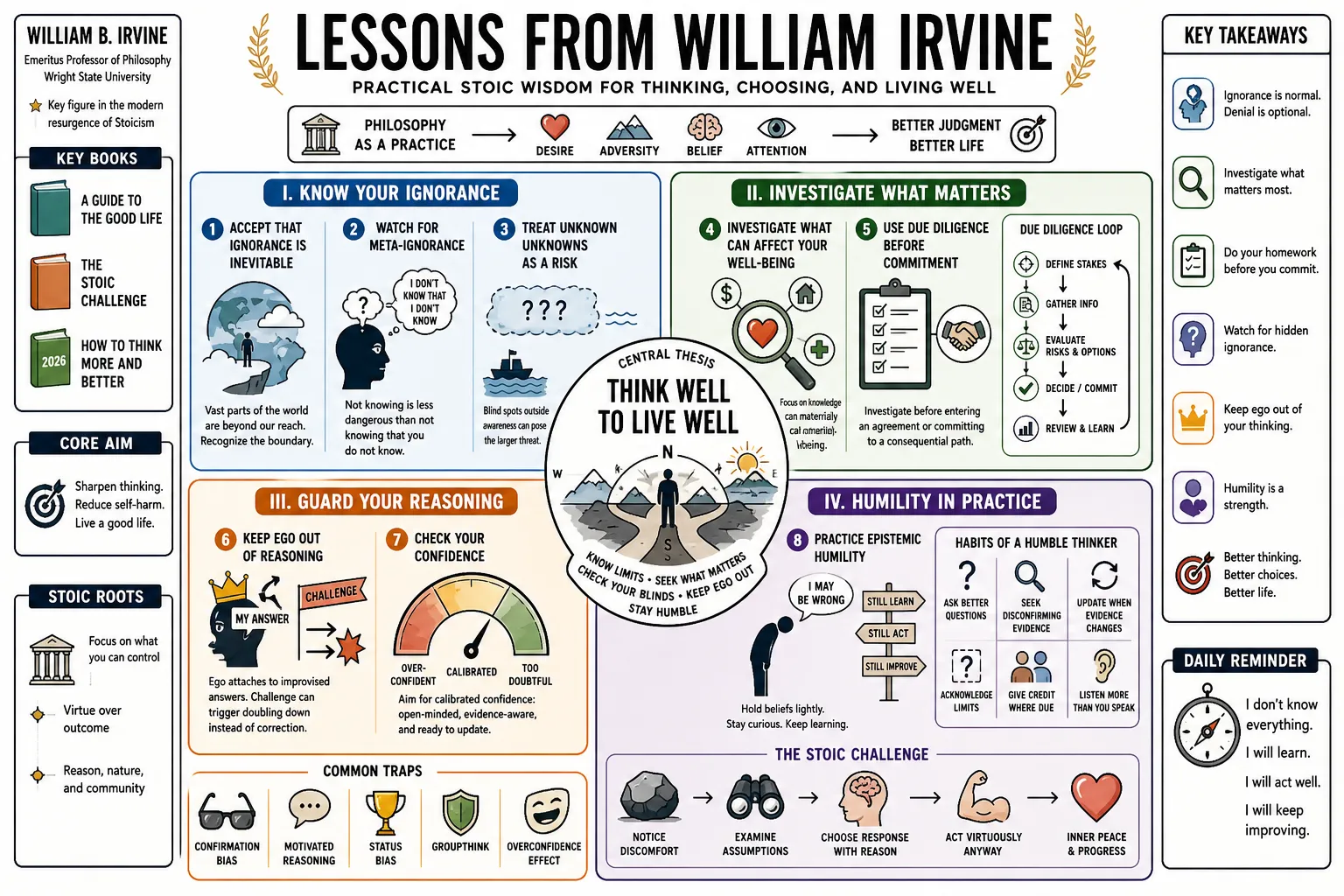
Thinking, Ignorance, and Better Decisions
- On Accept That Ignorance Is Inevitable: Limited mental capacity means everyone is ignorant about vast parts of the world; the important question is whether we recognize the boundary. — Reference: William B. Irvine — Stupidity, Reconsidered
- On Investigate What Can Affect Your Well-Being: Remaining ignorant is most costly when the missing knowledge can materially affect your well-being and is available with reasonable effort. — Reference: William B. Irvine — Stupidity, Reconsidered
- On Use Due Diligence Before Commitment: A careful thinker investigates before entering an agreement or committing to a consequential course of action. — Reference: William B. Irvine — Stupidity, Reconsidered
- On Watch for Meta-Ignorance: Not knowing is less dangerous than not knowing that you do not know, because hidden ignorance can masquerade as confidence. — Reference: William B. Irvine — Stupidity, Reconsidered
- On Treat Unknown Unknowns as a Risk: The blind spots outside our awareness can pose a larger threat than the questions we already know we cannot answer. — Reference: William B. Irvine — Stupidity, Reconsidered
- On Keep Ego Out of Reasoning: When ego becomes attached to an improvised answer, challenge can trigger doubling down instead of correction. — Reference: William B. Irvine — Stupidity, Reconsidered
- On Practice Epistemic Humility: Admitting ignorance demonstrates awareness of the limits of knowledge and can improve later decisions. — Reference: William B. Irvine — Stupidity, Reconsidered
- On Define Stupidity by Resistance to Correction: The deepest intellectual failure is not holding a mistaken belief but entering a state in which you are unlikely ever to identify and remove it. — Reference: William B. Irvine — Stupidity, Reconsidered
- On Choose What and How to Think: Better thinkers are distinguished less by the volume of mental activity than by their chosen subjects and their method of inquiry. — Reference: William B. Irvine — Are You Guilty of Overthinking?
- On Learn Before Drawing Conclusions: A thinking practice should combine learning about the world with drawing conclusions from what has actually been learned. — Reference: William B. Irvine — Are You Guilty of Overthinking?
- On Map Options and Trade-Offs: Before a decision, research the available options and identify the advantages and disadvantages of each. — Reference: William B. Irvine — Are You Guilty of Overthinking?
- On Seek the Optimal, Not the Perfect: A sound decision may select a bad option when every alternative is worse; perfection is not the relevant standard. — Reference: William B. Irvine — Are You Guilty of Overthinking?
- On Exercise Focused Thinking: Deliberate mental exercise makes concentrated reasoning easier and can turn decision-making into a source of satisfaction. — Reference: William B. Irvine — Are You Guilty of Overthinking?
Mindcare and Belief Maintenance
- On Form Beliefs Through Open-Minded Criticism: A Thinker habitually uses open-minded critical thinking rather than feeling a way toward a conclusion. — Reference: William B. Irvine — How to Stress Test Beliefs With AI
- On Prefer Evidence-Based Reasoning: The goal is to rely on evidence when forming conclusions and to fill the mind with beliefs that are both true and useful. — Reference: William B. Irvine — How to Stress Test Beliefs With AI
- On Build a Three-Part Mind Program: Intellectual maintenance combines mindcare to reduce incoming misinformation, mindcleaning to remove false beliefs, and mind expansion to find useful truths. — Reference: William B. Irvine — How to Stress Test Beliefs With AI
- On Avoid Cognitive Spas: Be selective about information sources and avoid environments designed mainly to confirm what you already believe. — Reference: William B. Irvine — How to Stress Test Beliefs With AI
- On Remove Misinformation That Slips Through: No information filter is perfect, so a mindcleaning regimen must search for misinformation that passed earlier defenses. — Reference: William B. Irvine — How to Stress Test Beliefs With AI
- On Expand Toward True and Useful Beliefs: Intellectual growth requires exploring the world for additional beliefs that improve both accuracy and usefulness. — Reference: William B. Irvine — How to Stress Test Beliefs With AI
- On Stress-Test with a Thoughtful Dissenter: Test a belief by finding a well-informed person who rejects it and can articulate the contrary case. — Reference: William B. Irvine — How to Stress Test Beliefs With AI
- On Listen Instead of Debating: The purpose of a belief stress test is to understand the opposing argument, not to win an exchange. — Reference: William B. Irvine — How to Stress Test Beliefs With AI
- On Welcome Reduced Confidence: A successful stress test may produce a more nuanced belief and lower confidence, which counts as intellectual progress rather than defeat. — Reference: William B. Irvine — How to Stress Test Beliefs With AI
- On Ask AI to Challenge Your View: When using AI for a belief audit, prompt it to make the strongest case against your position rather than turning it into a confirmation engine. — Reference: William B. Irvine — How to Stress Test Beliefs With AI
- On Do Not Substitute Social-Media Combat: Public debates often make people talk past one another and harden repeated claims into personal dogma. — Reference: William B. Irvine — How to Stress Test Beliefs With AI
- On Clean a Small Portion at a Time: Because the total belief set is enormous, focus each mindcleaning effort on a narrow domain rather than attempting a complete overhaul. — Reference: William B. Irvine — Time for Some Mindcleaning?
- On Seek Sources That Challenge You: A belief audit should deliberately counter the tendency to consume confirming sources while avoiding disconfirming ones. — Reference: William B. Irvine — Time for Some Mindcleaning?
- On Allow Five Legitimate Outcomes: After a stress test, you may keep a belief, lower confidence, refine it, replace it, or abandon it; ego protection is not the objective. — Reference: William B. Irvine — Time for Some Mindcleaning?
Practicing Stoicism in Daily Life
- On Prevent Negative Emotions Where Possible: Stoic practice begins by reducing the judgments and habits that cause destructive emotions to arise. — Reference: Daily Stoic — Interview with William B. Irvine
- On Study Emotional Episodes Afterward: When a negative emotion does arise, use Stoic advice in the moment and later examine the episode to reduce recurrence. — Reference: Daily Stoic — Interview with William B. Irvine
- On Embrace Positive Emotion: Stoicism is not emotional numbness; its practice makes room for delight and joy while limiting destructive emotion. — Reference: Daily Stoic — Interview with William B. Irvine
- On Use Negative Visualization to Notice Delight: Contemplating the possible loss of ordinary things can renew appreciation and create small moments of joy during a normal day. — Reference: Daily Stoic — Interview with William B. Irvine
- On Expect Practice to Drift: Stoicism requires ongoing attention because improvement in one area can coincide with neglect in another. — Reference: Daily Stoic — Interview with William B. Irvine
- On Use Marcus Aurelius for Difficult People: Irvine turns to Marcus Aurelius when prolonged contact with irritating people threatens composure. — Reference: Daily Stoic — Interview with William B. Irvine
- On Use Epictetus for Decisions: Important decisions become clearer when you separate what is under your control from what is not. — Reference: Daily Stoic — Interview with William B. Irvine
- On Use Musonius Rufus Against Consumer Lust: Desire for consumer goods can be put in perspective by recalling how little is necessary for a workable life. — Reference: Daily Stoic — Interview with William B. Irvine
- On Use Seneca Against Self-Pity: When self-pity appears, widen the comparison set and remember that circumstances could be much worse. — Reference: Daily Stoic — Interview with William B. Irvine
- On Keep the Psychological Insights Central: Irvine values Stoicism most for its practical understanding of human psychology rather than for historical ornament. — Reference: Modern Stoicism — Interview with William Irvine
- On Trust Techniques That Match Human Nature: Stoic techniques remain relevant because basic human psychology has changed far less than the surrounding technology and institutions. — Reference: Modern Stoicism — Interview with William Irvine
Joy, Equanimity, and Resilience
- On Notice Small Delights: Stoic practice can increase appreciation for the ordinary world and make small sources of delight easier to notice. — Reference: Modern Stoicism — Interview with William Irvine
- On Work with What Is Available: In a difficult predicament, act with the resources, position, and agency you actually possess. — Reference: Modern Stoicism — Interview with William Irvine
- On Treat Happiness as a Byproduct: Happiness is more likely to appear as the result of an equanimous day than as the direct product of chasing happiness itself. — Reference: The Creative Process — William Irvine Interview
- On Value What You Already Have: Equanimity grows when negative emotions are quiet and attention rests on existing possessions, relationships, and bodily well-being. — Reference: The Creative Process — William Irvine Interview
- On Reject the Emotionless Caricature: The dictionary image of a glum person suppressing every emotion misrepresents the practical aim of Stoicism. — Reference: The Creative Process — William Irvine Interview
- On Retain Equanimity Through Setbacks: Stoic strategies are designed to preserve balance when life presents setbacks, challenges, and tests. — Reference: The Creative Process — William Irvine Interview
- On Test-Drive the Philosophy: Stoicism has a low cost of entry: learn a few strategies, try them in real life, and observe whether they improve your response. — Reference: The Creative Process — William Irvine Interview
- On Use Stoicism for Creative Setbacks: Irvine applies Stoicism to uncooperative tools, writing that does not cohere, and the frustrations of publication. — Reference: Modern Stoicism — Interview with William Irvine
- On Treat Philosophy as Outreach Teaching: Irvine uses books to carry philosophical teaching beyond the classroom to a broad non-academic audience. — Reference: Modern Stoicism — Interview with William Irvine