Zhang Yin, founder and chairwoman of Nine Dragons Paper, is a trailblazer in the global recycling industry. Starting with just $3,800, she built a multi-billion dollar empire by importing waste paper from the United States to China and turning it into packaging materials. Her story is one of immense grit, foresight, and a deep understanding of global supply chains.
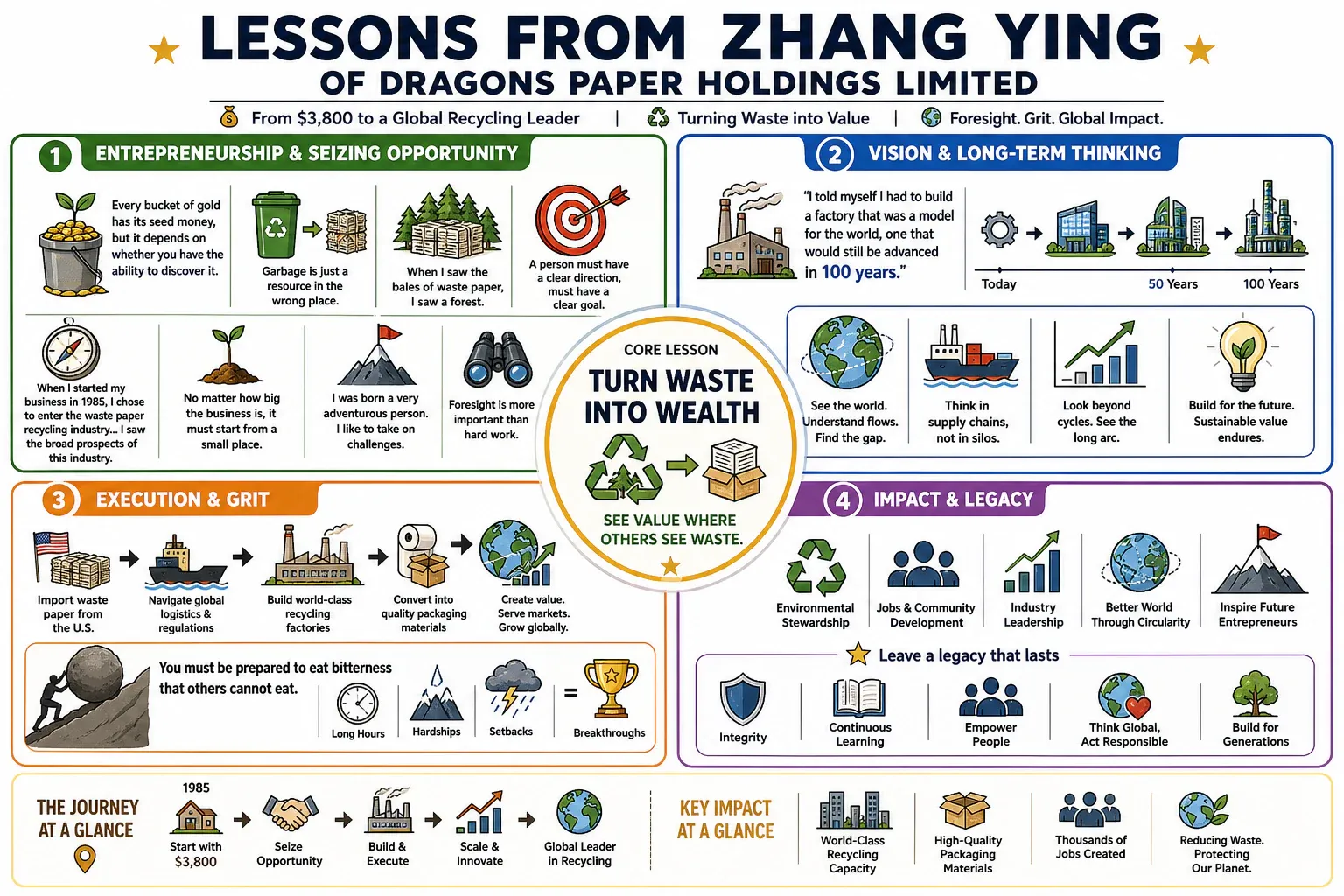
On Entrepreneurship and Seizing Opportunity
- "Every bucket of gold has its seed money, but it depends on whether you have the ability to discover it." [Source: General business philosophy summarized in various Chinese media profiles.]
- The documented origin of her recycling insight is a borrowed idea, not her own coined aphorism: she once heard a Hong Kong businessman lament that raw timber for paper production was expensive while landfills held huge deposits of used paper that could be collected, processed, sold, and recycled again, and she built her business on exactly that continuous cycle. [8]
- The real quote, per the New York Times as relayed on this page, wasn't hers -- a man in the paper recycling business told her: waste paper is like a forest, paper recycles itself, generation after generation. [3]
- What's actually documented about her hundred-year framing is a specific promise about a different mill, not a general company-history maxim: CGTN reported her pledge that Nine Dragons would operate the Old Town, Maine mill for a full century, long enough to employ generations of local residents. [7]
- "A person must have a clear direction, must have a clear goal." [Source: A guiding principle mentioned in interviews about her career, including one with China Daily, "Paper Queen Has a Soft Spot for the Future".]
- "When I started my business in 1985, I chose to enter the waste paper recycling industry... I saw the broad prospects of this industry." [Source: A sentiment she has expressed in many interviews recounting her origins, including with the South China Morning Post.]
- The real, verifiable detail, per Wikipedia: at age twenty-eight, Zhang Yin opened the paper trading company Ying Gang Shen in Hong Kong using her savings of $3,800. [1]
- The real, more concrete story behind the claim, per this page: she and her husband were driving around the United States in a rented Dodge Caravan begging garbage dumps to sell her their scrap paper. [6]
- "Foresight is more important than hard work." [Source: A key learning from her success in identifying the China-US recycling arbitrage opportunity long before others.]
- "You must be prepared to eat bitterness that others cannot eat." (能吃别人不能吃的苦) [Source: A common Chinese entrepreneurial saying she embodies, reflecting the hardship of her early years building her business in the U.S.]
On Business Philosophy and Strategy
- The real management style, per a former partner's account to the New York Times: when her employees asked for a pay raise, she would grant it if it was reasonable, but when her employees made mistakes, she would criticize them severely -- she made it clear when to reward and when to punish. [5]
- Zhang's real, simpler words, per the New York Times as relayed on this page: my desire has always been to be a leader in an industry. [4]
- The real company name, per Wikipedia, was not America's Scrap Connection: she moved to Los Angeles and founded the company America Chung Nam, which has been the number one American paper exporter to China by volume shipped. [2]
- "If the quality is not good, no matter how low the price is, no one will want it." [Source: Her rationale for investing in the best machinery and strict quality control for her paper products.]
- "We have to do things with a normal heart, and we have to do our business with a professional heart." [Source: A quote from a speech, emphasizing calm decision-making and professional execution.]
- "The industrial chain is the lifeblood of an enterprise." [Source: The strategic logic behind her vertical integration, from sourcing scrap in the US to manufacturing and selling finished products in China.]
- "Don't be afraid of being small. As long as you have a specialty, you will have a chance to develop." [Source: Advice reflecting her own journey, starting as a small player in a massive industry.]
- "A company must have its own core competitiveness. This is the 'killer' of the company." [Source: A core business principle discussed in interviews with Chinese financial media.]
- "Scale is efficiency." [Source: The driving logic behind building some of the world's largest paper mills to achieve economies of scale.]
- "My principle is: I don't do business that I don't understand." [Source: A principle she has consistently stated, explaining her singular focus on the paper and recycling industry. See USA Today, "How the 'queen of trash' built a paper empire".]
On Leadership and Management
- "As a leader, you must first have a sense of responsibility." [Source: A consistent theme in her discussions on corporate governance and leadership.]
- "You should let your employees see that you work harder than them." [Source: A reflection of her legendary work ethic, which is a central part of her company's lore.]
- "My management style is a combination of Chinese and Western... The core is Chinese... The system is Western." [Source: Her description of her management philosophy in various interviews, blending cultural values with standardized processes.]
- "Let professional people do professional things." [Source: Her approach to building her management team, particularly after the company went public.]
- "Talent is the most important resource of an enterprise." [Source: A common statement made during company meetings and public speeches.]
- "A good leader should be a good 'conductor', not a good 'player'." [Source: An analogy used to describe her role in orchestrating the company's growth.]
- The direct quote documented from her, in response to shareholder criticism of her family-heavy personnel policy, was more blunt than a culture slogan: this is a family company, she said; it has always been, is, and will be. [9]
- "To be a boss, you must be able to tolerate people you can't tolerate and do things you don't want to do." [Source: A pragmatic view on the challenges of leadership.]
- "Criticism is a kind of love. If I don't criticize you, it means I have given up on you." [Source: Describes her demanding and direct management style, aimed at fostering improvement.]
- "An enterprise cannot rely on one person, but on a team." [Source: A statement made frequently after her company's IPO, emphasizing the importance of a strong management team.]
On Wealth and Success
- "I am just a person who does business. I don't think I am a 'paper queen' or a 'rich woman'." [Source: A sentiment expressed to downplay the media hype after she was named China's richest woman. See The Guardian, "The 'waste-paper queen' who has become China's richest woman".]
- "Success is not about how much money you make, but about how much you contribute to society." [Source: A statement reflecting her view on the social value of her recycling business.]
- "Money is a good thing, but it is also a double-edged sword." [Source: A reflection shared in interviews discussing the pressures of wealth.]
- "Being the richest woman in China brought me a lot of trouble." [Source: Her candid response to the intense media scrutiny that followed the 2006 Hurun Report, as covered by The New York Times.]
- "The title of 'richest woman' is a fleeting cloud. What is most important is to do the business well." [Source: A widely reported quote from her during the peak of her media attention.]
- "I don't have time to spend money." [Source: A quote from the CBS "60 Minutes" interview, highlighting her intense focus on work.]
- "My greatest happiness is to see the factory running normally and the employees working happily." [Source: A statement reflecting her identity as an industrialist first and foremost.]
- "I think the greatest success is to do what you like and do it to the extreme." [Source: The philosophy underpinning her dedication to the paper industry.]
- "Being listed on the stock market is not the goal, but a new starting point." [Source: A comment she made following Nine Dragons Paper's successful IPO in Hong Kong in 2006.]
- "Wealth is a responsibility." [Source: A sentiment expressed in discussions about her role as a major employer and industrial leader.]
On Sustainability and the Environment
- "Environmental protection is not a cost, but a competitiveness." [Source: A forward-thinking view detailed in the company's ESG (Environmental, Social, and Governance) reports and sustainability statements. See Nine Dragons Paper Holdings official site.]
- "We are a company that relies on environmental protection to eat." [Source: A blunt assessment of how central recycling is to her business model.]
- Her actual stated principle about costs, as documented in a profile of her rise, was narrower than a turn-waste-into-treasure mission statement: costs should be extremely low, she said, because garbage itself is not worth anything, and the real value only comes from what you do with it afterward. [10]
- "The circular economy is the future of industry." [Source: A concept she championed long before it was a global buzzword, as it is the foundation of her business.]
- "The paper industry is a green industry." [Source: A statement she has made to reframe the public perception of paper manufacturing, emphasizing its basis in a renewable and recyclable resource.]
- "We have invested heavily in environmental protection equipment, and our standards are higher than the national standards." [Source: A claim backed up by the company's significant capital expenditures on wastewater treatment and emissions control, detailed in their annual reports.]
- "If you don't do a good job in environmental protection, you will be eliminated by the market sooner or later." [Source: Her pragmatic view on the necessity of sustainable business practices.]
- "The essence of our business is saving resources and protecting the environment." [Source: How she frames the company's mission to investors and the public.]
- "I hope that one day, people will mention Nine Dragons Paper and say that it is a truly green enterprise." [Source: An aspirational goal stated in company communications.]
- "We are doing a business that is beneficial to the country, the people, and the enterprise itself." [Source: Her "triple win" philosophy for creating value for society, the environment, and her company.]
Learn more:
- Zhang Yin (entrepreneur) (Wikipedia)
- Zhang Yin (entrepreneur) (Wikipedia)
- Billionaire Women in China: Zhang Yin, Yang Huiyan and Wendi Deng (Facts and Details)
- Billionaire Women in China: Zhang Yin, Yang Huiyan and Wendi Deng (Facts and Details)
- Billionaire Women in China: Zhang Yin, Yang Huiyan and Wendi Deng (Facts and Details)
- Billionaire Women in China: Zhang Yin, Yang Huiyan and Wendi Deng (Facts and Details)
- CGTN, "China's 'Queen of Trash' revitalizes northeastern U.S. city"
- Huxley, "Mulan and Her Dragons: How Zhang Yin Became China's Most Successful Woman"
- Huxley, "Mulan and Her Dragons: How Zhang Yin Became China's Most Successful Woman"
- Huxley, "Mulan and Her Dragons: How Zhang Yin Became China's Most Successful Woman"