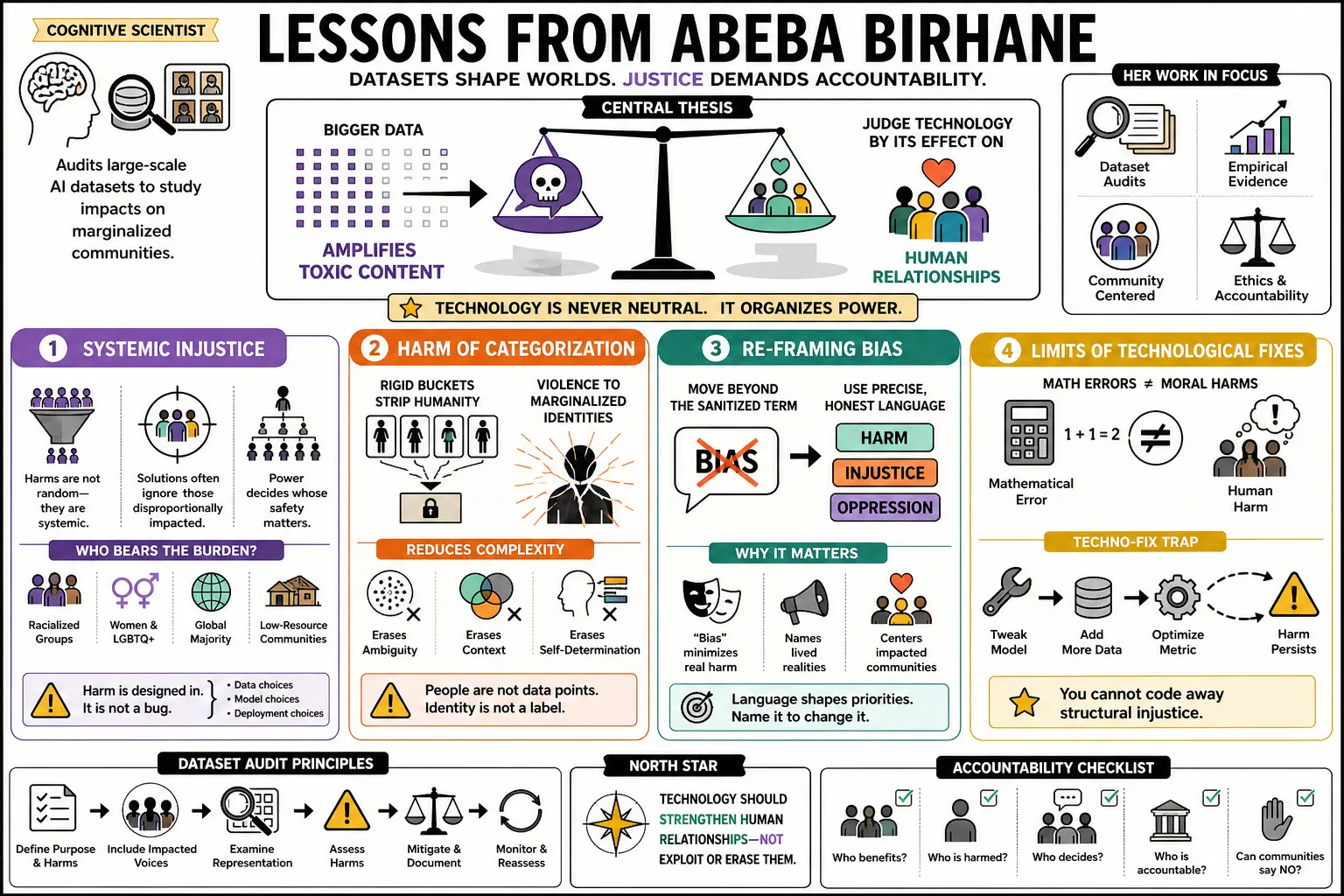
Lessons from Abeba Birhane
Abeba Birhane is a cognitive scientist whose research examines algorithmic injustice, relational ethics, embodied cognition, and the harms embedded in large AI datasets. Her work combines direct dataset audits with a broader argument: AI systems must be judged in their social and historical context, especially by their effects on communities that bear disproportionate risks. — Algorithmic Injustices — Towards a Relational Ethics.
Part 1: Algorithmic Injustice and Harms
- Systemic Injustice Requires More Than Technical Fixes: Responses to algorithmic harm often default to technical remedies while failing to center the communities that bear disproportionate consequences. — Algorithmic Injustices — Towards a Relational Ethics.
- Human Categories Are Moral Choices: Turning people into fixed machine-readable categories is not a neutral act; categories encode values and can erase ambiguity that matters in social life. — Algorithmic Injustices — Towards a Relational Ethics.
- Name the Harm Precisely: Treating injustice only as statistical “bias” can obscure the historical and structural conditions that produce algorithmic harm. — Algorithmic Injustices — Towards a Relational Ethics.
- Technical Fixes Cannot Resolve Structural Harm: Mathematical adjustments alone cannot repair algorithmic harms that arise from social institutions, historical inequities, and unequal power. — Algorithmic Injustices — Towards a Relational Ethics.
- Harms Are Distributed Unequally: Algorithmic systems can disproportionately burden marginalized communities, so impact must be evaluated from the position of those most affected. — Algorithmic Injustices — Towards a Relational Ethics.
- Center Affected Communities in AI Ethics: A relational approach to AI ethics begins with the people who bear the consequences rather than treating abstract technical performance as the only measure. — Algorithmic Injustices — Towards a Relational Ethics.
- Context Exceeds the Dataset: Quantitative representations cannot capture the full social and historical context in which people experience algorithmic decisions. — Automating Ambiguity.
- Prediction Can Reproduce Historical Injustice: Predictive systems trained on institutional data can carry past inequities into future decisions while presenting the result as technical judgment. — Algorithmic Injustices — Towards a Relational Ethics.
- Algorithmic Harm Is Structural: Algorithmic injustice is often continuous with longstanding social and historical power asymmetries rather than an isolated software failure. — Algorithmic Injustices — Towards a Relational Ethics.
- Fairness Metrics Have Boundaries: A fairness score cannot by itself determine whether the underlying system, categories, or social purpose are just. — Algorithmic Injustices — Towards a Relational Ethics.
Part 2: Dataset Auditing and The Fallacy of Scale
- Scale Does Not Automatically Improve Justice: Birhane’s audits challenge the assumption that larger datasets naturally become fairer: harmful content can increase as datasets grow. — TIME100 AI — Abeba Birhane.
- Hateful Content Scales Too: Across audited image-text datasets, increasing scale was associated with more hateful content rather than the disappearance of the problem. — On Hate Scaling Laws for Data-Swamps.
- Uncurated Scale Creates Data Swamps: Training on ever-larger web dumps without careful curation can amplify the harmful material already present online. — On Hate Scaling Laws for Data-Swamps.
- More Data Can Amplify Bias: The evidence from large image-text datasets runs against the idea that sheer volume will drown out discrimination and toxicity. — On Hate Scaling Laws for Data-Swamps.
- Audit the Data Swamp: Massive web-scraped corpora inherit hateful, stereotypical, and aggressive content, making provenance and curation central engineering concerns. — Into the LAION’s Den.
- Auditing Harm Has a Human Cost: Dataset audits expose researchers and annotators to disturbing material; Birhane has described how this changed even where she could safely work. — TIME100 AI — Abeba Birhane.
- Automated Filters Miss Contextual Harm: Standard filtering pipelines can leave harmful alt-text and aggressive content in large datasets, especially when filtering relies on narrow signals. — Into the LAION’s Den.
- Dataset Quality Is Foundational: Problems embedded in training datasets propagate into the systems built from them, so model evaluation must include dataset evaluation. — On Hate Scaling Laws for Data-Swamps.
- Treat Auditing as an Intervention: Independent audits, dataset documentation, and traceability can expose harms that benchmark performance alone will not reveal. — Handling and Presenting Harmful Text in NLP Research.
Part 3: Relational Ethics and Interconnectedness
- Cognition Is Relational: Cognition and personhood do not exist on isolated islands; they emerge through continuing interaction with other people and the world. — Abeba Birhane — About.
- Personhood Emerges Through Relations: A relational account treats the person as constituted through dynamic relationships rather than as a sealed, autonomous individual. — Abeba Birhane — About.
- Resist False Dichotomies: Birhane uses the Möbius strip to illustrate why nature and nurture, mind and body, person and world, and online and “real” cannot be cleanly separated. — Abeba Birhane — About.
- Build Ethics Around Relationships: Relational ethics evaluates how technologies reshape obligations, dependencies, and power between people—not only the choices of isolated individuals. — Algorithmic Injustices — Towards a Relational Ethics.
- Human Life Is Dynamically Entangled: People, bodies, environments, and social worlds form fluid and changing relationships that resist tidy separation. — Abeba Birhane — About.
- Look Beyond the Autonomous Individual: AI ethics needs a view of people as socially embedded and mutually dependent, not merely as independent users making private choices. — Algorithmic Injustices — Towards a Relational Ethics.
- Rational Models Cannot Exhaust Social Reality: Human systems are complex, adaptive, and relational, which limits ethics frameworks that assume stable preferences and fully predictable behavior. — Automating Ambiguity.
Part 4: Embodied Cognition and Reductionism
- Cognition Is Situated and Embodied: Thinking is shaped by bodies, environments, histories, and social interaction rather than occurring only as abstract information processing inside the brain. — Automating Ambiguity.
- The Mind Is More Than an Information Processor: Reducing cognition to symbol manipulation or computation overlooks embodiment, context, and continual interaction with the world. — Automating Ambiguity.
- Human Behavior Resists Precise Prediction: People are ambiguous and context-dependent complex systems, so predictions about them remain limited and uncertain. — Automating Ambiguity.
- People Are Complex Adaptive Systems: Human behavior changes through interaction with physical, social, cultural, and historical surroundings rather than following fixed rules. — Automating Ambiguity.
- Measurement Is Not Neutral Description: Systems that classify emotions, behavior, or social traits must confront the ambiguity of their targets and the values built into their measurements. — Automating Ambiguity.
- Bodies Shape How We Know: Embodied interaction with the world is part of cognition itself, not merely an input channel for a disembodied mind. — Abeba Birhane — About.
- Reject the Mind–Body Split: Treating mind and body as independent obscures the embodied, relational character of cognition. — Abeba Birhane — About.
- Reduction Loses Social Context: Representing people as fixed variables can suppress the context and ambiguity needed to understand the consequences of automated decisions. — Automating Ambiguity.
Part 5: Algorithmic Colonization
- Colonial Power Can Arrive as an AI Solution: Algorithmic colonialism can replace overt physical domination with imported systems that encode foreign values and define local problems through external priorities. — Algorithmic Colonization of Africa.
- Data Extraction Can Reproduce Colonial Relations: When foreign firms capture data and value while local communities lack control, AI development can reproduce extractive relations. — Algorithmic Colonization of Africa.
- Imported Tools May Not Fit Local Problems: AI systems designed elsewhere can be poorly matched to African contexts while displacing local expertise and products. — Algorithmic Colonization of Africa.
- Infrastructure Can Create Dependency: Reliance on foreign platforms and algorithmic systems can make local institutions dependent on external firms and priorities. — Algorithmic Colonization of Africa.
- Privilege Shapes the Ability to Opt Out: The more social and economic power people have, the more agency they generally have to avoid, contest, or choose how automated systems affect them. — Algorithmic Injustices — Towards a Relational Ethics.
- Decolonization Requires Shifting Power: Responsible technology in African contexts requires centering local ownership, knowledge, needs, and decision-making rather than merely adapting imported products. — Algorithmic Colonization of Africa.
- Start From Local Needs and Values: Systems deployed in African communities should be evaluated against locally defined needs and interests, not only the priorities of foreign companies. — Algorithmic Colonization of Africa.
- Imported Systems Can Marginalize Local Knowledge: When external systems define valid categories and solutions, they can suppress local knowledge and narrow whose values shape technology. — Algorithmic Colonization of Africa.
Part 6: The Illusion of AI Objectivity
- Mathematics Does Not Make a System Neutral: A technical model can appear objective while its data, categories, objectives, and deployment choices remain deeply value-laden. — Automating Ambiguity.
- Automation Cannot Eliminate Ambiguity: Formalizing human behavior does not remove its ambiguity; it replaces contested social judgments with particular technical definitions. — Automating Ambiguity.
- Data Carries History: Training data reflects the institutions, inequalities, and social conditions that produced it rather than providing a neutral record of the world. — Algorithmic Injustices — Towards a Relational Ethics.
- Design Choices Encode Values: Dataset selection, categories, objectives, and evaluation criteria all require human judgment, so model development is never purely mechanical. — Automating Ambiguity.
- Social Ground Truth Is Often Contested: In social settings, labels and targets can be ambiguous and value-laden; optimizing one definition can silence legitimate alternatives. — Automating Ambiguity.
- Historical Data Can Reproduce Historical Injustice: Learning from past institutional records can preserve their inequities unless the system’s social context and purpose are critically examined. — Algorithmic Injustices — Towards a Relational Ethics.
- Plausible Output Can Undermine Shared Reality: Generative systems can produce convincing material without regard for truth, creating risks for knowledge institutions and democratic life. — The Irish Times — AI and Democratic Life
Part 7: Accountability and Meaningful Regulation
- Accountability Needs Enforceable Consequences: Auditing matters most when institutions can be held responsible for failing to protect the public from discriminatory or harmful systems. — AI Accountability Lab.
- Ask Who Benefits From “AI for Good”: Claims of benevolent AI should be tested against who receives the benefits, who bears the harms, and whether the framing launders corporate accountability. — AI Accountability Lab.
- Study Corporate Capture, Not Only Technical Errors: Accountability research must examine how corporate power shapes policy, public narratives, and the institutions responsible for governing AI. — AI Accountability Lab.
- AI Deployment Is a Choice: The spread of automated systems is shaped by institutional decisions and incentives, so it should be debated and governed rather than treated as inevitable. — AI Accountability Lab.
- Benevolent Framing Does Not Settle Impact: Calling a system “AI for good” does not answer whether it advances justice, serves affected communities, or protects powerful actors from scrutiny. — AI Accountability Lab
Part 8: The Future of Responsible AI
- Let Dignity, Justice, and Rights Guide AI: Birhane argues that a better AI future depends on continual dialogue and meaningful accountability grounded in human dignity, justice, and rights. — Research Ireland — Accountability in AI.
- AI Needs Interdisciplinary Scrutiny: Understanding complex social systems requires computer science to engage seriously with philosophy, sociology, critical scholarship, and affected communities. — Automating Ambiguity.
- Measure Progress by Human Consequences: Model scale and benchmark gains are incomplete measures of progress; evaluation must include the system’s effects on marginalized people and social institutions. — Algorithmic Injustices — Towards a Relational Ethics.
- Give Affected Communities a Central Voice: People most exposed to a system’s harms should shape how its problems, categories, goals, and accountability mechanisms are defined. — Algorithmic Injustices — Towards a Relational Ethics.