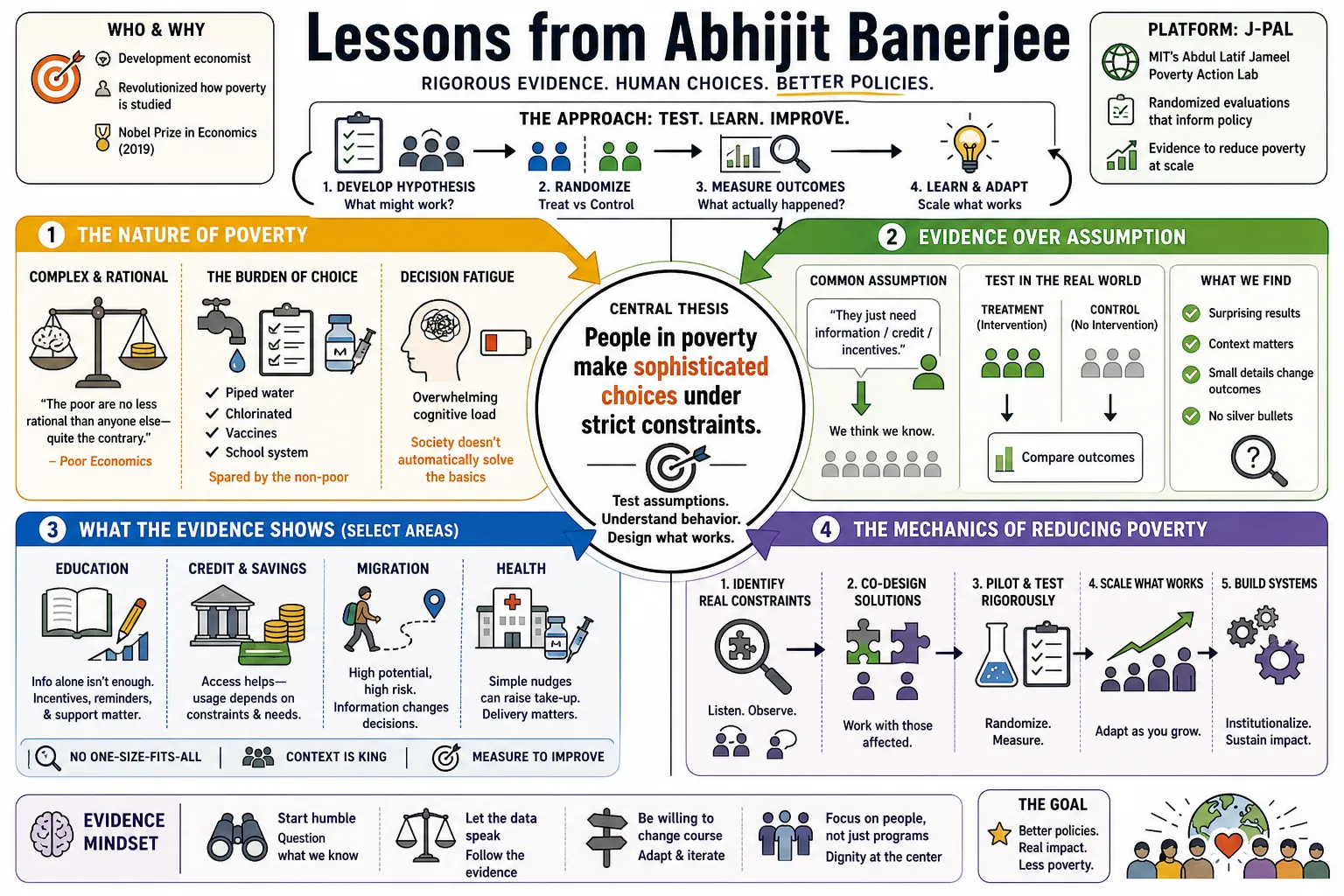
Lessons from Abhijit Banerjee
Development economist Abhijit Banerjee changed how poverty is studied by replacing broad theories with randomized controlled trials. Through MIT's J-PAL, he showed that people in poverty make sophisticated choices under strict constraints, and that governments must test their assumptions against actual behavior. This collection gathers his findings on education, credit, migration, and the mechanics of reducing poverty. — Nobel Prize — Abhijit Banerjee Biographical. — Nobel Prize Lecture — Field Experiments and the Practice of Economics.
Part 1: The Nature of Poverty
- On the complexity of poor households: Poverty policy should begin with the actual choices and constraints of low-income households, not the assumption that their economic lives are simple. — MIT Economics — Poor Economics
- On the burden of choice: Poverty makes ordinary decisions more consequential because many protections that wealthier households receive automatically—safe water, vaccination systems, savings, and insurance—must instead be actively managed. — MIT Economics — Poor Economics
- On risk and entrepreneurship: Microfinance can be useful without turning most borrowers into high-growth entrepreneurs; entrepreneurial potential and prior business experience vary substantially. — MIT Economics — Poor Economics
- On spending priorities: Even in extreme poverty, people allocate spending toward things that make life bearable—such as televisions or festivals—over basic caloric intake, because the desire for a less boring life is a fundamental human need. — American Economic Association — The Economic Lives of the Poor
- On the poverty trap: A poverty trap is present when a temporary opportunity or intervention produces gains that persist after the support ends, showing that poverty itself had blocked a better path. — IMF — Rethinking Poverty
- On nutrition and productivity: Providing the poor with cheaper food does not always lead them to buy more calories; they frequently switch to better-tasting, more expensive calories, indicating that taste and variety matter as much as pure energy. — American Economic Association — The Economic Lives of the Poor
- On hope as a catalyst: Hope matters when it is paired with credible opportunities and practical support, rather than offered as a substitute for resources. — MIT Economics — Poor Economics
Part 2: The Plumber's Approach to Economics
- On the value of randomized controlled trials (RCTs): Without RCTs, governments are left guessing whether an intervention worked because of the policy itself or because of the specific demographics of the people who chose to participate. — Nobel Prize Lecture — Field Experiments and the Practice of Economics
- On the illusion of obvious solutions: Poverty policy rarely has one obvious cure; progress comes from testing many specific steps and rejecting one-size-fits-all answers. — Knowledge at Wharton — A Conversation with the Authors of Poor Economics
- On scaling policies: Evidence-backed programs still require adaptation, implementation support, and repeated testing when they move from proof of concept into government systems. — Nobel Prize Lecture — Field Experiments and the Practice of Economics
- On evidence over ideology: Policies should be judged on empirical outcomes in the field rather than whether they fit neatly into a free-market or interventionist worldview. — Knowledge at Wharton — A Conversation with the Authors of Poor Economics
- On the complexity of human motivation: Economic policy should take dignity, identity, and social recognition seriously rather than assuming that income alone determines how people respond. — Stanford King Center — Abhijit Banerjee on Good Economics for Hard Times
- On humility in research: Good empirical work makes its uncertainty visible and uses surprising results to revisit both the theory and the interpretation of the evidence. — Nobel Prize Lecture — Field Experiments and the Practice of Economics
Part 3: Education and Learning
- On the illusion of schooling: Increasing school enrollment does not automatically translate into learning; millions of children in developing nations attend school for years without learning to read a single sentence. — MIT Economics — Poor Economics
- On elite-focused curricula: When curricula run far ahead of most pupils, instruction should begin from what children can currently do rather than from age or grade alone. — J-PAL — Teaching at the Right Level
- On teaching at the right level: The most effective educational intervention is grouping children by their current learning level rather than their age, allowing teachers to target foundational skills. — J-PAL — Teaching at the Right Level
- On the limitations of inputs: More schooling inputs are not enough when instruction remains mismatched to children’s learning levels; pedagogy and targeting matter. — J-PAL — Teaching at the Right Level
- On private versus public schools: Apparent differences between private and public schools should not be treated as proof of superior teaching without a causal comparison; school choice experiments reveal a more mixed, subject-specific picture. — J-PAL — School Choice in Andhra Pradesh
- On parental expectations: When parents see education as paying off mainly at a distant credential threshold, they may concentrate scarce investment on the children they believe are most likely to reach it. — J-PAL — Why Are Children Not Learning?
- On remedial education: Short, targeted remedial instruction can produce meaningful gains when it groups children by current learning level and focuses on foundational skills. — J-PAL — Teaching at the Right Level
- On technology in the classroom: Computer-assisted learning is most useful when it adapts practice to a child’s current level instead of reproducing the same rigid classroom sequence. — J-PAL — Teaching at the Right Level
Part 4: Health and Preventive Care
- On the paradox of preventive health: The poor are often willing to spend significant amounts on expensive cures for acute illnesses but hesitate to spend pennies on preventive measures like chlorine or bed nets. — MIT Economics — Poor Economics
- On the power of small nudges: Offering a tiny incentive, such as a kilogram of lentils, can overcome procrastination and double the rate of childhood immunizations in rural areas. — J-PAL — Improving Immunization Rates in India
- On trust and healthcare: Families respond not only to information but also to whether public health services are reliably present; predictable delivery can reduce the real cost of seeking care. — J-PAL — Improving Immunization Rates in India
- On the illusion of information: Information alone was less effective than combining education with reliable immunization camps and modest non-cash incentives. — J-PAL — Improving Immunization Rates in India
- On the limits of health subsidies: Charging even a nominal fee for preventive products like deworming pills or mosquito nets drastically reduces their usage compared to giving them away for free. — J-PAL — Free Preventive Health Products
Part 5: Microfinance and Entrepreneurship
- On the limits of microcredit: Microfinance is an effective tool for helping the poor manage household cash flow and weather shocks, but it does not spark the massive wave of entrepreneurship its early proponents promised. — American Economic Association — The Miracle of Microfinance?
- On Heterogeneous Returns to Credit: Average effects can hide an important subgroup: households already running businesses before microcredit arrived experienced persistent gains, while most other households did not. — NBER — Can Microfinance Unlock a Poverty Trap for Some Entrepreneurs?
- On Solving Several Constraints Together: For households facing multiple barriers at once, a package of assets, temporary consumption support, training, savings, and coaching can produce durable gains that a single intervention may not. — J-PAL — Long-Run Impact of the Graduation Approach
- On the myth of the poor entrepreneur: Microcredit does not turn every low-income borrower into an entrepreneur; long-run gains were concentrated among households already operating businesses. — NBER — Can Microfinance Unlock a Poverty Trap for Some Entrepreneurs?
- On the scale of informal businesses: Businesses run by the poor lack capital, rely heavily on unpaid family labor, and rarely grow beyond a single employee. — American Economic Association — The Economic Lives of the Poor
- On strict repayment schedules: Repayment design affects how borrowers invest: less frequent payments can allow more risk-taking and business investment without automatically increasing default, although longer grace periods can create tradeoffs. — J-PAL — Microfinance Repayment Schedules in West Bengal
- On the desire for stability: Many low-income parents aspire to stable salaried or government employment for their children, a reminder that security can be more valuable than the uncertainty of entrepreneurship. — EconTalk — Banerjee on Poverty and Poor Economics
- On the need for larger loans: Credit programs should account for entrepreneurial heterogeneity: a smaller group of experienced business owners may benefit from capital far more than the average borrower. — NBER — Can Microfinance Unlock a Poverty Trap for Some Entrepreneurs?
Part 6: Social Protection and Cash Transfers
- On the laziness myth: Across randomized cash-transfer programs, researchers found no systematic evidence that transfers caused recipients to work less. — J-PAL — Debunking the Lazy Welfare Recipient
- On targeting social programs: Targeting social assistance involves real tradeoffs: community knowledge can better reflect local ideas of need and improve satisfaction, while standardized formulas apply a different and sometimes narrower definition. — J-PAL — Community-Based Targeting of Social Assistance
- On universal basic income (UBI): Universal basic income is a design option worth comparing with costly or inaccurate targeting, especially where administrative capacity is limited. — NBER — Universal Basic Income in the Developing World
- On cash versus food: Cash transfers are a promising form of assistance, but whether they outperform in-kind support should be tested against concrete alternatives and local constraints rather than assumed in advance. — NDTV — The Fault Lines of Poverty
- On the dignity of welfare: Social protection should preserve recipients’ dignity and sense of social worth, not merely transfer money efficiently. — Stanford King Center — Abhijit Banerjee on Good Economics for Hard Times
- On the graduation approach: Providing the ultra-poor with a productive asset, combined with temporary cash support and mentoring, has proven highly effective at permanently lifting families out of extreme poverty. — J-PAL — Long-Run Impact of the Graduation Approach
Part 7: Migration, Trade, and Work
- On the inertia of migration: Contrary to political rhetoric, most people do not want to migrate; they are strongly attached to their homes, communities, and cultures, and will stay even in the face of significant economic hardship. — MIT News — Economics for Hard Times
- On the impact of immigrants on wages: Empirical evidence shows that low-skilled immigrants do not typically drive down the wages of native-born workers, largely because they take different types of jobs and consume local goods. — MIT News — Economics for Hard Times
- On the uneven gains of trade: Trade can raise aggregate income while imposing concentrated, persistent losses on particular workers and places when compensation is weak. — UNSW — Good Economics for Hard Times Transcript
- On worker mobility: The textbook economic assumption that workers who lose jobs to globalization will simply move to other cities or retrain for new industries is flawed; people are remarkably sticky. — MIT News — Economics for Hard Times
- On the destruction of local economies: When a major local employer disappears, the damage can persist because workers are less geographically and occupationally mobile than standard models assume. — UNSW — Good Economics for Hard Times Transcript
- On the definition of a good job: Work supplies identity, usefulness, and social connection as well as income, so transition policy should protect people’s sense of self. — MIT News — Economics for Hard Times
Part 8: Public Discourse and Ideology
- On the role of respect: Social policy should help people absorb shocks without treating job loss or hardship as a personal failure and without stripping away dignity. — MIT News — Economics for Hard Times