Abigail Shrier is a journalist and author of Irreversible Damage and Bad Therapy. Her work argues that some youth mental-health and gender interventions can pathologize ordinary distress, weaken parental authority, and amplify social influence. The lessons below describe Shrier’s documented arguments; they should not be read as independent medical consensus. — City Journal Interview.
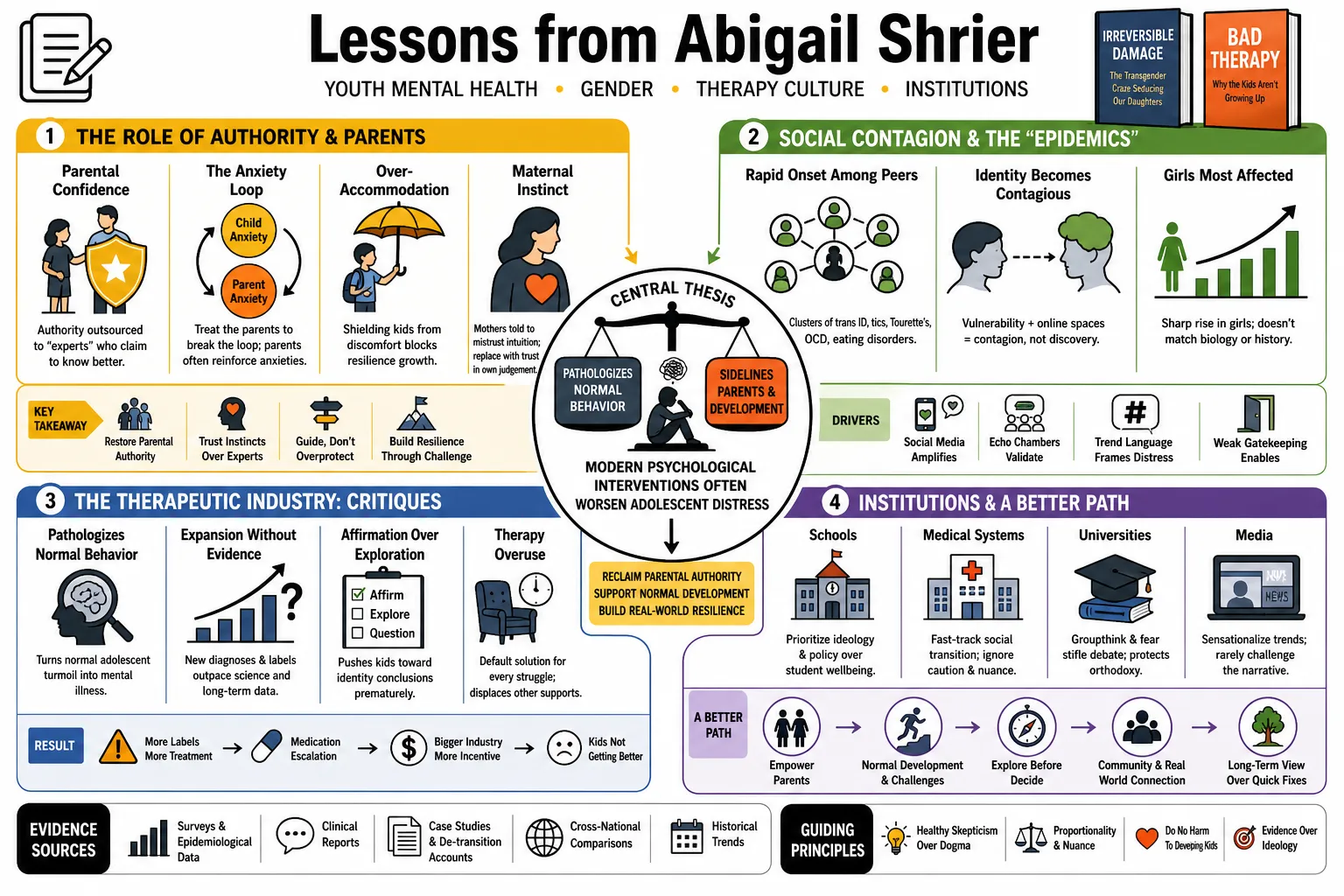
Part 1: The Role of Authority and Parents
- Parental Confidence: Shrier argues that parents today have been stripped of their natural authority, outsourced to a growing army of experts who claim to know better how to raise children. — The Parent-Therapy Trap.
- The Anxiety Loop: Shrier argues that a therapist should treat a kid’s anxiety by treating the kid’s parents. Parents often unwittingly reinforce their children's anxieties. — The Parent-Therapy Trap.
- Over-accommodation: Shrier argues that when parents constantly rearrange the physical and social world so a child never experiences discomfort, they prevent the development of the resilience needed to face reality. — The Parent-Therapy Trap.
- Setting Boundaries: Shrier argues that healthy parenting requires setting firm limits, which gives children a necessary sense of safety and predictability rather than leaving them to navigate a chaotic world alone. — The Parent-Therapy Trap.
- Therapeutic Parenting: Shrier argues that the adoption of 'therapeutic parenting'—where every tantrum is treated as a psychological crisis to be unpacked—exhausts parents and confuses kids. — The Parent-Therapy Trap.
- Natural Resilience: Shrier argues that children are inherently antifragile; they require exposure to stressors, failures, and disappointments to grow into capable adults. — The Parent-Therapy Trap.
- Adult Responsibility: Shrier argues that adults should be telling kids how imperfect and unreliable their emotions can be, rather than treating every fleeting feeling as a profound truth. — The Parent-Therapy Trap.
Part 2: The Pitfalls of Modern Therapy
- Iatrogenesis: Shrier uses iatrogenesis—the idea that a healer can harm a patient during treatment—to frame her critique of unnecessary therapy. — The Parent-Therapy Trap.
- Constant Self-monitoring: Shrier argues that asking teenagers to constantly monitor and report on their emotional states often manufactures the very anxiety and depression therapists claim to treat. — The Parent-Therapy Trap.
- Trauma Inflation: Shrier argues that the therapeutic industry has redefined 'trauma' so broadly that ordinary setbacks and conflicts are now categorized as clinical injuries requiring professional intervention. — The Parent-Therapy Trap.
- Rumination: Shrier argues that dwelling on your own sadness, your own anxiety, is the fastest way to make it worse. Therapy often encourages precisely this kind of toxic rumination. — The Parent-Therapy Trap.
- The Goal of Therapy: Shrier argues that historically, therapy aimed to equip individuals to leave therapy and live normal lives; today, it is often treated as an open-ended, lifelong commitment. — The Parent-Therapy Trap.
- School Counselors: Shrier argues that the expansion of mental health professionals in schools has resulted in students being continually surveyed for psychological distress, paradoxically driving up distress rates. — How Bad Therapy Hijacked Our Nation’s Schools.
- Pathologizing Childhood: Shrier argues that normal childhood behaviors, like boys struggling to sit still in classrooms, are increasingly pathologized as disorders needing treatment or medication. — How Bad Therapy Hijacked Our Nation’s Schools.
- Ignoring Feelings: Shrier argues that very often, kids should be skeptical that their feelings reflect an accurate picture of the world and even ignore their feelings entirely. — The Parent-Therapy Trap.
Part 3: Adolescence and Identity Formation
- Teenage Certainty: Shrier cautions against assuming that a teenager knows who they are with enough certainty to entrust them with life-altering decisions. — Independent Women Interview.
- Identity Flux: Shrier argues that adolescence is inherently a period of intense identity exploration and instability; it is a mistake to treat a teenager's current self-conception as permanent. — Independent Women Interview.
- The Search for Belonging: Shrier argues that teenagers who feel awkward, alienated, or uncomfortable in their changing bodies are highly susceptible to ideologies that offer a clear explanation and an instant community. — Independent Women Interview.
- Discomfort With Puberty: Shrier argues that the physical and emotional discomfort of puberty, especially for girls, is a normal developmental stage, not a medical condition to be cured. — Independent Women Interview.
- The Vulnerability of Girls: Shrier argues that teenage girls are particularly vulnerable to peer pressure and the desire to fit in, making them the primary demographic swept up in rapid-onset social trends. — Independent Women Interview.
- The Rush to Label: Shrier argues that assigning permanent labels to adolescents forecloses their natural psychological development and traps them in a specific moment of their youth. — Independent Women Interview.
- Self-discovery vs. Self-creation: Shrier argues that the modern obsession with adolescent 'self-discovery' often morphs into an exhausting, performative act of self-creation for an audience. — Independent Women Interview.
Part 4: Social Contagion and Peer Influence
- The Nature of Contagion: Shrier argues that like anorexia and bulimia in previous decades, certain mental health distresses and identity crises spread through friend groups via social contagion. — Independent Women Interview.
- Digital Echo Chambers: Shrier argues that online communities provide endless reinforcement and tutorials for youth adopting distress-based identities, insulating them from dissenting adult voices. — Independent Women Interview.
- The Influencer Economy: Shrier argues that online influencers act as charismatic mentors, coaching vulnerable adolescents on how to diagnose themselves and how to deceive their parents. — Independent Women Interview.
- The Role of Schools: Shrier argues that when schools secretly affirm a child's new identity without parental knowledge, they act as an institutional accelerant to peer contagion. — Independent Women Interview.
- The History of Hysteria: Shrier argues that mass psychogenic illness and behavioral contagions are not new phenomena, but social media has dramatically increased their transmission speed and reach. — Independent Women Interview.
Part 5: The Medicalization of Normalcy
- Self-diagnosis: Shrier argues that, outside cosmetic surgery, medicine generally does not allow patients to make their own diagnosis and prescribe their own treatment. — Independent Women Interview.
- Affirmative Care: Shrier argues that affirmative therapy compels therapists to endorse a falsehood: not that a teenage girl feels more comfortable presenting as a boy—but that she actually is a boy. — Independent Women Interview.
- The Loss of Gatekeeping: Shrier argues that the medical establishment has largely abandoned its traditional role of psychological gatekeeping, adopting a consumer-driven model for youth medical transition. — Independent Women Interview.
- Treating Symptoms as Root Causes: Shrier argues that medicalizing adolescent distress often treats the superficial symptom—such as a sudden declaration of a new identity—while ignoring underlying issues like autism, depression, or trauma. — Independent Women Interview.
- The Failure of the Medical Establishment: Shrier argues that major medical associations have been captured by activism, leading them to promote experimental treatments on minors without rigorous, long-term evidence. — Independent Women Interview.
- The Definition of Care: Shrier argues that true medical care requires objectivity, caution, and a willingness to say no to a patient, rather than automatic compliance with a teenager's demands. — Independent Women Interview.
Part 6: Tech, Social Media, and Anxiety
- The Smartphone Shift: Shrier argues that the iPhone was released in 2007. By 2018... 95 percent of teens had access to a smartphone and 45 percent reported being online 'almost constantly.' — The Parent-Therapy Trap.
- Constant Surveillance: Shrier argues that growing up under the constant surveillance of peers on social media creates an unprecedented level of self-consciousness and anxiety in modern teenagers. — The Parent-Therapy Trap.
- The Illusion of Connection: Shrier argues that social media provides a simulacrum of friendship that lacks the depth, friction, and genuine support found in real-world relationships. — The Parent-Therapy Trap.
- Online Radicalization: Shrier argues that algorithms designed to maximize engagement actively push vulnerable teenagers toward extreme content, whether it be self-harm communities or rigid ideological echo chambers. — The Parent-Therapy Trap.
- Parental Tech Boundaries: Shrier argues that parents must overcome the fear of their child's temporary anger and enforce strict boundaries around smartphone access, treating it as a matter of psychological safety. — The Parent-Therapy Trap.
- The Attention Economy: Shrier argues that tech companies are actively profiting off the psychological vulnerabilities of children, designing products that hijack the brain's reward system. — The Parent-Therapy Trap.
- Digital Permanence: Shrier argues that teenagers are forced to navigate the mistakes of adolescence with the added burden of digital permanence, where every misstep can be recorded and leveraged against them. — The Parent-Therapy Trap.
Part 7: Womanhood and Achievement
- Redefining Women: Shrier argues that the more incredible a woman is, the more barriers she busts through, the more 'gender nonconforming' she is deemed to be. In this perverse schema, by definition, the more amazing a woman is, the less she counts as a woman. — Independent Women Interview.
- Female Spaces: Shrier argues that the erosion of sex-segregated spaces, from sports to domestic violence shelters, disproportionately harms women and removes necessary sanctuaries. — Independent Women Interview.
- Erasing the Female Body: Shrier argues that the shift toward inclusive language often requires the clinical erasure of the female body, reducing women to biological functions or menstruators. — Independent Women Interview.
- Fairness in Sports: Shrier argues that allowing biological males to compete in female sports destroys the very purpose of Title IX, which was to ensure women and girls had equal opportunities to excel and win. — Independent Women Interview.
Part 8: The Cultural Landscape and Free Speech
- The Culture of Fear: Shrier argues that a pervasive culture of fear and self-censorship prevents well-meaning professionals, teachers, and doctors from speaking out against harmful practices. — City Journal Interview.
- The Necessity of Debate: Shrier argues that when controversial issues regarding children's health are shielded from public debate through censorship and accusations of bigotry, the most vulnerable suffer the consequences. — City Journal Interview.
- Parental Rights: Shrier argues that the state should not have the authority to bypass parents in making medical or psychological decisions for minors, except in genuine cases of abuse. — City Journal Interview.
- Standing Firm: Shrier argues that parents and citizens must find the courage to be disagreeable, prioritize the truth over social approval, and refuse to recite lies. — City Journal Interview.
- The Shift in Education: Shrier argues that schools have shifted some attention from academic instruction toward psychological intervention and ideological training. — How Bad Therapy Hijacked Our Nation’s Schools.