Dan Shipper is the co-founder and CEO of Every, a media and software company. He writes its Chain of Thought column and hosts the AI & I podcast, exploring AI, creative work, and productivity. — Mercury — What Comes Next?.
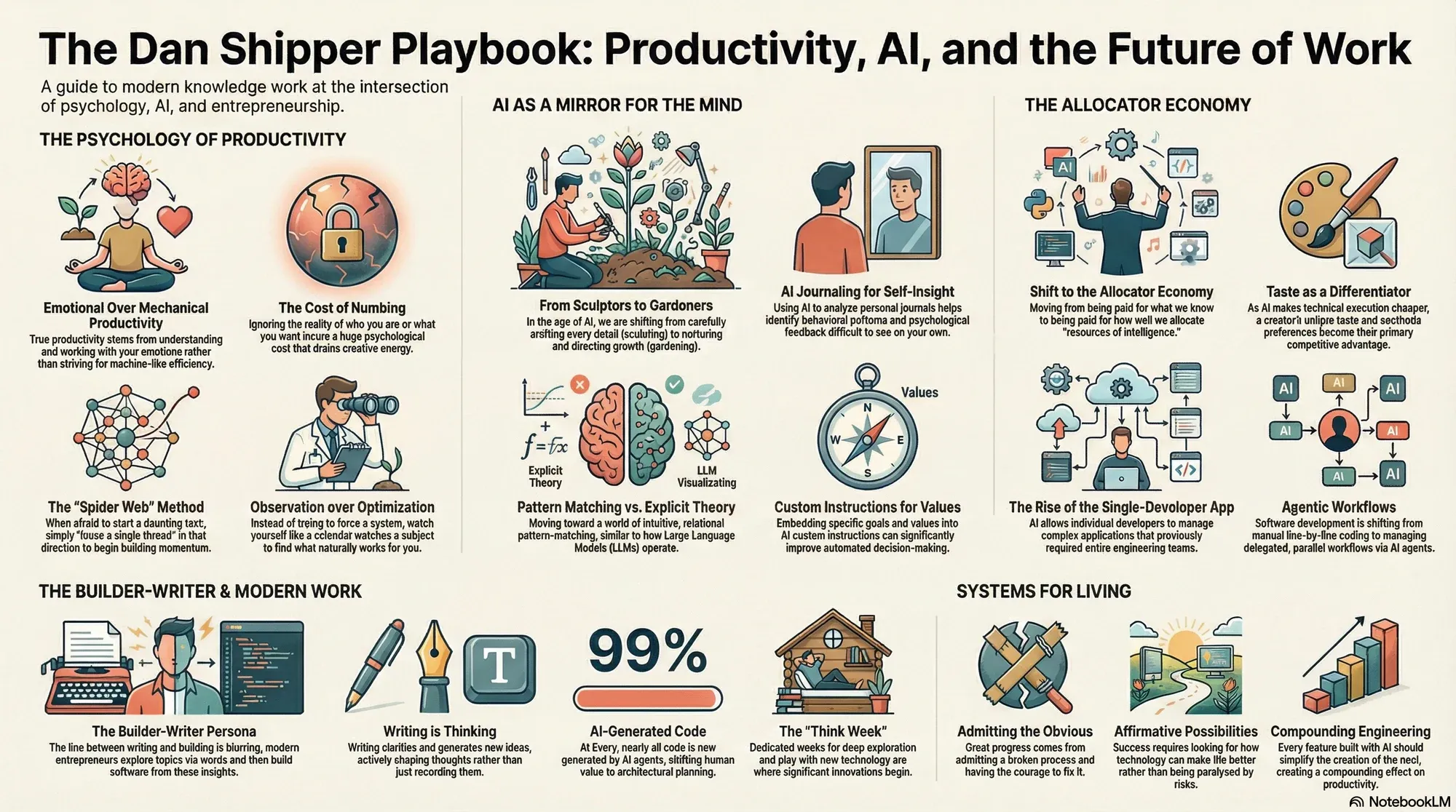
Part 1: The Psychology of Productivity
- Emotional Productivity: Productivity requires noticing emotional friction, observing it without judgment, and experimenting rather than trying to work like a machine. — TED — The Unexpected Key to Boosting Your Productivity.
- the Cost of Numbing: Ignoring an obvious truth about what you want consumes energy; acknowledging it can be freeing. — Every — Admitting What Is Obvious.
- Guilt and Shame: Guilt, shame, and fear can sit beneath a productivity problem and matter more than another tool. — TED — The Unexpected Key to Boosting Your Productivity.
- the Illusion of Control: Shipper recommends experimenting with systems, teams, and mindsets after understanding the friction behind poor output. — TED — The Unexpected Key to Boosting Your Productivity.
- Meaningful Work: Shipper could devote himself more fully to writing once he acknowledged that he genuinely wanted to be a writer. — Every — Admitting What Is Obvious.
- Personal Desires: Admitting a desire can feel threatening when it seems to conflict with an established identity. — Every — Admitting What Is Obvious.
- Productivity Frameworks: Productivity depends on psychology, relationships, and aims as well as tools and frameworks. — Every — What Is Underneath Productivity?.
- Self-Observation: Shipper proposes awareness, nonjudgmental observation, and experiments when work is stuck. — TED — The Unexpected Key to Boosting Your Productivity.
- the 'Spider Web' Method: He compares approaching a frightening desire to a spider sending one thread across a gap, then strengthening it. — Every — Admitting What Is Obvious.
- Status Paths: Choosing the desired path may mean leaving a conventional high-status trajectory. — Every — Admitting What Is Obvious.
Part 2: AI as a Mirror for the Mind
- AI as a Mirror: Shipper uses AI to reconsider what he means by intellect and which parts of creative work remain human. — Every — ChatGPT and the Future of the Human Mind.
- Pattern Matching: Intelligent behavior depends not only on explicit rules but also on contextual intuition that is hard to state fully. — Every — Seeing Like a Language Model.
- AI Journaling: In his experiments, AI-assisted journaling helped surface recurring thoughts and reframe experiences. — Every — GPT-3 Is the Best Journal You've Ever Used.
- Context Windows: A journal chatbot that remembers earlier sessions can reflect personal patterns more usefully than a fresh context each time. — Every — GPT-3 Is the Best Journal You've Ever Used.
- Overcoming Deficiencies: Shipper describes handing summarization to ChatGPT and shifting his role toward directing and editing the result. — Every — The Allocation Economy.
- Human vs. AI Intellect: As AI takes on tasks associated with intellect, Shipper calls for a more precise account of human and model contributions. — Every — ChatGPT and the Future of the Human Mind.
- the Shift to Gardening: Shipper contrasts sculpting every detail with gardening: directing and cultivating AI-assisted creative output. — Every — Seeing Creativity Like a Language Model.
- AI Custom Instructions: Personal context and priorities led ChatGPT to ask more relevant questions about a prospective Every course. — Every — Using ChatGPT Custom Instructions.
- LLM Intuition: Shipper emphasizes contextual pattern recognition and intuition rather than a complete set of explicit rules. — Every — Seeing Like a Language Model.
- AI and Therapy: AI journaling can supplement reflection or therapy but should not replace a coach or therapist. — Every — GPT-3 Is the Best Journal You've Ever Used.
Part 3: The Allocator Economy & The Future of Work
- the Allocator Economy: Shipper calls the shift from doing knowledge work to directing and evaluating AI work an allocation economy. — Every — The Allocation Economy.
- Managing Quality: He expects vision, taste, delegation, and quality evaluation to matter more as people manage AI-generated work. — Every — The Allocation Economy.
- Multidimensional Talent: Shipper argues that adaptable generalists can span writing, product work, and operations with AI assistance. — Lenny's Podcast — The AI-Native Startup.
- the 10x Difference: At Every, Shipper describes broad AI adoption as a company-wide practice, not an isolated engineer experiment. — Lenny's Podcast — The AI-Native Startup.
- AI Operations Leads: Every uses an AI operations lead to help staff identify tasks and adopt useful AI workflows. — Lenny's Podcast — The AI-Native Startup.
- Single-Developer Apps: Every's in-house software products are primarily built and run by one person each with agent support. — Every — Compound Engineering.
- Job Reshoring: Shipper suggests AI could make some domestic services more economical, potentially reshoring work; this is a forecast. — Lenny's Podcast — The AI-Native Startup.
- Taste as a Differentiator: Shipper says a team's taste and preferences shaped products such as Monologue as app-building became easier. — Mixergy — Building AI Apps.
- Agentic Workflows: Software work at Every now centers on directing agents to plan, write, test, and review code. — Every — Compound Engineering.
- Fractured Attention: Shipper describes orchestrating multiple coding agents in parallel, then reviewing and recording what they learn. — Every — Compound Engineering.
Part 4: Writing as a Tool for Thinking
- Externalizing Thought: Externalizing thoughts in prose makes them easier to inspect, sequence, and refine. — Every — Writing as a Way of Thinking.
- Generating Ideas: Writing can generate ideas during composition, not merely record thoughts formed beforehand. — Every — Writing as a Way of Thinking.
- Thinking vs. Writing: Shipper treats writing as one valuable way to think while noting that conversation also supports thinking. — Every — Writing as a Way of Thinking.
- the Human Voice: AI summaries can be useful but still need human taste and voice to become distinctive writing. — Every — We're Building AI Into Our Media Business.
- the Future of Writers: Shipper expects AI to change writers' skills and tools, not eliminate the need for writers. — Every — Writing Essays With AI.
- Clarity through Prose: Putting an idea into words exposes fuzziness and helps clarify the reasoning. — Every — Writing as a Way of Thinking.
- Public Thinking: Shipper argues that articulating a clear vision in writing is a consequential part of management. — Every — Writing as a Way of Thinking.
- AI Drafting: AI can aid a draft, but the writer must guide, check, and shape the work. — Every — Writing Essays With AI.
- Narrative in Business: Effective management requires articulating a problem and a coherent vision. — Every — Writing as a Way of Thinking.
Part 5: The Builder-Writer & Modern Entrepreneurship
- the Builder-Writer: Shipper describes a builder-writer who explores ideas in prose and turns promising insights into software. — Mercury — What Comes Next?.
- the Writing CEO: After acknowledging he wanted to be a writer, Shipper reorganized his CEO role to focus more on creative work. — Every — Admitting What Is Obvious.
- Building for Yourself: Every's products have often begun with something Shipper or a teammate personally wanted to use. — Mixergy — Building AI Apps.
- Early Profitability: Shipper reported that Firefly reached well into six figures in recurring revenue while he was in college. — Dan Shipper — Bootstrapping Firefly.
- Media Ecosystems: Every combines its writing and subscription business with AI software products. — Mercury — What Comes Next?.
- Small Team Efficiency: In 2025 Shipper described a roughly 15-person AI-first team publishing daily and shipping several products. — Lenny's Podcast — The AI-Native Startup.
- Affirmative Possibilities: Shipper urges readers to revisit assumptions about AI capabilities and test newly possible uses. — Every — When AI Gets More Capable.
Part 6: Personal Growth & Admitting the Obvious
- Self-Honesty: Shipper's writer-founder story illustrates the value of naming what one wants before reorganizing work around it. — Every — Admitting What Is Obvious.
- the Burden of 'Should': A high-status role he thought he should want kept Shipper from fully embracing writing. — Every — Admitting What Is Obvious.
- the Freeing Power of Truth: Naming his desire to be a writer frightened Shipper but made his work feel more aligned. — Every — Admitting What Is Obvious.
- Developing Taste: Shipper's blind-smelling practice shows how naming perceptions can sharpen and communicate taste. — Every — What I Do When I Can't Sleep.
- the Ineffable List: Shipper keeps an ineffable list of things that catch his attention to collect patterns in his creative taste. — Every — Seeing Creativity Like a Language Model.
- Redefining Intellect: AI's capabilities require rethinking which human capacities we group under the label intellect. — Every — ChatGPT and the Future of the Human Mind.
- Staying Static: Shipper calls the assumption that technology stays at current capability levels capability blindness. — Every — When AI Gets More Capable.
- Personal Philosophy: Shipper turns to psychology, philosophy, literature, and biology to understand his aims and methods. — Every — What Is Underneath Productivity?.
Part 7: Technical Evolution: From Code to Context
- Compounding Engineering: Compound engineering records what agents learn so later features can become easier to build. — Every — Compound Engineering.
- Coding with AI Agents: Shipper says agents now write Every's code while engineers direct, review, and improve the work. — Every — Compound Engineering.
- the Role of Planning: Shipper's engineering loop emphasizes planning and review before feeding lessons into later agent work. — Every — Compound Engineering.
- Rigid Assessments: At Every, engineers review agent output with tests, manual checks, and code-review agents. — Every — Compound Engineering.
- Claude Code: Every primarily uses Claude Code for compound engineering while some teammates use other agents. — Every — Compound Engineering.
- Software as Thought: Shipper describes writing and software as increasingly interwoven in Every's builder-writer model. — Mercury — What Comes Next?.
- Parallel Processing: A compound engineer runs agents in parallel to plan, implement, and assess software work. — Every — Compound Engineering.
Part 8: Systems for Living & Thinking
- Tools for Thought: Shipper's Roam experience suggests choosing a thinking tool by whether its value exceeds the upkeep. — Every — The Fall of Roam.
- Roam Research: Shipper stopped relying on Roam after maintaining accumulated links and notes outweighed their usefulness. — Every — The Fall of Roam.
- Achievable Goals: Shipper writes daily goals and a proposed schedule, using them without requiring a perfect completion rate. — Dan Shipper — Goal Setting and Time Management.
- Experimentation: At Every, Shipper experiments with AI tools and editorial workflows to learn what they can and cannot do. — Every — We're Building AI Into Our Media Business.
- AI and Personal Growth: Shipper uses AI journaling to reflect on emotions, values, and personal patterns while acknowledging its limits. — Every — GPT-3 Is the Best Journal You've Ever Used.
- Affirming the Future: Shipper cautions against assuming AI capabilities will stay static and recommends testing improved tools. — Every — When AI Gets More Capable.