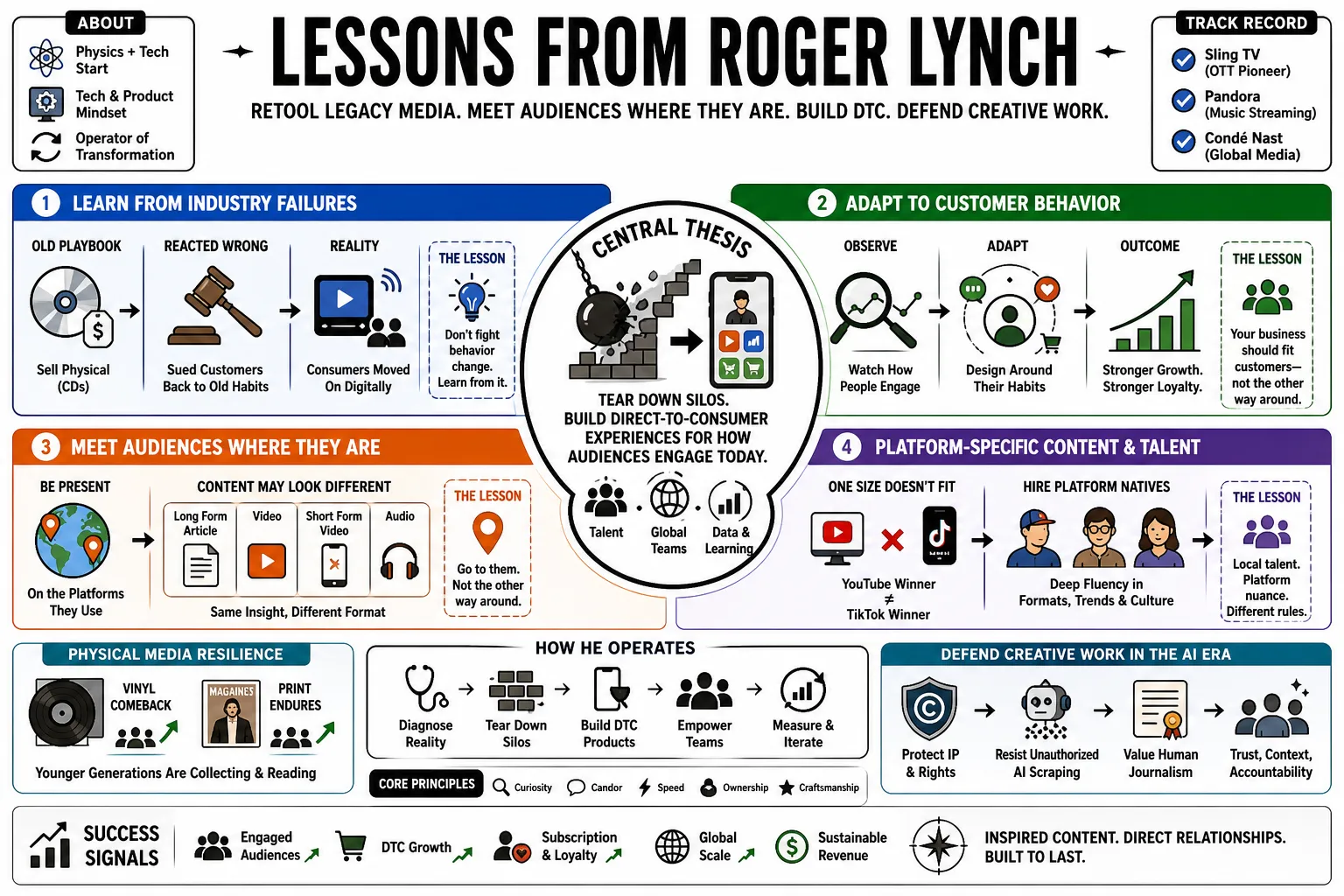
Roger Lynch started in physics and tech before taking over media operations like Sling TV, Pandora, and Condé Nast. He specializes in retooling legacy companies for the digital era by tearing down internal divisions and building direct-to-consumer businesses. This profile covers his methods for building digital products, managing global teams, adapting to shifting audience habits, and defending intellectual property against unauthorized AI scraping.
Part 1: Navigating Technological Disruption
- On learning from industry failures: The music industry mistakenly tried to sue customers into reverting to old behaviors like buying CDs, rather than adapting to their new digital consumption habits. — Reference: Condé Nast CEO Explains Why Human Journalism Wins in the AI Era
- On adapting to customer behavior: You must observe how your audience behaves and craft your business around those habits, rather than trying to force consumers to act in ways that benefit your existing model. — Reference: Condé Nast CEO Explains Why Human Journalism Wins in the AI Era
- On meeting audiences where they are: Brands must be present on the platforms where their audiences expect to find them, even if the content format differs significantly from traditional output. — Reference: The Future Of Global Media & Leadership With Roger Lynch
- On platform-specific content: You cannot simply take a video that performs well on YouTube and republish it on TikTok; success requires hiring people who deeply understand the unique formats and nuances of each specific platform. — Reference: Condé Nast CEO Interview: Remaking a Magazine Empire
- On physical media resilience: Despite digital shifts, physical formats like vinyl records and print magazines continue to see demand, growing in popularity among younger generations who value tangible products. — Reference: Condé Nast CEO Explains Why Human Journalism Wins in the AI Era
- On building licensing foundations: Successful disruptive distribution models, such as early broadband and streaming platforms, were built on licensing agreements that allowed creators and distributors to collaborate and reinvest in content. — Reference: InPublishing: Roger Lynch testifies
- On managing partner anxieties: When launching new distribution models like Sling TV's single-stream service, initial technical limitations are often required to appease cautious programming partners who are new to the format. — Reference: Interview: Roger Lynch, CEO of Sling TV
Part 2: Managing Global Organizations and Culture
- On eliminating internal silos: A media company structured entirely around independent country operations misses out on the ability to share content, technology, and cohesive brand guidelines. — Reference: The Future Of Global Media & Leadership With Roger Lynch
- On preventing internal competition: Allowing individual brands within the same company to operate completely independently can lead to a dysfunctional environment where their sales teams compete against one another for the same advertising dollars. — Reference: The Future Of Global Media & Leadership With Roger Lynch
- On structural modernization: When reorganizing a legacy print company, leaders must ask what structure would make the most sense if the company were being built from scratch today, keeping digital growth in mind. — Reference: The Future Of Global Media & Leadership With Roger Lynch
- On challenging assumptions with data: When local editorial teams insist their audiences only want local content, audience data often proves otherwise, showing significant engagement with international titles. — Reference: The Future Of Global Media & Leadership With Roger Lynch
- On maximizing global influence: Decentralizing a major brand like Vogue across isolated regional markets squanders the opportunity to launch powerful, unified global initiatives. — Reference: The Future Of Global Media & Leadership With Roger Lynch
- On driving cultural change: Restructuring a century-old business to operate globally and share technology requires both organizational shifts and massive cultural changes among the staff. — Reference: The Future Of Global Media & Leadership With Roger Lynch
- On operating in complex markets: Operating a media business in China requires a specific focus on lifestyle and luxury content rather than news, making it a difficult but potentially highly profitable endeavor. — Reference: Condé Nast CEO says no plans to shut more magazine brands
- On evaluating regional growth: Regions like the Middle East offer massive growth opportunities for luxury and fashion brands due to their highly digital and youthful populations. — Reference: Condé Nast CEO says no plans to shut more magazine brands
Part 3: Media Business Models and Monetization
- On capitalizing on intellectual property: Media companies hold a massive treasure trove of intellectual property that streaming services desperately need to feed their demand for high-quality content. — Reference: Condé Nast CEO Interview: Remaking a Magazine Empire
- On integrating editorial and production: To effectively turn journalism into film and television projects, writers and editors must be tightly integrated with the production team from the very beginning of a story's development. — Reference: Condé Nast CEO Interview: Remaking a Magazine Empire
- On diversifying revenue streams: A sustainable modern media business model should balance its revenue roughly equally across digital video, consumer revenue, and traditional advertising. — Reference: Condé Nast CEO Interview: Remaking a Magazine Empire
- On separating consumer and advertiser demands: While consumers may still show strong demand for print magazines, advertisers increasingly view print as a declining investment, requiring publishers to rely more heavily on direct consumer revenue. — Reference: Condé Nast CEO Interview: Remaking a Magazine Empire
- On taking advantage of platform scale: Distributing premium content on massive platforms like YouTube allows publishers to charge higher ad rates because advertisers value the brand-safe environment. — Reference: Condé Nast CEO Interview: Remaking a Magazine Empire
- On finding a clear path to profitability: Decisions to close or transition specific publications should be driven by an assessment of whether the brand has a clear path to continued growth and profitability. — Reference: Condé Nast CEO says no plans to shut more magazine brands
- On targeting specific consumer segments: New streaming services can find success by identifying distinct groups, such as cord nevers or cord cutters, and tailoring accessible, lower-cost offerings to those who reject traditional pay-TV prices. — Reference: Interview: Roger Lynch, CEO of Sling TV
- On editorial independence: A media company can successfully pursue confrontational or hard-hitting journalism when its ownership maintains a hands-off approach and trusts the appointed editors to do their jobs. — Reference: Condé Nast CEO says no plans to shut more magazine brands
- On cost management: Leading a legacy media brand through an industry transition often requires meticulously and ruthlessly cutting unnecessary costs. — Reference: Is Roger Lynch’s Job at Condé Nast Sorta Done?
Part 4: The Impact of Artificial Intelligence
- On the irreplaceable nature of journalism: "Gen AI cannot replace journalism. It takes reporters with grit, integrity, ambition and human creativity to develop the stories that allow free markets, free speech, and freedom itself to thrive." — Source: InPublishing: Roger Lynch testifies
- On unauthorized AI training: Using publisher content without permission or compensation to build massive AI models violates copyright law and threatens the production of high-quality media. — Reference: InPublishing: Roger Lynch testifies
- On the mechanics of generative AI: AI models do not learn the way humans do; instead, they often mash up copied content at massive scale and plainly display elements derived from the ingested works. — Reference: InPublishing: Roger Lynch testifies
- On the risk of misinformation: Generative AI enables the creation of customized, fake media at an unprecedented scale, which could lead the public to stop trusting any source of information entirely. — Reference: InPublishing: Roger Lynch testifies
- On the necessity of licensing frameworks: To ensure a sustainable ecosystem, policymakers must require AI companies to seek licenses and compensate publishers for using their content for both training and output. — Reference: InPublishing: Roger Lynch testifies
- On the limits of AI capabilities: "Whether reporting on local high school sports, fashion, architecture, art or foreign affairs, journalism is a uniquely human venture that AI can only parrot, not create." — Source: InPublishing: Roger Lynch testifies
- On shifting perspectives: While initially perceived as a threat, artificial intelligence can eventually serve as a business tailwind as media organizations learn to integrate it into their own operations. — Reference: Condé Nast CEO says no plans to shut more magazine brands
- On blending human taste with algorithms: A highly personalized consumer experience, like music streaming, is best achieved when data scientists tune their machine learning algorithms based on the foundational work of human experts. — Reference: Condé Nast CEO Explains Why Human Journalism Wins in the AI Era
Part 5: Leadership and Career Philosophy
- On career trajectories: Career paths are no longer strictly linear or predictable; professionals must remain continuously open to unexpected opportunities as they arise. — Reference: Alumnus, Condé Nast CEO on His Nontraditional Career Path
- On tackling difficult challenges: Solving the hardest problems, whether in physics, technology, or media, requires persistent focus and the confidence that a solution will eventually be found. — Reference: Alumnus, Condé Nast CEO on His Nontraditional Career Path
- On the value of mistakes: The biggest business lessons are usually learned by examining massive mistakes, such as legacy industries fighting their own customers instead of embracing changing consumer behaviors. — Reference: Condé Nast CEO Explains Why Human Journalism Wins in the AI Era
- On executive focus: A chief executive's day is best split across key operational metrics, sales performance, product development, and managing essential external partnerships. — Reference: Interview: Roger Lynch, CEO of Sling TV
- On the evolving role of editors: The editors of the future can no longer specialize in just one medium; they must be capable of working fluidly across print, digital, video, and social channels. — Reference: Condé Nast CEO Interview: Remaking a Magazine Empire
- On maintaining confidence: Approaching complex leadership roles across entirely different industries requires a core belief in your own ability to figure out structural solutions along the way. — Reference: Alumnus, Condé Nast CEO on His Nontraditional Career Path
- On the effort behind journalism: "Journalism is, simply, hard work. Journalists must develop reliable sources and seek out firsthand information, sometimes in very difficult places." — Source: InPublishing: Roger Lynch testifies
- On recognizing long-term trends: Even if a declining segment like print advertising experiences temporary growth, leaders should not mistake it for a long-term growth business that alters their strategic trajectory. — Reference: Condé Nast CEO Interview: Remaking a Magazine Empire
Part 6: Building and Transforming Digital Products
- On using new products as strategic hedges: Sling TV was designed as a lower-cost streaming bundle that could help Dish participate in the cord-cutting shift rather than merely defend its satellite business from it. — Reference: ‘The Cleaner’: Condé Nast’s new level-headed leader is a publishing newcomer
- On waiting for indispensable partners: Sling delayed its launch until major networks such as ESPN were willing to participate, showing that speed matters less than securing the content that makes a new distribution product credible. — Reference: ‘The Cleaner’: Condé Nast’s new level-headed leader is a publishing newcomer
- On turning a media service into a platform: Pandora's acquisition of AdsWizz expanded the company beyond selling its own inventory toward supplying programmatic audio-ad infrastructure to a broader market. — Reference: ‘The Cleaner’: Condé Nast’s new level-headed leader is a publishing newcomer
- On treating engagement as product infrastructure: At Pandora, Lynch redirected marketing capabilities toward increasing listening time, making consumer engagement a system the company could deliberately improve rather than a passive outcome. — Reference: ‘The Cleaner’: Condé Nast’s new level-headed leader is a publishing newcomer
- On building material subscription businesses: Pandora Premium grew into a nine-figure revenue stream representing nearly a third of company revenue, illustrating how a mature ad-supported product can develop a meaningful direct-to-consumer layer. — Reference: ‘The Cleaner’: Condé Nast’s new level-headed leader is a publishing newcomer
- On extending a proven recommendation system: Pandora explored applying the Music Genome Project's practice of breaking songs into component traits to podcasts, using structured content understanding to improve discovery in a new audio format. — Reference: Pandora’s Roger Lynch makes us a playlist
- On pairing cost discipline with selective investment: Effective turnarounds cut where the old organization is overbuilt while continuing to fund the products and capabilities that can create the next growth engine. — Reference: ‘The Cleaner’: Condé Nast’s new level-headed leader is a publishing newcomer
- On reducing the morale cost of restructuring: Financial discipline is stronger when leaders can relocate teams and trim headcount without needlessly alienating the people who remain to execute the new strategy. — Reference: ‘The Cleaner’: Condé Nast’s new level-headed leader is a publishing newcomer
- On making failure an active career choice: Difficult transitions become more manageable when leaders set short-term goals, move in the right direction, and remain willing to change course; taking on challenges where failure is possible is itself a way to learn. — Reference: Roger Lynch Tells Tuck Grads, “Actively Risk Failure”