Lessons from Paul Johnson
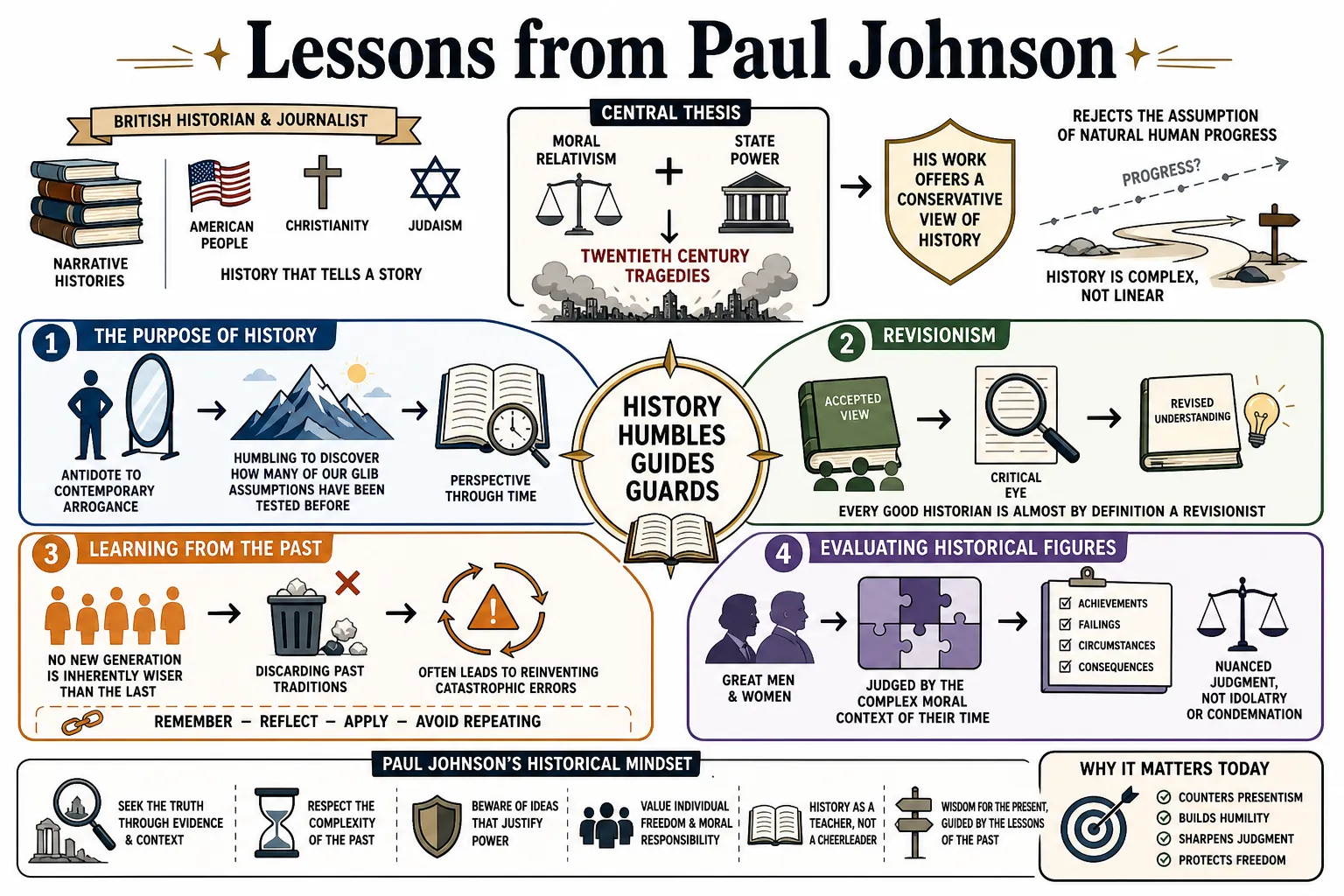
The British historian and journalist Paul Johnson wrote narrative histories covering everything from the American people to the development of Christianity and Judaism. He argued that intellectuals have no business managing society, blaming the tragedies of the twentieth century on moral relativism and state power. His work offers a conservative view of history that rejects the assumption of natural human progress.
Part 1: The Study of History
- On the purpose of history: "The study of history is a powerful antidote to contemporary arrogance. It is humbling to discover how many of our glib assumptions have been tested before." — Source: Goodreads
- On revisionism: "Every good historian is almost by definition a revisionist. He looks at the accepted view of a particular historic episode or period with a very critical eye." — Source: Goodreads
- On learning from the past: "History shows that no new generation is inherently wiser than the last, and discarding past traditions often leads to reinventing catastrophic errors." — Source: A History of the American People
- On evaluating historical figures: "Great men and women of history must be judged by the complex moral realities and constraints of their own eras rather than the pristine standards of the present." — Source: Churchill
- On the nature of progress: "True progress is never a historical inevitability; it is a fragile achievement that requires constant defense against the enduring forces of human folly." — Source: Modern Times
- On historical memory: "A society that deliberately erases or distorts its history loses the navigational tools required to navigate future crises." — Source: A History of the English People
- On historical inevitability: "The belief that historical forces are predetermined and unstoppable has been the primary excuse for the worst tyrannies of the twentieth century." — Source: Modern Times
- On primary sources: "A historian’s first duty is to the archives and the original texts, filtering out the ideological noise added by subsequent generations." — Source: Goodreads
- On the fragility of civilization: "Civilisation is a fragile creation, and requires constant vigilance and defense to prevent its collapse into barbarism." — Source: Modern Times
- On historical narrative: "History is best understood through the specific choices, flaws, and triumphs of individual men and women rather than abstract socio-economic forces." — Source: Creators
Part 2: The Danger of Intellectuals
- On intellectual arrogance: "Nothing appeals to intellectuals more than the feeling that they represent 'the people'. Nothing, as a rule, is further from the truth." — Source: Intellectuals
- On utopian systems: "It is a curious delusion of intellectuals, from Rousseau onwards, that they can solve the perennial difficulties of human education at a stroke, by setting up a new system." — Source: Goodreads
- On ideas versus people: "Intellectuals often love humanity in the abstract while treating actual, flesh-and-blood individuals in their own lives with shocking cruelty." — Source: Intellectuals
- On the appeal of Marxism: "Marxism captured the intellectual class because it offered a comprehensive secular religion, substituting the authority of the party for the authority of the church." — Source: Modern Times
- On social engineering: "The fatal conceit of the intellectual is the belief that society is a machine that can be dismantled and reassembled according to a rational blueprint." — Source: Intellectuals
- On Rousseau’s legacy: "Jean-Jacques Rousseau was the archetype of the modern intellectual, demanding absolute power for the state over education while abandoning his own children." — Source: Intellectuals
- On trusting experts: "Beware intellectuals. Not merely should they be kept well away from the levers of power, they should also be objects of peculiar suspicion when they seek to offer collective advice." — Source: Intellectuals
- On ideological blind spots: "Many leading twentieth-century writers and thinkers excused the atrocities of totalitarian regimes because those regimes claimed to serve higher philosophical ideals." — Source: Intellectuals
- On the intellectual's detachment: "The worst political disasters occur when intellectuals dictate policy from a comfortable distance, insulated from the real-world consequences of their theories." — Source: Intellectuals
- On common sense: "Ordinary citizens armed with traditional common sense are often far better equipped to make moral judgments than highly educated theorists." — Source: Intellectuals
Part 3: The Growth of the State
- On the state's capacity for harm: "The destructive capacity of an individual, however vicious, is small; of the state, however well-intentioned, almost limitless. Expand the state and the destructive capacity necessarily expands too." — Source: Goodreads
- On the twentieth century: "The dominant and most devastating phenomenon of the twentieth century was the dramatic expansion of state power and its willingness to use violence against its own people." — Source: Modern Times
- On state-sponsored morality: "When the state attempts to replace personal morality and religion with secular ideology, the result is inevitably a loss of both freedom and virtue." — Source: Modern Times
- On totalitarianism: "Totalitarianism is not merely a political system, but an attempt to abolish human nature itself by bringing every aspect of life under bureaucratic control." — Source: Modern Times
- On benevolent planning: "The belief that a centralized government can manage an economy better than millions of free individuals making independent choices is a persistent and destructive myth." — Source: A History of the American People
- On professional politicians: "The rise of the professional politician, individuals who have never worked in the productive economy, has isolated governments from the realities faced by ordinary citizens." — Source: Goodreads
- On the welfare state: "While aiming to eliminate poverty, the modern welfare state often ends up institutionalizing dependency and eroding the traditional family structure." — Source: Modern Times
- On central planning: "The central planners of the twentieth century consistently failed to realize that human beings cannot be engineered like steel or concrete." — Source: Modern Times
- On the rule of law: "The fundamental difference between a free society and a tyranny is that in a free society, the state itself is strictly bound and limited by the law." — Source: A History of the English People
- On liberty: "Political freedom is not the natural state of mankind; it is a rare and artificial construct that must be vigorously defended against the natural tendency of states to accumulate power." — Source: Modern Times
Part 4: The American Experiment
- On the significance of America: "The creation of the United States of America is the greatest of all human adventures. No other national story holds such tremendous lessons, for the American people themselves and for the rest of mankind." — Source: A History of the American People
- On American character: "This book is dedicated to the people of America: strong, outspoken, intense in their convictions, sometimes wrong-headed but always generous and brave, with a passion for justice no nation has ever matched." — Source: A History of the American People
- On the Founding Fathers: "The American founders were not merely philosophers, but practical men of business and law who designed a system based on a realistic, rather than utopian, view of human nature." — Source: George Washington: The Founding Father
- On American wealth: "The astonishing economic engine of the United States was built not by government mandate, but by releasing the creative and entrepreneurial energies of ordinary people." — Source: A History of the American People
- On religion in America: "Unlike Europe, where state religion bred secularism, America's separation of church and state allowed religious faith to flourish as a vital, voluntary force in civil society." — Source: A History of the American People
- On self-correction: "The unique strength of the American system is its built-in capacity for self-correction; it can acknowledge its historical sins and change course without destroying its foundational institutions." — Source: A History of the American People
- On the US Constitution: "The Constitution is a masterpiece of political engineering precisely because it focuses on limiting power and protecting minority rights from the passions of the majority." — Source: A History of the American People
- On American interventionism: "America has always wrestled with the tension between wanting to serve as a passive moral example to the world and feeling a duty to actively intervene against global tyranny." — Source: A History of the American People
- On the continuous frontier: "The concept of the frontier, whether geographic, technological, or economic, remains the defining psychological driver of American optimism and innovation." — Source: A History of the American People
Part 5: Moral Absolutes and Relativism
- On abandoning moral absolutes: "If you depart from moral absolutes, you go into a bottomless pit." — Source: Goodreads
- On Einstein and relativism: "The tragic irony of the modern era began when Einstein's scientific theory of relativity was erroneously applied by philosophers to morality, leading people to believe that right and wrong were merely matters of perspective." — Source: Modern Times
- On the misuse of language: "Those who treasure the meaning of words will treasure truth, and those who bend words to their purposes are very likely in pursuit of anti-social ones. The correct and honourable use of words is the first and natural credential of civilized status." — Source: Goodreads
- On moral equivalence: "The doctrine of moral equivalence, suggesting that democracies and dictatorships are equally flawed, is the most intellectually bankrupt and dangerous concept of the modern age." — Source: Modern Times
- On personal responsibility: "Freud and Marx successfully weakened Western society by popularizing the idea that individuals are not responsible for their actions, but are instead victims of their subconscious or their economic class." — Source: Modern Times
- On the cost of secularism: "Stripping a society of its religious moral framework does not lead to enlightened rationality, but invariably leaves a vacuum that is filled by fanaticism and state worship." — Source: The Quest for God
- On truth versus narrative: "The modern tendency to prioritize subjective experience and political narrative over objective, verifiable truth is a direct threat to the survival of a free society." — Source: Modern Times
- On human nature: "Any political system that demands a fundamental change in human nature is destined to fail, and will inevitably resort to violence to hide that failure." — Source: Intellectuals
- On courage: "Moral courage is rarer than physical bravery, yet it is the single most essential quality for a leader navigating an era of shifting values." — Source: Churchill
Part 6: The Contribution of the Jews
- On the Jewish gift to humanity: "To them we owe the idea of equality before the law, both divine and human; of the sanctity of life and the dignity of human person... Without Jews it might have been a much emptier place." — Source: A History of the Jews
- On historical survival: "The survival of the Jewish people through millennia of persecution, exile, and statelessness is the most remarkable and improbable phenomenon in human history." — Source: A History of the Jews
- On the concept of linear time: "The Jews fundamentally changed human consciousness by rejecting the ancient belief in cyclical time, introducing the idea that history has a direction, a purpose, and a moral destination." — Source: A History of the Jews
- On the written word: "By anchoring their identity in a book rather than a physical temple or territory, the Jews created an indestructible culture that could survive anywhere on Earth." — Source: A History of the Jews
- On rationalism and faith: "The Jewish intellectual tradition uniquely managed to balance a deep, abiding faith in the divine with a relentless, questioning rationalism and love of debate." — Source: A History of the Jews
- On the roots of Western morality: "The ethical foundations of the Western world, including the ideas of charity, individual conscience, and social justice, are entirely derived from Jewish thought." — Source: A History of the Jews
- On antisemitism: "Antisemitism is a deeply irrational, shape-shifting pathology that serves as an early warning system for a society in decline; it is the disease of nations that have lost their moral compass." — Source: A History of the Jews
- On Israel: "The creation of the State of Israel was not an act of colonial imposition, but the ultimate act of historical justice, returning an indigenous people to their ancestral homeland after centuries of exile." — Source: A History of the Jews
- On the rule of law: "The most profound Jewish innovation was the concept that even the highest political authority, even the king, is subject to, and bound by, a higher moral and divine law." — Source: A History of the Jews
Part 7: Christianity and Western Civilization
- On the impact of Christianity: "Christianity's radical assertion that every single human soul is of equal and infinite value was the philosophical seed that eventually grew into modern human rights." — Source: A History of Christianity
- On the institutional Church: "While the institutional Church has often been corrupted by power, the core message of Christianity has repeatedly inspired movements of internal reform and social renewal." — Source: A History of Christianity
- On St. Paul: "Paul of Tarsus was arguably the most successful intellectual in history, transforming a small Jewish sect into a universal, world-spanning faith." — Source: A History of Christianity
- On faith and reason: "The unique triumph of the Western mind was forged in the Middle Ages, when Christian theologians actively synthesized biblical revelation with Greek philosophical reason." — Source: A History of Christianity
- On the dignity of labor: "The Christian monastic tradition fundamentally elevated the status of physical work, viewing labor not as the curse of slaves, but as a dignified act of worship." — Source: A History of Christianity
- On the Renaissance: "The creative explosion of the Renaissance was not a rejection of Christianity, but rather an intense, religiously motivated desire to explore and celebrate the beauty of God's creation." — Source: The Renaissance
- On Western values: "Western civilization is an incredibly fragile construct that requires constant, deliberate effort to maintain; it can slip into barbarism remarkably quickly if its foundational beliefs are abandoned." — Source: Modern Times
- On art and faith: "The greatest achievements in Western art, architecture, and music were almost entirely driven by the desire to glorify the divine, proving that faith is the ultimate engine of creativity." — Source: Art: A New History
- On human imperfection: "The Christian doctrine of original sin is the most empirically verifiable of all religious dogmas, serving as a vital check against the utopian illusion that humans can create a perfect society." — Source: The Quest for God
Part 8: Creators and Individuals
- On the individual: "Great events in history are determined by all kinds of factors, but the most important single one is always the quality of the people in charge." — Source: Goodreads
- On true creativity: "Genuine creators do not merely reflect their times; they bend the trajectory of history through sheer force of will, originality, and relentless hard work." — Source: Creators
- On Mozart: "Mozart’s unparalleled genius was born of staggering, obsessive industriousness rather than mere divine inspiration." — Source: Mozart: A Life
- On Churchill's foresight: "Winston Churchill’s greatness lay in his historical imagination; because he understood the past so deeply, he could recognize the true nature of the Nazi threat long before his contemporaries." — Source: Churchill
- On Darwin: "Charles Darwin's profound impact on the world came from his meticulous, solitary observation of nature, uncorrupted by the academic dogmas of his day." — Source: Darwin: Portrait of a Genius
- On Socrates: "Socrates established the enduring model of the independent thinker by prioritizing the pursuit of objective truth above social conformity, even at the cost of his own life." — Source: Socrates: A Man for Our Times
- On humor as a tool: "The ability to laugh at oneself and the world is a vital characteristic of the greatest historical leaders; dictators, conversely, are almost universally devoid of a sense of humor." — Source: Creators
- On George Washington: "Washington's most remarkable historical act was not winning a war, but willingly walking away from absolute power when he resigned his commission and the presidency." — Source: George Washington: The Founding Father
- On writing and clarity: "The ultimate mark of a great thinker is not obscure complexity, but the ability to communicate profound and difficult truths with absolute clarity to the common man." — Source: Creators