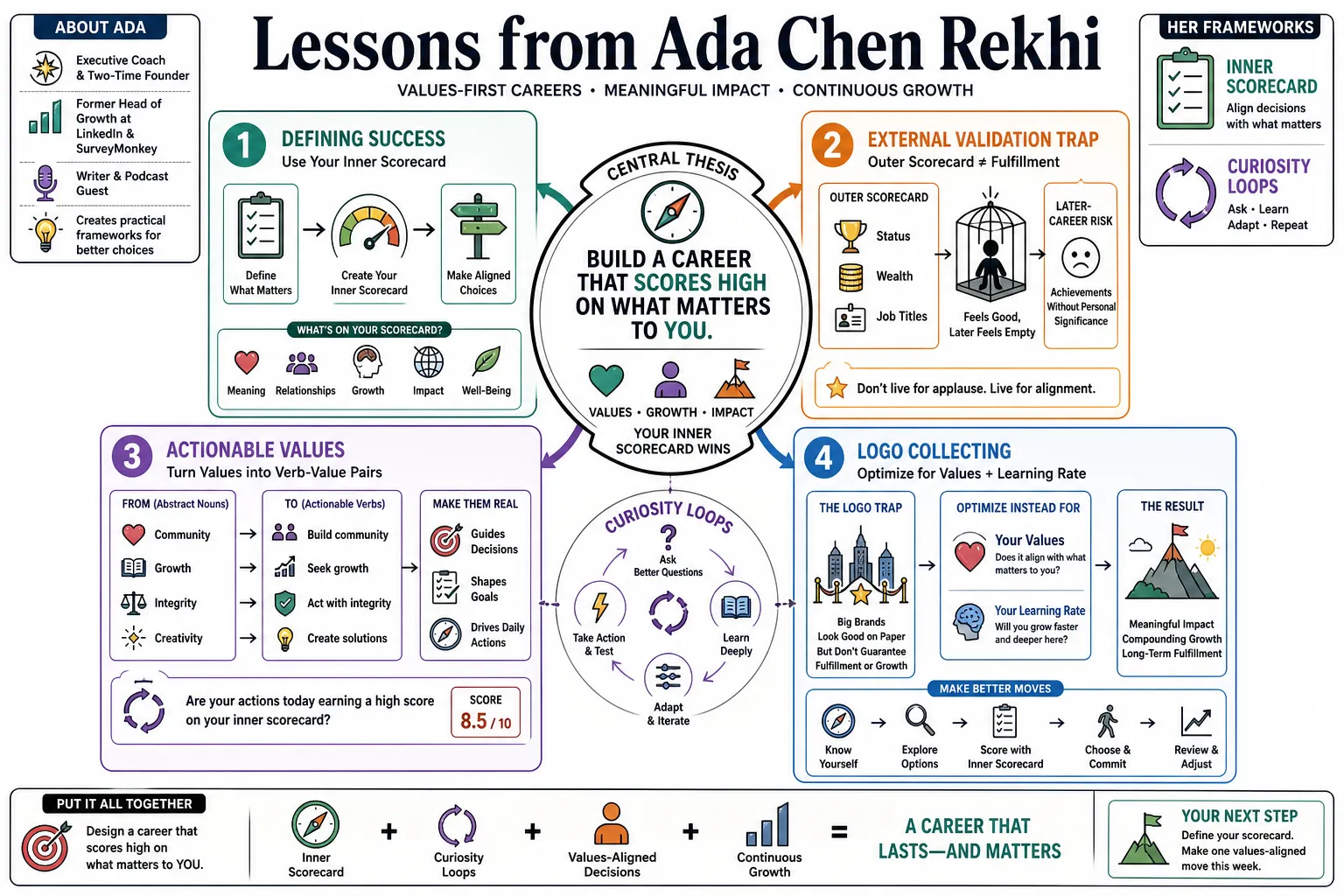
Lessons from Ada Chen Rekhi
Ada Chen Rekhi is an executive coach and Notejoy co-founder who previously held senior marketing roles at LinkedIn and SurveyMonkey. Her work emphasizes structured decision-making, values-aligned careers, and helping founders grow as leaders. — Lenny’s Podcast — How to Make Better Decisions and Build a Joyful Career.
Part 1: The Inner Scorecard and Core Values
- An Inner Scorecard: Define success with a personal rubric grounded in what you genuinely value, rather than in how others rank you. — Build Your Inner Scorecard.
- The Outer-Scorecard Trap: Status, money, and prestige can preserve optionality, but following them without examining what you want can lead to an outwardly successful and inwardly unfulfilling life. — Build Your Inner Scorecard.
- Turn Values Into Guidance: A useful values exercise produces a short, ranked list stated concretely enough to guide real choices. — Build Your Inner Scorecard.
- Choose Alignment Over Logos: Evaluate career opportunities against your values and desired learning, not only the prestige of the employer. — Lenny’s Podcast — How to Make Better Decisions and Build a Joyful Career.
- A Ten-Minute Values Exercise: Highlight and rank a list of values to create a practical inner scorecard in roughly ten to fifteen minutes. — Build Your Inner Scorecard.
- Revisit Values as Life Changes: The values themselves may endure while the way you allocate time among career, health, relationships, and family changes. — Build Your Inner Scorecard.
- Comparison Obscures What You Want: An outer-scorecard orientation makes it easy to compare yourself with others instead of defining your own aims. — Build Your Inner Scorecard.
- Audit the Calendar Against Your Values: Review how you spent the prior week to see whether your time and energy actually reflect the values you ranked. — Build Your Inner Scorecard.
Part 2: Career Navigation and The Explore/Exploit Framework
- Careers Alternate Between Explore and Exploit: Use exploration to test paths and exploitation to deepen a promising one; healthy careers can move between both modes. — Lenny’s Podcast — How to Make Better Decisions and Build a Joyful Career.
- Explore Early and at Transitions: Periods of exploration let you collect varied experiences and discover which work fits before committing deeply. — Lenny’s Podcast — How to Make Better Decisions and Build a Joyful Career.
- Exploit a Strong Fit: When a role, domain, or trajectory is working, stay long enough to compound learning and responsibility. — Lenny’s Podcast — How to Make Better Decisions and Build a Joyful Career.
- Notice When a Role Is Deteriorating: Do not adapt indefinitely to a worsening job; periodically step back and assess whether the environment still serves you. — Lenny’s Podcast — How to Make Better Decisions and Build a Joyful Career.
- Know When to Leave: A decision to leave should consider whether the role still supports the direction, learning, and life you want. — Lenny’s Podcast — How to Make Better Decisions and Build a Joyful Career.
Part 3: Decision Making and Curiosity Loops
- Run a Curiosity Loop: Ask a focused question of a carefully chosen group to gather contextual advice for an important decision. — Make Better Decisions with Curiosity Loops.
- Do Not Lead the Witness: Avoid stating your preferred answer before asking for feedback, because it can bias people toward agreement. — Make Better Decisions with Curiosity Loops.
- Ask Specific, Meaty Questions: A well-formed question gives respondents something concrete to react to and asks them to explain their reasoning. — Make Better Decisions with Curiosity Loops.
- Use Research Methods on Personal Decisions: Ada adapted practices from survey research and customer feedback to gather better evidence for career and life choices. — Lenny’s Podcast — How to Make Better Decisions and Build a Joyful Career.
- Examine Surprising Disagreement: When feedback conflicts with your preferred answer or varies sharply across advisers, inspect the reasons instead of averaging it away. — Make Better Decisions with Curiosity Loops.
- Use Your Network as Decision Data: Knowledgeable people who know you well can surface context and blind spots that solitary reflection misses. — Make Better Decisions with Curiosity Loops.
- Choose Advisers for the Question: Select people for their relevant experience, knowledge of you, or ability to offer a useful perspective. — Make Better Decisions with Curiosity Loops.
- Keep Ownership of the Decision: Assess the input you receive for surprises and patterns; the loop informs your judgment rather than replacing it. — Make Better Decisions with Curiosity Loops.
Part 4: Startup Fundamentals and The Founder Journey
- Expect the Founder Rollercoaster: Founding a company can magnify emotional highs and lows while removing the structure and feedback found in established organizations. — 7 Things No One Tells You About Being a Startup Founder.
- Build for Capturing and Finding Team Knowledge: Notejoy began from observing how context gets lost in email and chat and how often teams repeat work because knowledge remains in personal notes or people’s heads. — IdeaMensch Interview with Ada Chen Rekhi.
- Separate Work and Personal Conversations: Co-founding with a spouse requires deliberate ways to prevent company decisions from consuming the relationship. — Lenny’s Podcast — How to Make Better Decisions and Build a Joyful Career.
- Founders Must Understand the Details: Delegation helps companies scale, but founders should not delegate work they do not yet understand because important detail gets lost. — IdeaMensch Interview with Ada Chen Rekhi.
- Scale Yourself Alongside the Company: As the business grows, founders must develop new capabilities in communication, conflict, and people management. — I’m an Executive Coach.
- Operate Through the Fog of War: Early founders often make consequential choices with limited data, little feedback, and no established map. — 7 Things No One Tells You About Being a Startup Founder.
- Do Not Make the Startup Your Entire Identity: When self-worth tracks company metrics and every criticism feels personal, ordinary business setbacks become emotionally unsustainable. — 7 Things No One Tells You About Being a Startup Founder.
Part 5: Product Marketing and Growth
- Product Marketing Connects Product and Customer: Product marketers accelerate growth by championing the customer, communicating product value, and driving distribution. — What Is Product Marketing?.
- Position Around Distinct Customer Value: Messaging should explain who the product serves, which pain it resolves, and why its value differs from alternatives. — What Is Product Marketing?.
- Stay Close to Customer Evidence: Strong marketers combine research, support conversations, market observation, and product usage knowledge to understand what customers do and why. — Good Marketer / Bad Marketer.
- Define the First Marketing Hire by Outcomes: Start with the one or two business outcomes the hire must achieve, then map those outcomes to the specific skills and experience required. — How to Make Your First Marketing Hire.
- Translate Features Into Meaning: Good product marketing packages features into positioning and messaging that connects the product to a target customer’s motivations and pain. — What Is Product Marketing?.
- Treat Distribution as an Ongoing Discipline: Product marketing owns continued testing, analysis, and optimization of distribution channels rather than treating acquisition as a one-time launch. — What Is Product Marketing?.
Part 6: The Transition to Management
- Cross the Leadership Chasm: The skills that earn an individual-contributor promotion are different from the skills needed to deliver results through other people. — The Leadership Chasm.
- Measure Leadership by Team Outcomes: A manager’s leverage comes from helping the team deliver, grow, and stay unblocked—not from personally producing the old individual-contributor output. — The Leadership Chasm.
- Set Clear Goals Without Dictating the Method: Give people resources, clear outcomes, and constructive feedback while accepting that they may execute differently from you. — The Leadership Chasm.
- Feedback Is Core Leadership Work: Helping people improve through specific constructive feedback is part of a leader’s job, not an optional add-on. — The Leadership Chasm.
- Do Not Become the Super Individual Contributor: New managers can fall into micromanagement by teaching everyone to copy their execution instead of enabling each person’s best work. — The Leadership Chasm.
- Leadership Adds Emotional Work: Founders and executives must navigate loneliness, conflict, changing roles, and the pressure to project confidence while the business is uncertain. — I’m an Executive Coach.
Part 7: Building High-Performing Teams
- Surface Management Friction Early: Interpersonal friction can be a management problem; addressing it directly can strengthen relationships and psychological safety within the leadership team. — What Others Say About Ada’s Coaching.
Part 8: Personal Growth, Suffering, and Achievement
- Use Coaching for Reflection, Not Instructions: A coach can help a leader examine priorities, patterns, and choices without simply prescribing what to do. — I’m an Executive Coach.
- Collect People and Curiosity, Not Only Achievements: Looking back at forty, Ada emphasized following genuine interests and investing in relationships as durable career assets. — Eight Lessons at 40.
- Make Work-Life Tradeoffs Explicit: Leadership can pull time away from health, family, and other roles, so founders need to choose those tradeoffs consciously. — I’m an Executive Coach.
- Treat Founder Impostor Feelings as Predictable: Founders often grow into roles they were never formally trained for; recognizing that pressure can make it easier to address. — 7 Things No One Tells You About Being a Startup Founder.
- Prototype Career Changes: Before making a wholesale leap, run smaller conversations and experiences that test whether a possible path actually fits. — Finding Meaningful Work with Designing Your Life.
- Optimize for a Sustainable Career: Long careers are better served by choices that combine progress with meaning and alignment than by short-term external wins alone. — Lenny’s Podcast — How to Make Better Decisions and Build a Joyful Career.