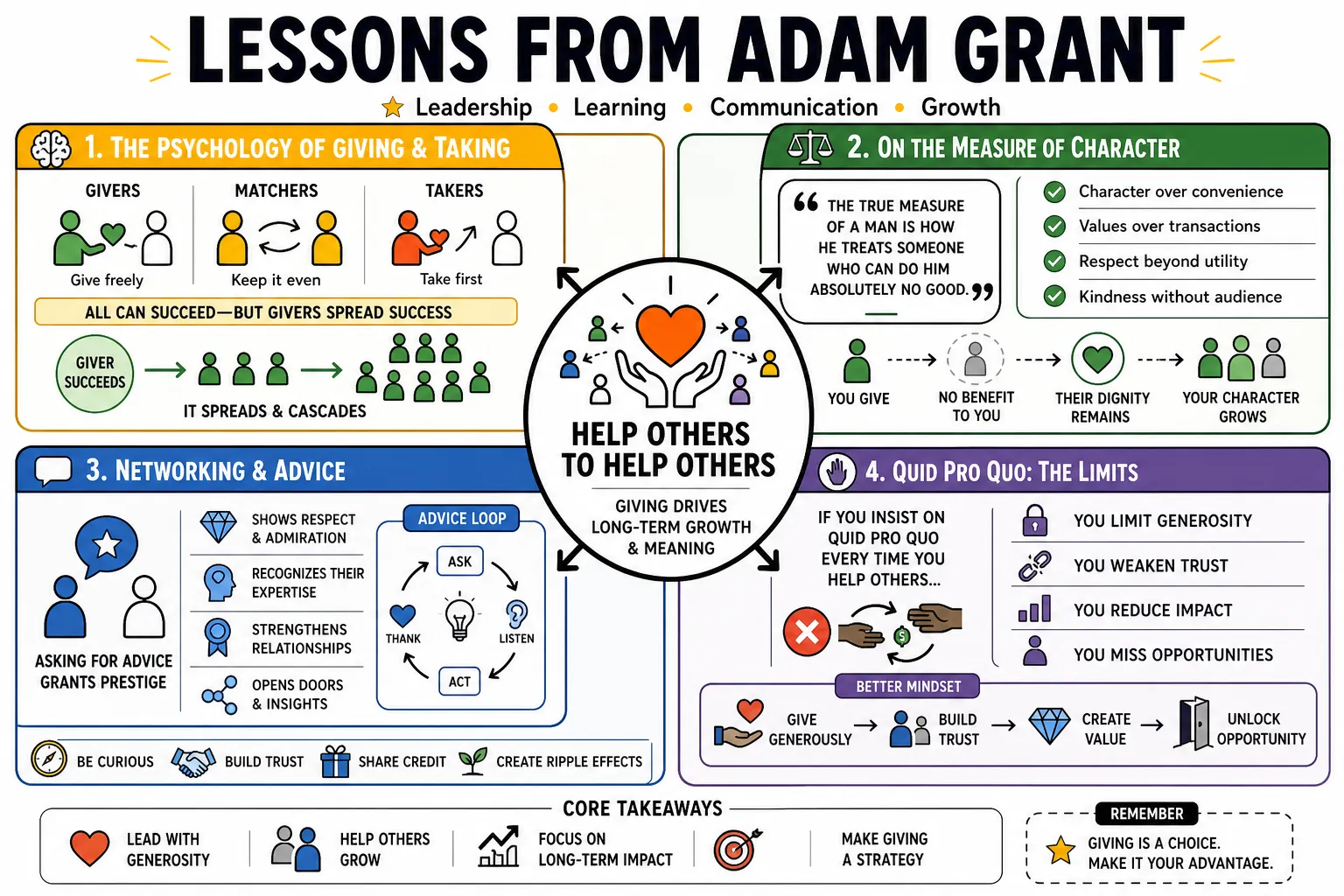
Lessons from Adam Grant
Adam Grant is an organizational psychologist and Wharton professor who studies how people find motivation and meaning at work. His research on reciprocity styles shows that helping others drives long-term career growth better than pure self-interest. This profile organizes his findings on leadership, learning, and communication to help you reevaluate your own work habits. — TED — Adam Grant.
Part 1: The Psychology of Giving and Taking
- On the Impact of Giving: Givers, takers, and matchers all can—and do—achieve success. But there's something distinctive that happens when givers succeed: it spreads and cascades. — Adam Grant — Give and Take.
- On the Strategy of Giving: Giving and taking are based on our motives and values, and they're choices that we make regardless of whether our personalities trend agreeable or disagreeable. — Adam Grant — Give and Take.
- On Networking and Advice: When we ask people for advice, we grant them prestige, showing that we respect and admire their insights and expertise. — Adam Grant — Give and Take.
- On Quid Pro Quo: If you insist on quid pro quo every time you help others, you will have a much narrower network. — Adam Grant — Give and Take.
- On Success and Values: Above all, I want to demonstrate that success doesn't have to come at someone else's expense. — Adam Grant — Give and Take.
- On the Five-Minute Favor: You don't have to be a Mother Teresa or a Gandhi to be a giver. You can just find small ways to add large value to other people's lives. — Adam Grant — Give and Take.
- On Vulnerability in Giving: Givers build deep trust by showing vulnerability, but they must set boundaries to avoid being exploited by takers. — Adam Grant — Give and Take.
- On Matchers: Matchers operate on the principle of fairness: when they help others, they protect themselves by seeking reciprocity. — Adam Grant — Give and Take.
- On Takers and Burnout: Takers often burn bridges by claiming disproportionate credit and exploiting the goodwill of their colleagues. — Adam Grant — Give and Take.
Part 2: Cultivating Originality
- On the Nature of Originality: The hallmark of originality is rejecting the default and exploring whether a better option exists. — TED — The Surprising Habits of Original Thinkers.
- On the Process of Innovation: The biggest barrier to originality is not idea generation—it's idea selection. — TED — The Surprising Habits of Original Thinkers.
- On the Myth of the First Mover: Being original doesn't require being first. It just means being different and better. — TED — The Surprising Habits of Original Thinkers.
- On Taking Action: Ultimately, the people who choose to champion originality are the ones who propel us forward... They feel the same fear, the same doubt, as the rest of us. What sets them apart is that they take action anyway. — TED — The Surprising Habits of Original Thinkers.
- On Dissent: Dissenting opinions are useful even if they are wrong. — TED — The Surprising Habits of Original Thinkers.
- On Conformity: In search of excellence and in fear of failure, most of us opt to fit in rather than stand out. — TED — The Surprising Habits of Original Thinkers.
- On Quantity and Quality: If you want to be more original, the most important thing you can do is generate more ideas. — TED — The Surprising Habits of Original Thinkers.
- On Risk Mitigation: The most successful originals are not the daredevils who leap before they look. They are the ones who reluctantly tiptoe to the edge of a cliff, calculate the rate of descent, triple-check their parachutes, and set up a safety net at the bottom just in case. — TED — The Surprising Habits of Original Thinkers.
- On Procrastination: Procrastination may be the enemy of productivity, but it can be a resource for creativity. — TED — The Surprising Habits of Original Thinkers.
- On Idea Feedback: Creators are often terrible judges of their own work. To evaluate ideas effectively, we need the critical distance of peers. — TED — The Surprising Habits of Original Thinkers.
Part 3: The Power of Rethinking
- On Wisdom: If knowledge is power, knowing what we don't know is wisdom. — Adam Grant — Think Again.
- On Growth: It takes humility to reconsider our past commitments, doubt to question our present decisions, and curiosity to reimagine our future plans. — Adam Grant — Think Again.
- On Learning: We learn more from people who challenge our thought process than those who affirm our conclusions. — Adam Grant — Think Again.
- On Intellectual Flexibility: My attachment to my ideas is provisional. There's no unconditional love for them. — Adam Grant — Think Again.
- On Debates: In a heated argument, you can always stop and ask, 'What evidence would change your mind?' If the answer is 'nothing,' then there's no point in continuing the debate. — Adam Grant — Think Again.
- On Intelligence: Intelligence is traditionally viewed as the ability to think and learn. Yet in a turbulent world, there's another set of cognitive skills that might matter more: the ability to rethink and unlearn. — Adam Grant — Think Again.
- On Scientific Thinking: Thinking like a scientist means viewing your ideas as hypotheses to be tested rather than beliefs to be defended. — Adam Grant — Think Again.
- On Identity: When you tie your identity to your opinions, changing your mind feels like losing yourself. Detach your self-worth from your beliefs. — Adam Grant — Think Again.
- On Confident Humility: You can be confident in your capacity to reach a goal while maintaining the humility to question your methods. — Adam Grant — Think Again.
- On the Comfort of Conviction: We often prefer the comfort of conviction over the discomfort of doubt, which leaves our beliefs brittle and rigid. — Adam Grant — Think Again.
Part 4: Unlocking Hidden Potential
- On Character: Personality is your predisposition—your basic instincts for how to think, feel, and act. Character is your capacity to prioritize your values over your instincts. — Adam Grant — Hidden Potential.
- On Growth and Mistakes: The best cure to feeling uncomfortable about making mistakes is to make more mistakes. — Adam Grant — Hidden Potential.
- On Nurture vs. Nature: People who make major strides are rarely freaks of nature. They're usually freaks of nurture. — Adam Grant — Hidden Potential.
- On Kindness vs. Politeness: Being polite is withholding feedback to make someone feel good today. Being kind is being candid about how they can get better tomorrow. — Adam Grant — Hidden Potential.
- On Motivation: Motivation isn't always innate; it frequently begins with a coach or teacher who turns learning into an engaging pursuit. — Adam Grant — Hidden Potential.
- On Scaffolding: Instead of relying purely on willpower, build scaffolding—temporary support systems and trusted coaches that help sustain your momentum. — Adam Grant — Hidden Potential.
- On the Value of Discomfort: Discomfort is not a sign of failure; it is an early indicator of progress and skill acquisition. — Adam Grant — Hidden Potential.
- On Measuring Progress: The true test of potential is not the peak of your success, but the distance you have traveled from your starting point. — Adam Grant — Hidden Potential.
- On Late Bloomers: We vastly underestimate what people can achieve over time when they are given the right environment to deliberately practice character skills. — Adam Grant — Hidden Potential.
Part 5: Leadership and Management
- On Handling Critics: Weak leaders silence their critics and make themselves weaker. Strong leaders invite dissenting voices to make themselves stronger. — WorkLife — How to Love Criticism.
- On Intrinsic Rewards: Leaders over-rely on extrinsic carrots like money and titles. Intrinsic motivation—fostering connection and meaning—is far more sustainable. — WorkLife — Burnout Is Everyone’s Problem.
- On the Challenge Network: Instead of surrounding yourself with yes-men, build a challenge network: trusted colleagues explicitly empowered to point out your blind spots. — Adam Grant — Think Again.
- On Coaching: A leader's primary job is not to dictate execution but to act as a coach, guiding individuals to realize their capabilities. — WorkLife — Burnout Is Everyone’s Problem.
- On Brainstorming Flaws: The wisdom of crowds mostly comes when you put people in separate rooms and get their judgment independently before bringing them together. — WorkLife — How to Love Criticism.
- On Leading by Example: Leaders who model vulnerability create psychological safety, allowing their teams to innovate without fear of retribution. — WorkLife — Is It Safe to Speak Up at Work?.
- On Success and Failure: The greatest originals are the ones who fail the most, because they're the ones who try the most. — TED — The Surprising Habits of Original Thinkers.
Part 6: Building a Better Work Culture
- On Culture Fit: Hiring for 'culture fit' often leads to homogeneity and groupthink. Organizations should hire for 'cultural contribution' instead. — WorkLife — The Wrong Way to Think About Culture Fit.
- On Psychological Safety: A healthy culture is one where people feel safe raising problems without fear of punishment, and are encouraged to challenge the consensus. — WorkLife — Is It Safe to Speak Up at Work?.
- On Meaningful Work: The most meaningful way to succeed is to help others succeed. — Adam Grant — Give and Take.
- On Burnout and Intensity: High performance does not require endless volume. Managing the intensity of your focus is what prevents burnout. — WorkLife — Burnout Is Everyone’s Problem.
- On Abandoning Old Tools: A hallmark of wisdom is knowing when it's time to abandon some of your most treasured tools—and some of the most cherished parts of your identity. — Adam Grant — Think Again.
- On Remote Work Autonomy: Trusting employees with autonomy over when and where they work frequently boosts both morale and productivity. — WorkLife — Returning to the Office.
- On Eliminating Hustle Culture: Success is not measured by the sheer number of hours worked, but by the focused attention given to tasks that actually matter. — WorkLife — Burnout Is Everyone’s Problem.
Part 7: Feedback, Advice, and Communication
- On the Feedback Sandwich: The compliment sandwich usually fails. Positives fall on deaf ears when people are bracing for the negative, or the negative gets drowned out by recency. — Adam Grant — Stop Serving the Compliment Sandwich.
- On Seeking Advice: Instead of seeking feedback, you're better off asking for advice. Feedback tends to focus on how well you did last time. Advice shifts attention to how you can do better next time. — Adam Grant — Stop Serving the Compliment Sandwich.
- On Defensive Reactions: When you get defensive about feedback, you fail twice. You fail to learn today, and you fail to encourage people to keep teaching you tomorrow. — Adam Grant — Stop Serving the Compliment Sandwich.
- On the Second Score: Adopt a 'second score' mentality: even if your initial performance was flawed, you can still earn a perfect score on how well you receive the critique. — WorkLife — How to Love Criticism.
- On Delivering Difficult Truths: Frame hard feedback clearly: 'I’m giving you these comments because I have very high expectations, and I’m confident that you can reach them.' — Adam Grant — Stop Serving the Compliment Sandwich.
- On Active Listening: Listening is not just about waiting for your turn to speak; it is a process of genuine inquiry aimed at understanding another's worldview. — WorkLife — How to Love Criticism.
- On Evaluative Phrasing: Phrasing questions as 'What is one thing I could do differently?' removes the sting of judgment and opens the door to actionable coaching. — Adam Grant — Stop Serving the Compliment Sandwich.
- On Recognizing Expertise: Before accepting a critique, evaluate the source: Does this person understand the context, and do they genuinely want me to succeed? — WorkLife — How to Love Criticism.
Part 8: Motivation and Career Success
- On Passion: Don't just follow your passion. Look for the work where you can learn the most, because growth is often more rewarding than chasing a static interest. — WorkLife — The Perils of Following Your Career Passion.
- On Underconfidence: A healthy degree of 'underconfidence' can act as a catalyst for a growth mindset, prompting you to double-check your work and remain open to alternatives. — Adam Grant — Think Again.
- On Authenticity: Authenticity means erasing the gap between what you firmly believe inside and what you reveal to the outside world. — WorkLife — Authenticity Is a Double-Edged Sword.
- On Dormant Ties: When you need new opportunities, reconnect with your 'dormant ties'—people you haven't spoken to in years who possess entirely different networks and perspectives. — Adam Grant — Give and Take.
- On Reevaluating Goals: Don't get trapped by the sunk cost fallacy. It is better to walk away from a career path that makes you miserable than to continue investing in a mistake. — WorkLife — How to Rethink a Bad Decision.
- On Sustained Success: The people who achieve the highest levels of sustained success are those who continuously seek ways to expand the pie for everyone around them. — Adam Grant — Give and Take.