Adam Guild is the co-founder and CEO of Owner, a software company serving independent restaurants. He began building online projects as a teenager, left high school while scaling a Minecraft business, and later developed Owner after helping his mother’s local business attract customers online. His interviews trace a path from manual outbound discovery through a pandemic-driven product pivot, integrated restaurant software, team building, and continuous self-education. — First Round In Depth: Adam Guild.
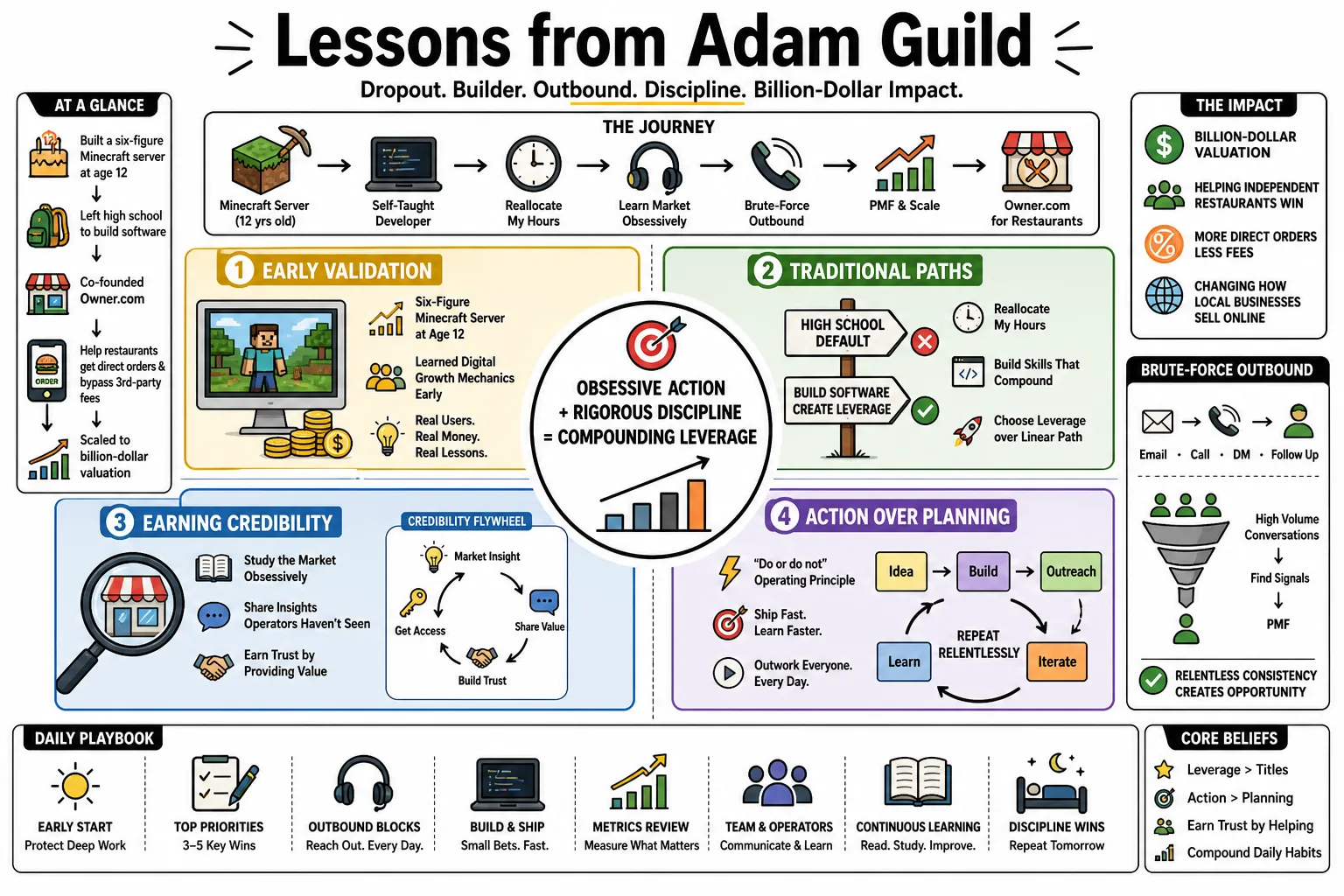
Part 1: Early Entrepreneurship & Mindset
- Early entrepreneurship: Guild started a Minecraft server at 12 and scaled it to millions of players and hundreds of thousands of dollars in profit by age 16, learning software engineering and growth marketing in the process. — First Round In Depth: Adam Guild.
- Replace school with self-directed learning: Guild left high school while scaling the Minecraft business, then deliberately intensified his self-education through books, courses, and business podcasts. — First Round In Depth: Adam Guild.
- Earn authority through useful expertise: After cold outreach repeatedly failed, Guild researched restaurant growth, wrote an extensively researched industry article, and used successful guest publishing to become a trusted marketing authority. — First Round In Depth: Adam Guild.
- Constraints sharpen resourcefulness: Bootstrapping Owner forced Guild to rely on direct outreach, hands-on customer work, and content before venture capital accelerated product and team investment. — First Round In Depth: Adam Guild.
- Learn from the communities you build: Running Minecraft servers exposed Guild to millions of players, community growth, software engineering, and the ethical downside of products optimized around highly engaged users. — First Round In Depth: Adam Guild.
- Follow the customer problem, even through a pivot: When the pandemic erased Owner’s dine-in business, Guild called former customers, heard the urgency around delivery fees, and rebuilt the product around direct online ordering. — First Round In Depth: Adam Guild.
- Turn one customer result into credibility: Owner’s earliest restaurant result became a proof point that improved later outreach; Guild personally handled sales and customer success to keep learning from those customers. — First Round In Depth: Adam Guild.
Part 2: Discovering the Market Problem
- Start with a real person’s problem: The first version of Owner grew from Guild helping his mother’s struggling dog-grooming business use local SEO and conversion improvements to attract customers. — First Round In Depth: Adam Guild.
- Transfer a working mechanism to a larger market: After the dog-grooming experiment worked, Guild researched local-business categories and chose restaurants as the largest group with an urgent need to succeed online. — First Round In Depth: Adam Guild.
- Listen beyond the first requested solution: Restaurant owners initially asked Guild to drive dine-in traffic rather than fix online ordering; he later concluded he had taken that proposed solution too literally instead of solving the deeper problem. — First Round In Depth: Adam Guild.
- Protect direct customer economics: Restaurants told Guild that delivery platforms took roughly 30% of orders and controlled the customer relationship, while restaurant profit margins were often far thinner. — First Round In Depth: Adam Guild.
- Give independents the digital capabilities of chains: Owner’s strategy is to equip independent restaurants with integrated discovery, ordering, loyalty, and marketing capabilities that large chains have spent heavily to build. — Owner Series C Memo.
- Look for pressing functional and emotional needs: Guild defines product-market fit as meeting pressing customer needs both functionally and emotionally; the delivery-fee crisis made that need unusually clear for restaurants. — First Round In Depth: Adam Guild.
- Reduce the technical burden on local owners: Owner’s thesis is that local businesses need a system that manages their online presence and growth without requiring each owner to assemble and operate many separate tools. — Owner Series C Memo.
- Own the direct customer relationship: Guild contrasts direct ordering with delivery platforms where restaurants lose both margin and customer relationships; Owner combines ordering data with CRM, email, and text marketing. — First Round In Depth: Adam Guild.
- Choose a market large enough for the mission: Guild selected independent restaurants because the category was large enough to support the company and provide a proving ground for eventually serving other local businesses. — Owner Series C Memo.
Part 3: Building Owner.com & The Pivot
- Use rough early versions to learn: Owner’s first restaurant product was a manually delivered website and local-search service; Guild stayed close to early customers through weekly updates and direct support. — First Round In Depth: Adam Guild.
- Let a crisis expose the real job to be done: COVID eliminated Owner’s dine-in value proposition, prompting Guild to refocus the website product around direct online ordering within weeks. — First Round In Depth: Adam Guild.
- Build a platform, not another isolated tool: Owner positions itself as an integrated growth system for local businesses, beginning with restaurants and expanding from websites and ordering into loyalty, marketing, and AI assistance. — Owner Series C Memo.
- Integrate products around the customer outcome: Customer conversations led Owner to combine online ordering, websites, CRM, email, and text marketing because the products reinforced one another and more consistently drove profitable sales growth. — First Round In Depth: Adam Guild.
- Design direct ordering around restaurant margin: Owner’s direct-ordering product was built to help restaurants avoid high marketplace commissions while giving guests a clearer value and convenience reason to order directly. — First Round In Depth: Adam Guild.
- Automate marketing from first-party data: Guild explains that integrating online-ordering data with CRM, email, and text marketing lets Owner automate messages that bring customers back and drive more direct orders. — First Round In Depth: Adam Guild.
- Expand from a successful wedge: Owner evolved from restaurant websites to direct online ordering, then bundled CRM, email, text, loyalty, and other tools after customers asked for a more complete system. — First Round In Depth: Adam Guild.
Part 4: Outbound Sales & Scrappy Growth
- Do direct discovery before scaling acquisition: Guild knocked on restaurant doors and sent thousands of cold emails, using the conversations to understand operators before Owner had a repeatable acquisition engine. — First Round In Depth: Adam Guild.
- Begin outreach as discovery: Guild avoided opening with a sales request; he approached owners as a learner, asked how they thought about online growth, and explained that he first needed to understand what had failed. — First Round In Depth: Adam Guild.
- Use founder-led sales to learn the journey: Guild sees an early sales-led motion as valuable because it forces founders to speak with customers throughout the journey and understand the product’s perceived value. — First Round In Depth: Adam Guild.
- Expect rejection before the first proof point: Guild was rejected hundreds of times before an early restaurant owner tried the product; that customer result then improved his credibility in later outreach. — First Round In Depth: Adam Guild.
- Bootstrap with manual work before building leverage: Owner’s first customers came from door knocking, cold email, cold texting, manual implementation, and founder-led support before content and product-led acquisition improved efficiency. — First Round In Depth: Adam Guild.
- Change the value proposition when the pain changes: Owner moved from helping restaurants drive dine-in demand through SEO to helping them capture direct online orders and avoid marketplace fees when COVID transformed the market. — First Round In Depth: Adam Guild.
Part 5: Product-Market Fit & Scaling
- Recognize product-market fit through urgent demand: After Owner launched direct ordering, demand exceeded Guild’s ability to run demos and the company went from nearly no customers or revenue to thousands of customers within months. — First Round In Depth: Adam Guild.
- Use capital to accelerate a validated direction: Owner raised its first venture round after direct ordering began showing strong demand; the funding expanded engineering, sales, and support rather than creating the initial customer need. — First Round In Depth: Adam Guild.
- Add adjacent products when they strengthen the core outcome: Owner added websites, CRM, email, text, and loyalty because customers wanted fewer fragmented tools and the combined products improved profitable sales growth. — First Round In Depth: Adam Guild.
- Treat the first vertical as a proving ground: Owner reports serving more than 10,000 restaurant owners while describing restaurants as the initial proving ground for a broader local-business platform. — Owner Series C Memo.
Part 6: Restaurant Marketing Tactics
- Distinguish attention from local purchase intent: Guild learned that social engagement could be a vanity metric for a local business: global likes did not translate into customers within his mother’s roughly five-mile service area. — First Round In Depth: Adam Guild.
- Match acquisition to geographic intent: Guild found local SEO effective because it captured people searching for a specific service in a specific city, unlike globally distributed social-media attention. — First Round In Depth: Adam Guild.
- Treat Google Business Profile as core local infrastructure: Owner’s local SEO guidance recommends complete and accurate business details, menu and ordering links, photos, reviews, and regular profile maintenance. — Owner: Local SEO for Restaurants.
- Connect first-party data to repeat marketing: Owner combines order data with CRM, email, and text tools so restaurants can automate relevant follow-up and generate more direct orders. — First Round In Depth: Adam Guild.
- Give guests a reason to order directly: Guild says direct ordering must win on value or convenience; Owner paired lower fees with loyalty rewards so guests received a tangible benefit for returning directly. — First Round In Depth: Adam Guild.
- Make menus mobile and conversion friendly: Owner’s website guidance recommends readable, mobile-friendly menus with strong imagery and direct ordering rather than PDF-only or high-friction experiences. — Owner: How to Build a Restaurant Website.
- Arm independents to compete with chains: Owner’s mission is to give local restaurants the digital system—discovery, ordering, loyalty, and marketing—that large chains use to acquire and retain customers. — Owner Series C Memo.
- Trigger marketing from customer behavior: Guild describes email and text automation working from online-ordering and website data so restaurants can drive repeat visits without manually operating separate systems. — First Round In Depth: Adam Guild.
- Use marketplaces for discovery, then win the direct relationship: Guild points to large restaurant brands that appear on delivery marketplaces for acquisition but make their own app or direct channel more convenient and valuable for repeat ordering. — Restaurant Unstoppable #1036 Transcript.
- Remove friction from the restaurant website: Owner recommends a mobile-friendly, easy-to-read website centered on menus and direct ordering, with content owners can keep accurate without technical work. — Owner: How to Build a Restaurant Website.
Part 7: Hiring, Culture, & Leadership
- Treat team quality as the company’s ceiling: Guild says the team a founder builds determines the company they build, and that finding people with distinct superpowers matters more than remaining the hero of every function. — First Round In Depth: Adam Guild.
- Give people context and expect ownership: Owner’s culture page says team members receive freedom and information to make decisions, are trusted to act like owners, and are expected to improve the business. — Owner Careers: Culture and Ownership.
- Keep upgrading yourself as the company scales: Guild sets aside substantial time for books, courses, and podcasts because he expects the next stage of the company to require a more capable version of himself. — First Round In Depth: Adam Guild.
Part 8: Personal Performance & Habits
- Be urgent with habits and patient with outcomes: Guild argues that reading, meditation, healthy eating, measurement, and consistent execution compound over time even when the benefits are not immediately visible. — Adam Guild: Patient With the Outcome, Urgent With the Process.
- Treat every problem as partly yours to improve: Owner’s culture defines ownership as refusing to dismiss problems as someone else’s job and taking responsibility for improving systems and the company. — Owner Careers: Culture and Ownership.