Adam Marblestone is a biophysicist and cofounder and CEO of Convergent Research, where he helped establish focused research organizations: finite, startup-like nonprofit teams that build enabling scientific tools, datasets, and platforms. His work also spans connectomics, molecular recording, NeuroAI, and the design of research institutions. — Issues in Science and Technology — Field Notes on Moving Focused Research Organizations Forward.
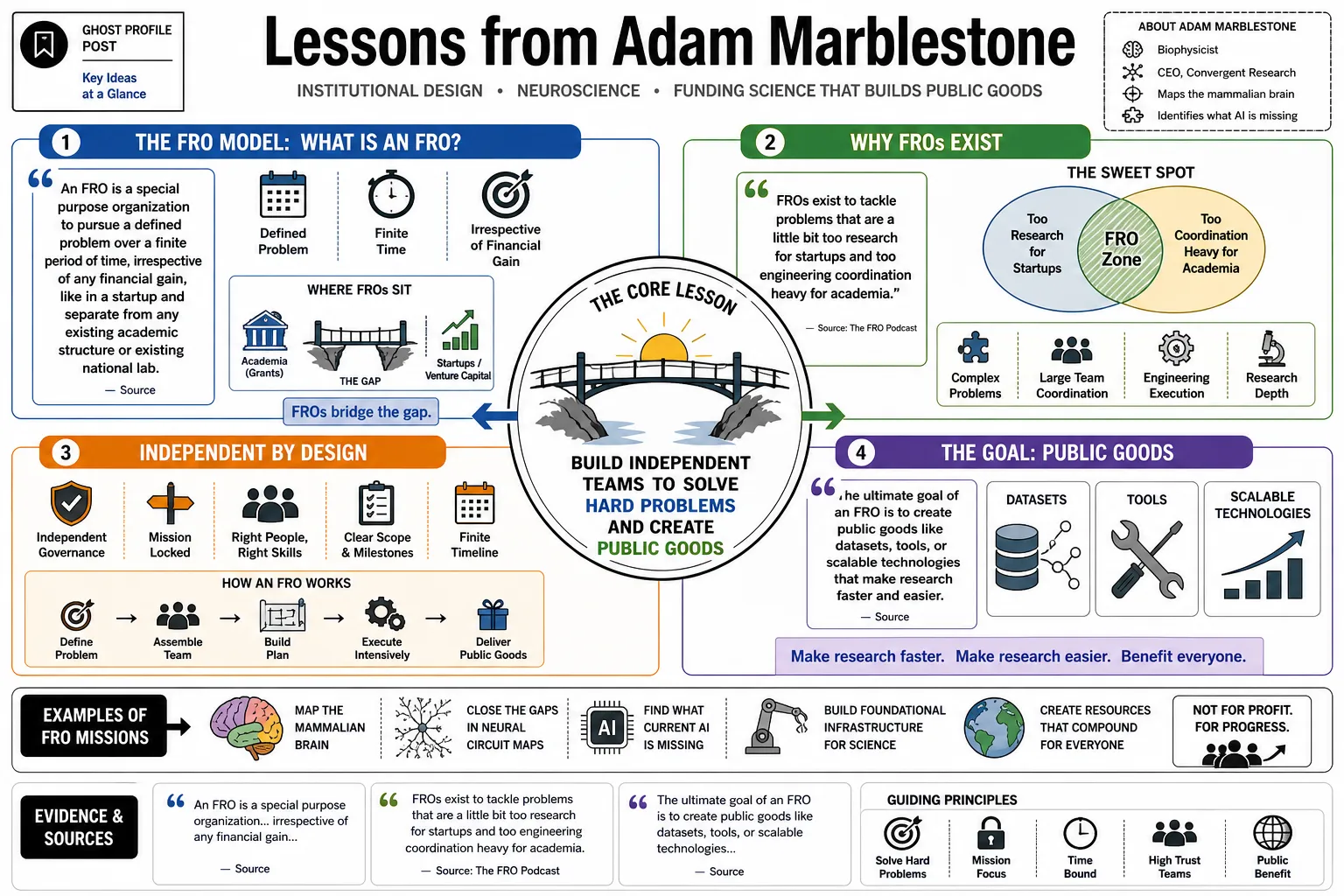
Part 1: The Focused Research Organization (FRO) Model
- Define the Mission and the End Date: A focused research organization is a special-purpose team created to solve a defined problem over a finite period, outside an existing academic lab or national laboratory. — Idea Machines — Focusing on Research with Adam Marblestone.
- Use FROs for the Institutional Gap: FROs target work that is too research-oriented for a startup yet too dependent on coordinated engineering for a conventional academic lab. — Idea Machines — Focusing on Research with Adam Marblestone.
- Build Public Scientific Infrastructure: The most suitable FRO outputs are enabling tools, datasets, and platforms that other researchers can use. — Issues in Science and Technology — Field Notes on Moving Focused Research Organizations Forward.
- Organizational Independence: FROs should operate as stand-alone moonshot organizations insulated from both academic and commercial incentive structures. — How to Build Essential Technology.
- Engineering Intensity: Academics can rarely muster the time, focus, and workforce coordination needed to turn a proof-of-principle technology into a reliable, scalable technique. — Issues in Science and Technology — Field Notes on Moving Focused Research Organizations Forward.
- Project Scope: Not everything should be a FRO; they are meant only for specific, time-limited engineering efforts that do not fit anywhere else. — How to Build Essential Technology.
- Startup Parallels: While FROs operate with the intensity of startups, they are accountable to their funders rather than shareholders. — How to Build Essential Technology.
- Design the Transition at the Start: An FRO is organized around a finite goal and should plan from the beginning where its technology and team will go after that goal is met. — Issues in Science and Technology — Field Notes on Moving Focused Research Organizations Forward.
- Match the Team to Bridge-Scale Science: FROs use integrated teams of roughly 10 to 30 people for projects too large for one lab but smaller than national megaprojects. — Issues in Science and Technology — Field Notes on Moving Focused Research Organizations Forward.
Part 2: Structural Gaps in Science Funding
- Engineering In Biology: The tools that allow us to ask fundamental biological questions often require massive, unglamorous engineering efforts that no grant wants to fund. — How to Build Essential Technology.
- Bridge the Engineering Valley of Death: FROs can support research infrastructure that needs substantial coordinated engineering but lacks a venture-scale business model. — Existential Hope — Adam Marblestone on Solving Science’s Biggest Gaps.
- Fund Capabilities, Not Only Hypotheses: Some scientific bottlenecks require building a measurement system, dataset, or platform rather than testing one academic hypothesis. — Issues in Science and Technology — Field Notes on Moving Focused Research Organizations Forward.
- Use Stable, Integrated Engineering Teams: A rotating academic lab is often a poor fit for infrastructure that needs sustained interdisciplinary engineering and program management. — Issues in Science and Technology — Field Notes on Moving Focused Research Organizations Forward.
- Do Not Force Public Goods into a Venture Model: Venture capital is poorly aligned with broadly accessible research tools whose value is distributed across an entire field. — Existential Hope — Adam Marblestone on Solving Science’s Biggest Gaps.
- Change the Organization, Not Only the Budget: More scientific funding is not sufficient when the missing capability requires a different operating structure. — Issues in Science and Technology — Field Notes on Moving Focused Research Organizations Forward.
Part 3: Brain Mapping and the Rosetta Brain
- Build Rosetta Stone Brain Datasets: Connectomics becomes more informative when wiring diagrams can be linked to molecular annotations and transcriptomic cell types in the same tissue. — Rosetta Brains: A Strategy for Molecularly-Annotated Connectomics.
- Annotate Connections with Molecular Context: A wiring diagram alone omits molecular information—such as cell-type markers and ion-channel placement—that matters for interpreting and simulating circuits. — Rosetta Brains: A Strategy for Molecularly-Annotated Connectomics.
- Connect Multiple Measurement Modalities: Rosetta Stone datasets should link connectomic, molecular, and transcriptomic measurements rather than leaving each modality isolated. — E11 Bio — Roadmap to Whole-Brain Connectomics.
- Treat Measurement as a Core Bottleneck: Theoretical progress in neuroscience is constrained when researchers cannot cheaply observe the detailed structure of real brains. — Juan Benet Podcast — Mapping the Brain with Adam Marblestone.
- Use Molecular Labels to Scale Brain Mapping: Sequencing-based molecular labels can help identify cells and connections at scales that are difficult to reach with electrodes alone. — Rosetta Brains: A Strategy for Molecularly-Annotated Connectomics.
- Organize Whole-Brain Mapping as an Engineering Program: Whole-brain connectomics requires coordinated advances in labeling, imaging, computation, storage, and automation. — E11 Bio — Roadmap to Whole-Brain Connectomics.
- Record Activity in Molecules: Molecular recording aims to write aspects of cellular activity into durable biological substrates that can later be read at scale. — Juan Benet Podcast — Mapping the Brain with Adam Marblestone.
- Reverse Engineering Biology: You cannot successfully reverse-engineer a complex system if you are only allowed to measure one variable at a time. — Juan Benet Podcast — Mapping the Brain with Adam Marblestone.
- Roadmap Around Physical Constraints: Dense brain tissue makes mapping a coupled problem in labeling, optics, sample processing, computation, and data handling. — Juan Benet Podcast — Mapping the Brain with Adam Marblestone.
Part 4: Neuroscience and Biological Intelligence
- Expect Biology to Compute Differently from Silicon: Brains combine architecture, local learning rules, cost functions, and biological dynamics rather than implementing one uniform artificial-network recipe. — Dwarkesh Podcast — Adam Marblestone on AI and the Brain.
- Study How Brains Learn Efficiently: A central NeuroAI question is how evolved architectures and learning signals let animals acquire useful behavior with different data and energy constraints than today’s models. — Dwarkesh Podcast — Adam Marblestone on AI and the Brain.
- Do Not Assume We Understand the Brain’s World Model: The brain appears to learn internal representations, but Marblestone emphasizes that their form—and whether they resemble symbolic variables or geometric maps—remains unresolved. — Dwarkesh Podcast — Adam Marblestone on AI and the Brain.
- Look Beyond Next-Token Prediction: Marblestone argues that understanding biological intelligence requires examining architecture, learning rules, initialization, and cost functions—not only prediction objectives. — Dwarkesh Podcast — Adam Marblestone on AI and the Brain.
- Account for Evolutionary Priors: Brains do not begin as blank slates: evolution supplies innate circuitry and learning signals that shape what later experience can teach. — Dwarkesh Podcast — Adam Marblestone on AI and the Brain.
Part 5: The Missing Primitives of AI
- Connect Learned Concepts to Innate Drives: One unresolved problem is how evolution wires learned, high-level representations to innate rewards and aversions without knowing those representations in advance. — Dwarkesh Podcast — Adam Marblestone on AI and the Brain.
- Compare Whole Learning Systems, Not One Objective: Biological intelligence combines multiple subsystems for perception, action, memory, reward, and learning; it should not be reduced to next-token prediction. — Dwarkesh Podcast — Adam Marblestone on AI and the Brain.
- Search for Missing Architectural Ingredients: Marblestone’s NeuroAI agenda asks which combinations of architecture, learning rules, and cost functions are present in brains but absent from current AI. — Dwarkesh Podcast — Adam Marblestone on AI and the Brain.
- Treat Neuromodulation as Part of the Learning System: Chemical signals and subcortical systems can change how biological circuits learn and act, making them relevant when comparing brains with artificial networks. — Dwarkesh Podcast — Adam Marblestone on AI and the Brain.
- Continual Learning Is Still Mechanistically Unclear: The hippocampus, replay, consolidation, and multiple timescales of plasticity are plausible pieces of continual learning, but Marblestone stresses that the mechanism is not settled. — Dwarkesh Podcast — Adam Marblestone on AI and the Brain.
- Separate Memory Systems: The brain clearly separates working memory from long-term storage, using the hippocampus to index and consolidate information over time. — Dwarkesh Podcast — Adam Marblestone on AI and the Brain.
- Expect Algorithmic Diversity: Different brain regions appear to implement distinct computations and learning dynamics rather than one homogeneous neural algorithm. — Dwarkesh Podcast — Adam Marblestone on AI and the Brain.
- Use Neuroscience to Expand the AI Design Space: Studying brain architecture, learning rules, and cost functions can reveal design possibilities that standard machine-learning abstractions overlook. — Dwarkesh Podcast — Adam Marblestone on AI and the Brain.
Part 6: Ecosystem Design and Metascience
- Treat Scientific Institutions as Designed Systems: Research organizations are shaped by incentives and historical evolution, so institutional experiments can test better ways to build scientific capabilities. — Idea Machines — Focusing on Research with Adam Marblestone.
- Roadmap Before Launching the Program: Technology roadmaps help distinguish projects ready for a focused engineering organization from earlier problems that still require conceptual exploration. — Juan Benet Podcast — Mapping the Brain with Adam Marblestone.
- Use Philanthropy for Shared Infrastructure: Philanthropic capital can fund enabling scientific infrastructure whose benefits are broad and difficult for one company to capture. — Issues in Science and Technology — Field Notes on Moving Focused Research Organizations Forward.
- Coordinating Talent: The most valuable resource in science is not money, but the ability to tightly coordinate elite talent around a highly specific goal. — Idea Machines — Focusing on Research with Adam Marblestone.
- Measure Whether the Tools Spread: An FRO should plan for dissemination and transition so that its tools, data, or methods reach the researchers and institutions able to extend their use. — Issues in Science and Technology — Field Notes on Moving Focused Research Organizations Forward.
- Alternative Incentive Structures: We have to build career paths for scientists where they are rewarded for engineering reliable tools, rather than exclusively for publishing novel papers. — Idea Machines — Focusing on Research with Adam Marblestone.
Part 7: Engineering vs. Discovery in Biology
- Prioritize Enabling Techniques: Marblestone invokes Sydney Brenner’s hierarchy—new techniques, then discoveries, then ideas—to emphasize how better tools can open entire scientific fields. — How to Build Essential Technology.
- Build Tools That Let Others Ask Better Questions: FROs focus on constructing enabling infrastructure that expands the experiments and questions available to the wider research community. — How to Build Essential Technology.
- Recognize Engineering Bottlenecks: Important scientific fields can be blocked by missing instruments, datasets, and platforms even when researchers have abundant hypotheses. — How to Build Essential Technology.
- Make Biological Tools Reproducible and Scalable: Cultivarium builds open tools, protocols, and datasets so work with non-model organisms becomes less bespoke and more reusable. — Cultivarium — Why Is It So Hard to Do Research on Non-Model Microorganisms?.
- Value Standardization Work: Characterizing organisms, protocols, and tools may be less glamorous than a discovery paper, but it can make a much larger research community productive. — Cultivarium — Why Is It So Hard to Do Research on Non-Model Microorganisms?.
- Separation Of Concerns: We need to separate the people who invent new biological tools from the people who must engineer those tools to be reliable. — How to Build Essential Technology.
- Hardware For Biology: We lack the fundamental hardware devices necessary to manipulate and observe biological systems at the required speed and scale. — How to Build Essential Technology.
- Exploit Engineering Overhangs: Some high-value projects need less of a new scientific insight than a coordinated effort to turn known principles into a reliable system. — How to Build Essential Technology.
Part 8: The Future of Scaling Research
- Make the Model Repeatable: Convergent Research is testing whether FROs can become a repeatable organizational format across fields rather than a one-off exception. — Issues in Science and Technology — Field Notes on Moving Focused Research Organizations Forward.
- Accelerating Progress: If we can solve the institutional bottlenecks, we can dramatically accelerate the pace of scientific discovery across all disciplines. — Existential Hope — Adam Marblestone on Solving Science’s Biggest Gaps.
- Experiment Between Academia and Industry: FROs illustrate a useful institutional space between academic labs, permanent public research centers, and venture-backed companies. — Issues in Science and Technology — Field Notes on Moving Focused Research Organizations Forward.
- Integration Of AI And Wet Labs: The next frontier of research will require deeply integrating artificial intelligence with high-throughput biological wet labs. — Existential Hope — Adam Marblestone on Solving Science’s Biggest Gaps.
- Bridge Research to Usable Infrastructure: FROs are designed to carry enabling technologies through coordinated engineering until scientists can actually adopt them. — Idea Machines — Focusing on Research with Adam Marblestone.