Adam Mosseri leads Instagram and previously ran Facebook’s News Feed. His work spans ranking systems, creator products, messaging and video, platform safety, artificial intelligence, and the launch and maturation of Threads. — YouTube — Adam Mosseri on AI, Product Teams, and Authenticity.
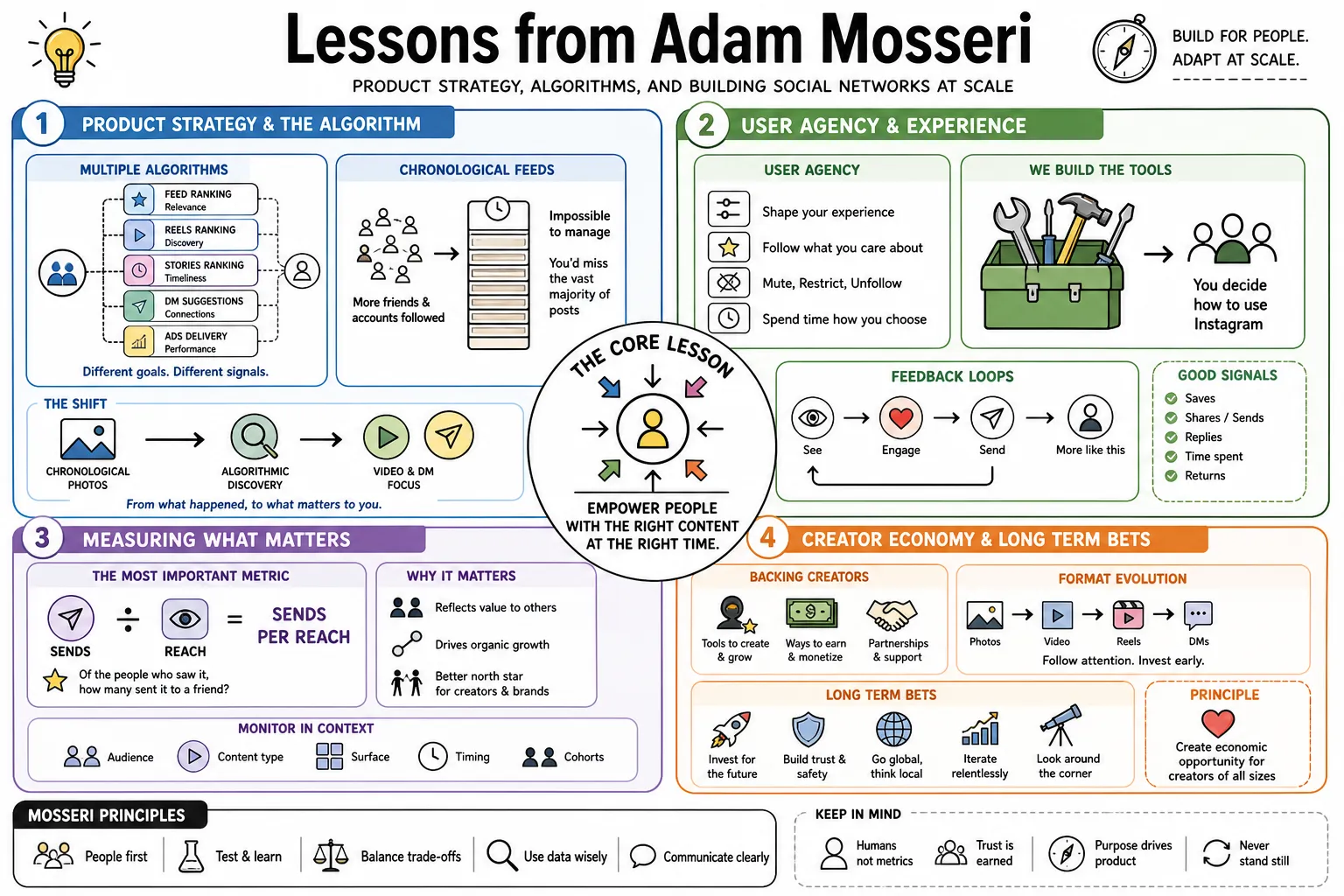
Part 1: Product Strategy and the Algorithm
- Use Different Ranking Systems for Different Surfaces: Instagram does not rely on one universal algorithm; different surfaces and goals require distinct ranking systems, signals, and predictions. — Meta — News Feed Ranking in Three Minutes Flat.
- Rank When Inventory Exceeds Attention: Ranking becomes necessary when people follow more accounts than they can reasonably keep up with chronologically. — Meta — News Feed Ranking in Three Minutes Flat.
- Optimize for Meaningful Sharing: For creators evaluating reach, sends per reach are a useful signal because private sharing indicates that content mattered enough to pass to another person. — YouTube — Adam Mosseri on AI, Product Teams, and Authenticity.
- Give People Ways to Shape the Feed: Favorites, Following, recommendation controls, and resets give people meaningful ways to influence what Instagram shows them. — Instagram — Two New Ways to Control Your Feed.
- Follow Where Social Sharing Moves: As personal sharing moved toward Stories and messaging, Instagram’s public feed increasingly mixed followed accounts with recommendations. — Instagram — Two New Ways to Control Your Feed.
- Separate Signals from Predictions: Ranking combines available content, behavioral signals, predictions about likely actions, and a relevance score rather than simply counting likes. — Meta — News Feed Ranking in Three Minutes Flat.
- Explain the System People Depend On: Mosseri argues that platforms earn more trust when they explain how ranking and recommendation systems work. — Meta — News Feed Ranking in Three Minutes Flat.
- Treat Complexity as a Product Constraint: Large products accumulate features, so teams must evolve the experience without making the core product unintelligible. — YouTube — Adam Mosseri on AI, Product Teams, and Authenticity.
- Product Adaptation: Part of the company DNA is competitiveness and the willingness to adopt and refine formats that become industry standards if they serve the user. — YouTube — Adam Mosseri on AI, Product Teams, and Authenticity.
- Communicate Experiments Before They Define You: At Instagram’s scale, tests quickly become public; teams should explain their intent and success criteria before backlash supplies the narrative. — Meta — News Feed Ranking in Three Minutes Flat.
Part 2: The Creator Economy and Monetization
- Judge Features by Creator Outcomes: Instagram evaluates creator products partly by whether they help people take creative risks, reach audiences, and build sustainable work. — Instagram — Inspiring Creativity That Brings People Together.
- Pay for Incremental Value, Not Activity Alone: A creator incentive has weak economics when the paid content merely replaces engagement that unpaid content would have generated anyway. — YouTube — Adam Mosseri on Instagram and Creators.
- Do Not Push Monetization Too Early: Most creators begin small; audience and craft often need to develop before direct monetization becomes a useful focus. — YouTube — Adam Mosseri on Instagram and Creators.
- Treat Reach as a Means: Reach matters because of what it enables—connection, influence, or a business—not as an isolated score. — YouTube — Adam Mosseri on Instagram and Creators.
- The Creator Funnel: When launching new platforms, bringing creators on board early creates a fear of missing out that drives broader user adoption. — Instagram — Inspiring Creativity That Brings People Together.
- Listening To Creators: The platform's direction is heavily influenced by feedback from creators who depend on the app for their livelihood. — Instagram — Inspiring Creativity That Brings People Together.
- Create Content People Want to Send: Content that people naturally share with a friend tends to earn broader distribution over time. — YouTube — Adam Mosseri on Instagram and Creators.
- Match Monetization to the Format: Revenue sharing is easier when contribution can be attributed clearly; fast-scrolling short-form feeds make that attribution harder. — YouTube — Adam Mosseri on Instagram and Creators.
- Building For The Creator Class: Instagram transitioned from a chronological app for friends to a platform fundamentally structured around the broader creator economy. — Instagram — Inspiring Creativity That Brings People Together.
Part 3: Content Shifts and Video
- Recognize That the Original Feed Has Changed: Instagram’s identity is no longer limited to a chronological grid of square photos; video, recommendations, Stories, and messaging now carry much of the activity. — YouTube — Adam Mosseri on Instagram and Creators.
- Polished Aesthetics: The platform has shifted away from the era of high-contrast photography, skin smoothing, and perfect landscapes. — YouTube — Adam Mosseri on Instagram and Creators.
- The Shift To Video: The amount of content people post publicly in feeds is dropping because users are moving their attention toward Stories and video formats. — YouTube — Adam Mosseri on Instagram and Creators.
- Do Not Stack Too Many Changes at Once: Instagram’s 2022 feed redesign combined several large shifts too quickly, making it difficult to learn which changes helped and intensifying user backlash. — YouTube — Adam Mosseri on AI, Product Teams, and Authenticity.
- Design for Private Sharing: A growing share of social interaction happens through direct messages, so messaging is central rather than secondary to Instagram’s product. — YouTube — Adam Mosseri on Instagram and Creators.
- Stories Adoption: The decision to launch Stories was a direct response to user behavior, specifically the need for ephemeral, low-pressure sharing. — YouTube — Adam Mosseri on Instagram and Creators.
- Evaluating New Formats: When deciding product directions, teams must focus on the fundamental human need being met and assess whether that need will persist over time. — YouTube — Adam Mosseri on AI, Product Teams, and Authenticity.
- Choose the Right Product Primitive: The first Reels implementation inherited the Stories format, which constrained the experience; familiar primitives are not always the right foundation for a new behavior. — YouTube — Adam Mosseri on AI, Product Teams, and Authenticity.
Part 4: Leadership and Team Building
- Repeat Priorities Until They Travel Without You: Leadership communication has to be repeated enough that teams can restate the goals and make aligned decisions independently. — Apple Podcasts — Adam Mosseri Product and Leadership Interview.
- Mark Zuckerberg'S Expectations: Mark is very consistent. He is always going to hold a really, really high bar. He's always going to push you really, really hard. — Apple Podcasts — Adam Mosseri Product and Leadership Interview.
- Debating The Boss: He and Mark Zuckerberg argued a decent amount in the early years, but over time he learned to anticipate the CEO’s feedback. — Apple Podcasts — Adam Mosseri Product and Leadership Interview.
- Combine Skills Instead of Chasing One Perfect Specialty: Mosseri describes executive leadership as a combination of judgment, communication, management, and accumulated experience rather than mastery of one isolated skill. — Apple Podcasts — Adam Mosseri Product and Leadership Interview.
- Measure Managers by Team Output: Moving from individual contributor to manager means shifting attention from personal production to the quality and effectiveness of the team. — Apple Podcasts — Adam Mosseri Product and Leadership Interview.
- Public Criticism: He historically engages directly with dissatisfied users on the platform, famously asking harsh critics what he has done to lose their confidence. — Apple Podcasts — Adam Mosseri Product and Leadership Interview.
- Launching New Products: When launching a new application from scratch, it is statistically always more likely to fail than to succeed. — Apple Podcasts — Adam Mosseri Product and Leadership Interview.
- Learn Service Recovery from Frontline Work: Bartending taught Mosseri to read people, absorb frustration, resolve conflict, and keep serving—a useful foundation for product and support work. — Apple Podcasts — Adam Mosseri Product and Leadership Interview.
- Learning From Rivals: Successful competition requires the humility to learn from competitors rather than simply assuming your product is superior. — Apple Podcasts — Adam Mosseri Product and Leadership Interview.
- Use Small Generalist Pods with Specialist Support: Instagram is experimenting with compact product teams whose generalists own more of the work and call on deep specialists when the problem demands it. — YouTube — Adam Mosseri on AI, Product Teams, and Authenticity.
- Preserve Exceptional Specialist Depth: Broader roles do not eliminate the need for people with deep expertise on novel, difficult, or high-consequence problems. — YouTube — Adam Mosseri on AI, Product Teams, and Authenticity.
- Expect Taste to Become More Valuable: As AI lowers the cost of making artifacts, judgment about what should be made—and what is actually good—becomes a scarcer advantage. — YouTube — Adam Mosseri on AI, Product Teams, and Authenticity.
- Learn in Public During Rapid Change: Curiosity, experimentation, and willingness to look imperfect help people adapt faster when tools and roles are changing quickly. — YouTube — Adam Mosseri on AI, Product Teams, and Authenticity.
- Lead as a Curator: Strong product leaders can create leverage by selecting and combining the right people, ideas, technologies, and strategies rather than originating everything themselves. — YouTube — Adam Mosseri on AI, Product Teams, and Authenticity.
- Execute Enough to Settle the Debate: A disciplined attempt can reveal whether an idea has real market fit; even a well-run failure can end an unproductive argument and redirect resources. — YouTube — Adam Mosseri on AI, Product Teams, and Authenticity.
- Treat Backlash as Evidence: When criticism of a redesign is reinforced by behavioral data, leaders should pause, learn what was disrupted, and iterate rather than dismissing users as change-averse. — YouTube — Adam Mosseri on AI, Product Teams, and Authenticity.
- In-Person Collaboration: In-person work can strengthen creativity and collaboration when teams share a strong office culture. Mosseri points to Instagram's New York office as evidence of the dynamic he wants to preserve. — YouTube — Adam Mosseri on AI, Product Teams, and Authenticity.
Part 5: Well-Being and Platform Responsibility
- Distinguish Clinical Addiction from Problematic Use: Mosseri’s testimony distinguishes a clinical diagnosis from spending more time on a platform than a person feels good about. — Associated Press — Mosseri Testimony on Problematic Use.
- Define Problematic Use by the Person’s Own Experience: A practical warning sign is using a platform more than one intends or feels is beneficial, even when that does not establish clinical addiction. — Associated Press — Mosseri Testimony on Problematic Use.
- The Subjectivity Of Usage: Yeah, I do think it's possible to use Instagram more than you feel good about. Too much is relative. It's personal. — Associated Press — Mosseri Testimony on Problematic Use.
- Align Long-Term Business Health with Well-Being: Mosseri argues that product decisions that harm people’s well-being are also bad for the platform’s long-term interests. — Associated Press — Mosseri Testimony on Problematic Use.
- Treat Youth Safety as a Shared System: Protecting young people online requires platform controls, families, educators, researchers, and policymakers rather than relying on one company alone. — U.S. Senate Hearing — Protecting Kids Online.
- Balance Safety and Expression Explicitly: Content policy requires trade-offs: platforms need protective controls while avoiding unnecessary suppression of legitimate speech. — U.S. Senate Hearing — Protecting Kids Online.
- Correct Casual Medical Language: Mosseri acknowledged using “addiction” too casually in earlier remarks and clarified that he is not making a clinical judgment. — Associated Press — Mosseri Testimony on Problematic Use.
- Give People Tools to Set the Tone: Limits, comment warnings, and Hidden Words let people reduce abuse without shutting off all interaction with their communities. — Instagram — Protecting Our Community from Abuse.
- The Netflix Comparison: Binge-watching a show late at night might be casually called an addiction, but it does not equate to clinical addiction. — Associated Press — Mosseri Testimony on Problematic Use.
Part 6: Artificial Intelligence and Authenticity
- Assume Synthetic Media Changes the Trust Model: As generated images and video become harder to distinguish, viewers can no longer treat visual polish as proof that an event or identity is authentic. — YouTube — Adam Mosseri on AI, Product Teams, and Authenticity.
- Authenticate Real Media, Not Only Detect Fakes: At scale, provenance signals for known real media may be more tractable than trying to identify every possible synthetic artifact. — YouTube — Adam Mosseri on AI, Product Teams, and Authenticity.
- Make Adaptation a Core Platform Capability: Mosseri identifies the speed of technological and cultural change as a central risk: a mature platform can fail by adapting too slowly. — YouTube — Adam Mosseri on AI, Product Teams, and Authenticity.
- Expect Creation Tools to Democratize Polish: Generative tools make sophisticated production and imitation accessible to far more people, changing what gives creators differentiation. — YouTube — Adam Mosseri on AI, Product Teams, and Authenticity.
- Let Imperfection Carry Information: When polished output is cheap, visible process, specificity, and imperfection can become signals of human involvement. — YouTube — Adam Mosseri on AI, Product Teams, and Authenticity.
- Do Not Equate Polish with Effort: Synthetic media weakens traditional quality proxies, so platforms need richer signals than production value alone. — YouTube — Adam Mosseri on AI, Product Teams, and Authenticity.
- Provide Context for Trust Decisions: Account history, provenance, and contextual labels can help people judge who produced or shared a piece of media. — YouTube — Adam Mosseri on AI, Product Teams, and Authenticity.
- The Devaluation Of Polish: A highly produced aesthetic is losing its premium because generative models can replicate perfection effortlessly. — YouTube — Adam Mosseri on AI, Product Teams, and Authenticity.
- The Future Of Identity: The defensive posture for creators moving forward is to embrace flaws, as imperfection is the only thing AI struggles to fake authentically. — YouTube — Adam Mosseri on AI, Product Teams, and Authenticity.
- Make Strategy Contestable: A strategy should express an arguable path from current constraints to a vision; AI is more useful when leaders supply context and ask it to challenge that path. — YouTube — Adam Mosseri on AI, Product Teams, and Authenticity.
- Measure AI by Value per Cost: Token consumption is not an outcome. Teams should evaluate AI use by the value it creates relative to its financial and computational cost. — YouTube — Adam Mosseri on AI, Product Teams, and Authenticity.
Part 7: Threads and Market Competition
- Use a Standalone App Only When the Upside Warrants the Risk: Threads was launched separately because a distinct product could develop its own identity, despite the much harder cold-start problem. — The Verge — Adam Mosseri on Building Threads.
- Trade Distribution Certainty for Product Independence: Embedding a new experience in Instagram would ease distribution, while a standalone app creates more failure risk but more room to become consequential. — The Verge — Adam Mosseri on Building Threads.
- Reduce Cold-Start Friction with an Existing Graph: Threads let people carry over Instagram identity and connections, dramatically reducing the work required to find an initial community. — The Verge — Adam Mosseri on Building Threads.
- The Chicken-And-Egg Problem: To solve the cold-start problem for Threads, Meta prioritized onboarding creators first so that general users would have content to consume. — The Verge — Adam Mosseri on Building Threads.
- Set Cultural Norms Through Product Controls: Reply, moderation, and Hidden Words controls help establish the tone of a new network, not merely its utility. — Platformer — Adam Mosseri on the First Year of Threads.
- TikTok'S Execution: I think they are the most well-executing competitor we've ever faced. There are a couple of others up there, but I think they're at the top of that. — Platformer — Adam Mosseri on the First Year of Threads.
- Building Tangibly Better Products: To compete with a dominant platform, it is not enough to match their features; you have to build something demonstrably superior. — Platformer — Adam Mosseri on the First Year of Threads.
- Choose a Product Architecture That Fits the Conversation: Instagram’s photo-and-video architecture was a poor fit for public text discussion, supporting the case for Threads as a distinct product. — Platformer — Adam Mosseri on the First Year of Threads.
- Give Mature Products Dedicated Leadership: As Threads developed its own community and roadmap, Meta moved it from an Instagram side project toward dedicated product leadership. — Platformer — Adam Mosseri on the First Year of Threads.
Part 8: Career Path and Personal Life
- Let a Nonlinear Career Compound: Mosseri’s path through service work, design, product management, News Feed, and Instagram gave him a broader operating toolkit than a single-track career would have. — Apple Podcasts — Adam Mosseri Product and Leadership Interview.
- Put Priorities on the Calendar: Writing down personal and professional priorities helps keep a platform-scale job from consuming every available hour. — Apple Podcasts — Adam Mosseri Product and Leadership Interview.
- Use a Simple Personal Order of Operations: Mosseri frames his personal priorities around caring for himself, his children, his spouse, and his friends before allowing work to fill the remainder. — Apple Podcasts — Adam Mosseri Product and Leadership Interview.
- Protect Recurring Family Anchors: He tries to be present with his children in both the morning and evening, using recurring boundaries rather than relying on leftover time. — Apple Podcasts — Adam Mosseri Product and Leadership Interview.
- His Design Background: He graduated from New York University with a degree in Information Design, which shaped his approach to software interfaces. — Apple Podcasts — Adam Mosseri Product and Leadership Interview.
- Starting Early: During his university years, he demonstrated an early entrepreneurial streak by launching his own design firm, Blank Mosseri. — Apple Podcasts — Adam Mosseri Product and Leadership Interview.
- Treat Service Jobs as Leadership Training: Hospitality work develops expectation management, complaint handling, teamwork, and awareness of different personalities. — Apple Podcasts — Adam Mosseri Product and Leadership Interview.
- Read Behavior, Not Only Stated Preference: Mosseri connects reading a crowded bar with product work: useful judgment comes from observing what people actually do, not only what they say. — Apple Podcasts — Adam Mosseri Product and Leadership Interview.
- Personal Time: He is vocal about ensuring that the pressure of leading a massive global platform does not erode his identity outside of the office. — Apple Podcasts — Adam Mosseri Product and Leadership Interview.
- Teach Children to Make with Technology: Mosseri favors supervised boundaries that include creating with technology—for example, building an AI-assisted game together—rather than treating screens only as passive consumption. — YouTube — Adam Mosseri on AI, Product Teams, and Authenticity.