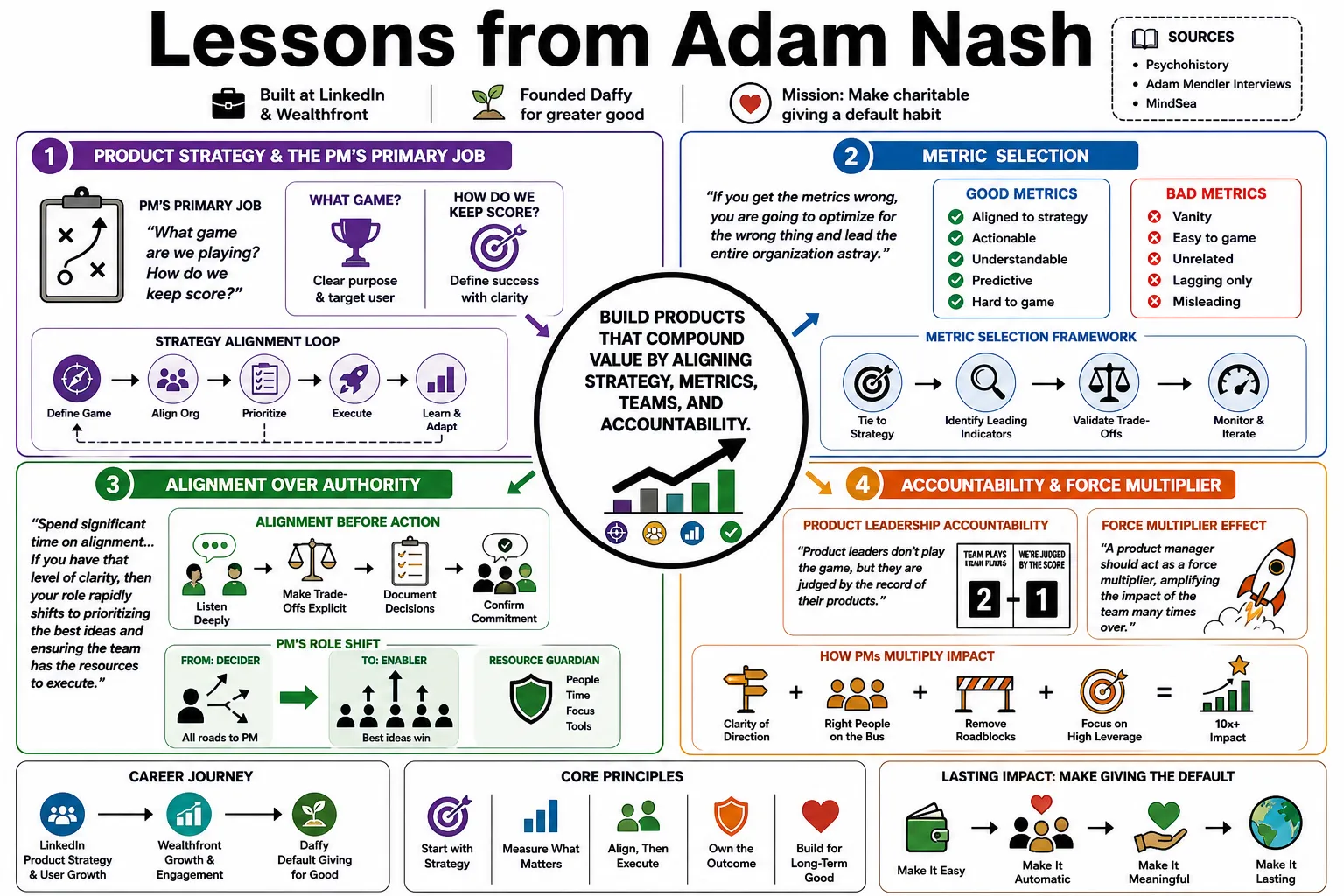
Lessons from Adam Nash
Adam Nash has led product work at companies including LinkedIn and Wealthfront and later founded Daffy, a platform focused on making charitable giving easier and more habitual. — First Round Review — Building Products That Delight Customers.
Part 1: Product Strategy and Alignment
- the Product Manager's Primary Job: Quite simply, it's the product manager's job to articulate two simple things: What game are we playing? How do we keep score? — Adam Nash — Be a Great Product Leader.
- Metric Selection: If you get the metrics wrong, you are going to optimize for the wrong thing and lead the entire organization astray. — Adam Nash — Be a Great Product Leader.
- Alignment Over Authority: My advice is to spend significant time on alignment... If you have that level of clarity, then your role rapidly shifts to prioritizing the best ideas and ensuring the team has the resources to execute against them. — Adam Nash — Be a Great Product Leader.
- Product Leadership Accountability: Product leaders don't play the game, but they are judged by the record of their products. — Adam Nash — Be a Great Product Leader.
- The Force Multiplier Effect: A product manager should act as a force multiplier, providing the context and vision that allows the rest of the team to do their best work. — Adam Nash — Be a Great Product Leader.
- Strategy Constraints: In "Solve the Product Maze Backwards," Nash leans on Michael Porter's line that strategy is choosing what not to do, arguing that teams need explicit clarity on what the product will and will not become so roadmap debates stay grounded in long-term direction instead of turning into endless existential arguments. — Adam Nash — Solve the Product Maze Backwards.
- the PM's Role in Cross-Functional Teams: The PM is the glue that binds engineering, design, operations, and marketing to run in the same direction. — Adam Nash — Be a Great Product Leader.
- Outcome Over Output: You are measured by the success of the product in the market, not just the features you ship. — Adam Nash — Be a Great Product Leader.
- Answering the Why: strong product strategy starts with defining the game you are playing, the value you provide the customer, and the differentiated advantage you bring to market before the team can sensibly decide what to build next. — Adam Nash — Be a Great Product Leader.
- Winning: Great PMs win games. — Adam Nash — Be a Great Product Leader.
- Solve the problem as if starting today: When technology changes, ask how you would solve the problem if you were starting today; experience can otherwise anchor you to obsolete constraints. — Adam Mendler — Interview with Adam Nash.
- Platform shifts change preferences: Platform shifts change customer expectations and behavior, not only technical capabilities, so leaders should watch how AI products reshape consumer and business preferences. — Adam Mendler — Interview with Adam Nash.
- Product strategy nests inside company strategy: Product strategy must nest inside company strategy; recurring feature and prioritization fights often reveal upstream strategic misalignment. — First Round Review — Building Products That Delight Customers.
- Design compounding distribution into the product: If product-led growth matters, design compounding distribution into how people use the product rather than bolting growth on later. — First Round Review — Building Products That Delight Customers.
- Build platforms, not only applications: When the opportunity supports it, build a platform that enables applications and businesses to form on top rather than treating the product as a single application. — First Round Review — Building Products That Delight Customers.
- The startup-incumbent distribution race: A startup’s race is to build distribution before the incumbent can absorb its innovation. — FinTech Weekly — Interview with Adam Nash.
Part 2: Product Execution and Prioritization
- Product Planning Buckets: Maintain balance by categorizing work into three distinct buckets: Metric Movers, Customer Requests, and Delight Features. — Adam Nash — Guide to Product Planning: Three Feature Buckets.
- Metric Movers: You need work focused specifically on moving a key business number to ensure the product drives sustainable growth. — Adam Nash — Guide to Product Planning: Three Feature Buckets.
- Customer Requests: Always allocate resources for features or fixes specifically requested by users to maintain trust and address immediate friction. — Adam Nash — Guide to Product Planning: Three Feature Buckets.
- Delight Features: customer-delight work as features people did not explicitly ask for but that genuinely delight them because the team understood their pain points and used technology and design to create an unexpectedly elegant experience. — Adam Nash — Guide to Product Planning: Three Feature Buckets.
- Taking Ownership: The best advice I would give any product leader is to just do the work. Invest yourself in your product and be the owner. — Adam Nash — Be a Great Product Leader.
- Startup Prioritization: Every startup has a million things it could do. The trick is to narrow that to the handful of things that really matter. — Adam Nash — Be a Great Product Leader.
- Priority Management: Product management is often less about project management and more about priority management—focusing on what truly deserves attention. — Adam Nash — Be a Great Product Leader.
- Iteration: It's not what you launch with, it's the constant iteration and improvement. — We Are For Good — The Trillion-Dollar Generosity Gap.
- Executing Complex Products: The challenge is balancing the capabilities of the technology, the needs of the user, and the economics of the business. — FinTech Weekly — Interview with Adam Nash.
- The Prioritization Rule of Three: Keep the three most important priorities explicit across any time horizon; the Rule of Three prevents simple or urgent work from crowding out what matters most. — Adam Mendler — Interview with Adam Nash.
- Confirm hypotheses with a second signal: Pair quantitative and qualitative evidence, and seek confirmation from a second independent signal before treating a product hypothesis as reliable. — FinTech Weekly — Interview with Adam Nash.
Part 3: Customer Experience and Empathy
- Finding the Heat: what powerful emotions surround a product and whether users want that feeling again, because breakthrough products are built by understanding the emotional charge around the experience rather than treating usage as a purely functional flow. — Adam Nash — The Game Has Changed: Design for Passion.
- Emotional Drivers: that human beings are still driven by strong emotions and desires, so metrics alone are not enough to explain durable product behavior unless the team also understands the hopes, status motives, and feelings underneath the usage patterns. — Adam Nash — The Game Has Changed: Design for Passion.
- Simplifying the Journey: Identify friction points in the user experience and relentlessly simplify them, especially in complex industries. — FinTech Weekly — Interview with Adam Nash.
- Education as a Feature: Don't shy away from complex terminology; use it as an opportunity to educate and empower your customers. — Adam Nash — Be a Great Product Leader.
- The Non-User: If you want to grow a viral product, you have to spend a considerable amount of time thinking about the non-user, and where they touch your brand. — Adam Nash — User Acquisition: Viral Factor Basics.
- Going Beyond Utility: utility remains important, but it is no longer sufficient on its own; competitive products now need to trigger real emotion and become something people like, want, and love rather than something they merely find useful. — Adam Nash — The Game Has Changed: Design for Passion.
- User Identity: In "Design for Passion," Nash uses social products and even LinkedIn's mix of vanity and greed to show that user behavior is often tied to identity-level desires and status signals, not just to the narrow functional utility of the software. — Adam Nash — The Game Has Changed: Design for Passion.
- The purpose of technology: Technology is best used to take services that are rare and expensive and make them ubiquitous and nearly free for everyone. — WealthTech Today — Adam Nash on Philanthropy as a Service.
- Create value before capturing it: Enduring fintech products create meaningful customer value and capture only a small share of that value through a clear product, pricing, positioning, and distribution model. — FinTech Weekly — Interview with Adam Nash.
Part 4: Leadership and Building Teams
- Hiring Criteria: You really want to look for people who are smart, trustworthy, and ambitious. Having just two of the three is a problem. — Adam Nash — Figma: A Random Walk in Palo Alto.
- Avoiding Command-and-Control: If you are building a high-performing team full of talented professionals, you won't get the most out of them through direct command-and-control. — Adam Mendler — Interview with Adam Nash.
- Empowering Teams: Once alignment is clear, your job is to get out of the way and ensure the team has the resources to execute. — Adam Mendler — Interview with Adam Nash.
- Humanity in Business: Leading teams requires acknowledging the humanity underneath—people want to be part of something meaningful. — Crazy Good Turns — Adam Nash: Finding $1 Trillion More for Charity.
- Optimism and Agency: To build a new business, you have to have a belief that things can get better. The future isn't written. We have agency. — Crazy Good Turns — Adam Nash: Finding $1 Trillion More for Charity.
- Leading Cross-Functional Groups: You rarely have direct authority over the people whose work you depend on, which makes influence and clarity your most vital tools. — Adam Nash — Be a Great Product Leader.
- The Role of the Executive: that as products scale, leadership has to act more like a curator and editor by deciding what fits together, what should be cut, and where second-pair-of-eyes review is needed to preserve coherence and quality. — Adam Nash — Product Leaders as Curators & Editors.
- Startup scalability vs. AI: Despite the hype around AI enabling billion-dollar startups with just one or two people, scaling a responsible financial product still requires a dedicated, albeit highly leveraged, team. — WealthTech Today — Adam Nash on Philanthropy as a Service.
- Transfer moral authority with the role: Leadership transitions become durable when founders publicly transfer real authority to the new leader rather than leaving them as a proxy. — First Round Review — Building Products That Delight Customers.
Part 5: Career and Life Choices
- Choosing Companies: In "Ikigai," Nash advises people to be intentional about professional choices by testing opportunities against what they love, what they are good at, what the world needs, and what the market will pay for, rather than drifting into roles that score well on only one dimension. — Adam Nash — Ikigai: How to Find Professional Success.
- Work for leaders you can learn from: Early in your career, work for leaders you respect and can learn from; persistent lack of learning from your manager and company leadership is a sound reason to leave. — Adam Mendler — Interview with Adam Nash.
- Protect space for creativity: Protect quiet, unstructured space for creativity because less obvious solutions often emerge outside active execution. — Adam Mendler — Interview with Adam Nash.
Part 6: Personal Finance and Wealth Building
- the Ultimate Secret: Spend less than you make. It is the ultimate secret to personal financial success. — Stanford CS 007 — Saving & Budgets.
- Boring Investing: If you're having too much fun investing, you're probably taking too much risk. Good investing is usually quite boring. — Stanford CS 007 — Investing.
- Tax Efficiency: You can't control the market so make the most of the things you do have power over, like fees and taxes. — Stanford CS 007 — Investing.
- the Rule of 72: Understand the Rule of 72. It is a simple mental math trick to calculate how long it takes for your investments to double. — Stanford CS 007 — Investing.
- Compound Interest: Compound interest is a force that can either work tirelessly for you or relentlessly against you. — Stanford CS 007 — Investing.
- Financial Illiteracy: Financial illiteracy is a massive problem, even among graduates of top-tier universities. — Stanford CS 007 — Adam Nash Course Materials.
- Automation: The best way to stick to a financial plan is to automate your savings and investments so you don't have to think about them. — Stanford CS 007 — Saving & Budgets.
- Long-term Happiness: Money is simply a tool for long-term happiness and success, not the end goal itself. — Stanford CS 007 — Adam Nash Course Materials.
Part 7: Behavioral Finance and Psychology
- Keeping Up with the Joneses: Be wary of the psychological pressure to match the spending habits of your peers; it leads to poor financial decisions. — Stanford CS 007 — Adam Nash Course Materials.
- the Signal-to-Noise Problem: Personal finance suffers from a terrible signal-to-noise ratio—there is far more bad advice available than good, reliable information. — Adam Nash — Why Personal Finance for Engineers?.
- Engineering Rationality: Engineers often pride themselves on being rational, but they are just as susceptible to psychological biases as anyone else. — Adam Nash — Why Personal Finance for Engineers?.
- Herd Behavior: Following the herd in investing usually means you are buying high and selling low. — Stanford CS 007 — Adam Nash Course Materials.
- Overconfidence: Overconfidence in your ability to pick stocks or time the market is one of the most expensive psychological biases. — Stanford CS 007 — Adam Nash Course Materials.
- Financial Friction: Every additional step required to save or invest drastically reduces the number of people who will actually do it. — Stanford CS 007 — Adam Nash Course Materials.
- Behavioral Finance: Understanding why you make certain money decisions is just as important as knowing the math behind them. — Stanford CS 007 — Adam Nash Course Materials.
- Anchoring: Don't let your past purchase price anchor your decision on whether to hold or sell an asset today. — Stanford CS 007 — Adam Nash Course Materials.
Part 8: Philanthropy and Generosity
- the Generosity Gap: The fundamental problem with Donor Advised Funds is that they focus on the wealthy. Most people have never heard of them. — We Are For Good — The Trillion-Dollar Generosity Gap.
- the Mission of Daffy: Our mission is very simple: it is to help people be more generous, more often. — Crazy Good Turns — Adam Nash: Finding $1 Trillion More for Charity.
- Habit Building in Giving: People want to be generous, but life gets in the way. We can use the same innovations that help us shop and save to make giving a habit. — Crazy Good Turns — Adam Nash: Finding $1 Trillion More for Charity.
- Automating Charity: By setting a goal and automating it, the experts say that can boost your giving by about 32%. — We Are For Good — The Trillion-Dollar Generosity Gap.
- Family Giving: Every donation is a teachable moment for your family. — Daffy — Four Years of Building a Community for Giving.
- Intentionality: If things are important to you, name them and know them—especially when it comes to the causes you support. — We Are For Good — The Trillion-Dollar Generosity Gap.
- Redefining Philanthropy: We need to expand the definition of philanthropy beyond billionaires to include everyday people who want to help their communities. — Crazy Good Turns — Adam Nash: Finding $1 Trillion More for Charity.
- Financial Goals: Charitable giving should be treated as a deliberate financial goal rather than a year-end afterthought. — Crazy Good Turns — Adam Nash: Finding $1 Trillion More for Charity.
- Cryptocurrency and charity: Today, there's more than $2 trillion in crypto. Given our mission, we said if people want to donate those assets to charity, we should make that easy – that's more money for charity and good causes. — WealthTech Today — Adam Nash on Philanthropy as a Service.