Adam S. Posen is president of the Peterson Institute for International Economics and served on the Bank of England’s Monetary Policy Committee from 2009 to 2012. His research includes macroeconomic policy, central banking and Japan. — PIIE — Adam S. Posen.
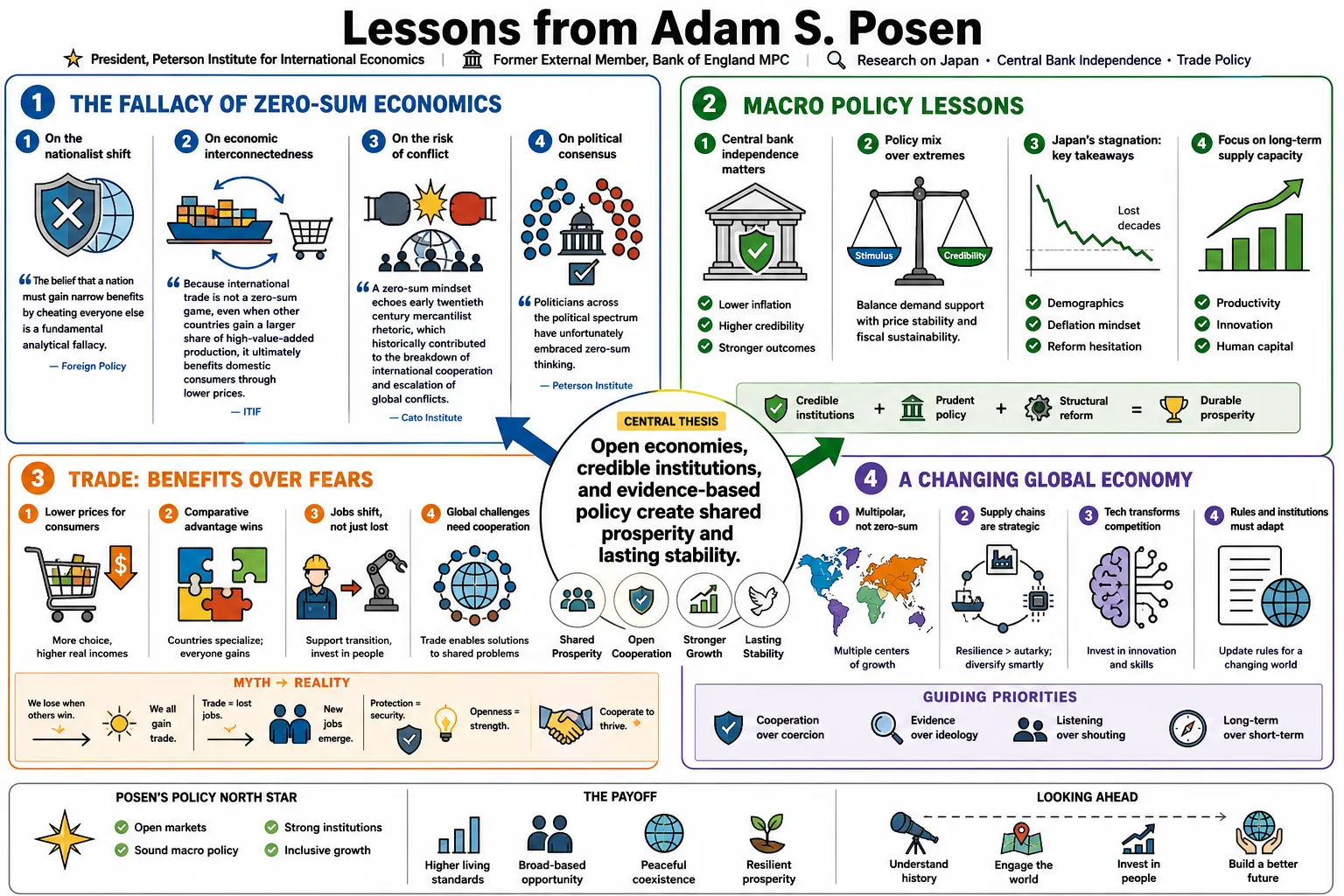
Part 1: The Fallacy of Zero-Sum Economics
- Economic nationalism: Posen rejects the idea that one country must prosper by denying gains to its trading partners. — Globalization with Minimal Apologies.
- Gains from trade: Cross-border specialization can raise living standards even when production shifts between countries. — Globalization with Minimal Apologies.
- Zero-sum rivalry: Treating every trading partner as an adversary can make cooperation harder and invite harmful policy responses. — Geopolitics Is Corroding Globalization.
- Political convergence: Posen warns that economic nationalism now draws support from more than one part of the political spectrum. — Globalization with Minimal Apologies.
- The value of an open order: US leadership in an open, rules-based economy brought benefits that zero-sum accounting overlooks. — America’s Future in a Post-American World Economy.
- Self-defeating restrictions: Trade restrictions meant to strengthen domestic industry can raise input costs and reduce its competitiveness. — Posen’s 2025 Senate Testimony.
- Prosperous partners: Posen’s case for globalization rests partly on larger markets and reciprocal gains, not merely on cheap imports. — Globalization with Minimal Apologies.
- A break with postwar policy: Retreating from broadly open trade would depart from the cooperative framework that the United States helped build. — America’s Future in a Post-American World Economy.
- Domestic costs: Protectionist measures distribute real costs within the United States, including to consumers and firms that use imported inputs. — Posen’s 2025 Senate Testimony.
Part 2: The Resurgence of Industrial Policy
- The price of nostalgia: A policy centered on restoring an earlier manufacturing economy can miss the needs of lower-income workers. — The Price of American Economic Nostalgia.
- Opportunity costs: Firm-specific industrial subsidies use resources that could instead support research, skills and infrastructure. — The True Costs of a Subsidies War with China.
- Misdiagnosing workers’ needs: Posen argues that blaming trade alone for American workers’ problems leads to an inadequate policy response. — The Price of American Economic Nostalgia.
- Picking firms: Posen cautions that subsidies for selected companies can entrench incumbents instead of fostering productive competition. — The True Costs of a Subsidies War with China.
- Testing public value: Industrial support should be judged against its public cost and realistic alternatives, rather than assumed to create national gains. — The True Costs of a Subsidies War with China.
- Costs of withdrawal: Insulating the US economy from competition and trade does not by itself solve the problems of lower-income workers. — The Price of American Economic Nostalgia.
- Manufacturing favoritism: Favoring manufacturing over other sectors can divert attention from investments that benefit a broader workforce. — The Price of American Economic Nostalgia.
- Protection and partners: Broad protectionism can provoke retaliation from trading partners as well as raise costs at home. — The True Costs of a Subsidies War with China.
- Promises to workers: Posen argues that industrial favoritism is a poor substitute for direct investment in people and public capabilities. — The Price of American Economic Nostalgia.
Part 3: Tariffs and Trade Policy
- Transactional trade: Posen criticizes the move from stable trade rules toward one-sided bargaining and economic nationalism. — Globalization with Minimal Apologies.
- Who pays tariffs: Tariffs raise costs for US households, with lower-income families bearing a greater burden relative to income. — Posen’s 2025 Senate Testimony.
- Retaliation: Tariffs can draw foreign retaliation against US exports, compounding the original domestic costs. — Posen’s 2025 Senate Testimony.
- Competing with China: Posen favors productive domestic investment over a broad subsidy war or wholesale economic separation from China. — The True Costs of a Subsidies War with China.
- Supply-chain resilience: Diversifying suppliers and preserving access to partners can strengthen resilience more plausibly than attempting complete self-sufficiency. — The True Costs of a Subsidies War with China.
- Trade and inflation: Closing off imports can create adverse supply shocks and inflation even when growth is weak. — PIIE — Inflation Is Coming to the US.
- Allied costs: Indiscriminate tariffs can burden allies whose cooperation matters to US economic and security goals. — Posen’s 2025 Senate Testimony.
- Trade rules: Smaller and middle-sized economies have a strong interest in predictable multilateral trade rules instead of power-based bargaining. — Geopolitics Is Corroding Globalization.
Part 4: Inflation and Central Bank Independence
- Inflation targeting: Posen describes inflation targeting as a disciplined framework that still leaves room for policy judgment. — Macro Musings with Adam Posen.
- Credibility is conditional: A central bank’s credibility depends on political and institutional support, not a formal label alone. — Posen on Central Bank Independence.
- Central bank independence: Posen treats central bank independence as an institutional and political arrangement whose effects depend on context. — Posen on Central Bank Independence.
- Communicating policy: An explicit target helps organize policy communication but cannot substitute for credible decisions and public support. — Posen on Central Bank Independence.
- Flexibility under a target: Posen and his coauthor find no evidence that the Bank of England’s formal inflation target made it less flexible than the Federal Reserve. — How Flexible Can Inflation Targeting Be?.
- Asset bubbles: Posen argues that central banks should not routinely tighten monetary policy for the express purpose of bursting asset bubbles. — Why Central Banks Should Not Burst Bubbles.
- Responding to crisis: Posen’s analysis of Japan supports timely banking repair and monetary easing when financial distress threatens recovery. — Japan’s Recovery and Macroeconomic Lessons.
- Supply shocks: Weak growth does not rule out inflation when policy itself constrains supply. — PIIE — Inflation Is Coming to the US.
- Political pressure: Central-bank independence must be sustained politically; legal form alone cannot insulate every difficult policy decision. — Posen on Central Bank Independence.
- Delayed inflation: Posen warns that the inflationary effects of tariffs and restrictions on labor supply may emerge with a lag. — PIIE — Tariffs, Deportations and Inflation.
Part 5: Lessons from Japan's Great Recession
- Policy mistakes in Japan: Posen attributes much of Japan’s prolonged 1990s weakness to avoidable fiscal, banking and monetary-policy errors. — Japan’s Recovery and Macroeconomic Lessons.
- A comprehensible downturn: Japan’s experience was not an inexplicable exception: standard macroeconomic mechanisms help explain its setbacks. — Japan’s Recovery and Macroeconomic Lessons.
- Interrupted recoveries: Japan’s 1990s output followed a sawtooth pattern as emerging recoveries were interrupted by policy mistakes. — Japan’s Recovery and Macroeconomic Lessons.
- Banking repair: Delays in addressing weak banks and bad loans impeded Japan’s recovery. — Japan’s Recovery and Macroeconomic Lessons.
- Deflation with nuance: Posen cautions against a simple story about Japanese deflation: its observed costs were lower than many had expected, though its effects still warranted study. — Japan’s Recovery and Macroeconomic Lessons.
- Underlying capacity: Japan achieved periods of substantial recovery, undercutting the view that structural weakness made growth impossible. — Japan’s Recovery and Macroeconomic Lessons.
- Lessons beyond Japan: Posen argues that Japan’s policy experience offers relevant lessons to other advanced economies facing financial distress. — Japan’s Recovery and Macroeconomic Lessons.
- Avoiding Japan’s errors: Earlier banking action and macroeconomic support can reduce the risk that a financial crisis turns into repeated aborted recoveries. — Japan’s Recovery and Macroeconomic Lessons.
Part 6: The Economic Realities of Brexit
- The single-market loss: Posen identifies leaving the European single market as the central economic cost of Brexit. — Brexit Sets a Dangerous Precedent.
- A self-imposed trade shock: Posen has described Brexit as a trade war the United Kingdom chose to wage on itself. — Posen’s Brexit and Trade War Lecture.
- Persistent damage: In an interview, Posen compared Brexit’s long-lasting economic cost to chronic pain rather than a one-off shock. — Posen’s Brexit Interview in The Independent.
- The European beachhead: Reduced access to the European market weakened the UK’s attraction as a base for firms serving Europe. — Brexit Sets a Dangerous Precedent.
- Trade gravity: The UK’s proximity to the European market makes new distant trade deals an incomplete substitute for lost integration. — Brexit Britain in a Changing Global Economy.
- Currency cannot undo barriers: Posen argues that a weaker pound cannot fully restore the competitiveness lost through reduced European market access. — Brexit Sets a Dangerous Precedent.
- Foreign investment: Posen and his coauthor document a relative decline in UK foreign direct investment after Brexit. — Brexit Britain in a Changing Global Economy.
- Several growth headwinds: Brexit reduced UK openness to trade, investment and migration, creating multiple pressures on long-run productivity. — Brexit Britain in a Changing Global Economy.
- A resilient economy can still lose: Invoking Adam Smith’s observation about a nation’s capacity to absorb damage, Posen argues that UK resilience does not erase Brexit’s costs. — Britain after Brexit: Mugged by Economic Reality.
- Forecastable tradeoffs: The weaker openness and investment outcomes following Brexit were consistent with mechanisms economists identified before departure. — Brexit Britain in a Changing Global Economy.
Part 7: Multilateralism versus Transactionalism
- Institutional erosion: Posen warns that geopolitical fragmentation weakens the multilateral institutions that help countries manage shared economic risks. — Geopolitics Is Corroding Globalization.
- Reduced US insurance: Posen describes the United States as stepping back from a postwar role in providing open markets, security and predictable rules to partners. — America’s Future in a Post-American World Economy.
- Populist parallels: Posen linked Brexit’s nationalist politics with a broader backlash against international cooperation. — Brexit Sets a Dangerous Precedent.
- Global public goods: Posen’s account of the US-led order includes security for shipping, liquid capital markets and rule-based economic access. — America’s Future in a Post-American World Economy.
- Middle-power choices: Fragmentation puts middle powers under pressure to navigate competing blocs rather than rely on broad common rules. — Geopolitics Is Corroding Globalization.
- Splintering standards: As partners adapt to reduced US leadership, competing technology and trade standards may increase fragmentation. — America’s Future in a Post-American World Economy.
- Why institutions matter: Multilateral institutions provide shared rules that ad hoc power-based bargains cannot reliably replace. — Geopolitics Is Corroding Globalization.
- Economic coercion: Posen warns that economic ties can be used for geopolitical leverage when governments frame them primarily as security vulnerabilities. — Geopolitics Is Corroding Globalization.
- Rebuilding cooperation: Posen argues for preserving and renewing multilateral cooperation rather than accepting fragmentation as inevitable. — Geopolitics Is Corroding Globalization.
Part 8: Geoeconomics and the Global Order
- European agency: Posen argues that European partners can respond to reduced US leadership by strengthening their own institutions and economic capacity. — America’s Future in a Post-American World Economy.
- Limits of decoupling: Posen argues that complete separation from China is impractical and that broad subsidy wars impose costs on the countries pursuing them. — The True Costs of a Subsidies War with China.
- Interdependence as exposure: Geopolitical rivalry can turn existing trade and financial connections into perceived vulnerabilities and instruments of pressure. — Geopolitics Is Corroding Globalization.
- Innovation across borders: Posen favors investment in research and capabilities while cautioning against protectionist efforts to wall off entire technology supply chains. — The True Costs of a Subsidies War with China.
- Dollar advantages: Posen attributes the dollar’s international role in part to deep, liquid markets and network advantages while warning it is not immune to policy choices. — Why the Euro Will Not Rival the Dollar.
- Security exceptions: Posen accepts genuine security-related tradeoffs but warns against using them to justify indiscriminate economic closure. — Globalization with Minimal Apologies.
- Costs for developing economies: Trade fragmentation can narrow the options available to developing countries seeking growth through global markets. — Geopolitics Is Corroding Globalization.
- Investment fragmentation: Geopolitical barriers can redirect cross-border investment away from its most productive uses. — Geopolitics Is Corroding Globalization.
- Globalization persists: Posen argues that globalization is adapting rather than disappearing, with trade sometimes redirected through other partners. — Globalization with Minimal Apologies.