Adam Tooze is the Kathryn and Shelby Cullom Davis Professor of History at Columbia University and directs its European Institute. His work connects economic, political and military history with contemporary crises. — Columbia — Adam Tooze.
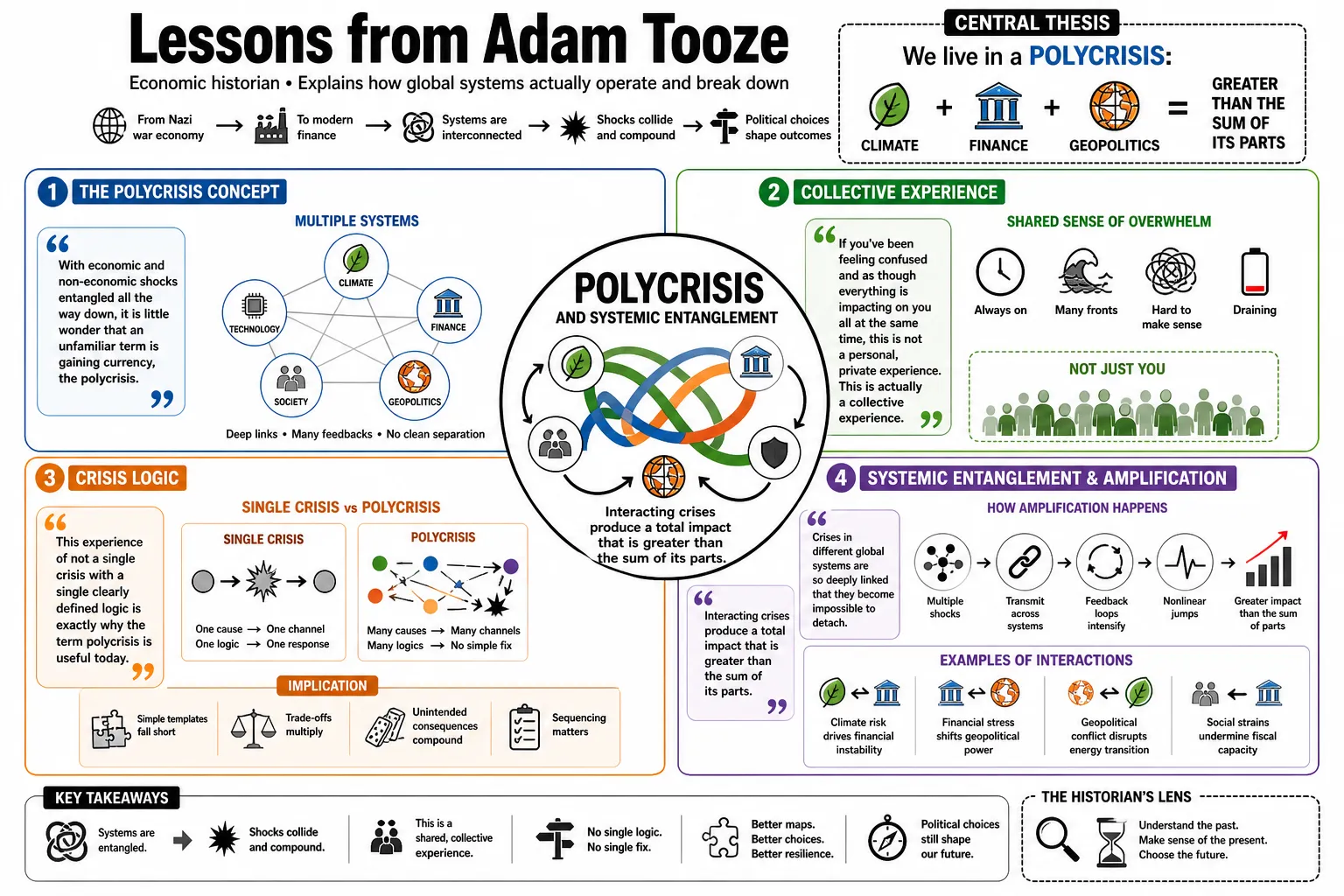
Part 1: The Polycrisis and Systemic Entanglement
- Interacting crises: Tooze uses polycrisis for simultaneous shocks whose interactions matter as much as each shock alone. — Chartbook 130 — Defining Polycrisis.
- A shared experience: He describes disorientation amid overlapping crises as a collective experience, not merely an individual failure to understand events. — World Economic Forum — Adam Tooze Interview.
- No single crisis logic: The term helps name a period when economic, political and ecological pressures cannot be reduced to one simple cause. — World Economic Forum — Adam Tooze Interview.
- Systemic connections: A crisis in one domain can transmit pressure into others, so analysis must follow the links between systems. — Chartbook 130 — Defining Polycrisis.
- Compounding effects: Tooze stresses that interacting crises can become more dangerous than their separate components. — Chartbook 130 — Defining Polycrisis.
- Uncertain futures: Polycrisis registers a loss of confidence that familiar narratives can explain or manage a confusing conjuncture. — Chartbook 192 — Deglobalisation and Polycrisis.
- Causal entanglement: The value of the concept lies in investigating how distinct shocks interact, not merely listing several bad events. — Chartbook 130 — Defining Polycrisis.
- Ecology and geopolitics: Tooze places climate pressures alongside geopolitical and economic conflict in his account of compounding risk. — Chartbook 165 — Polycrisis.
- A provisional concept: He treats polycrisis as an analytical aid for a confusing period rather than a settled theory of every disruption. — Chartbook 192 — Deglobalisation and Polycrisis.
Part 2: The 2008 Financial Crisis and Its Aftermath
- The long aftermath of 2008: Tooze traces the crash into subsequent Eurozone and political crises, rather than ending the story with the initial bailout. — Framing Crashed — Trans-Atlantic Power.
- Political choices in finance: Crisis management depended on government and central-bank decisions as well as the vulnerabilities of private finance. — Framing Crashed — Trans-Atlantic Power.
- Public backstops: The 2008 crash exposed how heavily private financial markets depended on public stabilization. — Framing Crashed — Trans-Atlantic Power.
- Reverberations after the crash: Tooze describes Crashed as a history whose crisis continued to unfold through later European and political events. — Chartbook 341 — Thinking in Medias Res.
- Fragile bank balance sheets: Highly leveraged transatlantic banks, including European banks with dollar mismatches, amplified the financial shock. — Framing Crashed — Trans-Atlantic Power.
- Eurozone bargaining: The Eurozone response became a political struggle over bank fragility, public support and the burdens placed on crisis countries. — Framing Crashed — Trans-Atlantic Power.
- Political legacies: Tooze connects the unresolved aftermath of 2008 with later instability rather than treating it as a closed financial episode. — CFR — Adam Tooze on the 2008 Crisis.
- Hidden dollar wiring: The crisis exposed European banks’ dependence on dollar funding and the Fed swap lines needed to stabilize them. — The Dollar Funding Crisis of 2008.
- European power struggles: The Eurozone crisis revealed conflicts between creditor governments and states seeking more expansive stabilization. — Framing Crashed — Trans-Atlantic Power.
Part 3: The COVID-19 Economic Shock
- Affordability and capacity: Tooze invokes Keynes to argue that public financing possibilities must be considered alongside the real resources needed to act. — Chartbook — Keynes and Affordability.
- Choice, not just accounting: Once financial constraints are examined rather than assumed, the question becomes what societies choose to do and can actually deliver. — Chartbook — Keynes and Affordability.
- Treasury-market stress: The normally liquid US Treasury market malfunctioned in March 2020, creating an unusually severe financial threat. — Chartbook 172 — US Treasuries.
- A fast-moving global shock: Tooze observed financial stress spreading internationally before the pandemic’s full epidemiological impact was visible. — Harvard — Adam Tooze Pandemic Transcript.
- A synchronized contraction: Tooze describes the pandemic as an exceptionally fast and widespread contraction of the world economy. — Shutdown — Adam Tooze.
- An extraordinary Fed response: The Fed’s March 2020 Treasury-market intervention was much larger than its early 2008–09 asset purchases. — Chartbook 172 — US Treasuries.
- A more nuanced labor recovery: Tooze notes that the US post-pandemic recovery did not uniformly worsen wage inequality; real wages recovered for most workers. — Chartbook 227 — The Inflation Debate.
- Overlapping supply shocks: Pandemic supply disruptions, stimulus and war together helped create the later inflationary surge. — Chartbook 207 — Finance and the Polycrisis.
- The return of fiscal policy: The pandemic response showed that governments could mobilize unusually large fiscal and monetary resources in a crisis. — Chartbook 207 — Finance and the Polycrisis.
Part 4: The Climate Transition and Green Economy
- Security and climate budgets: Tooze argues European climate and energy-transition investment should match its renewed commitment to military spending. — Sustainable Development and US Hegemony.
- Limits of a green Marshall Plan: He questions rhetoric that a Western-led green Marshall Plan will solve the transition while China supplies much of the actual scale. — Chartbook 316 — Climate Politics.
- Low-cost clean power: Solar and wind have become commercially central to new electricity generation, though cost alone does not settle the politics of transition. — Chartbook 386 — China’s Green Electricity Shift.
- A historic energy shift: The global addition of renewable electricity capacity has accelerated dramatically, with China supplying an outsized share. — Chartbook 386 — China’s Green Electricity Shift.
- A political financing challenge: The investment needed for sustainable development is large, but the harder question is which governments and institutions will mobilize it. — Carbon Notes 3 — Sustainable Development Finance.
- Organizing collective action: Tooze points to clean-energy solutions while stressing that implementation must be effective and democratically legitimate. — World Economic Forum — Adam Tooze Interview.
- Energy and security: Reducing fossil-fuel dependence can serve both climate goals and security needs, as Europe’s exposure to Russian energy illustrated. — Chartbook 105 — Heat Pumps and Energy Security.
- Mobilizing transition investment: Tooze sees the challenge as organizing public and private investment on a scale far beyond isolated projects. — Carbon Notes 3 — Sustainable Development Finance.
- Climate inside the polycrisis: Climate risk is one of the interacting pressures that contemporary economic and political choices must address together. — Chartbook 165 — Polycrisis.
- Development and carbon limits: China’s scale means its development and energy choices strongly influence whether global emissions targets are achievable. — Chartbook 324 — China’s Emissions Path.
Part 5: China's Role in Global Capitalism
- China’s solar surge: Tooze argues that China’s rapid expansion of solar manufacturing and deployment has materially improved prospects for clean electrification. — Chartbook 284 — China’s Solar Surge.
- Industrial scale without the analogy: Chinese solar capacity now exceeds what many transition pathways had assumed possible, lowering the cost of clean-power expansion. — Chartbook 414 — China’s Renewable Revolution.
- State-led green expansion: China’s renewable surge reflects large-scale industrial investment and domestic deployment, not simply a market price signal. — Chartbook 284 — China’s Solar Surge.
- China’s global weight: The scale and breadth of Chinese production make its domestic trajectory consequential for the wider world economy. — Chartbook 393 — Whither China?.
- Beyond property-led growth: Tooze analyzes China’s shift from an extraordinary property boom toward a more high-tech manufacturing expansion. — Chartbook 393 — Whither China?.
- Clean-tech dependence: Western climate strategies must contend with China’s dominant place in solar manufacturing and other clean-energy supply chains. — Chartbook 284 — China’s Solar Surge.
- The cost of separation: Tooze warns that radical US-China trade decoupling would be a major shock to consumers and markets. — Chartbook 372 — US-China Decoupling.
- Interpreting the China shock: Tooze distinguishes China’s observed trade surplus from predictions about the precise effect of a second China shock. — Chartbook 462 — China Shock.
- Development is not democratization: China’s industrial modernization raises political questions that cannot be answered by assuming a single Western path of development. — Chartbook 464 — The China Squeeze.
- Manufacturing capabilities: China’s competitiveness spans low- and high-skill production, not simply low-wage assembly. — Chartbook 464 — The China Squeeze.
- Historical foundations: Tooze cautions that accounts of China’s current industrial position should consider earlier state-building and development choices. — Chartbook 464 — The China Squeeze.
- Development as politics: He treats development paths as contingent political and institutional outcomes, not a predetermined queue of countries. — Chartbook 464 — The China Squeeze.
Part 6: American Hegemony and Dollar Power
- Power and legitimacy: Tooze asks how enduring structures of US power can coexist with contested political legitimacy. — Framing Crashed — Trans-Atlantic Power.
- Dollar predominance: The dollar remains central to global money and finance even as economic production becomes more multipolar. — Chartbook 397 — Dollar Trap or Empire by Invitation?.
- Different kinds of power: A more multipolar production economy can coexist with continued US predominance in global finance. — Chartbook 397 — Dollar Trap or Empire by Invitation?.
- Financial networks: US influence operates through dollar funding and capital-market networks as well as conventional state power. — The Dollar Funding Crisis of 2008.
- A global Fed backstop: Fed swap lines supplied dollar liquidity to foreign central banks during the 2008 crisis. — The Dollar Funding Crisis of 2008.
- Financial leverage: The centrality of dollar markets gives US policy choices unusually wide international consequences. — Chartbook 397 — Dollar Trap or Empire by Invitation?.
- Power is not legitimacy: Tooze separates the resilience of US financial structures from the political legitimacy of the order around them. — Framing Crashed — Trans-Atlantic Power.
- Attraction of US assets: US financial influence rests in part on global demand for dollar-denominated assets and returns, not just its industrial output. — Chartbook 397 — Dollar Trap or Empire by Invitation?.
- Treasuries as infrastructure: US Treasury securities are a foundation of global liquidity, but their market can still become fragile under stress. — Chartbook 172 — US Treasuries.
- Against simple decline stories: Tooze cautions that predictions of dollar decline have repeatedly underestimated the forces attracting world capital to US markets. — Chartbook 397 — Dollar Trap or Empire by Invitation?.
- The changing dollar: Tooze describes a dollar system shaped by liquid financial markets and the pursuit of returns, not just trade settlement. — Chartbook 457 — The Metamorphoses of the Dollar.
- Reserve self-insurance: Emerging-market reserve accumulation, notably in China, helped reinforce dollar demand and US borrowing capacity. — Chartbook 457 — The Metamorphoses of the Dollar.
Part 7: The Nazi Economy and World War II
- Material and ideological motives: Tooze analyzes Nazi aggression in relation to Germany’s material position while rejecting any claim that economics made its ideology rational. — The Wages of Destruction — Adam Tooze.
- Contingency in 1940: Tooze cautions against describing Germany’s 1940 campaign as the execution of an inevitable, settled strategy. — Tooze’s Response on Wages of Destruction.
- Business and dictatorship: Tooze’s analysis of Nazi mobilization includes the cooperation of industrial elites in destroying democratic and labor opposition. — Tooze’s Response on Wages of Destruction.
- Relative economic weakness: Germany faced major productive and resource disadvantages against its Anglo-American rivals despite rapid rearmament. — Chartbook 25 — Economic History of World War II.
- The American challenge: Tooze interprets Nazi grand strategy partly against the rise of the United States as a global power. — The Wages of Destruction — Adam Tooze.
- Consumer promises and war: Nazi claims of prosperity sat alongside the diversion of national resources into rearmament and racial war. — The Wages of Destruction — Adam Tooze.
- Material constraints: Food, resources and industrial capacity constrained the regime’s war-making choices. — Chartbook 25 — Economic History of World War II.
- Limits of conquest: Conquest and mobilization did not erase Germany’s relative resource and productive weakness. — Chartbook 25 — Economic History of World War II.
- Ideology and political economy: Tooze joins a materialist account of the Nazi economy to an insistence on the independent force of racial ideology. — The Wages of Destruction — Adam Tooze.
Part 8: Historical Agency and the Role of the Historian
- Writing amid events: Tooze argues that historians can interpret history from within ongoing crises rather than waiting for a detached endpoint. — Writing in Medias Res — Adam Tooze.
- Beware historical role-play: He warns that nostalgic reenactment of past political struggles can distract from the urgent present. — Chartbook 341 — Thinking in Medias Res.
- Contingency and situatedness: Tooze emphasizes that actors make choices inside inherited circumstances, not from outside history. — Writing in Medias Res — Adam Tooze.
- Technical structures matter: Historical explanation should trace institutions such as dollar funding and central-bank swap lines, not only visible political rhetoric. — The Dollar Funding Crisis of 2008.
- Notice discontinuities: Tooze sees historical writing as a way to interpret unfolding change without assuming that today simply repeats the past. — Writing in Medias Res — Adam Tooze.
- No view from nowhere: He rejects the premise that historians can stand outside their own moment; inquiry must recognize its situated perspective. — Writing in Medias Res — Adam Tooze.
- Crossing disciplines: Tooze brings historical, economic and political tools together to understand contemporary crises. — Writing in Medias Res — Adam Tooze.