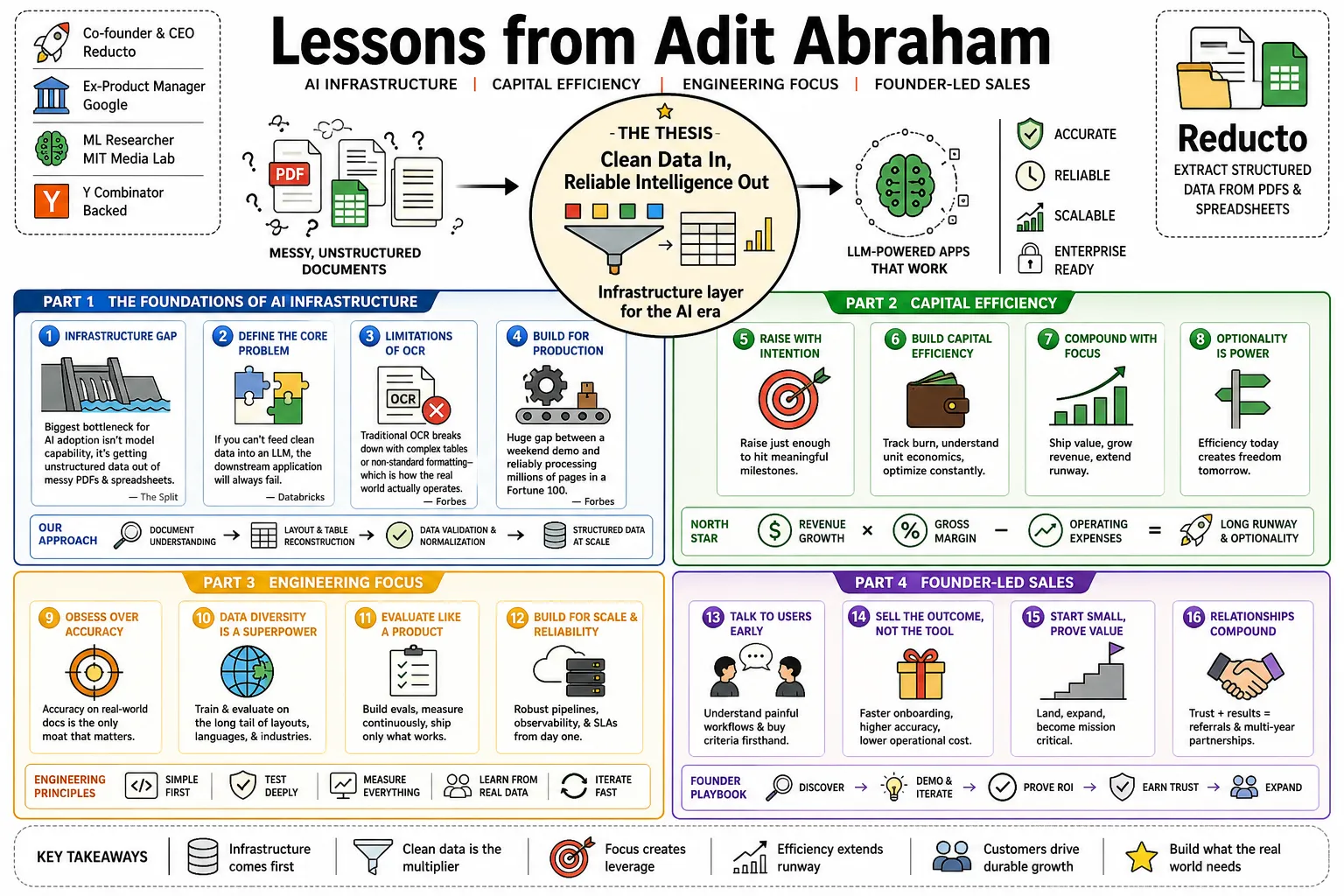
Lessons from Adit Abraham
Adit Abraham is the co-founder and CEO of Reducto, a Y Combinator-backed startup that builds infrastructure to extract structured data from PDFs and spreadsheets. He previously worked as a product manager at Google and a machine learning researcher at the MIT Media Lab. The following sections compile his observations on capital efficiency, engineering focus, and founder-led sales.
Part 1: The Foundations of AI Infrastructure
- The infrastructure gap: Reducto turns PDFs, spreadsheets and other unstructured files into inputs for AI workflows. — The Split interview.
- Defining the core problem: Parsing mistakes at ingestion can propagate into downstream AI answers, especially when tables or layouts are misread. — The Split interview.
- The limits of OCR: Legacy extraction tools struggle with complex tables, columns and visual layouts that people interpret naturally. — First Round Review interview.
- Building for production: A working demo was only the start; Reducto had to meet a quality bar on customers’ real documents before broadening access. — First Round Review interview.
- The illusion of solved problems: Longstanding PDF tools had not solved the accuracy needed for complex documents in AI workflows. — The Split interview.
- Data quality: Better downstream models cannot recover information that the ingestion stage has already misread or omitted. — The Split interview.
- Evaluating AI tools: Customers could judge extraction quality on their own hard documents rather than trust an architecture pitch. — First Round Review interview.
- The value of boring problems: The document parser drew stronger customer pull than the original memory product because it removed an immediate bottleneck. — First Round Review interview.
- Adaptive document systems: The parser had to handle varied real-world files, not just clean examples that fit a fixed template. — First Round Review interview.
- Infrastructure moats: Hard production documents exposed edge cases; customer feedback helped Reducto improve its models repeatedly. — EO Mag interview.
Part 2: Navigating Founder-Led Sales
- Founder-led sales: The founders handled early sales themselves, using calls and demos to learn what buyers needed. — The Split interview.
- Qualifying demand: A prospect’s curiosity was weaker evidence than an urgent workflow problem and willingness to use the product. — First Round Review interview.
- First meetings: Early calls worked best when Reducto quickly showed what its parser could do for a concrete customer problem. — The Split interview.
- Technical-founder selling: Letting prospects test difficult documents made the technical product’s value visible. — EO Mag interview.
- Listening to the market: Customer conversations revealed that file ingestion was a more pressing need than long-term memory. — First Round Review interview.
- Early traction: Early adoption followed proof that Reducto could handle difficult customer documents, including for a Fortune 10 buyer. — First Round Review interview.
- Avoiding distracting customers: The team declined narrow feature requests when they would divert effort from transferable parsing improvements. — First Round Review interview.
- Demoing real data: Customers uploaded their hardest documents into a playground to verify extraction quality for themselves. — First Round Review interview.
- Founder conviction: Abraham stayed involved in selling until he understood the buyer problem and the repeatable product story. — The Split interview.
Part 3: Extreme Focus and Execution
- Resource allocation: Abraham describes guarding focus and burn even while raising capital for an ambitious market. — The Split interview.
- Engineering focus: A small team concentrated on core parsing work rather than spreading engineering across every adjacent request. — First Round Review interview.
- Capital efficiency: Reducto validated quality and customer demand before building a large team around the product. — First Round Review interview.
- Over-hiring: Abraham says the company hired deliberately, favoring people who could deepen its core technical work. — First Round Review interview.
- Saying no: Reducto said no to one-off requests that would distract from broadly useful table and layout parsing. — First Round Review interview.
- Iterating quickly: A rough weekend prototype surfaced a strong customer signal, which the team developed into a focused product. — First Round Review interview.
- Surviving the early days: The founders worried about aimless pivots, so they pursued a specific customer pull rather than chasing every new AI idea. — The Split interview.
- Maintaining focus: The company focused on document parsing after that pain drew much stronger demand than its initial memory API. — First Round Review interview.
- Constraints: New capital did not eliminate the need to protect focus and spend against real product progress. — The Split interview.
- Aligning the company: The team used customer problems to prioritize improvements that could generalize across document workflows. — First Round Review interview.
Part 4: Extracting Value from Documents
- The nature of PDFs: PDF layouts, columns and tables preserve visual structure that ordinary text extraction can scramble. — First Round Review interview.
- Handling complex layouts: A misread table cell can corrupt a downstream answer, making layout and table accuracy consequential. — The Split interview.
- Unstructured vs. structured data: Reducto targets the ingestion step that turns unstructured company documents into usable AI inputs. — The Split interview.
- The volume of data: At the time of the interview, Abraham reported processing more than a billion pages; production documents exposed hard cases not present in public examples. — EO Mag interview.
- Multi-modal extraction: Charts and images require more than plain-text OCR because their spatial relationships carry meaning. — The Split interview.
- The cost of errors: In accuracy-sensitive customer workflows, document extraction errors can have material downstream consequences. — The Split interview.
- Building parsers: Real customer documents included unusual annotations and large financial tables that required iterative handling. — EO Mag interview.
- The evolution of document AI: Reducto moved beyond simple templates by training models to interpret document layout and visual cues. — First Round Review interview.
- Unlocking enterprise value: Reliable parsing can make information in archived company documents more usable for new workflows. — The Split interview.
Part 5: From Y Combinator to Series B Growth
- The YC experience: During YC the founders tested their memory idea with users, then followed the much stronger pull for document parsing. — First Round Review interview.
- Early growth: The parser addressed an ingestion bottleneck that was stopping customers from building downstream AI products. — First Round Review interview.
- Early pivots: Abraham shifted away from a technically interesting product when users showed far more urgent demand for document handling. — EO Mag interview.
- Pitching investors: Abraham advises evaluating the individual investor’s behavior during hard moments, not only the firm’s brand. — EO Mag interview.
- Scaling expectations: As larger customers adopted Reducto, the team had to improve reliability while keeping the core parser broadly useful. — First Round Review interview.
- Finding initial traction: The first strong traction signal came when users asked how to purchase the rough document-segmentation prototype. — First Round Review interview.
- Building early momentum: Customer examples and direct feedback became inputs for repeated model improvements. — EO Mag interview.
- Defining success: Early success was clearer when users had a pressing problem and wanted to use or buy the parser, not merely praise a demo. — First Round Review interview.
- Handling rapid scaling: Growing customer use brought harder documents and an ongoing support burden, not just more demo traffic. — EO Mag interview.
- The founder mindset: Abraham emphasizes preserving operating focus after fundraising instead of treating a larger balance sheet as permission to scatter effort. — The Split interview.
Part 6: Navigating the Product Management Transition
- The Google PM experience: After Google, Abraham found that startup work demanded direct ownership of impact and faster feedback from customers. — First Round Review podcast.
- Startup execution: The small Reducto team could make decisions near customers and see the effects quickly. — First Round Review podcast.
- Prioritizing features: Reducto prioritized features that transferred across customers while keeping most effort on core parsing. — First Round Review interview.
- Understanding the user: Customer requests revealed that messy-document ingestion was blocking the AI workflows they wanted to build. — First Round Review interview.
- Transitioning to CEO: As CEO, Abraham remained close to product and sales to understand the customer problem before hiring a broader GTM team. — The Split interview.
- Building intuition: Direct customer calls and Slack channels gave the founders detailed feedback about failures in real documents. — EO Mag interview.
- The MIT Media Lab influence: Abraham brought product and go-to-market interests to a founding team with deep machine-learning expertise. — First Round Review interview.
- Eliminating friction: Reducto removed a document-processing burden that customers had been handling before they could build desired AI features. — First Round Review interview.
- Defining product scope: The early product focused first on layout parsing and expanded toward broadly useful improvements such as tables. — First Round Review interview.
Part 7: Doing the "Unsexy" Work in AI
- Manual quality work: Abraham personally labeled document boxes after an initial data-labeling team failed to meet the needed quality. — EO Mag interview.
- The reality of AI startups: The product improved through hands-on labeling and attention to messy customer edge cases. — EO Mag interview.
- Doing things that don't scale: In Reducto’s early days Abraham labeled documents and manually set up customer subscriptions. — EO Mag interview.
- Edge cases: The team labeled difficult tables to expose extraction errors and improve on hard cases, rather than claim a universal final accuracy percentage. — First Round Review interview.
- Founder involvement: The founders stayed reachable when customers hit failures and used those cases to improve the product. — EO Mag interview.
- The illusion of magic: Reliable extraction depended in part on carefully labeled examples and tests against difficult documents. — First Round Review interview.
- Embracing the grind: Abraham treated repetitive document labeling and customer setup as useful work because it moved the company forward. — EO Mag interview.
- Evaluating quality: The team measured parser quality on difficult, human-labeled tables instead of relying only on a broad product claim. — First Round Review interview.
- Building trust: Customers built trust by testing Reducto on their own hard documents and seeing continued improvement. — EO Mag interview.
Part 8: Engaging Enterprise Customers
- Landing large customers: A Fortune 10 customer arrived early; the team gated onboarding while it improved quality and support capacity. — The Split interview.
- Enterprise security: For large buyers, security reviews, legal contracts and procurement became part of the path from a successful demo to deployment. — The Split interview.
- Enterprise sales learning: Customer conversations identified urgent workflows and specific document failures for the team to address. — EO Mag interview.
- Enterprise pilots: The best early tests came from customers with hard, accuracy-critical documents and a real reason to try the parser. — First Round Review interview.
- Scaling deployments: Signing an enterprise contract was only one milestone; onboarding, use and renewal tested whether the product kept delivering value. — First Round Review interview.
- Customer support: On the first large on-prem deployment, team members handled support and other tasks beyond their formal roles. — EO Mag interview.
- Solving specific workflows: Abraham points to concrete workflows, such as processing security questionnaires, rather than selling document AI as an abstraction. — The Split interview.
- Building champions: A strong internal champion helped turn demonstrated document quality into an urgent enterprise buying process. — First Round Review interview.
- Long-term partnerships: Reducto’s founders stayed directly engaged with customers to fix failures and earn trust over time. — EO Mag interview.