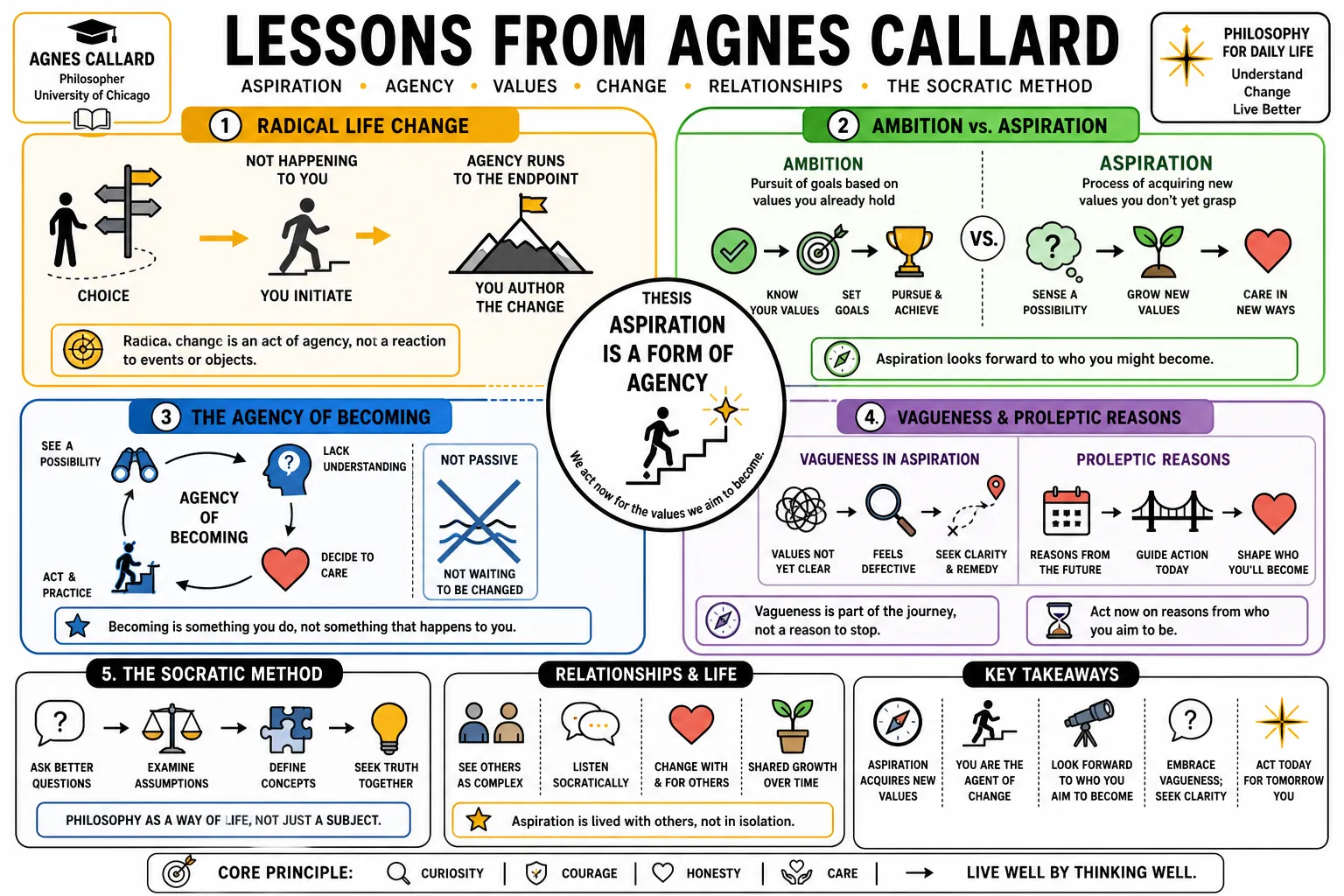
Lessons from Agnes Callard
University of Chicago philosopher Agnes Callard studies how people acquire new values and why serious inquiry requires other people. In Aspiration, she describes becoming someone new as a process of learning to care about a value one does not yet fully grasp. — Aspiration manuscript.
Part 1: Aspiration and Agency
- Radical Life Change: Radical change can be an extended activity of learning to value something new, rather than a single transformative event imposed on a passive person. — Aspiration manuscript.
- Ambition vs. Aspiration: Ambition pursues a goal one already values; aspiration involves learning why a new object of concern is valuable. — EconTalk on Aspiration.
- The Agency of Becoming: Callard describes aspiration as rational, purposive value acquisition. — Aspiration manuscript.
- Vagueness in Aspiration: An aspirant grasps the new value only dimly and works to remedy that incomplete understanding. — Aspiration manuscript.
- Proleptic Reasons: Proleptic reasons let people begin an activity while their grasp of its eventual value is still incomplete. — Aspiration manuscript.
- Value Acquisition: Acquiring a new value involves learning to see the world differently, not simply choosing a new preference. — Aspiration manuscript.
- Losing Everything: Because a hoped-for future can become part of one’s identity, losing it can feel like losing a self one was becoming. — Aspiration manuscript.
- Being an Aspirant: Callard asks how someone can reason toward a value they do not yet fully possess, rather than only from values they already hold. — Aspiration manuscript.
- the Rationality of Change: She treats aspiration as an active contribution to personal transformation, even while luck and outside influences matter. — EconTalk on Aspiration.
- Massive Aspiration: Callard describes erotic attraction as opening the possibility of radical personal change, not merely confirming a fixed self. — Marriage of the Minds interview.
Part 2: Anger and Forgiveness
- the Function of Anger: Anger can track a real moral grievance even though acting on anger carries dangers. — Angry Forever.
- Eternal Anger: The fact that time has passed does not by itself remove the reason for anger about a past wrong. — Angry Forever.
- Problem-Solving Anger: Callard resists treating anger only as an instrument for solving a problem; its grounds require moral attention. — EconTalk on Anger.
- Social Miracles: Callard calls apologies and other acts of relational repair social miracles because people cannot simply command them to work. — The Paradox of Apology.
- the Paradox of Apology: A demanded apology can fail precisely because the offended person needs an unprompted recognition of the wrong. — The Paradox of Apology.
- the Reality of Betrayal: Practical reasons to stop dwelling on anger do not by themselves show that the original grievance was unfounded. — Angry Forever.
- Forgiveness as Repair: A successful apology may unexpectedly restore trust even when neither party could specify in advance how to bring that about. — The Paradox of Apology.
- the Limits of Forgiveness: Callard treats forgiveness as difficult partly because the original reason for anger may remain intelligible. — EconTalk on Anger.
- Moral Grievances: Anger can register an injustice that a quick demand to move on would obscure. — Angry Forever.
- Moving Past Anger: A person may have reasons to preserve a relationship while still recognizing a valid reason for anger. — EconTalk on Anger.
Part 3: Marriage and Loneliness
- the Purpose of Marriage: Callard and her husband use the possibility of divorce to examine the dependency and uncertainty within marriage; the memorable preparation-for-divorce line begins with her husband, not Callard. — Marriage of the Minds interview.
- Finality in Love: Callard links some marital conflicts to one partner’s aspiration toward self-sufficiency and the other’s insistence that mutual need remains. — Marriage of the Minds interview.
- Philosophical Marriage: Callard brings philosophical questioning into marriage, treating disagreement as a chance to investigate rather than a defect to suppress. — Nautilus interview.
- Marital Exhaustion: She acknowledges that sustained questioning can feel exhausting in philosophy and in a relationship. — Nautilus interview.
- Marital Loneliness: In her account, marital loneliness can arise even when a marriage basically works, because closeness makes each failure of connection palpable. — The Problem of Marital Loneliness.
- the Discomfort of Connection: Her essay argues that even considerate compromises may leave partners aware of a distance between their perspectives. — The Problem of Marital Loneliness.
- Fighting: Callard describes some fights as arguments about whether the partners still need one another. — Marriage of the Minds interview.
- Dependency: Their discussion of marriage makes dependence on another person an issue to confront, rather than a condition one can simply wish away. — Marriage of the Minds interview.
- Polyamory and Jealousy: Callard treats jealousy as an emotion whose desires and assumptions are worth examining rather than accepting as self-explanatory. — EconTalk on Anger.
Part 4: Parenting and Children
- the Value of Children: Callard says children offer parents a chance to learn how the world appears to someone not yet fully shaped by it. — Nautilus interview.
- the Loneliness of Early Parenting: Callard writes that early parenting can be lonely because a newborn does not yet recognize the parent as another person. — Parenting and Panic.
- Posing Questions: She describes making philosophical questions routine in conversations with her children. — Nautilus interview.
- Parental Perfectionism: Callard argues that modern parenting is stressful partly because parents are expected to accept futures they cannot foresee. — Acceptance Parenting.
- Alternative Realities: Children can challenge a parent’s settled perspective by seeing the world in ways the parent does not. — Nautilus interview.
- Educational Opportunities: She treats conversation with children as an educational opportunity for the parent as well as the child. — Nautilus interview.
- Shaping Perspectives: For Callard, acceptance parenting asks adults to learn from children rather than assume they already know what happiness must look like for them. — Acceptance Parenting.
Part 5: Philosophy and the Socratic Method
- the Socratic Motto: Callard presents Socratic inquiry as a reciprocal effort to persuade or be persuaded, not a command to question everything alone. — Open Socrates excerpt.
- Admitting Error: She distinguishes admitting a past error from being open to the possibility that one’s current belief is wrong. — Open Socrates excerpt.
- the Fear of "Why?": Callard interprets resistance to Socrates as, in part, resistance to having one’s reasons questioned. — Open Socrates excerpt.
- Being Refuted: Callard is drawn to the Socratic willingness to be challenged and to learn through another person’s objections. — Berkeley Socrates conversation.
- Plato versus Socrates: She says she reads Plato’s dialogues while trying to reach the Socratic arguments and activity within them. — Berkeley Socrates conversation.
- Intellectualism: Callard presents Socratic philosophy as a cooperative division of intellectual labor between an interlocutor and a refuter. — Conversations with Tyler.
- Philosophy and Death: Callard connects philosophical reflection on mortality with a refusal to look away from difficult questions about life’s meaning. — Nautilus interview.
- the Gadfly: Callard’s account of Socrates emphasizes asking questions that unsettle unexamined certainties. — UChicago Socrates interview.
- Socratic Questioning: In Callard’s reading, a Socratic dialogue gives two people different roles in a shared attempt to discover what they do not yet know. — Conversations with Tyler.
- On The inquisitive life: An inquisitive life means acting without assuming you already know how to live; problems in romance, death, and politics grow when inherently open-ended activities are managed without inquiry. — The Guardian
Part 6: Persuasion and Disagreement
- Blind Spots: Other people can notice mistakes that our own self-justifying habits prevent us from seeing. — Nautilus interview.
- Civil Disagreement: Socratic disagreement aims at mutual learning, not a performance designed to impress onlookers. — The Pretense of Political Debate.
- Arguing: For Callard, genuine argument requires each participant to be open to being persuaded by the other. — The Pretense of Political Debate.
- Socratic Inquiry: Socratic inquiry asks participants to expose their convictions to another person’s questions. — Open Socrates excerpt.
- Persuasion: The aim of persuasion in Callard’s Socratic model is a two-way search for truth, not manipulation of an audience. — The Pretense of Political Debate.
Part 7: Advice and Public Discourse
- the Advice Segment: Callard argues that generic advice from a public intellectual rarely provides the sustained, personal engagement needed for real transformation. — Against Advice.
- Academic Publishing: She criticizes academic writing shaped chiefly by acceptance and career incentives rather than communication with readers. — Publish and Perish.
- Public Intellectuals: Callard worries that public philosophy becomes shallow when it promises easy answers or entertainment instead of joint inquiry. — Is Public Philosophy Good?.
- Institutional Neutrality: She argues that campus protest exposes tension between a university’s intellectual mission and its political ambitions. — Beyond Neutrality.
- Art and Morality: Callard argues that art can help viewers confront evil and suffering rather than shelter them from uncomfortable truths. — Art Is for Seeing Evil.
- Public Philosophy: Her case for public philosophy depends on inviting non-specialists into serious, open-ended inquiry. — Is Public Philosophy Good?.
- Thoughts and Prayers: In writing about a family medical crisis, Callard examines why conventional gestures of prayer or consolation can feel inadequate. — Thoughts and Prayers.
- Status Games: Callard describes how people can quietly negotiate status through competing importance and leveling games in ordinary encounters. — Who Wants to Play the Status Game?.
- On Local contexts and the unicontext: Historically, local settings supplied different norms for how to act; the unicontext replaces those many contexts with one norm set expected everywhere. — The Ringer
- On Technology and the unicontextual impulse: Communications technologies do not create the unicontext by themselves; they spread because they satisfy a human drive to escape the limits of a small local world. — The Ringer
Part 8: Identity and Value Acquisition
- Future Selves: A person cannot fully grasp the value of the identity they are working toward before completing the learning involved in becoming it. — Aspiration manuscript.
- Reasoning Toward Value: Aspiration poses a puzzle: the fullest reasons for a transformation become available only through the process of undergoing it. — Aspiration manuscript.
- Becoming Someone Else: Substantive change can require practicing activities whose value is not yet fully visible from one’s present point of view. — Aspiration manuscript.
- Bridging the Gap: Teachers, institutions and models can help an aspirant begin to understand a value they have not yet mastered. — Aspiration manuscript.
- Learning to See: Value acquisition is partly a learning process in which one comes to perceive new reasons and priorities. — Aspiration manuscript.
- Acquiring New Desires: Callard distinguishes learning to value something from simply deciding, in an instant, to want it. — Aspiration manuscript.
- Incomplete Appreciation: An aspirant recognizes that their present appreciation of the sought-after value is incomplete. — Aspiration manuscript.
- Meritocracy: Callard proposes rewarding genuine achievement without treating lack of achievement as grounds for shame or deprivation. — A More Perfect Meritocracy.
- the Endpoint of Agency: Aspiration is an exercise of agency that develops the capacity to care about a value not yet fully one’s own. — Aspiration manuscript.