Aidan Gomez co-authored the 2017 Attention Is All You Need paper, which introduced the Transformer architecture. He later left Google Brain to co-found Cohere, an enterprise AI company focused on efficient, privately deployable language models. This profile examines his views on AI architecture, enterprise deployment, sovereignty, and building an AI company. — Attention Is All You Need — Original Paper. — Oracle — Aidan Gomez on Enterprise AI.
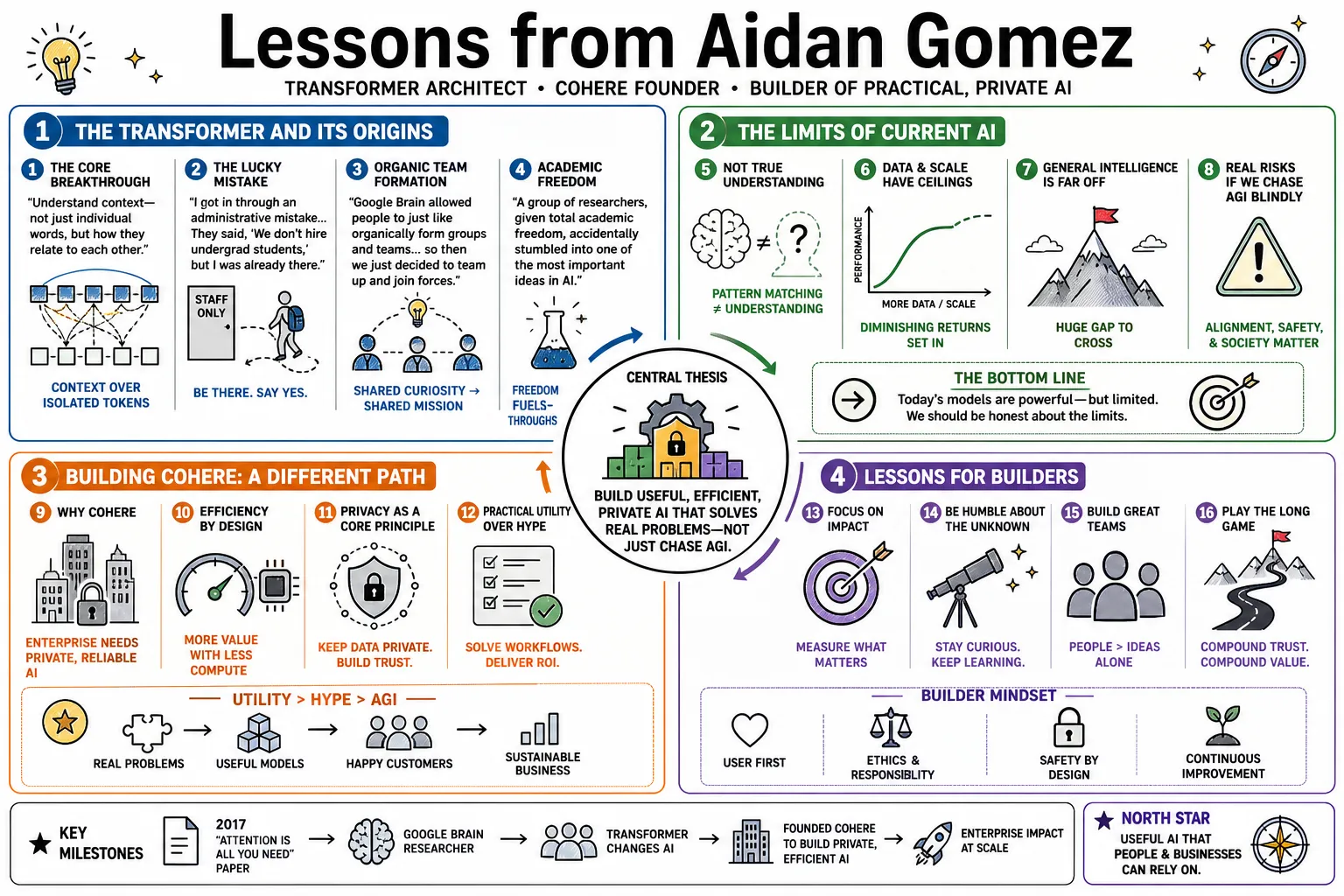
Part 1: The Transformer and Its Origins
- On the core breakthrough: The Transformer replaced recurrent and convolutional sequence architectures with an attention-only design that trained faster and parallelized more effectively.Attention Is All You Need — Original Paper.
- On the lucky mistake: Gomez entered Google Brain unusually early as an undergraduate intern, an opportunity that put him inside the team developing the Transformer.YouTube — Inside the Paper That Changed AI Forever.
- On organic team formation: The Transformer team formed from researchers at Google Brain who discovered they were attacking related sequence-modeling problems and combined their work.YouTube — Inside the Paper That Changed AI Forever.
- On infinite resources: Leaving Google Brain meant giving up exceptional collaborators and abundant compute, but Gomez believed building products would create more impact.Radical Ventures — Aidan Gomez on Building an AI Business.
- On leaving the lab: Gomez argues that the highest-impact phase is shifting from pure industrial-lab research toward startups that turn the previous decade of AI progress into products.Radical Ventures — Aidan Gomez on Building an AI Business.
- On the frustration of stagnancy: Watching powerful research move slowly into products convinced Gomez that wider access and practical deployment were the next important step.Radical Ventures — Aidan Gomez on Building an AI Business.
- On understanding intelligence: For Gomez, building artificial intelligence is also a way to investigate how intelligence itself emerges.Oracle — Aidan Gomez on Enterprise AI.
Part 2: The Future of AI Architecture
- On the need for successors: Gomez hopes the Transformer will eventually be surpassed by an architecture capable of reaching another plateau of performance.YouTube — Inside the Paper That Changed AI Forever.
- On the longevity of Transformers: The Transformer has proved unusually durable: newer ideas are often absorbed into it rather than replacing the basic platform.Newcomer Interview — Aidan Gomez on AGI and Sovereign AI.
- On experiential learning: Useful enterprise models improve through deployment because real workflows expose the integrations, access controls, and failure modes that laboratory work alone cannot reveal.Unsupervised Learning — Aidan Gomez Transcript.
- On the limit of scale: Scaling compute remains a dependable route to better models, but Gomez sees it as a blunt method compared with algorithmic and data improvements.YouTube — Inside the Paper That Changed AI Forever.
- On the flattening curve: As adoption grows, Gomez expects cycles of exuberant spending followed by compression and efficiency that make many more applications economical.Newcomer Interview — Aidan Gomez on AGI and Sovereign AI.
- On synthetic data: As high-quality public text becomes less differentiating, progress depends more heavily on carefully constructed data and reasoning traces.YouTube — Inside the Paper That Changed AI Forever.
- On the shift in AI focus: The next capability gains are increasingly being built above the base architecture through reasoning and planning rather than by replacing the Transformer outright.Newcomer Interview — Aidan Gomez on AGI and Sovereign AI.
Part 3: Enterprise AI and Business Strategy
- On AI 2.0: Enterprise AI is moving from generic chat toward integrated, customizable systems designed around specific business workflows.Unsupervised Learning — Aidan Gomez Transcript.
- On isolation vs. integration: Language models create more value when connected to trusted information and external systems than when used only as standalone chat interfaces.Associated Press — Aidan Gomez Interview.
- On custom models: Teams that control both models and applications have more ways to tailor quality, tools, and integrations to a customer’s actual workflow.Unsupervised Learning — Aidan Gomez Transcript.
- On regulated industries: High-stakes domains such as healthcare require specialized data, strict access controls, and deployments that protect sensitive information.Unsupervised Learning — Aidan Gomez Transcript.
- On the value of proprietary data: Proprietary enterprise and scientific data can create differentiated value precisely because it is siloed and absent from public web training sets.Unsupervised Learning — Aidan Gomez Transcript.
- On the pyramid of automation: The most capable enterprise agents need access to the same software and context as employees, with permissions and guardrails matched to each organization.Unsupervised Learning — Aidan Gomez Transcript.
- On human productivity: Gomez measures AI’s value by whether it expands human capacity and makes people more productive in concrete work.Associated Press — Aidan Gomez Interview.
- On solving real problems: A practical healthcare use case is drafting patient notes so clinicians can spend less of their day on documentation.Associated Press — Aidan Gomez Interview.
- On Enterprise adoption: Coding adoption has advanced quickly, but Gomez believes most other enterprise workflows remain largely untouched by AI.Newcomer Interview — Aidan Gomez on AGI and Sovereign AI
Part 4: Efficiency and Hardware Pragmatism
- On production economics: A model that is impressive in a demo can still fail commercially if serving real users makes its inference costs explode.Associated Press — Aidan Gomez Interview.
- On hardware constraints: Cohere treats a small GPU footprint as an engineering constraint, pushing teams to extract more intelligence from limited hardware.YouTube — Inside the Paper That Changed AI Forever.
- On infrastructure spending: Gomez expects model compression and efficiency gains to push serving costs down even after periods of rapid infrastructure spending.Newcomer Interview — Aidan Gomez on AGI and Sovereign AI.
- On the Transformer's original edge: The Transformer’s original advantage was computational efficiency: it parallelized training and reached strong results with substantially less training time.Attention Is All You Need — Original Paper.
- On avoiding brute force: Gomez prefers algorithmic, architectural, and data improvements to relying exclusively on brute-force scale.YouTube — Inside the Paper That Changed AI Forever.
- On capital intensity: Efficient model development and compression broaden access by reducing the capital and operating cost required for strong systems.Newcomer Interview — Aidan Gomez on AGI and Sovereign AI.
- On model footprints: Deployability is a design goal: models should fit realistic enterprise hardware rather than require an impractical serving footprint.YouTube — Inside the Paper That Changed AI Forever.
Part 5: Independence and Sovereign AI
- On sovereign control: Gomez frames sovereign AI as the ability for countries and institutions to retain autonomy over critical models, data, and infrastructure.The Upstarts Podcast — Aidan Gomez on Sovereign AI.
- On avoiding vendor lock-in: Avoiding dependence on a single hyperscaler protects strategic leverage and reduces the risk that one provider controls access or margins.The Upstarts Podcast — Aidan Gomez on Sovereign AI.
- On owning vs. renting: Enterprises increasingly want AI they can customize and deploy in their own controlled environments rather than only consume as a shared service.Unsupervised Learning — Aidan Gomez Transcript.
- On data privacy as a blocker: Privacy is a central constraint for agents because useful systems may need access to email, CRM, HR, patient, or customer data.Unsupervised Learning — Aidan Gomez Transcript.
- On private deployments: Private VPC and on-premises deployment let organizations keep sensitive data and model access inside their own security boundary.Unsupervised Learning — Aidan Gomez Transcript.
- On the risk of shadow AI: If employees lack an approved secure AI option, they may route sensitive work through consumer tools with weaker organizational controls.Unsupervised Learning — Aidan Gomez Transcript.
- On hard mode independence: Cohere deliberately chose the harder path of avoiding early hyperscaler control in order to preserve strategic independence.The Upstarts Podcast — Aidan Gomez on Sovereign AI.
- On cloud agnosticism: Cloud-agnostic deployment lets AI run where an organization’s data already resides, including private cloud and on-premises environments.Unsupervised Learning — Aidan Gomez Transcript.
- On Systemic fragility: Concentrating critical AI infrastructure in a tiny number of providers creates a single point of failure for democratic economies.Newcomer Interview — Aidan Gomez on AGI and Sovereign AI
- On Building democratic alliances: Gomez argues that several democracies should build frontier capability together rather than rely on a single national supplier.Newcomer Interview — Aidan Gomez on AGI and Sovereign AI
- On Digital sovereignty: Digital sovereignty matters when access to foundational AI becomes critical to economic and public infrastructure.Newcomer Interview — Aidan Gomez on AGI and Sovereign AI
- On Diversified supply chains: Resilient AI infrastructure requires multiple capable suppliers and alliances so access cannot be withdrawn by one jurisdiction or company.Newcomer Interview — Aidan Gomez on AGI and Sovereign AI
Part 6: Perspectives on AGI and "AI Religion"
- On cosplaying religion: Gomez rejects treating AGI as a quasi-religious end goal; he prioritizes measurable positive impact from useful systems.Associated Press — Aidan Gomez Interview.
- On the AGI timeline: He treats general intelligence as a continuum and argues that current systems already exceed people on many bounded problems.Newcomer Interview — Aidan Gomez on AGI and Sovereign AI.
- On existential risk narratives: Gomez believes science-fiction takeover narratives receive disproportionate attention compared with the practical work of making AI beneficial and mitigating known risks.Associated Press — Aidan Gomez Interview.
- On present capabilities: On many knowledge tasks, Gomez already defers to models because their breadth can exceed an individual person’s expertise.Newcomer Interview — Aidan Gomez on AGI and Sovereign AI.
- On saving the world pragmatically: His preferred ambition is using AI to improve real outcomes—such as healthcare and productivity—rather than pursuing AGI as an abstract trophy.Associated Press — Aidan Gomez Interview.
- On Achieving AGI: Gomez’s practical test for general intelligence is whether a system can be applied broadly and surpass human performance across many problems.Newcomer Interview — Aidan Gomez on AGI and Sovereign AI
Part 7: AI Agents, Tool Use, and RAG
- On the burden of proof: RAG gives a model a burden of proof by tying answers to documents that users can inspect and fact-check.Associated Press — Aidan Gomez Interview.
- On the limit of text generation: Tool access turns a model from a text generator into a system that can act through software and APIs on a user’s behalf.Associated Press — Aidan Gomez Interview.
- On supercharging intelligence with tools: Models become more useful when they can call external tools instead of memorizing or simulating every operation internally.Associated Press — Aidan Gomez Interview.
- On the step change of RAG: Connecting a model to trusted private sources through RAG can sharply reduce hallucinations and improve confidence in its answers.Associated Press — Aidan Gomez Interview.
- On the necessity of citations: Document-level citations make AI outputs auditable, a requirement for confidence and compliance in regulated work.Associated Press — Aidan Gomez Interview.
- On the agentic experience: Agents become substantially more useful when they receive the same relevant context and authorized software access as human workers.Unsupervised Learning — Aidan Gomez Transcript.
- On RAG vs. long context: Long context alone does not solve enterprise retrieval: useful systems must connect securely to distributed, changing organizational data.Unsupervised Learning — Aidan Gomez Transcript.
- On teaching models to reason: Enterprise reasoning is valuable when models can work through business problems using the same tools employees use.Unsupervised Learning — Aidan Gomez Transcript.
- On building agent platforms: An enterprise agent platform must connect models to company software and data while preserving customized access controls.Unsupervised Learning — Aidan Gomez Transcript.
Part 8: Building Startups and Operating Philosophy
- On assuming success: Operate as though success is possible, then work backward to identify what must be done today to reach it.Radical Ventures — Aidan Gomez on Building an AI Business.
- On trusting your instincts: In the chaos of a fast-growing startup, Gomez’s advice to his earlier self is to trust his own judgment more.Radical Ventures — Aidan Gomez on Building an AI Business.
- On building the airplane: Rapid company building often means developing the organization while it is already operating—the familiar experience of building the airplane in flight.Radical Ventures — Aidan Gomez on Building an AI Business.
- On returning to the open source community: Open publication of foundational research allowed the Transformer to become a platform that researchers and builders across the field could extend.Attention Is All You Need — Original Paper.
- On the need for different regulations: AI regulation should provide clear guardrails and distinguish concrete harms and use contexts rather than treating every system identically.Axios — Interview with Aidan Gomez.
- People Should Know When AI Is Speaking: Gomez argues that people should have a right to know whether content or an interlocutor is machine-generated rather than human. — Axios — Interview with Aidan Gomez
- On long-term ownership: Gomez sees an eventual public listing as a way to impose discipline and broaden ownership beyond private investors and hyperscalers.The Upstarts Podcast — Aidan Gomez on Sovereign AI.