Alain Bertaud is an urban planner and author of Order Without Design. His work across many cities examines how labor markets, land prices, mobility, and planning rules shape urban opportunity. He argues that planners can improve cities by measuring these systems and providing public infrastructure while allowing residents and firms room to adapt. — Alain Bertaud Publications.
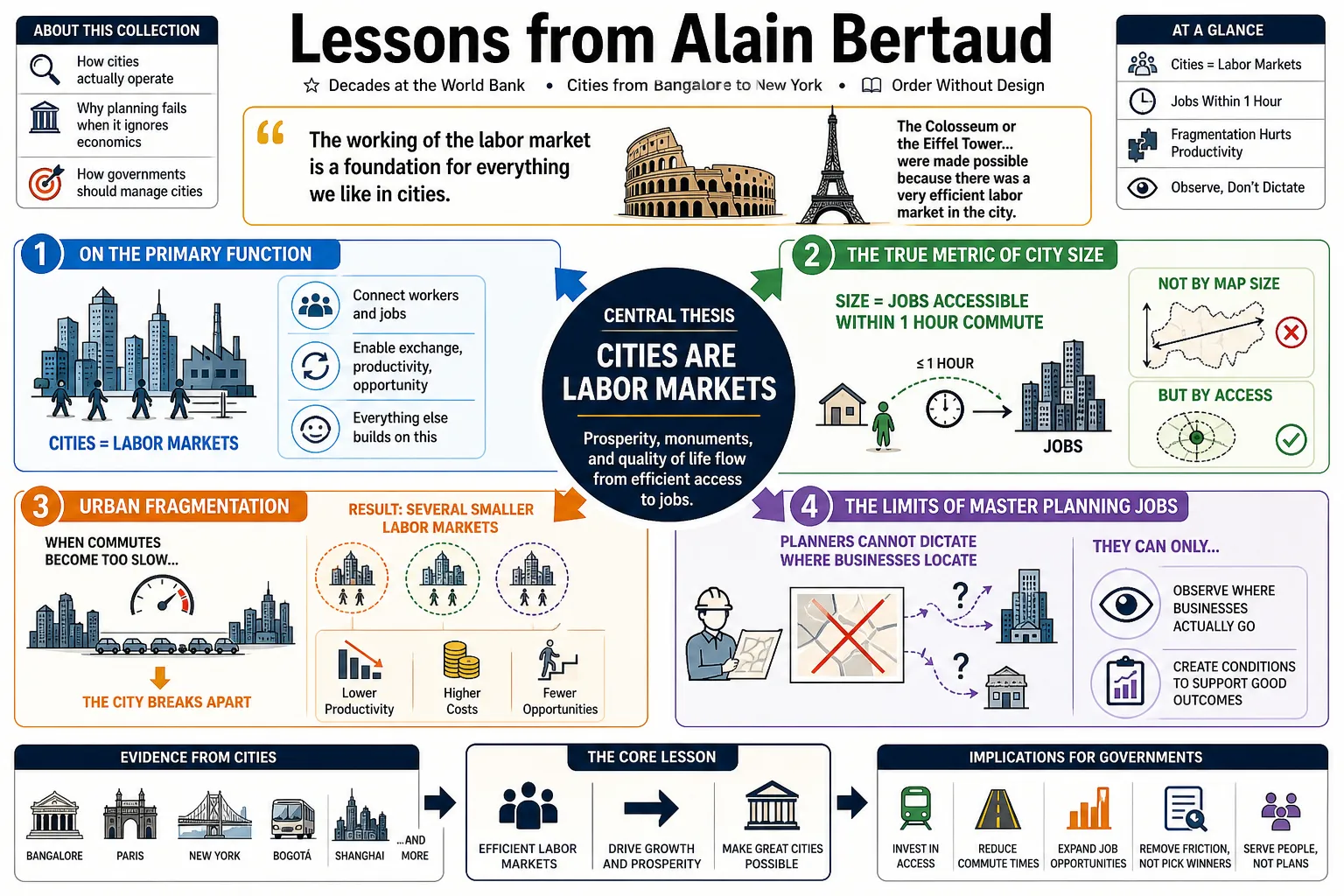
Part 1: Cities as Labor Markets
- The primary function of a city: Bertaud treats the functioning of a large labor market as the foundation of urban productivity and many other amenities. — EconTalk: Cities and Planning.
- what enables monuments: He argues that an efficient labor market helped create the wealth and specialized work behind monuments such as the Colosseum and Eiffel Tower. — EconTalk: Cities and Planning.
- The true metric of city size: For Bertaud, the economically relevant size of a city depends on how many jobs residents can reach within a reasonable commuting time, not just its mapped footprint. — Converting Land into Affordable Floor Space.
- urban fragmentation: Slow transport can fragment even a large metropolis into smaller, less effective labor markets. — EconTalk: Cities and Planning.
- The limits of master planning jobs: Planners cannot assign every firm and household an enduring location; their stronger role is to plan infrastructure and rules around observed market behavior. — Converting Land into Affordable Floor Space.
- spatial mismatches: Housing built far from accessible jobs can leave low-income households with a lower price but an unaffordable commute. — Converting Land into Affordable Floor Space.
- The goal of a mayor: Bertaud says mayors should enable residents’ productivity and initiative rather than impose a fixed vision of the city. — Charter Cities Podcast.
- The density of interaction: A large city’s value comes partly from enabling workers and firms to search across a broader pool of potential matches. — EconTalk: Cities and Planning.
- what planners forget: Bertaud challenges planning slogans that lack measurable indicators and urges planners to track mobility and housing affordability. — Converting Land into Affordable Floor Space.
- The definition of a successful city: He argues that a productive labor market makes it possible to support the amenities people enjoy in cities. — EconTalk: Cities and Planning.
Part 2: The Gap Between Planners and Economists
- ignoring gravity: Bertaud compares ignoring urban markets to ignoring gravity: prices and market forces shape outcomes whether planners acknowledge them or not. — Conversations with Tyler.
- The core failure of the planning profession: His book argues that planning practice needs the analytical tools of urban economics, not design rules alone. — Converting Land into Affordable Floor Space.
- understanding outcomes: Before changing an unwanted urban outcome, Bertaud urges planners to understand the market forces and regulations producing it. — Converting Land into Affordable Floor Space.
- market blindness: Bertaud uses the gravity analogy to argue that planners must account for markets rather than assume a design can override them. — Conversations with Tyler.
- repeating mistakes: He warns that obsolete land-use rules can persist long after their original rationale has disappeared and should be audited against their costs. — Converting Land into Affordable Floor Space.
- The illusion of the city as a building: Bertaud rejects the idea that an entire city can be designed in advance like a single building; he gives planners a narrower role in infrastructure and regulation. — Converting Land into Affordable Floor Space.
- The need for collaboration: Bertaud wants economists’ analysis to inform the practical decisions planners make about infrastructure and regulation. — Converting Land into Affordable Floor Space.
- qualitative vs. quantitative goals: He criticizes qualitative goals such as livability when planners do not connect them to measurable outcomes. — Converting Land into Affordable Floor Space.
- action vs. understanding: Citing Angus Deaton, Bertaud warns that pressure to act can displace the work of understanding what needs to change. — Cities as Markets.
- top-down ignorance: A plan that assigns homes near fixed jobs misses workers’ need to change employers and households’ need to balance more than one commute. — EconTalk: Cities and Planning.
Part 3: Spontaneous Order vs. Design
- stumbling into establishments: Bertaud describes urban order as emerging from many individual actions rather than a single designer’s comprehensive plan. — Converting Land into Affordable Floor Space.
- Hayek's influence: He invokes Hayek’s idea of order without design while still reserving public responsibilities for infrastructure and rules. — Market Urbanism Interview.
- messy cities: Bertaud says he is tolerant of messy cities because locally evolved streets and uses can reflect residents’ choices. — Conversations with Tyler.
- The ideal role of a planner: He says mayors and planners should enable and facilitate urban activity rather than imagine they can create it all. — Cities as Markets.
- Casablanca: Bertaud names Casablanca as a favorite city film because its characters move through a place of arrivals, departures, and refuge. — Conversations with Tyler.
- cities designing themselves: Bertaud describes urban form as the combined result of many decisions about location, housing, access, and land prices. — Converting Land into Affordable Floor Space.
- The failure of master plans: He warns that freezing a city’s land use or building stock prevents it from adapting as needs change. — Conversations with Tyler.
- socialist cities: His comparison of planned cities shows how suppressing land-price signals can leave land uses poorly matched to valuable central locations. — The Costs of Utopia.
- Brasilia: Bertaud criticizes Brasília as a city built around bureaucratic relocation rather than an open choice of jobs and residences. — Conversations with Tyler.
Part 4: Mobility and Transportation
- The purpose of transit: Transport matters because it determines which jobs workers can reach and which workers firms can recruit. — EconTalk: Cities and Planning.
- average commute times: Bertaud recommends tracking commuting time and job accessibility across transport modes as practical measures of city performance. — Urban Progress Interview.
- war against the car: Before slowing one mode of travel, planners should ask whether the change improves or worsens access to jobs for residents. — Urban Progress Interview.
- transit monopolies: Bertaud evaluates transit by how well its routes, speed, and connections serve the actual spatial distribution of jobs and residents. — Charter Cities Podcast.
- land prices and transit: Where land is expensive and dense, the space consumed by private cars and parking carries a higher opportunity cost. — EconTalk: Cities and Planning.
- motorcycles in Asia: Bertaud’s transport analysis shows how scooters and motorcycles can enlarge the area that workers can reach affordably in some Asian cities. — Converting Land into Affordable Floor Space.
- walking distances: Transit viability depends on the density and accessibility of homes and jobs around its stations. — EconTalk: Cities and Planning.
- managing congestion: Bertaud proposes congestion pricing that adjusts to keep traffic moving on scarce road space. — EconTalk: Fixing Sick Cities.
- integrating modes: He advocates combinations of transport modes that let commuters choose efficient door-to-door trips rather than forcing a car-versus-transit dichotomy. — Converting Land into Affordable Floor Space.
- Expanding road capacity in democracies: In dense cities, Bertaud considers tunnels and other grade-separated routes among the ways to add circulation without taking more surface land. — EconTalk: Cities and Planning.
Part 5: Housing Affordability and Markets
- The root of housing crises: Bertaud argues that restrictions on land and housing supply can materially worsen affordability; he does not claim every housing problem is a regulatory failure. — Converting Land into Affordable Floor Space.
- floor area ratios: A low maximum floor-area ratio limits how much housing floor space can be produced on land where demand is high. — Converting Land into Affordable Floor Space.
- trade-offs: Housing choices involve a trade-off among floor area, location, price, and the cost of reaching work; minimum-size rules can remove options affordable to poorer households. — Converting Land into Affordable Floor Space.
- The illusion of affordability mandates: Bertaud criticizes inclusionary requirements that tie a small supply of lower-cost units to the production of expensive market-rate units. — EconTalk: Cities and Planning.
- single-family zoning: He connects widespread single-family zoning in U.S. cities with lower densities and fewer nearby customers for neighborhood businesses. — EconTalk: Fixing Sick Cities.
- land as an input: When central land is valuable, allowing more floor space can let builders use it more intensively rather than requiring every household to consume a large lot. — Converting Land into Affordable Floor Space.
- The elasticity of supply: Bertaud urges cities to make the supply of buildable land and floor space more responsive to demand by removing bottlenecks and extending infrastructure. — Converting Land into Affordable Floor Space.
- informal settlements: He describes informal settlements as rational responses by households excluded from affordable formal options, while stressing the need for basic infrastructure and safety. — Urban Progress Interview.
- protecting incumbents: Bertaud notes that incumbent homeowners may oppose nearby construction partly because they treat their property as a protected store of value. — Conversations with Tyler.
- changing regulations: His supply-side agenda includes removing height and floor-area constraints where they unnecessarily block additional housing. — Converting Land into Affordable Floor Space.
Part 6: Land Use and Zoning
- arbitrary borders: Green belts and restrictions on converting land can reduce the supply of developable land and raise prices when demand grows. — Converting Land into Affordable Floor Space.
- parking minimums: Parking minimums consume land and construction resources that could otherwise serve housing or other uses. — Converting Land into Affordable Floor Space.
- The cost of aesthetics: Bertaud accepts that aesthetic preservation can be a legitimate democratic choice, but says its housing-access and affordability costs should be explicit. — EconTalk: Fixing Sick Cities.
- dynamic zoning: He recommends regularly auditing land-use regulations against observed land prices, rents, and supply constraints. — Converting Land into Affordable Floor Space.
- mixed-use development: Bertaud points to Paris as an example of regulating building form while leaving many commercial and residential uses free to mix. — EconTalk: Fixing Sick Cities.
- evaluating planners: He asks planners to judge outcomes such as affordability, permits, land supply, and commuting access rather than conformity to a static map. — Urban Progress Interview.
- The arrogance of planners: Bertaud cautions planners not to impose their own preferred housing consumption on households whose income and location needs differ. — Urban Progress Interview.
- building heights: Height limits can prevent additional floor space in valuable central locations and shift some growth toward less accessible land. — Converting Land into Affordable Floor Space.
- property rights: Bertaud argues for property rights that let owners adapt their own parcels while limiting neighbors’ veto power over change. — Charter Cities Podcast.
- Pricing parking: Bertaud calls parking a form of real estate—a hotel for cars—whose price should respond to demand rather than being supplied free at the curb. — EconTalk: Fixing Sick Cities.
- The separation of structure and use: He contrasts Paris’s rules for physical building form with its relative flexibility about how interior and street-level spaces are used. — EconTalk: Fixing Sick Cities.
Part 7: Infrastructure as a Tool
- Robert Moses: Asked what he would tell Robert Moses, Bertaud said infrastructure should serve people, not become an end in itself. — Conversations with Tyler.
- The planner's true job: Bertaud describes planners’ core public task as providing the streets and infrastructure that support residents’ own activities. — Charter Cities Podcast.
- street grids: Bertaud emphasizes protecting a connected network of streets and rights-of-way that can serve many changing private uses. — Converting Land into Affordable Floor Space.
- infrastructure trailing development: Where informal development has already occurred, Bertaud favors legalizing and servicing settlements instead of pretending they do not exist. — Converting Land into Affordable Floor Space.
- location rarity: Bertaud argues that a viable city needs a strong location and access to a real labor market; attractive rules alone cannot manufacture one anywhere. — Conversations with Tyler.
- pricing infrastructure: He asks cities to account for the land, maintenance, and access costs of roads and utilities when deciding where to extend infrastructure. — Converting Land into Affordable Floor Space.
- transit-oriented development: High-capacity transit delivers less access if land-use rules prevent enough homes and jobs near its stations. — Converting Land into Affordable Floor Space.
- anticipating demand: Bertaud recommends using observed land prices and expected densities to guide infrastructure plans rather than assuming a predetermined spatial form. — Converting Land into Affordable Floor Space.
- adapting grids: He assigns government responsibility for reserving streets and major infrastructure corridors that individual landowners cannot coordinate alone. — Converting Land into Affordable Floor Space.
- The cost of density vs. sprawl: Bertaud argues that adapting pipes in an existing city can be less costly than treating peripheral expansion as a cost-free alternative. — EconTalk: Fixing Sick Cities.
- Planning priorities: He recommends that planning departments monitor land prices and commuting indicators so infrastructure can respond to actual demand. — Market Urbanism Interview.
Part 8: The Role of Government and Social Policy
- homelessness: Bertaud distinguishes emergency help for people experiencing homelessness from policies aimed at making ordinary housing supply more affordable. — EconTalk: Cities and Planning.
- mixing policy: He treats shelter and specialized support for people unable to house themselves as a social responsibility, not a substitute for broader housing-market reform. — EconTalk: Cities and Planning.
- market limits: Bertaud explicitly rejects the idea that markets alone can address every housing need. — EconTalk: Cities and Planning.
- providing public goods: His account gives government a central role in streets, drainage, sanitation, and other public infrastructure that informal markets alone cannot provide. — Converting Land into Affordable Floor Space.
- subsidizing people, not places: Bertaud supports targeted public help for people unable to afford housing while arguing that broad public-housing programs cannot replace a functioning housing market. — Urban Progress Interview.
- taxation: Bertaud has favored ordinary property taxation based on market land value rather than improvements, while warning against confiscatory taxation of all land-value gains. — Market Urbanism Interview.
- municipal boundaries: Because a metropolitan labor market crosses municipal and state boundaries, Bertaud calls for regional coordination of transit and other shared infrastructure. — Charter Cities Podcast.
- data collection: He urges planning departments to publish and use data on land prices, housing costs, permits, and commute times to test whether policies work. — Market Urbanism Interview.
- evaluating mayors: Bertaud proposes judging city leaders by observable outcomes such as housing affordability and mobility rather than by the elegance of their plans. — Market Urbanism Interview.