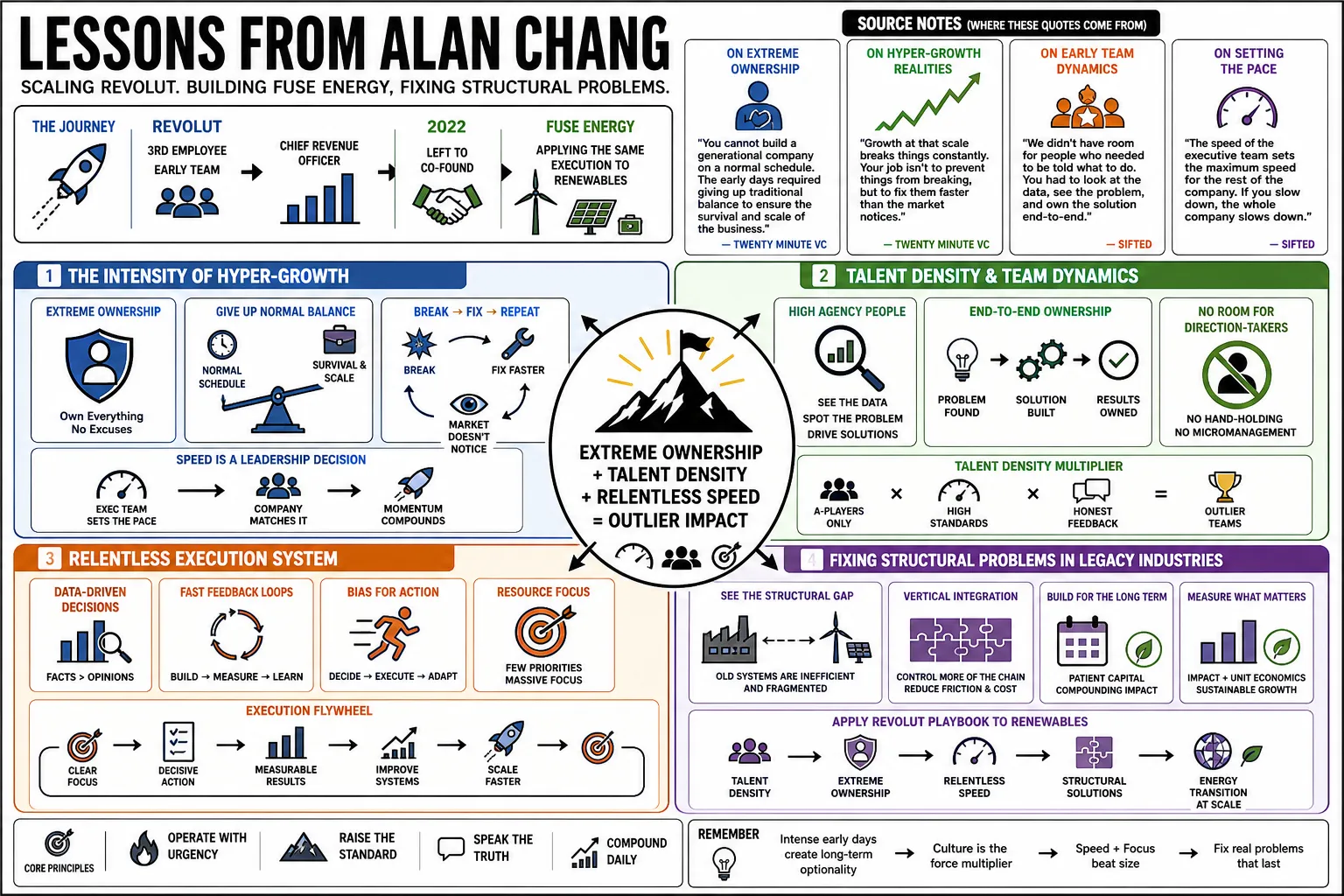
Lessons from Alan Chang
Alan Chang joined Revolut early and later served as chief revenue officer. He and Charles Orr founded Fuse Energy after deciding that energy presented a larger, less solved challenge. These lessons focus on his directly documented approach to execution, hiring, and building an integrated energy company. — BILLIONS Podcast.
Part 1: The Intensity of Hyper-Growth
- Work ethic: Chang argues that building a generational company requires an unusually strong work ethic, while acknowledging that a balanced job is a legitimate choice for others. — 20VC — Alan Chang Interview.
- Self-directed teams: He prefers people who can identify and hit their own targets, or at least execute well against clear targets. — 20VC — Alan Chang Interview.
- An urgent pace: Chang says he carried Revolut’s get-it-done culture to Fuse and intensified its emphasis on execution. — 20VC — Alan Chang Interview.
- Metrics and incentives: Chang values useful performance measures but cautions that tying rewards to a KPI can encourage teams to game it. — 20VC — Alan Chang Interview.
- Care as a hiring criterion: After overvaluing intelligence in past hires, Chang says he now looks for people who care deeply about the company and its mission. — 20VC — Alan Chang Interview.
- Ambition and execution: Looking back at Revolut’s early competition, Chang credits the team’s ambition and execution speed more than a distinctive product roadmap. — 20VC — Alan Chang Interview.
Part 2: Talent and Performance Standards
- Pay for exceptional skill: Fuse grades candidates on specific skills and may offer exceptional performers substantially higher compensation without fixed pay bands. — 20VC — Alan Chang Interview.
- The candidate’s response: When Chang describes Fuse’s difficult ambition, he watches whether a candidate leans toward the challenge or away from it. — 20VC — Alan Chang Interview.
- Direct performance feedback: Chang says Fuse gives an underperforming hire a verbal warning and a chance to improve rather than relying on a formal performance-improvement plan. — 20VC — Alan Chang Interview.
- Small independent teams: Chang favors small teams with clear goals and room to execute, while leadership monitors their results. — 20VC — Alan Chang Interview.
- Assess transferable skills: Fuse tests coding, system design, problem-solving and fit; Chang says a backend candidate need not already know Python. — 20VC — Alan Chang Interview.
- Feedback while work is live: Chang describes direct negative feedback as useful when strong performers can use it to improve. — 20VC — Alan Chang Interview.
- Mission fit: Chang tells candidates how demanding Fuse will be and asks why they personally want to take on that work. — 20VC — Alan Chang Interview.
- A named owner for workplace performance: Chang says Fuse is creating a Human Performance team and hiring a Workplace Performance Manager to own conditions that affect employees’ work. — Chang on Workplace Performance.
Part 3: Speed as a Defensive Strategy
- Execution as an advantage: Chang believed Revolut’s ambition and speed mattered even when its competitors had broadly similar roadmaps. — 20VC — Alan Chang Interview.
- Avoid committee decisions: In a later interview, Chang criticizes running a startup by committee and favors clear decision ownership. — BILLIONS Podcast.
- A fast customer-feedback loop: Chang says Fuse’s local support team passes customer feedback to founders and engineers daily, sometimes enabling app changes the next day. — Chang on Fuse Customer Support.
- Engineering hiring bottleneck: Asked what might prevent Fuse from reaching its next revenue goal, Chang names the speed of hiring quality engineers rather than access to capital. — 20VC — Alan Chang Interview.
- Tools for support agents: Chang says Fuse built internal tools that give its support agents the same account context the customer sees in the app. — Chang on Fuse Customer Support.
- Keep raising the execution bar: Chang says he pushes the team to examine what it could have done better rather than treating current speed as sufficient. — 20VC — Alan Chang Interview.
Part 4: Solving Unsolved Problems
- Why leave fintech: Chang says he and Charles Orr viewed the remaining fintech challenge as more about customer distribution, and wanted to tackle another important problem. — BILLIONS Podcast.
- Choosing energy: Chang says he and Orr sought an important problem they believed would otherwise remain unsolved, then spent about a year researching energy. — BILLIONS Podcast.
- Applying the Revolut playbook: Fuse carried an emphasis on speed, ambition and hard execution from Chang’s Revolut experience into energy. — 20VC — Alan Chang Interview.
- More than an app: Chang describes Fuse as a full-stack energy company, combining supply, generation, trading skills and software rather than only an interface. — 20VC — Alan Chang Interview.
- A large market: Chang argues that energy is a very large market in which a company could keep growing for decades; this is his ambition, not a forecasted result. — BILLIONS Podcast.
- Physical infrastructure: Fuse’s first full-stack experiment included a single wind turbine, a supplier licence and a qualified trader. — 20VC — Alan Chang Interview.
Part 5: First-Principles Thinking
- An ageing grid: In his Balderton interview, Chang argues that the UK grid needs a rebuild joining hardware and software to lower costs. — Balderton What’s Next Podcast.
- Savings from integration: Fuse’s investor describes a model intended to pass savings from renewable generation through to retail customers. — Lowercarbon — Fuse.
- Lowering the cost of energy: Chang argues that high and unstable power costs affect the economics of businesses far beyond the energy sector. — The City Is Paying the Price for Britain’s Energy Failure.
- Regulation and delivery: Chang says he wants planning rules reviewed for their usefulness and made simpler, not all regulation removed. — City A.M. Interview.
- Hiring beyond energy: In a direct interview, Chang says the challenge is hiring world-class engineers who can learn the energy problem, rather than relying only on industry veterans. — BILLIONS Podcast.
- Learn the problem first: Chang and Orr spent roughly a year researching energy before committing to build Fuse. — BILLIONS Podcast.
- Affordable, abundant power: Chang argues that lower-cost, lower-carbon power need not require a general reduction in energy use; this is his policy view. — 20VC — Alan Chang Interview.
Part 6: Vertical Integration and The Full-Stack Approach
- Owning renewable assets: Fuse develops and owns renewable generation assets as part of its supply model. — City A.M. Interview.
- Forecasting demand: Fuse uses software models, weather and consumption patterns to forecast demand and manage energy purchasing. — City A.M. Interview.
- A future virtual power plant: Fuse describes virtual power plants as a future opportunity for customer solar and batteries, while explicitly saying it does not yet offer a direct VPP service. — Fuse Energy — Virtual Power Plant Guide.
- A reinvestment flywheel: Fuse’s investor describes a proposed cycle in which demand for lower-cost clean energy funds additional renewable capacity. — Lowercarbon — Fuse.
- Cost advantage as a company claim: Chang says Fuse has removed roughly 17% of operating costs compared with a median UK energy company; the figure is his claim, not independently audited here. — City A.M. Interview.
- Complexity behind a simple offer: Balderton’s interview describes Fuse handling complexity in-house so customers can receive a simpler, lower-cost product. — Balderton What’s Next Podcast.
- A global ambition: Chang describes Fuse’s goal as becoming the world’s leading energy company, which would require international expansion. — BILLIONS Podcast.
Part 7: Regulation and Industry Incumbents
- Competing on costs: Chang presents lower energy costs, a better product and customer experience as Fuse’s route to winning customers from incumbents. — Balderton What’s Next Podcast.
- International expansion: Chang says Fuse intends to expand internationally; later company plans include Ireland and the US. — BILLIONS Podcast.
- Policy and energy capacity: Chang argues that Britain needs faster grid connections and more reliable domestic capacity, not just targets. — The City Is Paying the Price for Britain’s Energy Failure.
- Planning as a bottleneck: Chang says capital is available for energy projects but slow planning and grid connections can prevent projects from being built. — The City Is Paying the Price for Britain’s Energy Failure.
Part 8: Founder Mindset and Extreme Ownership
- Looking forward: In the Riding Unicorns interview, Chang says he rarely dwells on past milestones and focuses on the next energy problem to solve. — Riding Unicorns Podcast.
- Founder accountability: Chang describes the transition from operator to founder as taking full responsibility for decisions and outcomes. — Scaling Europe Interview.
- Stacked constraints: Chang describes building a full-stack energy business as difficult because infrastructure, licences, trading and engineering must be assembled together. — 20VC — Alan Chang Interview.
- Never settle: Of Revolut’s cultural values, Chang says the one he carried most strongly to Fuse was “never settle,” particularly on important roles. — 20VC — Alan Chang Interview.
- A long-term ambition: Chang says the energy market is large enough that Fuse could, in his view, keep growing beyond its founders’ lifetimes. — BILLIONS Podcast.