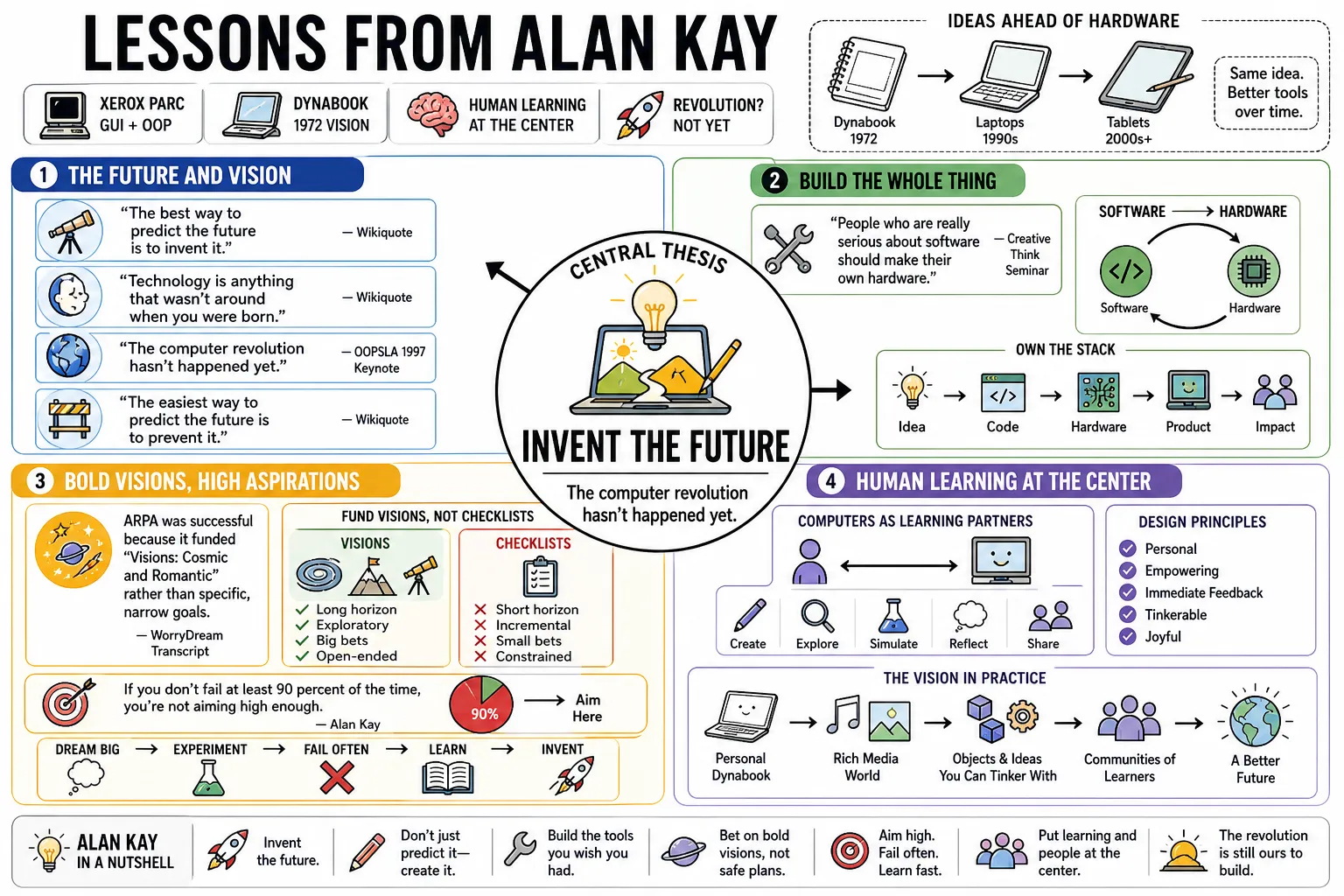
Alan Kay helped develop personal computing, graphical interfaces, and Smalltalk at Xerox PARC. His Dynabook proposal imagined a portable medium for children to create, explore, and learn. These lessons examine his ideas about software architecture, research, and a computer literacy that reaches beyond using finished applications. — The Early History of Smalltalk.
Part 1: The Future and Vision
- Inventing the future: Kay’s research agenda treated the future of computing as something researchers could build, not merely forecast. — The Early History of Smalltalk.
- The unfinished computer revolution: Kay argued that mass adoption of computers had not yet delivered the deeper literacy and expressive power he envisioned. — The Computer Revolution Hasn’t Happened Yet.
- Hardware and software together: At PARC, Kay’s group built both hardware and software so the machine could serve their research goals instead of constraining them. — The Machine That Changed the World Interview.
- Bold visions: Kay credits ARPA’s broad vision of interactive, networked intellectual amplification with leaving room for researchers to find the right problems. — How?.
- High aspirations: Kay’s account of ARPA treats unsuccessful experiments as an expected cost of discovering valuable new ideas, not automatically as failed research. — How?.
- Licklider’s scope: Kay recounts Licklider asking for an “Intergalactic” network to push engineers beyond a smaller design. — How?.
- The goal of research: Kay argues that ambitious computing research can create whole new capabilities and industries rather than only improve existing products. — How?.
- Information architecture: In his history of Smalltalk, Kay describes a Xerox strategy joining personal computers, communications links, and information utilities. — The Early History of Smalltalk.
Part 2: Object-Oriented Programming and Messaging
- Coining the term: Kay said he coined “object-oriented” but that the C++ interpretation was not what he had in mind. — OOPSLA 1997 Keynote.
- Messaging over objects: Kay later wrote that the important idea behind Smalltalk was messaging between components, not the noun “object.” — Kay on Messaging.
- Late binding: Kay’s own definition of OOP includes extreme late binding alongside messaging and protected local state. — Kay on Object-Oriented Programming.
- Encapsulation: For Kay, an object protects its local state and process while interacting with other objects through messages. — Kay on Object-Oriented Programming.
- The Actor model: Kay’s Smalltalk history traces an early connection with Carl Hewitt’s Actor work, while noting that the two paths later diverged. — The Early History of Smalltalk.
- Beyond exposed data: Kay wanted programmers to work with higher-level behaviors of protected components rather than directly manipulating their internal state. — The Early History of Smalltalk.
- Java and C++: Kay criticized C++ and Java for making a new computing metaphor look too much like older programming practice. — OOPSLA 1997 Keynote.
- Lisp as an influence: Kay recounts Lisp among the important ideas that shaped Smalltalk, while his own goal was a different interactive system for children. — The Early History of Smalltalk.
- Corporate adoption of OOP: Kay complained that mainstream uses of “object-oriented” often preserved older programming habits rather than the message-based design he sought. — The Early History of Smalltalk.
Part 3: Complexity, Architecture, and Code Scale
- Simple and complex tasks: Kay recorded the design maxim that simple tasks should stay simple while complex tasks remain possible. — The Early History of Smalltalk.
- Large software systems: Kay argues that scaling software requires better architecture and more expressive ideas, not simply more low-level code. — STEPS 2007 Report.
- Program size: The STEPS project asked whether more expressive ideas could greatly reduce the amount of code needed for a personal computing system. — STEPS 2007 Report.
- Architecture over materials: Kay’s STEPS work treats architecture and powerful abstractions as the route to scaling a system, not simply more low-level code. — STEPS 2007 Report.
- Layered systems: Kay’s concern was that large systems become hard to understand when layers lack clear, runnable meanings; STEPS explored a smaller semantic model. — STEPS 2007 Report.
- The 20,000-line question: STEPS posed 20,000 lines as a test of whether a personal computing system could be expressed far more compactly; it was a research question, not a proved final size. — STEPS 2007 Report.
- Runnable models: Kay’s group sought domain-oriented, runnable descriptions whose meaning could be inspected and debugged instead of buried in implementation code. — STEPS 2007 Report.
Part 4: Biological Metaphors in Computing
- Computing and biology: Kay used biological cells as a design analogy for scaling systems through protected, communicating parts rather than tightly coupled mechanisms. — OOPSLA 1997 Keynote.
- The cell metaphor: Kay described Smalltalk objects as protected cells or small computers that communicate through messages. — The Early History of Smalltalk.
- Scaling like cells: Kay asked how cell-like units could scale far beyond simple mechanical structures and what software designers might learn from that. — OOPSLA 1997 Keynote.
- Protected internal state: In Kay’s analogy, the inside of one unit should not become a hidden dependency of the whole system. — OOPSLA 1997 Keynote.
- Signals between components: Kay’s biological analogy emphasizes messages across boundaries; the receiver retains control of its internal implementation. — OOPSLA 1997 Keynote.
- Dog houses do not become cathedrals: Kay uses a dog-house analogy to show why simply enlarging a small software design does not solve scaling problems. — OOPSLA 1997 Keynote.
- Distributed coordination: Kay’s account favors systems of protected components that communicate, with no single component needing direct access to all internal states. — The Early History of Smalltalk.
- The Internet as an ecology: Kay describes the Internet’s simple messaging and distributed structure as a useful quasi-biological architecture. — The Computer Revolution Hasn’t Happened Yet.
- The limits of the analogy: Biological networks inspired Kay’s designs, but he presents them as a model to explore rather than proof of an unkillable universal architecture. — The Computer Revolution Hasn’t Happened Yet.
Part 5: Children, Learning, and the Dynabook
- Children as active agents: Kay’s 1972 Dynabook paper describes children as active model-builders, not passive recipients of instruction. — A Personal Computer for Children of All Ages.
- Constructing to know: Kay opens the Dynabook paper with Cesare Pavese’s line about constructing the world and develops a learning-by-doing vision. — A Personal Computer for Children of All Ages.
- A computer for self-expression: Kay expected people to use a personal computer partly to think and communicate with themselves, as they do with paper and notebooks. — A Personal Computer for Children of All Ages.
- The child programs the computer: Kay quotes Seymour Papert’s question about whether the computer should program the child or the child should program the computer, and sides with children making programs for their own ends. — A Personal Computer for Children of All Ages.
- Advertising filters: Kay imagined that an owner might program the Dynabook to filter advertising from a networked information service. — A Personal Computer for Children of All Ages.
- Physics through play: Kay’s Dynabook scenario has a child alter a space game to model the Sun’s gravity, learning by constructing and testing the simulation. — A Personal Computer for Children of All Ages.
- Portable access: Kay proposed a portable personal medium that children and adults could use wherever they wished, while acknowledging the proposal was speculative. — A Personal Computer for Children of All Ages.
- Interactive models: The Dynabook was intended to let its owner construct and manipulate models, rather than merely consume a fixed book-like presentation. — A Personal Computer for Children of All Ages.
- A new literacy: Kay saw personal computing as a medium in which children could learn to express ideas through programs and dynamic models, not just receive instruction. — Howard Rheingold Interview.
Part 6: Perspective, Knowledge, and the Mind
- The value of perspective: Kay’s formulation is that a point of view can be worth “80 IQ points”: a better conceptual frame changes what one can see and do. — The Early History of Smalltalk.
- The Dijkstra joke: In his OOPSLA talk, Kay joked that computer-science arrogance could be measured in “nano Dijkstras.” — OOPSLA 1997 Keynote.
- Unlearning old paradigms: Kay warned that languages and tools can reshape thought, making an inherited paradigm hard to see beyond. — The Early History of Smalltalk.
- Context for knowledge: Kay argues that the surrounding context and conceptual tools can transform the quality of researchers’ thinking. — How?.
- What feels normal: Kay told an interviewer that children can settle into the “common sense” world early, which is one reason he favored early opportunities to examine assumptions. — Alan Kay on the Context and Catalysts of Personal Computing.
- Scientific outlook: Kay distinguishes powerful scientific ways of thinking from mere accumulation of facts and argues that education should cultivate the former. — How?.
Part 7: The Culture of Research and Xerox PARC
- Fund people, not projects: Kay describes the ARPA approach as finding exceptional people and letting them choose problems and methods within a broad vision. — How?.
- Baseball, not golf: Kay recounts Licklider’s baseball analogy: a low hit rate can still produce transformative research results. — How?.
- Corporate risk aversion: Kay contrasts Xerox’s commercial caution with the broader opportunity represented by PARC’s personal-computing work. — The Early History of Smalltalk.
- Researcher autonomy: Kay says research funders should avoid commanding every project and instead give capable investigators room to pursue the shared vision. — How?.
- Mathematical culture: Kay presents the ARPA–PARC community as joining scientific questions, mathematical models, and engineering of working systems. — How?.
- A connected research community: Kay credits interaction among researchers and students across institutions with spreading ideas and cooperation. — How?.
- Managing researchers: Kay’s model of research leadership is to provide a compelling vision and resources while leaving problem selection to exceptional investigators. — How?.
- Commercialization missed parts of the vision: Kay argues that commercial personal computers adopted only part of the expressive, authoring-centered medium PARC imagined. — Howard Rheingold Interview.
- Long research horizons: Kay’s account of ARPA and PARC emphasizes sustained investment in a research community rather than narrow short-term product targets. — How?.
Part 8: The Media Revolution and Printing Press
- The Web and the Internet: In a 2012 interview, Kay sharply distinguished the Web from the Internet, criticizing the Web’s design while praising the Internet’s underlying architecture. — Dr. Dobb’s Interview.
- Computing’s early stage: Kay compares present computing to early print culture: reproducing older media is easier than discovering the new medium’s deeper possibilities. — The Computer Revolution Hasn’t Happened Yet.
- Automating older media: Kay notes that many ordinary computer tasks simulate paper, film, or recordings with relatively few native computational additions. — STEPS 2007 Report.
- What print ultimately changed: Kay argues that print’s deeper consequence was new ways to reason and argue, not simply cheaper copies of handwritten books. — Howard Rheingold Interview.
- The computer as metamedium: Kay and Adele Goldberg described a dynamic medium able to represent older media and enable new kinds of interactive content. — Personal Dynamic Media.
- Simulation as literacy: Kay argues that real computer literacy includes shaping and understanding executable models, not just using finished applications. — The Computer Revolution Hasn’t Happened Yet.
- Argument through executable models: Kay hoped dynamic computing would let people explore and contest ideas in ways fixed print cannot. — Howard Rheingold Interview.
- Reading and writing a dynamic medium: Kay wanted ordinary users to author and examine interactive content as well as consume it. — Howard Rheingold Interview.