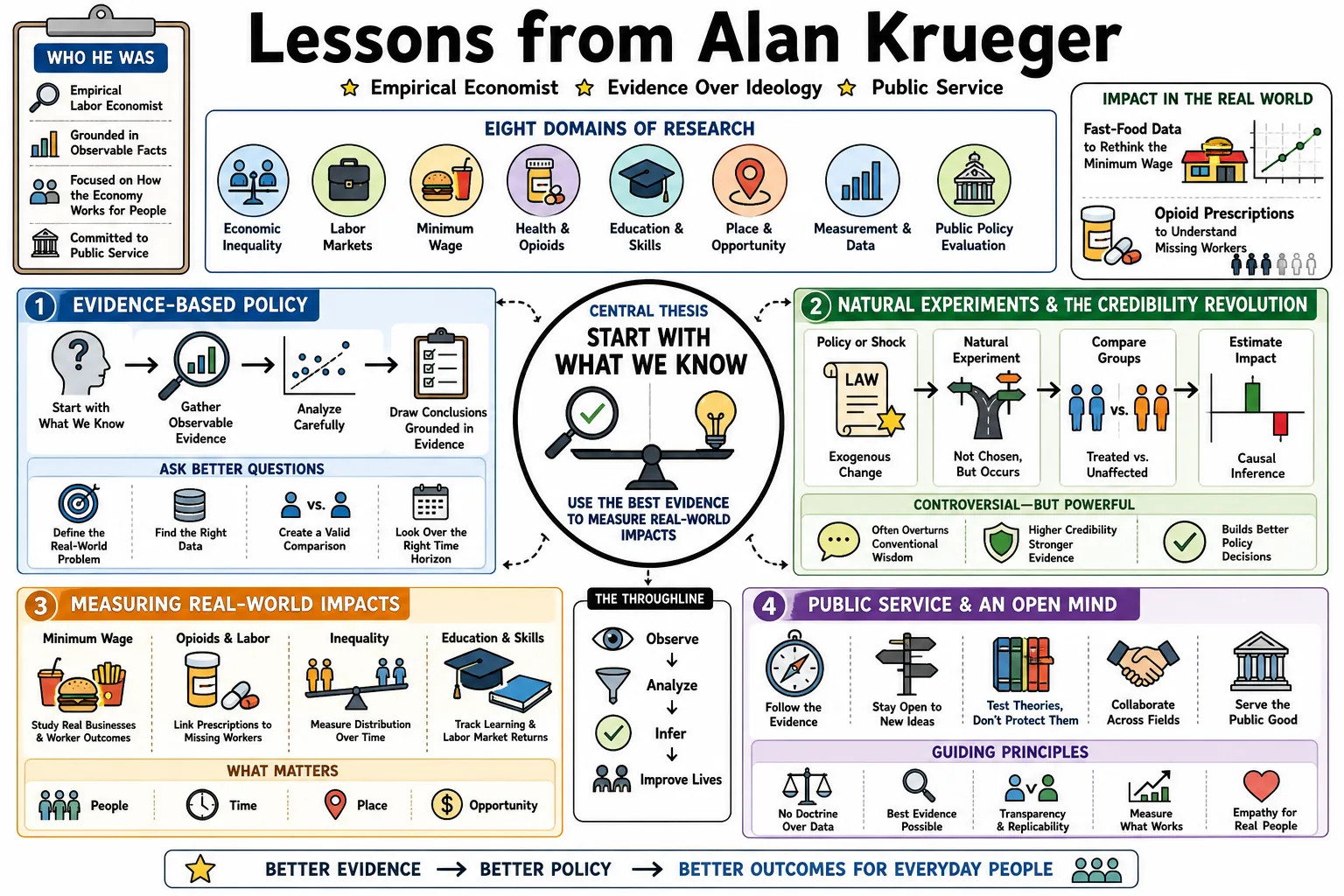
Lessons from Alan Krueger
Alan Krueger used empirical evidence to test labor-market assumptions, from the minimum wage to inequality and labor-force participation. His opioid research reported an association between local prescribing rates and participation, not a proven individual causal effect. — U.S. Senate Testimony.
Part 1: Evidence-Based Economics and Public Service
- Evidence-Based Policy: In policy work, Krueger said his team usually began by asking what evidence was available, while acknowledging that the evidence was often incomplete. — Social Science Space Interview.
- Economics as a Test of Ideas: Krueger told the Senate that he sought the best available evidence to test economic theories rather than commit himself to one doctrine. — U.S. Senate Testimony.
- Natural Experiments: Krueger used natural experiments and original data to test conventional economic assumptions against observed behavior. — U.S. Senate Testimony.
- Public Service: Krueger connected his family’s public-service tradition with his interest in using economics and statistics to improve people’s lives. — U.S. Senate Testimony.
- Credible Comparisons: Natural experiments can reveal policy effects when a change affects one group but leaves a suitable comparison group unaffected; the design and its limits still matter. — Card–Krueger Minimum-Wage Study.
- Research Credibility: Krueger emphasized original data and transparent evidence as ways to make empirical claims more credible. — U.S. Senate Testimony.
Part 2: The Minimum Wage and Labor Fairness
- Minimum-Wage Effects: In their New Jersey–Pennsylvania fast-food study, Card and Krueger did not find the job losses predicted by a simple competitive model; that finding is specific to the studied increase and setting. — Card–Krueger Minimum-Wage Study.
- The New Jersey Study: Card and Krueger compared fast-food restaurants in New Jersey and Pennsylvania after New Jersey raised its minimum wage in 1992 and found no employment decline in their sample. — Card–Krueger Minimum-Wage Study.
- Limits of a $15 Federal Floor: In 2015 Krueger supported a more moderate federal increase but warned that a nationwide $15 floor went beyond the range then well tested by research. — PBS NewsHour: Fighting for $15.
- Employer Wage-Setting Power: Krueger argued that employers can have room to set wages when workers face search frictions, so labor markets do not always behave like frictionless textbook markets. — The Rigged Labor Market.
- Employer Collusion: Krueger documented contemporary wage-suppression practices and urged more attention to employer collusion and labor-market competition. — The Rigged Labor Market.
- Search Frictions: Workers cannot instantly move to another job after a small pay cut; Krueger treated search costs as one reason employers may have wage-setting power. — The Rigged Labor Market.
- Wage Spillovers: Krueger observed that minimum-wage changes can affect pay above the legal floor as employers maintain internal pay relationships. — Card–Krueger Interview.
- Uncertain Higher Thresholds: Krueger distinguished the evidence on moderate minimum-wage increases from proposals far above the previously studied range. — PBS NewsHour: Fighting for $15.
- Employer Adjustment: In an interview, Krueger said employers may respond to moderate wage increases through prices, reduced turnover, filling vacancies, or cutting waste, not only by reducing jobs. — PBS NewsHour Interview.
Part 3: Inequality and the Great Gatsby Curve
- Inequality and Mobility: The Great Gatsby Curve describes a cross-country association between higher income inequality and lower intergenerational mobility; Krueger cautioned against reading it as a proven causal relationship. — The Great Utility of the Great Gatsby Curve.
- Forecasting Opportunity: Krueger used the Great Gatsby Curve to offer a rough forecast about future mobility while stressing that the outcomes for today’s children cannot yet be observed. — The Great Utility of the Great Gatsby Curve.
- A Historical Inequality Comparison: In a White House speech, Krueger compared pre–Great Recession U.S. income inequality with the high-inequality era evoked by The Great Gatsby. — White House Speech.
- Fairness in Labor Markets: Krueger argued that fairer labor-market institutions could benefit workers and the wider economy. — White House Speech.
- Institutions Shape Inequality: Krueger connected inequality partly to labor-market institutions and policy choices, while also recognizing broader economic forces. — White House Speech.
- Long-Term Unemployment: Krueger and coauthors found that the long-term unemployed faced persistent reemployment difficulties; the evidence does not show every detached worker suffers permanent loss. — Long-Term Unemployment Study.
- Recession Support: In Senate testimony, Krueger defended payroll-tax relief and emergency unemployment benefits as support during a weak recovery. — U.S. Senate Testimony.
- Origins of the Curve: Krueger credited earlier cross-country research, including Miles Corak’s work, in explaining the Great Gatsby Curve. — The Great Utility of the Great Gatsby Curve.
- Reading the Curve: The curve compares a measure of income inequality with intergenerational income persistence across countries; it establishes an association, not a country-by-country causal law. — The Great Utility of the Great Gatsby Curve.
Part 4: The Economics of the Music Industry
- Music and Well-Being: Krueger used music as a way to study enjoyment and social experience alongside market outcomes; the original aphoristic quotation was not verified as his exact words. — Princeton PAWcast: Rockonomics.
- Music as Economics: Krueger used the music industry to explain economic concepts such as superstar markets, pricing, and digital disruption. — Princeton PAWcast: Rockonomics.
- Recorded-Music Economics: Krueger described the steep fall in recorded-music revenue through 2015 and a later streaming-led recovery, instead of relying on an unverified potato-chip comparison. — Princeton PAWcast: Rockonomics.
- The Turn Toward Live Performance: Krueger described how concerts became more important to artists as recorded-music revenue fell in the digital era. — Princeton PAWcast: Rockonomics.
- Touring Revenue: Live performances offered artists a scarce experience that recordings could not replicate, but Krueger did not claim touring was the only way to earn money. — Princeton PAWcast: Rockonomics.
- Superstar Markets: Krueger described an increasingly concentrated music business in which a small number of superstar performers captured a disproportionate share of revenue. — Princeton PAWcast: Rockonomics.
- Ticket Underpricing: Krueger explained that some artists price primary tickets below market-clearing levels, leaving room for secondary resellers and reflecting concerns about fan goodwill. — Princeton PAWcast: Rockonomics.
- Rockonomics as a Lens: Krueger used the music industry as an early example of digital disruption and near-zero-cost reproduction affecting wider markets. — Princeton PAWcast: Rockonomics.
Part 5: What Makes a Terrorist
- Poverty and Terrorism: Krueger and Malečková found no direct causal effect of poverty or education on terrorism in the contexts they studied and called the evidence tentative and exploratory. — Education, Poverty and Terrorism.
- Political Motivation: In his book introduction, Krueger argued that political commitment can matter more than personal economic desperation in the cases he examined. — What Makes a Terrorist — Introduction.
- Ask About Political Aims: Krueger urged researchers to examine political motives and opportunities rather than assume low income explains participation in terrorism. — What Makes a Terrorist — Introduction.
- The Voting Analogy: Krueger compared participation in terrorism to political participation, including voting, to challenge a purely opportunity-cost account. — What Makes a Terrorist — Introduction.
- A Political-Participation Frame: Krueger treated terrorism as politically motivated action in the examined cases, while not endorsing or excusing violence. — What Makes a Terrorist — Introduction.
- Education in Studied Groups: Some groups examined by Krueger and coauthors had recruits who were not less educated than their comparison populations; this is not a universal terrorist profile. — Education, Poverty and Terrorism.
- Civil Liberties and Terrorism: Krueger’s book argued that political rights and civil liberties deserve attention in explaining terrorism alongside economic conditions. — What Makes a Terrorist — Introduction.
- Selective Recruitment: Krueger discussed how terrorist organizations may select better-educated recruits when many candidates are available. — What Makes a Terrorist — Introduction.
- Limits of Anti-Poverty Policy: Krueger warned against assuming economic aid alone would reduce terrorism when the studied evidence did not support poverty as its simple cause. — What Makes a Terrorist — Introduction.
Part 6: Education and Human Capital
- College Selectivity and Earnings: After adjusting for students’ application choices, Dale and Krueger found no statistically distinguishable average earnings premium from attending a more selective college. — Dale–Krueger College Selectivity Study.
- Selection Matters: Dale and Krueger used students’ application and admission patterns to account for characteristics that otherwise make selective-college graduates appear to earn more. — Dale–Krueger College Selectivity Study.
- Important Subgroup Exceptions: Their study found notable positive selectivity returns for Black and Hispanic students and for students from less-educated families. — Dale–Krueger College Selectivity Study.
- Smaller Classes: Krueger’s analysis of Tennessee’s STAR experiment found that smaller classes improved early test scores, with larger gains for minority and free-lunch students. — Krueger Class-Size Study.
- Distribution of Class-Size Gains: The STAR findings suggest that early class-size reductions can particularly benefit disadvantaged students, without proving they alone close achievement gaps. — Krueger Class-Size Study.
- Evaluate Education Policies: Krueger used experimental evidence, including STAR, to test education-policy claims instead of relying only on ideological assumptions. — Krueger Class-Size Study.
Part 7: The Gig Economy and the Alternative Workforce
- Online Gig Work Was Small: Katz and Krueger estimated that online labor intermediaries accounted for about 0.5 percent of all workers in 2015, a dated estimate rather than a current count. — Katz–Krueger Alternative Work Study.
- Worker Classification Uncertainty: Harris and Krueger described uncertainty over whether platform workers should be treated as employees or independent contractors. — Harris–Krueger Independent-Worker Proposal.
- An Independent-Worker Proposal: Harris and Krueger proposed a new independent-worker category for certain intermediary-platform jobs; it was a policy proposal, not enacted law. — Harris–Krueger Independent-Worker Proposal.
- Alternative Work Beyond Apps: Katz and Krueger counted temporary-help, contract-firm, on-call, and independent-contractor work, not just app-mediated gigs. — Katz–Krueger Alternative Work Study.
- Revising Gig-Work Estimates: Katz and Krueger’s later reconciliation of survey data suggested a modest upward trend in alternative work rather than the initially reported sharp surge. — Understanding Trends in Alternative Work.
- Looking Beyond the Recession: Katz and Krueger examined longer-running changes in alternative arrangements; the later data revision calls for caution about attributing a dramatic rise to any one cause. — Understanding Trends in Alternative Work.
- Platform Control: Harris and Krueger noted that intermediaries may set fees or other terms for independent workers, creating a case for tailored protections; the proposal did not establish universal monopsony. — Harris–Krueger Independent-Worker Proposal.
Part 8: The Opioid Epidemic and the Labor Force
- Opioids and Participation: Krueger found an observational association between local opioid-prescribing rates and lower prime-age labor-force participation, alongside other drivers such as aging. — Where Have All the Workers Gone?.
- Daily Pain Medication: Nearly half of prime-age men outside the labor force in Krueger’s survey reported taking pain medication daily. — Where Have All the Workers Gone?.
- Prescription Pain Medication: Among those men reporting daily pain medication, roughly two-thirds said they used prescription pain medication; the study did not say all such medication was opioids. — Where Have All the Workers Gone?.
- Geographic Association: Krueger found lower labor-force participation in areas with higher opioid-prescription rates, an association that alone does not establish causation. — Where Have All the Workers Gone?.
- Prescribing and Pain Medication: After adjustment, a 10 percent higher area opioid-prescribing rate was associated with about a one-percentage-point higher probability of daily pain-medication use. — Where Have All the Workers Gone?.
- Barriers to Participation: Krueger examined pain medication and opioid prescribing as possible contributors to reduced participation, while identifying demographic aging as an important overall driver. — Where Have All the Workers Gone?.