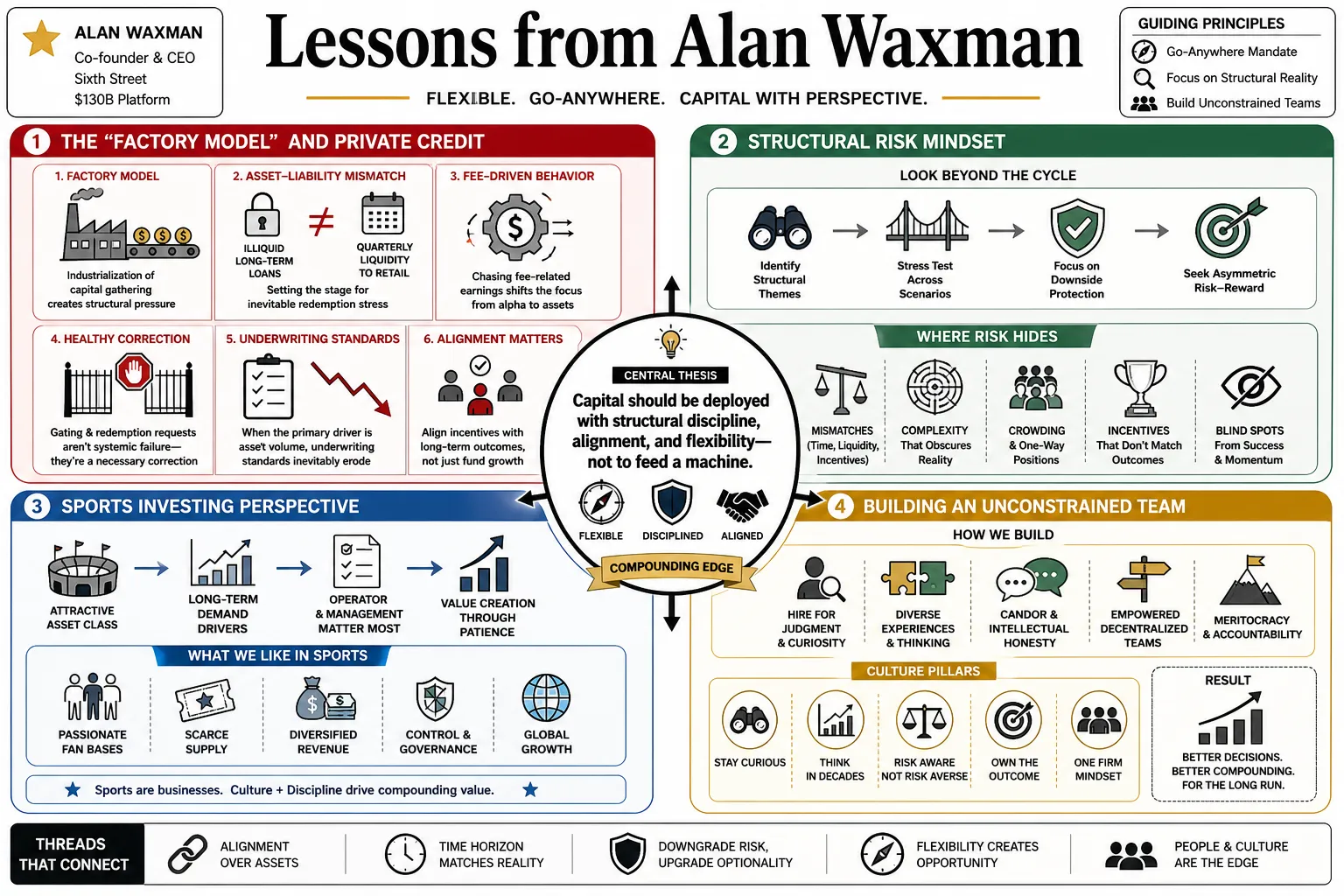
Lessons from Alan Waxman
Alan Waxman is Sixth Street’s co-founder and CEO. His interviews describe an investment firm organized for flexibility across asset classes, collaborative risk assessment, and customized solutions for capital partners. — Goldman Sachs Exchanges.
Part 1: The "Factory Model" and Private Credit
- The Factory Model: Waxman contrasts investment-led capital allocation with a factory model that raises and deploys capital at scale; his concern is that growth incentives can overtake returns. — Invest Like the Best: Clarity of Purpose.
- Match Assets and Liabilities: Waxman flags a mismatch when vehicles offering periodic liquidity hold long-duration, illiquid investments. The point is a risk to manage, not a prediction of inevitable failure. — Invest Like the Best: Clarity of Purpose.
- Fee Incentives: He asks investors to examine whether fee-related earnings reward managers for gathering assets rather than for earning differentiated returns. — Invest Like the Best: Clarity of Purpose.
- Avoid Crisis Analogies: The 2026 discussion distinguishes private-credit stress and redemption pressure from a repeat of the global financial crisis. — Invest Like the Best: Clarity of Purpose.
- Protect Underwriting: His factory-model critique warns that capital raised in advance can create pressure to deploy even when attractive investments are scarce. — Invest Like the Best: Clarity of Purpose.
- Wealth-Channel Liquidity: When private-credit products are offered through the wealth channel, Waxman emphasizes that redemption promises must fit the liquidity of the underlying investments. — Invest Like the Best: Clarity of Purpose.
- Scale Versus Returns: Waxman argues that a firm should not raise a larger fund simply because investors would provide the capital; the opportunity set and expected returns matter. — Goldman Sachs Exchanges.
Part 2: Flexibility and "Go-Anywhere" Investing
- Flexible Mandates: Sixth Street was built to compare opportunities across asset classes rather than requiring a team to invest in one fixed category. — Goldman Sachs Exchanges.
- Cross-Asset Comparison: Waxman describes evaluating credit, real estate, infrastructure and equity opportunities against a common risk-and-return framework. — Goldman Sachs Exchanges.
- Flexible Capital in Dislocations: Sixth Street’s flexible structure lets teams examine transactions that cross conventional fund or asset-class boundaries, including complex portfolios. — Goldman Sachs Exchanges.
- Capital as a Solution: Waxman describes starting with the counterparty’s problem and designing a transaction around its needs rather than selling a preset product. — Goldman Sachs Exchanges.
- Adapt During Dislocations: In the Airbnb transaction during COVID, teams across regions and specialties worked together under time pressure to evaluate a bespoke financing. — Goldman Sachs Exchanges.
- Structure to Fit the Need: The firm’s Lloyds and Credit Suisse transactions illustrate assembling different kinds of assets and risk exposures into tailored solutions. — Goldman Sachs Exchanges.
- Adapt Rather Than Predict: Waxman says Sixth Street’s founding premise was to adapt to accelerating change, using flexible mandates and cross-team collaboration. — Goldman Sachs Exchanges.
- Begin With the Partner: In sports and other complex transactions, Waxman describes collaborative whiteboarding to identify what the partner is trying to accomplish. — Goldman Sachs Exchanges.
Part 3: The Architecture of Sixth Street
- Founding Architecture: Waxman says Sixth Street was founded to make cross-asset investing possible without the internal fiefdoms and silos he observed elsewhere. — Goldman Sachs Exchanges.
- Flexibility by Design: The firm built its cross-asset mandate and collaborative operating model from its founding rather than treating them as occasional exceptions. — Goldman Sachs Exchanges.
- One Team: Waxman repeatedly links the firm’s investment model to a culture without silos, fiefdoms or internal politics. — Goldman Sachs Exchanges.
- Share Information: He argues that investment teams should share relationships and insights across disciplines so opportunities can be evaluated by the people best placed to help. — Goldman Sachs Exchanges.
- Scale Without Silos: As Sixth Street grew, Waxman sought to preserve the collaborative culture and integrated decision-making that supported its early investments. — Goldman Sachs Exchanges.
- Match Mandate to Opportunity: The TAO strategy can evaluate large cross-asset opportunities while narrower funds stay aligned with their specific opportunity sets; this is not a claim that all capital is permanent. — Goldman Sachs Exchanges.
- Escalate Risk Early: Waxman says junior colleagues should raise potential problems promptly, even when the message is uncomfortable; he credits Hank Paulson with teaching him this discipline. — Goldman Sachs Exchanges.
Part 4: Sports, Media, and Live Events
- Sports as a Business Theme: Waxman treats sports franchises and related rights as commercial platforms with global audiences, rather than simply prestige holdings. — Bloomberg Originals: The Deal.
- Bay FC Thesis: Waxman says Sixth Street saw a commercial opportunity in women’s soccer and made Bay FC a controlling investment, despite the then-record expansion fee. — Bloomberg Originals: The Deal.
- Different Sports Rights, Different Structures: Sixth Street’s sports investments include a Barcelona media-rights agreement and a Real Madrid stadium-related partnership, reflecting distinct partner needs. — Goldman Sachs Exchanges.
- Stadium Economics: The Real Madrid transaction concerned commercial opportunities around the renovated Santiago Bernabéu, rather than a generic loan to a football club. — Goldman Sachs Exchanges.
- Minority Stakes: Waxman distinguishes minority equity stakes in franchises such as the Spurs from Sixth Street’s controlling investment in Bay FC. — Goldman Sachs Exchanges.
- Global Fan Opportunity: In the Bloomberg interview, Waxman discusses international audience growth as an important opportunity for professional sports franchises. — Bloomberg Originals: The Deal.
- Partner-Specific Sports Deals: Waxman describes sports transactions as different structures for different needs: media rights, stadium-related commercial ventures, and team equity. — Goldman Sachs Exchanges.
- Live Experiences: Waxman argues that shared live experiences retain value in a world where much entertainment is viewed on screens. — Goldman Sachs Exchanges.
Part 5: Identifying Alpha and Unitizing Risk
- Unitize Risk and Return: Waxman describes comparing very different investments by breaking down their sources of risk and potential return. — Goldman Sachs Exchanges.
- Relative Value Across Assets: The firm compares prospective returns and risks across credit, real estate, infrastructure and equity instead of judging each only within its own silo. — Goldman Sachs Exchanges.
- Capital Protection: Waxman describes capital protection as a core consideration alongside yield and upside when constructing a diversified portfolio. — Goldman Sachs Exchanges.
- Yield and Convexity: In discussing the SSG portfolio, Waxman sought investments combining income, upside potential and capital protection rather than one uniform payoff profile. — Goldman Sachs Exchanges.
- Price Risk Across Mandates: Cross-asset comparisons help the firm decide where the available compensation is attractive relative to the risks assumed. — Goldman Sachs Exchanges.
Part 6: Navigating Crisis and Complex Deals
- Airbnb During COVID: Sixth Street’s Airbnb investment drew on teams in the United States, Europe and Asia working around the clock during the pandemic. — Goldman Sachs Exchanges.
- Spotify as a Case Study: Waxman discusses Spotify as one of the transactions illustrating Sixth Street’s flexible approach; the original claim about a non-dilutive structure is not established. — Invest Like the Best: Building Sixth Street.
- Respond to Stress With Flexibility: Waxman describes how a flexible mandate and teams able to work across disciplines helped Sixth Street evaluate opportunities during disrupted markets. — Goldman Sachs Exchanges.
Part 7: Culture, Teamwork, and Leadership
- Culture Is Everything: Waxman treats culture as central to Sixth Street’s ability to work across asset classes and respond to change. — Goldman Sachs Exchanges.
- Win as One Team: Waxman argues that people sharing ideas and relationships can accomplish more than isolated stars or competing investment silos. — Goldman Sachs Exchanges.
- Popovich and Team Play: Waxman cites Gregg Popovich and the Spurs as an influence on his thinking about team culture and putting collective success first. — Goldman Sachs Exchanges.
- Connectedness Over Fiefdoms: He says a firm’s effectiveness depends on its people sharing information and helping one another rather than guarding individual territories. — Goldman Sachs Exchanges.
- Hire for Teamwork: Waxman says Sixth Street has parted with successful investors whose behavior undermined its one-team culture. — Goldman Sachs Exchanges.
- Surface Bad News: Waxman wants potential problems escalated early, including by junior people, so the team can address risk before it compounds. — Goldman Sachs Exchanges.
- Communicate Under Stress: Waxman stresses raising bad news quickly and bringing the team together to solve problems instead of retreating into silos. — Goldman Sachs Exchanges.
- Select for Shared Culture: Technical investing ability alone is insufficient for Waxman when a person will not share credit, relationships and responsibility with the team. — Goldman Sachs Exchanges.
Part 8: The Goldman Sachs Era and Career Lessons
- Early Rejection: After graduation, Waxman went through 35 job interviews, including four at Goldman Sachs without a callback, before finding a route into finance. — Goldman Sachs Exchanges.
- The SSG Training Ground: At Goldman’s Special Situations Group, Waxman worked with a mandate spanning real estate, infrastructure, direct lending and private equity. — Goldman Sachs Exchanges.
- Learning Risk Management: Waxman credits Goldman mentors and the financial crisis with lessons about liquidity, duration matching, risk escalation and avoiding organizational silos. — Goldman Sachs Exchanges.
- A Nonlinear Entry: Waxman’s career began in client service and the mail room; he studied for the CFA and reached Goldman after a chance meeting on a plane. — Goldman Sachs Exchanges.
- Why Build Sixth Street: Waxman says he founded Sixth Street in 2009 to build a flexible, collaborative investing firm suited to a changing environment. — Goldman Sachs Exchanges.
- Structure Shapes Behavior: His experience of crisis-era silos informed Sixth Street’s founding design: integrated teams, broad mandates and early sharing of risks. — Goldman Sachs Exchanges.
- A Personal Idea System: In his 2026 interview, Waxman describes a one-sheet, pen-and-paper system for organizing ideas accumulated over his career; the original claim of a rigid leadership system goes beyond the source. — Invest Like the Best: Clarity of Purpose.