Albert Wenger, a partner at Union Square Ventures and author of The World After Capital, argues that digital technology is shifting the defining scarcity from productive capital to human attention. He calls for economic, informational, and psychological freedom so more people can contribute to the creation and sharing of knowledge. — World After Capital: Preface.
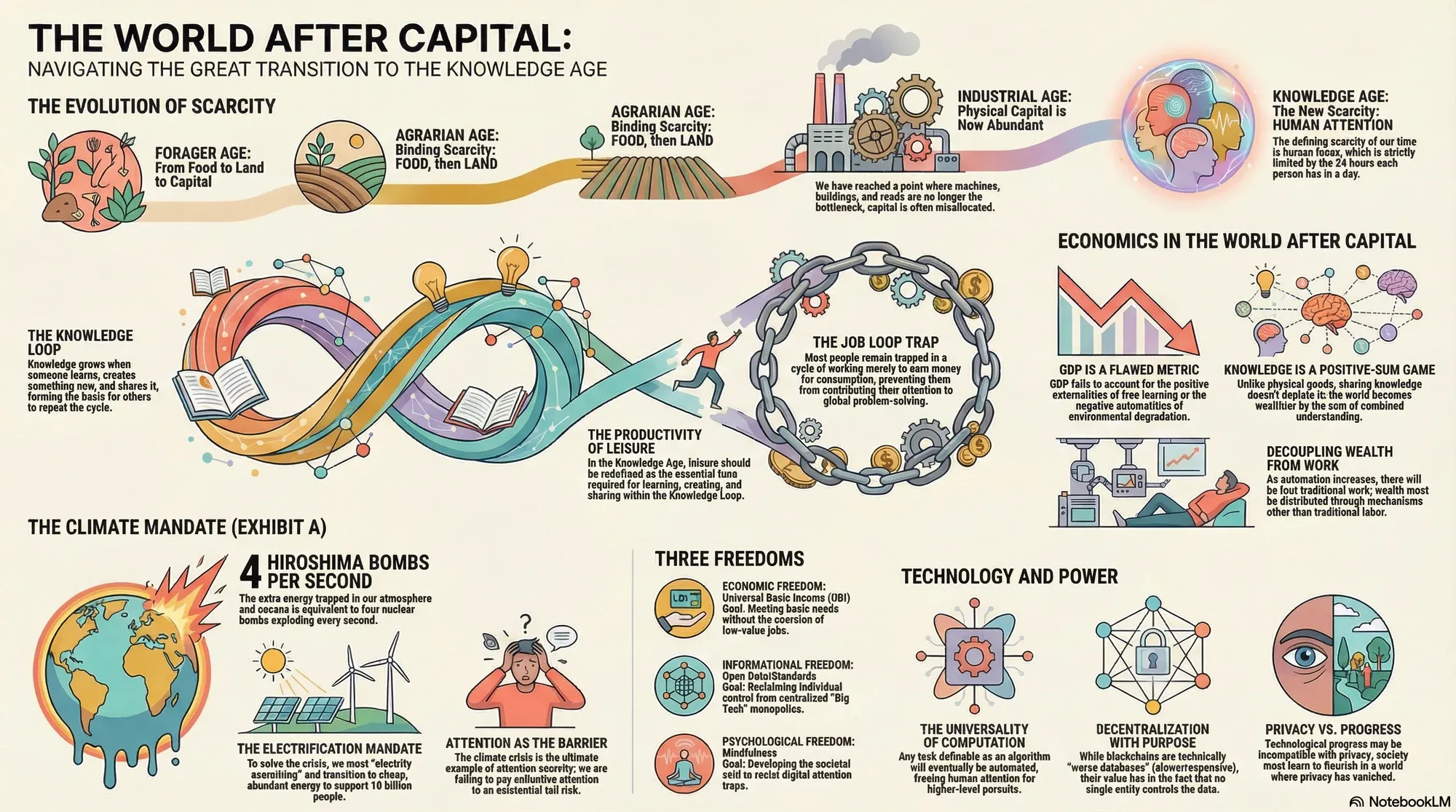
Part 1: The Transition to the Knowledge Age
- Historical Transitions: Wenger frames history as shifts in the binding scarcity: food for foragers, land for agrarian societies, and productive capital for the Industrial Age. — World After Capital: History.
- The End of the Industrial Age: Wenger argues that digital technology has made the Industrial Age's economic assumptions inadequate and that the transition to a Knowledge Age is underway. — World After Capital: Preface.
- The Interregnum: Wenger describes the present as a transition in which digital technology is shifting the key scarcity from productive capital to human attention. — World After Capital: History.
- Physical Capital Abundance: Wenger argues that productive physical capital is sufficient in aggregate to meet human needs, while distribution remains a separate problem. — World After Capital: Capital.
- The Binding Constraint: Wenger calls human attention scarce because it is finite and must be deliberately directed; each person has only 24 hours per day. — World After Capital: Attention.
- Digital Technology as an Enabler: Wenger identifies digital technology's zero marginal cost of copying and distribution as a force expanding access to knowledge. — World After Capital: Digital.
- The Universality of Computation: Wenger explains that computers are universal machines in principle, following Turing's account of computation; this greatly expands what software can do. — World After Capital: Digital.
- The Knowledge Age Shift: Wenger describes a shift from capital as the defining constraint to attention as the central scarcity of a proposed Knowledge Age. — World After Capital: Preface.
- Historical Success: Wenger argues that past transitions depended on human choices, entrepreneurship, markets, and strategic state support rather than technology alone. — World After Capital: History.
- Moving Beyond Scarcity Thinking: Wenger asks readers to distinguish real limits from scarcity created by ownership or regulation, so old economic assumptions do not govern new possibilities. — World After Capital: Scarcity.
Part 2: The Attention Economy and the Knowledge Loop
- The Knowledge Loop: Wenger describes knowledge as recorded information improved through sharing and criticism, allowing later people to build on earlier discoveries. — World After Capital: The Knowledge Loop.
- Attention Misallocation: Wenger argues that abundant online content and systems designed to capture attention can divert it from urgent collective problems. — World After Capital: Misallocation.
- Positive Externalities: Wenger argues that markets cannot fully reward knowledge creation and sharing because digital copies are nearly free and many benefits are not priced. — World After Capital: Limits.
- The Failure of Markets to Price Attention: Wenger argues that prices do not capture everything deserving human attention, leaving climate and other collective needs systematically neglected. — World After Capital: Limits.
- The Productivity of Leisure: Wenger argues that time released from obligatory work and consumption could be redirected toward learning, creating, and sharing knowledge. — World After Capital: Trapped.
- The Job Loop Trap: Wenger uses the 'job loop' to describe earning wages to fund consumption, a cycle that can crowd out participation in the knowledge loop. — World After Capital: Trapped.
- Mindfulness as a Survival Skill: Wenger recommends a personal mindfulness practice to recognize attention traps and participate more deliberately in the knowledge loop. — World After Capital: Mindfulness.
- The Under-delivery of Digital Tech: Wenger argues that the significance of digital technology is not merely new consumer services but universal computation and near-zero-cost information distribution. — World After Capital: The Knowledge Loop.
- Meaningful Focus: Wenger argues that choosing where to direct one's attention is essential to using economic and informational freedom well. — World After Capital: Psychological.
Part 3: Economics in the World After Capital
- The Flaws of GDP: Wenger argues that GDP misses benefits from free digital knowledge, using the shift from paid encyclopedias to Wikipedia as an example. — Growth and Progress: A Venture Investor's Perspective.
- Universal Basic Income (UBI): Wenger proposes universal basic income as a foundation for economic freedom: meeting basic needs without dependence on a particular job. — World After Capital: Economic.
- Decoupling Wealth from Work: Wenger argues that as automation advances, income tied entirely to jobs limits people's freedom to contribute to the knowledge loop. — World After Capital: Economic.
- Zero Marginal Cost Monopolies: Wenger notes that digital goods with near-zero marginal cost can concentrate market power, calling for regulation that preserves access and competition. — World After Capital: Limits.
- Financial and Productive Capital: Wenger distinguishes money from productive capital: financial claims do not directly produce food, housing, or other goods. — World After Capital: History.
- Speculation and Capital: Wenger argues that too much investible capital flows into largely zero-sum financial trading instead of research and technologies that expand human capabilities. — Capital Is No Longer Scarce.
- The Scarcity of Energy: Wenger argues that high living standards require substantial energy and that the transition needs much more clean supply, not merely conservation. — Energy and Progress.
- Allocation Problems: Wenger argues that aggregate productive capacity is sufficient to meet basic needs, while recognizing that distribution is unresolved. — World After Capital: Capital.
- Positive Sum Games: Wenger emphasizes that sharing knowledge lets others build on it without depriving the original holder of that knowledge. — World After Capital: Power.
- Economic Inequality: Wenger argues that concentration of wealth and market power, combined with unpriced collective harms, limits capitalism's ability to allocate attention. — World After Capital: Limits.
Part 4: The Existential Mandate of the Climate Crisis
- The Scale of the Crisis: Wenger uses the analogy of four Hiroshima-scale bombs per second to convey the scale of heat trapped by greenhouse gases; this is his illustration, not an independently verified measurement here. — World After Capital: Climate.
- Compulsory Civil Disobedience: Wenger argues that the climate emergency is severe enough to justify civil disobedience alongside research, entrepreneurship, and policy change. — Thought Economics Interview.
- Terminology: Wenger deliberately calls it a climate crisis to stress its urgency and potential to disrupt the transition to a Knowledge Age. — World After Capital: Climate.
- The Electrification Mandate: Wenger points to electric heating and clean power as practical parts of climate action, alongside research into removing greenhouse gases. — Energy and Progress.
- Energy Abundance: Wenger argues that abundant clean energy, including solar and potentially fusion, is needed to address climate risks and support human needs. — Energy and Progress.
- Geoengineering as a Last Resort: Wenger compares geoengineering to chemotherapy: an undesirable intervention that may be worth researching for a severe emergency, not a substitute for emissions cuts. — Climate Tech VC Interview.
- The Climate as Exhibit A: Wenger uses the climate crisis as a central example of a high-stakes problem receiving too little collective attention. — World After Capital: Preface.
- Systemic Change: Wenger argues that technological entrepreneurship and government policy must work together to address the climate crisis. — Thought Economics Interview.
- The 'Build, Baby, Build' Mentality: Wenger calls for more clean-energy research, solar deployment, and greenhouse-gas removal rather than relying on individual consumption changes alone. — Energy and Progress.
Part 5: Technology, AI, and Machine Intelligence
- AI as a Tool for Individual Agency: Wenger argues that broadly accessible AI models can help individuals explore opposing views, understand difficult material, and solve practical problems. — Thinking About AI: Structural Risks.
- The Risk of Machine Attention: Wenger warns that recommendation algorithms optimized for engagement can reinforce existing views and draw attention toward emotionally salient content. — Thinking About AI: Structural Risks.
- Programmability as Power: Wenger argues that people need the ability to program and direct large digital systems instead of being programmed by them. — Convoco Podcast.
- The Turing Machine and Work: Wenger explains that universal computation expands the kinds of tasks software can perform, creating scope for automation; it does not guarantee that every human activity will be automated. — World After Capital: Digital.
- Privacy and Progress: Wenger argues that technological progress creates tensions with privacy and that society must debate safeguards rather than assume privacy can remain unchanged. — Capitalisn't Transcript.
- Survivability Without Privacy: Wenger suggests designing institutions robust to the reduced privacy that advanced technologies may bring, while recognizing the tradeoffs. — Capitalisn't Transcript.
- Technology and Freedom: Wenger explicitly rejects the notion that computers or the web automatically increase freedom; empowering design and regulation are choices. — Convoco Podcast.
- Digital Connectivity: Wenger emphasizes that connecting people through digital networks makes sharing recorded knowledge much cheaper and more widely accessible. — World After Capital: The Knowledge Loop.
- Machines in the Loop: Wenger argues that computational tools can participate in producing and improving recorded knowledge, but human judgment remains important. — World After Capital: The Knowledge Loop.
- The Scale of AI Progress: Wenger treats advanced machine intelligence as both a possible source of progress and a potential long-term risk requiring deliberate choices. — World After Capital: Conclusion.
Part 6: Decentralization, Web3, and Shifting Power
- The Mistake of Centralization: Wenger argues that excessive concentration of decision-making in governments and firms can inhibit local experimentation. — Thought Economics Interview.
- The Subsidiarity Principle: Wenger favors subsidiarity: decisions should be made as locally as feasible, while global problems such as the climate crisis need larger-scale coordination. — Thought Economics Interview.
- Blockchain as a 'Worse Database': Wenger says blockchains are less efficient databases than conventional systems, but their distinguishing advantage is that no single organization controls them. — Web3/Crypto: Why Bother?.
- Permissionless Data: Wenger argues that a lack of permissionless shared data on the original web helped centralize power in companies controlling private databases. — Web3/Crypto: Why Bother?.
- Decentralization with Purpose: Wenger advocates decentralization because it can permit more experimentation and participation, not because every distributed technology is inherently beneficial. — World After Capital: Decentralization.
- Bitcoin as a Protocol: Wenger argues that Bitcoin's distributed public ledger could function as a protocol for permissionless innovation, beyond its use as a payment system. — Bitcoin as Protocol.
- Decentralized Infrastructure: Wenger sees blockchain networks as one possible route to more open digital infrastructure, while acknowledging that their value depends on actual use. — Web3/Crypto: Why Bother?.
- Decentralization's Tradeoffs: Wenger argues that technology can enable good or bad outcomes; decentralization requires choices about the institutions and uses built on it. — World After Capital: Choices.
- Beating Network Effects: Wenger argues that open protocols and rules limiting concentrated control can create room for more decentralized innovation. — World After Capital: Decentralization.
Part 7: Governance, Regulation, and Collective Action
- Smart Regulation: Wenger argues that regulation can be designed to open useful possibilities and correct market failures rather than merely protect incumbents. — World After Capital: Choices.
- The Limitations of Capitalism: Wenger argues that capitalism has been highly productive but cannot by itself solve attention scarcity, concentrated power, and unpriced environmental harms. — World After Capital: Limits.
- Defending Democracy: Wenger argues that democracy enables policy experimentation and peaceful correction, conditions he considers important for the knowledge loop. — World After Capital: Democracy.
- Measuring What Matters: Wenger urges measures of progress that account for access to knowledge and people's freedom to direct attention, rather than equating progress with GDP growth alone. — Growth and Progress: A Venture Investor's Perspective.
- Collective Action on Tail Risks: Wenger notes that rare catastrophic risks, such as a comet impact, lack market prices to guide how much collective attention they deserve. — Growth and Progress: A Venture Investor's Perspective.
- Anti-Central Planning: Wenger rejects both technological determinism and an absence of regulation; societies must design rules to make desirable outcomes possible. — World After Capital: Choices.
- Political Denial: Wenger argues that leaders invested in the old scarcity can favor incremental repairs rather than the deeper institutional change a new age requires. — World After Capital: History.
- Historical Transition Costs: Wenger notes that earlier transitions were prolonged and violent, a warning that the current transition will depend on deliberate choices. — World After Capital: History.
- Global Coordination: Wenger argues for local experimentation where possible and international cooperation on problems, such as climate, that cross borders. — Thought Economics Interview.
Part 8: Venture Capital and the Pursuit of Purpose
- Thesis-Driven Investing: Union Square Ventures describes itself as thesis-driven, using a shared investment thesis to focus its search and decisions. — USV Thesis 3.0.
- Aligning Incentives: Wenger argues that trusted brands align their business incentives with users; he contrasts this with advertising models that can create conflicts. — From Advertising to Subscriptions.
- Broadening Access: USV's stated thesis is to back trusted brands that broaden access to knowledge, capital, and well-being through networks, platforms, and protocols. — USV Thesis 3.0.
- The Importance of Unlearning: Wenger says investors must unlearn old assumptions as conditions change; he cites USV's initial hesitation about crypto projects organized outside the conventional equity model. — Robin Capital Interview.
- Avoiding Concentrated Buyers: Wenger says USV is wary of selling into highly concentrated industries because a small number of powerful buyers can constrain a young company's bargaining position. — Robin Capital Interview.
- The Three Freedoms: Wenger proposes three complementary freedoms: the means to meet basic needs, control over information and computation, and the ability to direct one's attention. — Growth and Progress: A Venture Investor's Perspective.
- Purpose Beyond Consumption: Wenger argues that a Knowledge Age requires sources of purpose beyond a job or ever-growing material consumption. — World After Capital: Preface.
- Humanism: Wenger grounds his argument in human agency, responsibility, and critical inquiry as foundations for progress. — World After Capital: Humanism.
- Optimism for All Species: Wenger ends on a guarded optimism that knowledge and technology can improve life for humans and other species if society makes the right choices. — Thought Economics Interview.