Alec Radford coauthored the 2018 generative-pretraining paper. The sections below examine that work and other coauthored publications; the lessons summarize reported results, not personal quotations. — GPT-1 Paper.
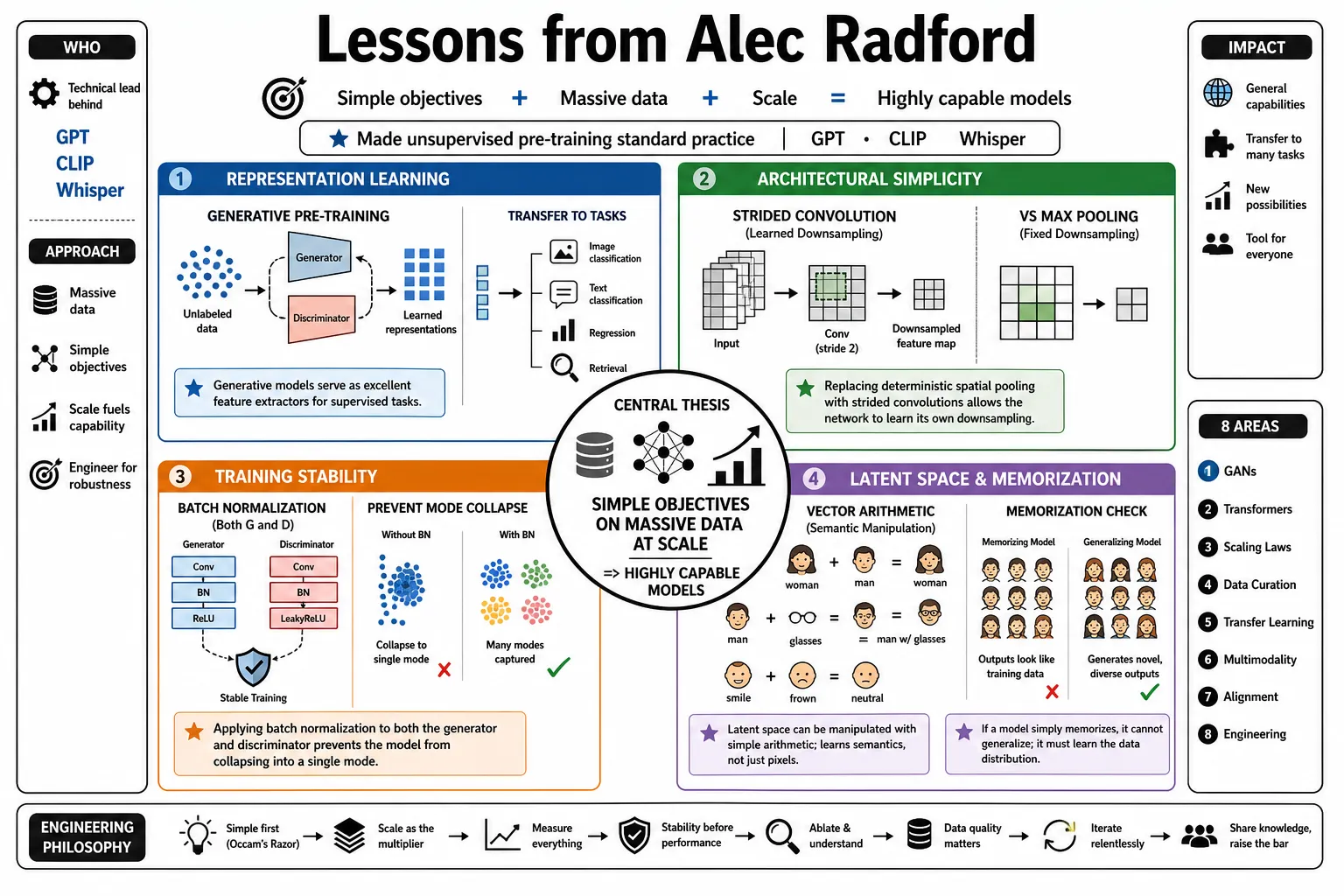
Part 1: Generative Adversarial Networks
- Representation Learning: The DCGAN discriminator learned features that transferred to supervised image classification. — DCGAN Paper.
- Architectural Simplicity: The architecture uses learned strided convolutions instead of fixed spatial pooling. — DCGAN Paper.
- Batch Normalization: Batch normalization in both networks was one guideline for more stable training, not a guarantee against mode collapse. — DCGAN Paper.
- Vector Arithmetic: The paper demonstrates recognizable attribute changes through arithmetic in the learned latent space. — DCGAN Paper.
- Memorization: Interpolated latent vectors produced plausible intermediate bedrooms in the reported experiment. — DCGAN Paper.
- Filter Visualization: The authors visualized discriminator filters responsive to scene elements such as beds and windows. — DCGAN Paper.
- Dropping Layers: Removing fully connected hidden layers was a guideline; the paper also notes tradeoffs in convergence speed. — DCGAN Paper.
- Feature Reusability: Features from an unsupervised discriminator performed competitively on the paper’s classification benchmarks. — DCGAN Paper.
Part 2: Generative Pre-Training
- The Supervision Bottleneck: The paper addresses scarce task labels by pretraining on unlabeled text before task-specific fine-tuning. — GPT-1 Paper.
- The Pre-Training Objective: Its pretraining objective predicts the next token from preceding context. — GPT-1 Paper.
- Task-Agnostic Learning: Task-aware input formats let one pretrained model transfer to multiple language tasks with minimal architecture changes. — GPT-1 Paper.
- The Transformer Advantage: A Transformer decoder was used for pretraining; the authors reported steadier zero-shot transfer than an LSTM comparison. — GPT-1 Paper.
- Zero-Shot Capabilities: Task-relevant zero-shot behavior appeared during pretraining, although the strongest benchmark results used fine-tuning. — GPT-1 Paper.
- Fine-Tuning Efficiency: Pretraining improved multiple labeled tasks after fine-tuning; the paper does not establish universal few-label sufficiency. — GPT-1 Paper.
- Auxiliary Objectives: An auxiliary language-model objective during fine-tuning helped generalization and convergence in the reported experiments. — GPT-1 Paper.
- Handling Different Inputs: Multiple-choice and related tasks were encoded as token sequences without changing the core architecture. — GPT-1 Paper.
- Word Embeddings: The pretrained Transformer generated contextual token representations transferable across tasks. — GPT-1 Paper.
- The Scaling Hypothesis: In a later coauthored study, language-model loss followed empirical power laws with model size, data and training compute over the ranges studied. — Scaling Laws Paper.
Part 3: Multitask Learning and Scaling
- Narrow Expert Systems: The authors contrasted task-specific supervised systems with more general transfer from language modeling. — GPT-2 Paper.
- Unsupervised Multitasking: They tested whether language modeling supports multiple tasks without task-specific parameter updates. — GPT-2 Paper.
- Dataset Quality: WebText used links shared on Reddit above a karma threshold rather than indiscriminate web scraping. — GPT-2 Paper.
- Prompt Engineering: Zero-shot tasks were evaluated by conditioning on context and task formatting without gradient updates. — GPT-2 Paper.
- Zero-Shot Transfer: GPT-2 achieved competitive or state-of-the-art zero-shot results on some evaluated tasks. — GPT-2 Paper.
- Capacity and Generalization: Held-out WebText performance improved with the tested model sizes, and the largest still underfit that dataset. — GPT-2 Paper.
- Byte-Pair Encoding: Byte-level BPE avoids an ordinary out-of-vocabulary category for text inputs. — GPT-2 Paper.
- Predictable Scaling: The coauthored scaling-law study found smooth performance relationships with parameter count, dataset size and compute under its tested conditions. — Scaling Laws Paper.
- The Goal of NLP: The paper treats zero-shot transfer as progress toward less task-specific supervision. — GPT-2 Paper.
- Token-Level Filtering: On the studied task, token-level filtering reduced targeted-domain capability at lower cost to retained capability than document filtering. — Token-Filtering Paper.
- The Scalability of Filtering: Filtering grew more effective relative to an unfiltered baseline across the model scales tested. — Token-Filtering Paper.
Part 4: Few-Shot Prompting and In-Context Learning
- In-Context Learning: GPT-3 performed many tasks from examples in its context without per-task weight updates. — GPT-3 Paper.
- The Limits of Fine-Tuning: The paper contrasts in-context learning with separate fine-tuning and labeled examples, without claiming fine-tuning always causes forgetting. — GPT-3 Paper.
- Meta-Learning: The authors describe in-context adaptation after language-model pretraining while leaving its mechanism open. — GPT-3 Paper.
- Parameter Count: The 175-billion-parameter model often outperformed smaller versions, but gains varied by task. — GPT-3 Paper.
- Few-Shot Demonstrations: A few input-output demonstrations often improved task performance without parameter updates. — GPT-3 Paper.
- Arithmetic Reasoning: Arithmetic tests improved at larger scales, with remaining limits on harder calculations. — GPT-3 Paper.
- Human Evaluation: In one news-generation evaluation, human judges had difficulty distinguishing some GPT-3 samples from human articles. — GPT-3 Paper.
- Data Contamination: The authors investigated benchmark overlap with training data because contamination complicates interpretation. — GPT-3 Paper.
Part 5: Connecting Vision and Language
- Natural Language Supervision: CLIP learned from large-scale web image-text pairs rather than only fixed human-assigned class labels. — CLIP Paper.
- Contrastive Learning: The contrastive objective selected matching image-text pairs within a batch. — CLIP Paper.
- Zero-Shot Image Classification: Zero-shot classification compares image embeddings with text descriptions of candidate classes. — CLIP Paper.
- Escaping ImageNet: The authors evaluated transfer on many datasets beyond a single ImageNet benchmark. — CLIP Paper.
- Prompt Ensembling: Prompt templates and multiple descriptions improved zero-shot classification in reported experiments. — CLIP Paper.
- Concept Abstraction: Image-text alignment allowed natural-language descriptions to specify visual concepts, without implying human-like understanding. — CLIP Paper.
- Reliability: On studied natural distribution shifts, zero-shot CLIP narrowed the robustness gap; the authors caution against broad causal claims. — CLIP Paper.
- Efficiency: A contrastive objective was chosen partly for efficiency relative to predicting exact captions. — CLIP Paper.
Part 6: Scaling Speech Recognition
- Weak Supervision: Large-scale weakly supervised audio-text training improved robustness on evaluated datasets. — Whisper Paper.
- Scaling Audio Data: Whisper trained on about 680,000 hours of multilingual audio, not every possible accent or condition. — Whisper Paper.
- Avoiding Complex Pipelines: An encoder-decoder Transformer processes log-Mel spectrograms and predicts text directly. — Whisper Paper.
- Multitask Audio Processing: Task tokens condition one model for transcription, language identification and translation. — Whisper Paper.
- Out-of-Distribution Generalization: The paper assesses out-of-the-box performance across diverse datasets without task-specific fine-tuning. — Whisper Paper.
- Hallucinations in Audio: The authors describe long-form transcription failure modes and decoding heuristics including no-speech detection. — Whisper Paper.
- Timestamp Generation: Timestamp tokens locate transcript segments, not guaranteed individual words. — Whisper Paper.
- Data Filtering: The data pipeline filtered noisy and duplicate speech-text pairs before training. — Whisper Paper.
Part 7: Research Philosophy and Engineering
- Trusting the Data: GPT-2 tested transfer from text context without hard-coded task-specific architectures. — GPT-2 Paper.
- Benchmarks: GPT-3 was evaluated under zero-, one- and few-shot protocols, with limitations to interpreting benchmark results. — GPT-3 Paper.
- Mechanistic Interpretability: Generative priors for neural activations were explored as an alternative to interpretability methods with structural assumptions. — Generative Meta-Model Paper.
- Scalable Interpretability: The diffusion meta-model improved intervention fluency and isolated concepts more strongly as loss decreased. — Generative Meta-Model Paper.
Part 8: Evaluating Generalization and Vintage Data
- Vintage Language Models: Talkie is a 13B model trained on pre-1931 text, although the team still identified temporal leakage. — Introducing Talkie.
- Measuring Generalization: The team measured surprise for later historical events and proposed better future forecasting evaluations, not a pure reasoning measure. — Introducing Talkie.
- Contamination: Historical cutoffs help probe memorization, but the authors found some post-cutoff knowledge leakage. — Introducing Talkie.
- Scientific Discovery: The team proposes testing post-cutoff inventions and discoveries; it does not report that Talkie achieved them. — Introducing Talkie.
- Memorization vs. Reasoning: The historical training cutoff helps study generalization to later events, subject to leakage checks. — Introducing Talkie.
- Cultural Alignment: Older training text affected the model’s conversational style and cultural framing. — Introducing Talkie.
- Controlled Experiments: Time-limited training data creates a useful evaluation setting if post-cutoff leakage is measured. — Introducing Talkie.