Alex Behring is the co-founder and co-managing partner of 3G Capital, known for directing the operations and strategy behind acquisitions like Burger King and Kraft Heinz. His approach relies on extreme operational immersion and a concentrated "one investment per fund" model to overhaul management structures. This profile synthesizes his public statements and operational history to outline his specific methods for managing talent and capital.
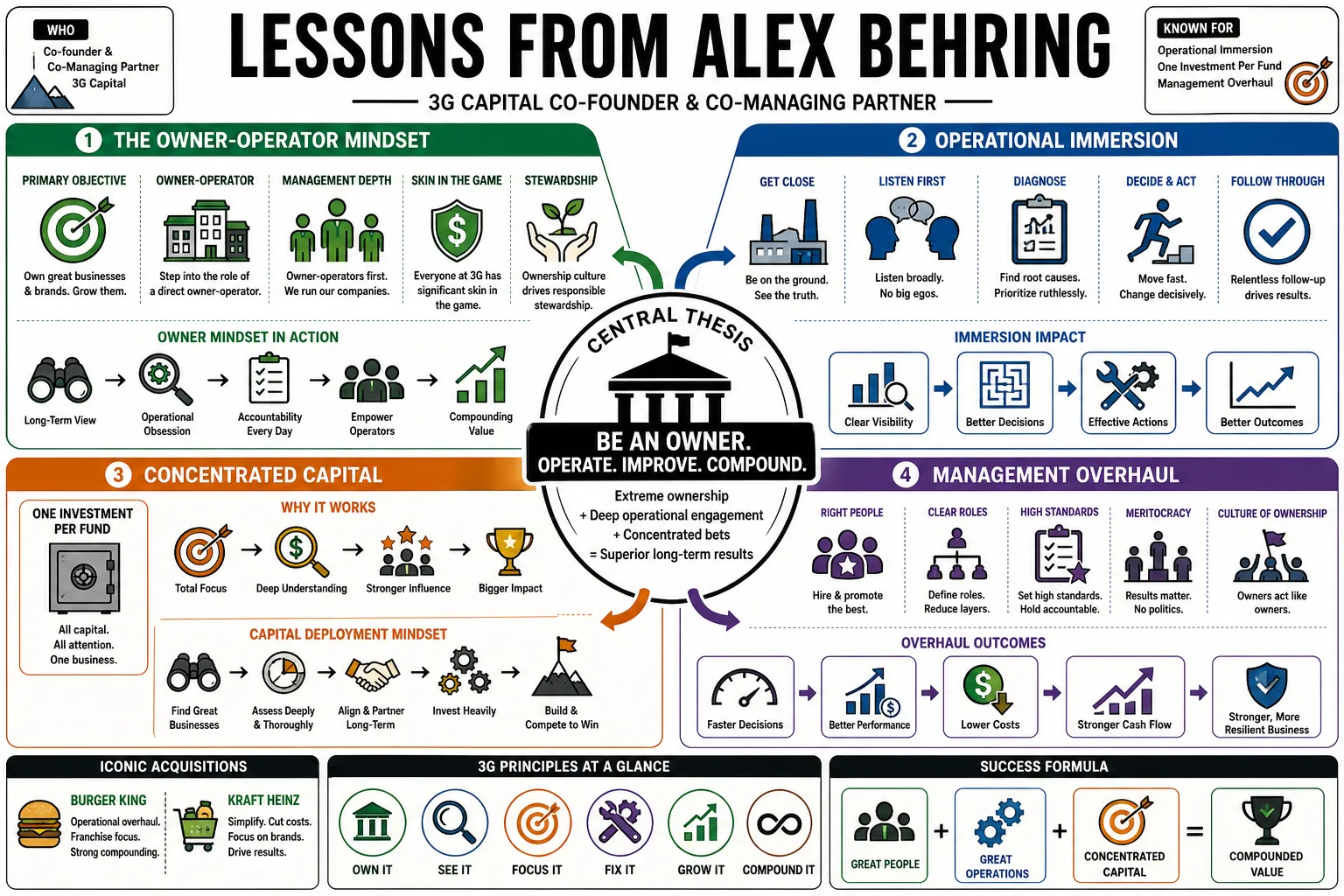
Part 1: The Owner-Operator Mindset
- On the primary objective: "At 3G, we are owners of great businesses and brands and our goal is to grow them." — Source: [Financial Times]
- On the illusion of the financial buyer: "Approaching a business strictly as a financial investment limits your ability to improve it; you have to step into the role of a direct owner-operator." — Source: [Invest Like the Best]
- On management depth: "We are owner-operators first and foremost, as our owners are the individuals directly responsible for operating our companies." — Source: [Financial Times]
- On skin in the game: "Everyone at 3G has considerable skin in the game, which creates powerful incentives to do what is right for the long term." — Source: [Financial Times]
- On stewardship: "Our culture of ownership leads to responsible stewardship of capital and resources at all levels of our organisations." — Source: [Financial Times]
- On holding periods: "We want to own these companies forever." — Source: [Financial Times]
- On maintaining discipline: "A permanent holding period affords you the luxury of being strictly disciplined about which businesses you buy." — Source: [Financial Times]
- On identifying targets: "Ownership requires certainty; you only acquire a company when you are entirely satisfied it is positioned for profitable growth." — Source: [Financial Times]
- On operational involvement: "At the core of our operating involvement, is the creation and committed implementation of an ownership culture." — Source: [Financial Times]
Part 2: Managing People and Talent
- On the nature of companies: "A business is ultimately a group of people working together toward an objective." — Source: [Invest Like the Best]
- On operational transitions: "When you transition from working in finance to working at one of our companies, you cannot simply manage the business; you need to manage the people, and let the people manage the business." — Source: [Business Insider]
- On talent attraction: "We are also promoters of people and we believe that we attract best-in-class talent because of our long-term focus." — Source: [Financial Times]
- On talent over tenure: "Building a world-class executive team often means moving quickly to promote young, capable individuals rather than relying strictly on industry veterans." — Source: [Invest Like the Best]
- On organizational design: "Centralize the specific goals you want to achieve, but decentralize the execution methods so managers have the freedom to act." — Source: [Invest Like the Best]
- On recruiting the right mindset: "You need executives who prefer to tie their personal net worth to the company's performance." — Source: [Capital Allocators]
- On internal promotions: "Sustained success relies on building an internal machine that consistently develops and elevates its own operating partners." — Source: [Financial Times]
- On handling transitions: "If an executive team lacks an ownership mindset, you must act decisively to bring in people who do." — Source: [Capital Allocators]
- On accountability: "A meritocracy only functions if people are held directly responsible for their specific operational outcomes." — Source: [Capital Allocators]
- On aligning incentives: "The financial rewards for managers must be tied directly to the equity value they create over time." — Source: [Invest Like the Best]
Part 3: The Railroad Immersion
- On understanding a business: "You cannot learn how a company works from a spreadsheet; you have to go to the ground floor." — Source: [Invest Like the Best]
- On extreme immersion: "When taking over a railroad, the fastest way to understand the operational bottlenecks is to spend weeks driving the trains and living with the engineers." — Source: [Invest Like the Best]
- On asking obvious questions: "Being an outsider gives you permission to ask simple questions about why tasks are performed a certain way." — Source: [Invest Like the Best]
- On identifying real problems: "Many operational failures are basic issues of morale and ignored feedback rather than complex engineering problems." — Source: [Invest Like the Best]
- On rapid iteration: "Once a problem is identified on the front lines, it needs to be fixed immediately rather than studied for quarters." — Source: [Invest Like the Best]
- On frontline respect: "Workers will adopt an ownership culture if they see the leadership team enduring the same conditions they do." — Source: [Invest Like the Best]
- On structural simplicity: "A business should be stripped down to the basic functions required to deliver the product or service effectively." — Source: [Capital Allocators]
- On urgency over caution: "Waiting for perfect information before fixing a glaring operational inefficiency is a waste of capital." — Source: [Capital Allocators]
- On physical proximity: "Leaders need to be physically close to the core operations instead of being isolated in a corporate headquarters." — Source: [Invest Like the Best]
Part 4: The One-Investment Model
- On capital concentration: "Raising capital with the intent to make only one major investment per fund forces extreme discipline." — Source: [Invest Like the Best]
- On resource allocation: "A single massive acquisition allows a firm to commit its absolute best people entirely to one target without distraction." — Source: [Capital Allocators]
- On the risk of portfolios: "Traditional private equity models spread talent too thin across a wide portfolio, degrading the quality of management applied to each company." — Source: [Invest Like the Best]
- On vetting targets: "When you can only buy one company, the criteria for defensibility and long-term durability become exceptionally strict." — Source: [Invest Like the Best]
- On customer relationships: "The ideal acquisition target has a direct relationship with the customer that cannot be easily disintermediated by competitors." — Source: [Invest Like the Best]
- On avoiding tech risks: "Prioritize businesses with physical presence and established consumer habits over those dependent on rapidly changing technology." — Source: [Invest Like the Best]
- On brand durability: "A brand that has survived and grown for decades possesses a resilience that is difficult to manufacture from scratch." — Source: [Capital Allocators]
- On compounding value: "The goal of a concentrated investment is compounding the equity value over ten or twenty years." — Source: [Capital Allocators]
- On margin of safety: "Buying an established consumer brand provides a floor of cash flow while the team implements operational improvements." — Source: [Invest Like the Best]
- On partnership acquisitions: "It is often better to partner with the existing founders or families of a durable brand rather than attempting a hostile takeover." — Source: [Capital Allocators]
Part 5: Efficiency and Capital Allocation
- On zero-based budgeting: "Managers must justify every expense from scratch annually rather than assuming last year's budget as a baseline." — Source: [Business Insider]
- On the purpose of cost-cutting: "While we are known for being efficient operators, focusing only on our ability to drive efficiencies overlooks several important aspects of our approach." — Source: [Financial Times]
- On reinvestment: "The primary objective of identifying inefficiencies is to free up capital that can be reinvested into brand growth and innovation." — Source: [Financial Times]
- On unnecessary layers: "Corporate bloat slows down decision-making and distances leadership from the actual customer experience." — Source: [Invest Like the Best]
- On organic growth: "Kraft Heinz doesn't need another acquisition to drive profitable growth for the long term." — Source: [PitchBook]
- On evaluating deals: "As always, we will evaluate any opportunity that makes strategic sense, with the objective of growing for the long term." — Source: [PitchBook]
- On capital stewardship: "Treating company money with the exact same care as your own personal money is the foundation of good capital allocation." — Source: [Capital Allocators]
- On lean operations: "A leaner company is structurally more competitive and can react faster to changing consumer demands." — Source: [Financial Times]
- On continuous improvement: "Efficiency is a permanent daily habit embedded in the company, never a one-time restructuring event." — Source: [Invest Like the Best]
Part 6: Culture and Skin in the Game
- On dreaming big: "A big dream is as much work as a small dream. So dream big." — Source: [Financial Times]
- On radical transparency: "Teams operate best when performance metrics are clear, visible, and completely transparent across the organization." — Source: [Invest Like the Best]
- On shared goals: "Everyone in the company must understand exactly what the top priority is, leaving no ambiguity about direction." — Source: [Capital Allocators]
- On co-investment: "3G Capital is built to partner with companies like these." — Source: [PitchBook]
- On meritocracy: "A true meritocracy rewards actual outcomes and execution while entirely disregarding tenure or past titles." — Source: [Invest Like the Best]
- On cultural alignment: "When merging two companies, the first and most pressing task is establishing a single, unified culture of ownership." — Source: [Capital Allocators]
- On ego: "The focus must remain on the business results, requiring leaders to leave their personal egos at the door." — Source: [Invest Like the Best]
- On confronting reality: "A strong culture demands that bad news travels fast and problems are faced directly without sugarcoating." — Source: [Capital Allocators]
- On shared suffering: "If cuts are necessary to save the business, the leadership team must bear the financial and physical burden first." — Source: [Invest Like the Best]
- On the ultimate test of culture: "A culture is only real if it dictates how employees make decisions when the leadership team is absent." — Source: [Financial Times]
Part 7: Long-Term Growth and Brand Building
- On building over decades: "We've been building businesses for over four decades." — Source: [Financial Times]
- On franchising models: "Transitioning a business to a heavily franchised model requires deep trust and alignment with the individual operators on the ground." — Source: [Capital Allocators]
- On brand equity: "A brand's value is derived from the consistent quality of the product delivered to the customer every single day." — Source: [Capital Allocators]
- On international expansion: "Taking a legacy brand global requires localizing the operations while maintaining the core identity of the product." — Source: [Invest Like the Best]
- On patience: "Profitable, long-term growth often means sacrificing short-term public market expectations to make the right structural investments." — Source: [Financial Times]
- On strategic focus: "You cannot grow a brand by cutting costs alone; the cuts must serve a specific reinvestment thesis." — Source: [Invest Like the Best]
- On consumer habits: "Focus on products that are a daily habit for consumers, as they provide the most reliable baseline for expansion." — Source: [Capital Allocators]
- On scale: "The advantage of scale is the ability to attract better talent and deploy better systems, rather than solely relying on purchasing power." — Source: [Invest Like the Best]
- On adaptability: "Brands must evolve their operational footprint to match changing demographics without losing their heritage." — Source: [Capital Allocators]
Part 8: Simplicity, Urgency, and Execution
- On complexity: "Complex corporate structures usually serve as a hiding place for poor performance and lack of accountability." — Source: [Invest Like the Best]
- On speed: "Act with urgency to solve morale and operational bottlenecks." — Source: [Invest Like the Best]
- On the execution gap: "The difference between a good idea and a great business is entirely found in the daily execution of the details." — Source: [Capital Allocators]
- On overthinking: "Do not spend quarters studying a problem that can be fixed today by walking the factory floor or visiting the restaurant." — Source: [Invest Like the Best]
- On clear metrics: "If you cannot measure a specific operational task, you cannot manage or improve it." — Source: [Invest Like the Best]
- On focusing on the core: "Strip away every distraction that does not directly contribute to the product or the customer experience." — Source: [Capital Allocators]
- On daily discipline: "Maintaining an efficient business requires the exact same level of discipline on day 1000 as it did on day one." — Source: [Financial Times]
- On leading by example: "You cannot mandate urgency from a spreadsheet; leaders must demonstrate it in their own schedule and actions." — Source: [Invest Like the Best]
- On the ultimate goal: "Building a great company requires a relentless, uncompromising focus on the actual work." — Source: [Financial Times]