Alex Buder Shapiro is Head of People at Clay, after serving as Chief People Officer at Jasper and Flatiron Health. She has described borrowing from couples therapy to coach workplace conflict and experimenting with AI in People-team workflows. — First Round Review Interview.
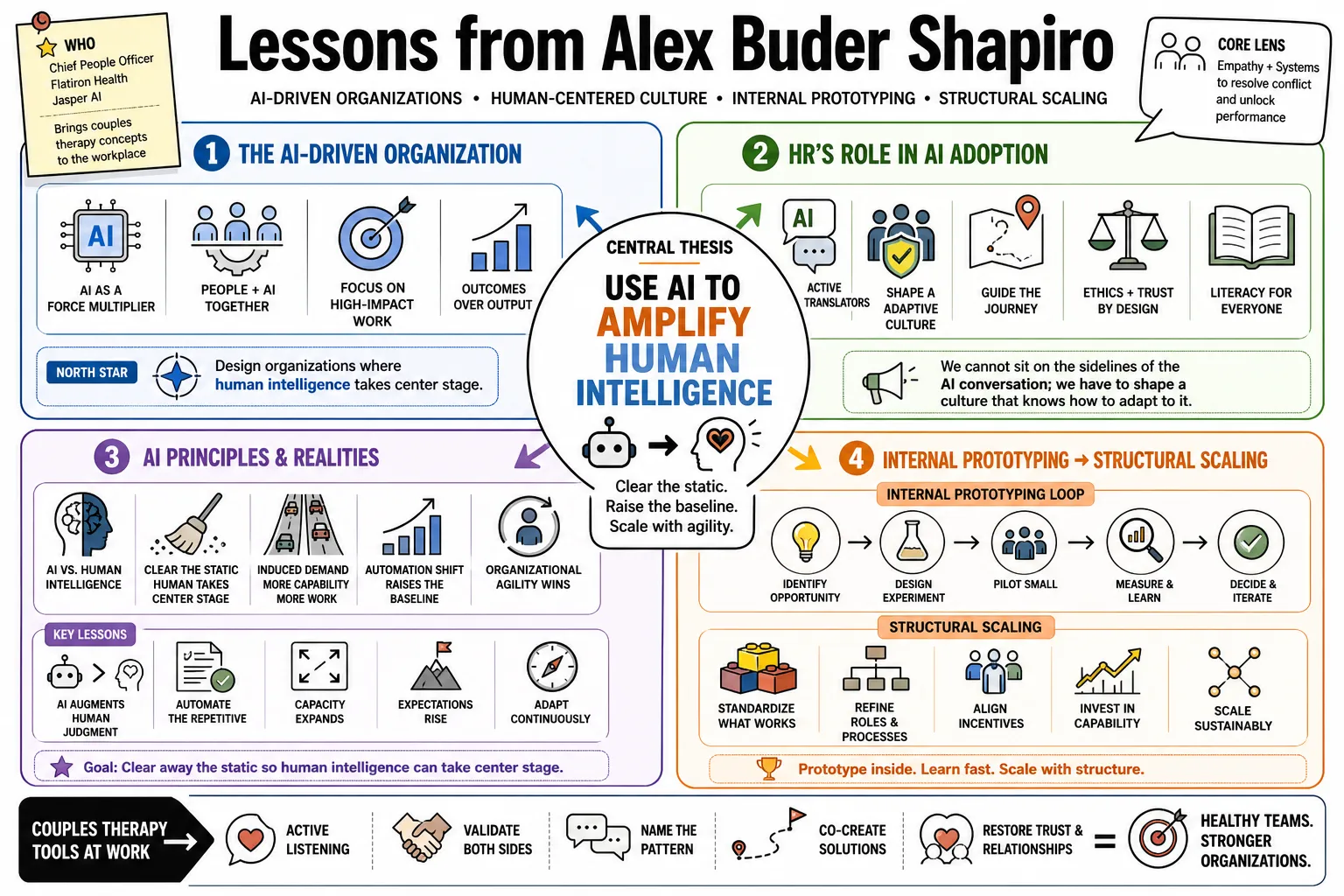
Part 1: The AI-Driven Organization
- HR in the AI Conversation: People leaders should take part in AI adoption across departments, not focus only on HR use cases. — Modern People Leader #243.
- Induced Demand: Shapiro uses the more-roads-more-traffic analogy to argue that AI-created capacity can change what work people choose to pursue, rather than simply redistribute a fixed workload. — Jasper AI Transformation Keynote.
- Beyond Tool Adoption: Becoming AI-native requires changes in organizational assumptions, workflows, and behaviors; introducing tools alone does not reproduce that operating pace. — People Leader Accelerator #43.
- The Human Side of AI Change: AI adoption can make familiar skills feel less relevant. Leaders should acknowledge that discomfort and help people see concrete ways to work differently. — Jasper AI Transformation Keynote.
- Redesign the Workflow: Shapiro describes looking at how AI changes teams and roles, then redesigning People-team work through experimentation rather than treating adoption as a software handoff. — Modern People Leader #243.
- Experimentation Builds Empathy: At Jasper, joining her team’s AI experimentation helped Shapiro understand both the opportunity and the difficulty of changing familiar workflows. — Jasper AI Transformation Keynote.
- On capability ladders for AI adoption: AI integration requires building capability ladders that meet employees at their current skill levels and allow them to adapt alongside new technology. — Jasper Webinar: Unlocking People for AI Transformation
Part 2: HR as Prototyper and Innovator
- People Teams as Prototypers: Inspired by product teams, Jasper’s People team built quick prototypes and used what they learned to iterate on its own work. — Modern People Leader #243.
- Learning from pAIn: Jasper’s People team called its weekly AI-project debrief “pAIn,” making difficulty and failed experiments visible while the team learned. — Jasper AI Transformation Keynote.
- Prototype Learning Tools: The Jasper People team experimented with learning-and-development formats, including podcast-based training, instead of waiting for a finished program. — Modern People Leader #243.
- Track What Experiments Teach: Jasper’s People team tracked what its AI experiments taught it, using those learnings to adjust subsequent prototypes. — Modern People Leader #243.
- Test an Unpolished People Practice: Clay launched its Starting Fresh onboarding worksheet quickly and let employees improve the ritual after seeing it in use. — People Leader Accelerator #43.
Part 3: Managing Growth and Scaling
- Design for the Current Stage: At Flatiron, Shapiro learned that elaborate frameworks built too early can trap a fast-growing company; start with its present need and add structure as that need becomes clear. — First Round Review Interview.
- Align Growth with Employee Ambition: Shapiro says long-tenured employees often stay energized when successive company challenges also create new opportunities for their own impact and growth. — First Round Review Interview.
- On culture as a commercially relevant operating system: A strong company culture acts as a commercially relevant operating system that becomes believable only through the consistent daily decisions made by leadership. — People Leader Accelerator Podcast
- On solving the organization in front of you: Focus on solving the immediate challenges of the current organization rather than clinging to past structures or over-engineering for speculative future issues. — People Leader Accelerator Podcast
- On building culture from ingredients already present: Successful culture initiatives do not invent new values out of thin air, but rather amplify existing elements and ensure total alignment with the founders. — People Leader Accelerator Podcast
- On the quiet work of negative maintenance: Healthy cultures rely on negative maintenance: the quiet, continuous work of leaving the organization better than you found it. — People Leader Accelerator Podcast
- On momentum without attachment to one answer: Sustain momentum through non-attached action: keep moving and iterating while remaining willing to let go of any particular method or answer. — People Leader Accelerator Podcast
Part 4: Workplace Conflict and Resolution
- Borrow from Couples Therapy: Shapiro draws on couples-therapy ideas when coaching workplace conflict, including framing perceptions as one’s own rather than as settled facts. — First Round Review Interview.
- Separate Words from Interpretation: When coaching a disagreement, Shapiro asks people to reconstruct what was actually said before treating their interpretation as fact. — First Round Review Interview.
- Play Back What You Heard: In difficult career conversations, Shapiro emphasizes active listening and having the manager play back the employee’s perspective to check understanding. — First Round Review Interview.
- Test Alternative Explanations: Shapiro asks what else a colleague might have meant or been trying to solve, then suggests a clarifying question to test that interpretation. — First Round Review Interview.
- Start Feedback Conversations Deliberately: Shapiro developed a difficult-feedback conversation guide with starter questions to help managers identify when a conversation is needed and begin it constructively. — First Round Review Interview.
- Coach People to Resolve Their Own Conflicts: Shapiro says it is not enough for the People partner to know what happened; the people involved need to test assumptions and understand one another themselves. — First Round Review Interview.
- Assume Positive Intent, Then Investigate: Her “reasonable person” principle starts from the possibility of shared goals and asks what different constraints or motivations might explain another person’s view. — First Round Review Interview.
Part 5: Efficiency, Time, and Possibility
- Efficiency Creates Possibility: When technology frees time, leaders need to define the different work people can do and help them become comfortable leaving familiar tasks behind. — Modern People Leader #243.
- Work at the Top of Your License: Shapiro applies the idea of “practicing at the top of your license” to the redesign of work in an AI-enabled future. — AI and the Future of Work #345.
Part 6: The Future of Early-Career Talent
- Early-Career Jobs Are Changing: Shapiro distinguishes changing entry-level tasks from the continuing value of early-career talent, who need new ways to learn and contribute. — Modern People Leader #243.
- Reverse Mentorship: People entering work with AI fluency may teach experienced colleagues new ways to work, even as they still need support from those colleagues. — Modern People Leader #243.
- Teach Judgment Earlier: If AI changes routine junior work, Shapiro argues mentorship should introduce judgment, critical thinking, and problem solving earlier in a career. — Modern People Leader #243.
- Beyond Manual Apprenticeship: Shapiro questions whether early-career employees must repeat the manual work earlier generations used to learn before taking on more complex problems. — Modern People Leader #243.
- Hire for Learning Agility: In discussing AI-native organizations, Shapiro emphasizes curiosity, adaptability, and what candidates can teach the company over a fixed role checklist. — People Leader Accelerator #43.
Part 7: Leadership in Ambiguity
- Set Behavioral Goals Before Process: Shapiro treats training and People processes as ways to change behavior, so she starts by naming the behavior needed rather than assuming a fixed program is the answer. — First Round Review Interview.
- Clarify the End State: When colleagues agree on broad success but disagree on trade-offs, Shapiro asks them to clarify the desired end state, facts, and guiding principles. — First Round Review Interview.
Part 8: Designing Human-Centered Systems
- Human-Centered Implementation: Shapiro argues that successful AI implementation depends on understanding the human experience of change as well as the tools being introduced. — Jasper AI Transformation Keynote.
- Make the AI Bargain Credible: Shapiro says employees are more likely to embrace AI-enabled efficiency when they can see how they share in the value created, rather than only returning time to the company. — PeopleReign Interview Clip.
- Leave Old Workplace Baggage Behind: Clay’s Starting Fresh onboarding exercise asks new hires to examine assumptions carried from previous jobs, then shred the written notes; employees subsequently improved the ritual. — People Leader Accelerator #43.