Lessons from Alex Embiricos
Alexander Embiricos has led product work on OpenAI Codex and previously co-founded Remotion, later renamed Multi, a collaboration product for technical teams. His direct interviews and signed essays discuss coding agents, human review bottlenecks, AI product design and the Remotion-to-Multi pivot. — Lenny’s Podcast.
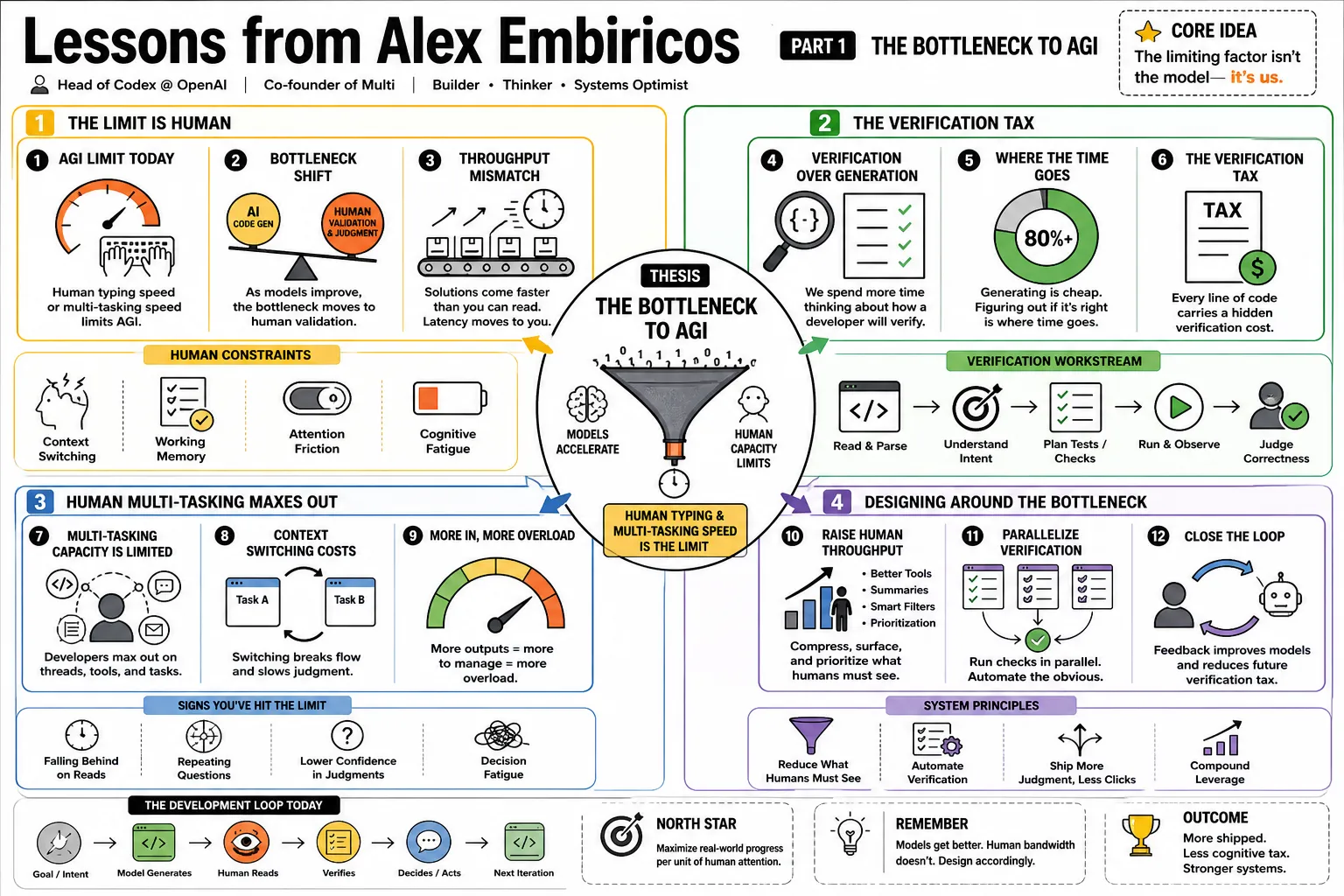
Part 1: The Bottleneck to AGI
- On AGI limits: Embiricos has called human typing and prompt-writing speed an underappreciated limit on how often people can benefit from AI; he also names validation as a bottleneck. — Lenny’s Podcast.
- On human constraints: As agents produce more code, people still need to decide what to build, review proposed plans and validate the result; model capability is not the only constraint. — 20VC Interview.
- On prompt throughput: A proactive assistant would need to notice useful opportunities without requiring a person to invent and type every prompt. — Lenny’s Podcast.
- On evaluating output: For delegated coding work, Embiricos emphasizes reviewing the agent’s plan and intended architecture before judging only the final diff. — 20VC Interview.
- On the verification tax: He describes code review as a new pressure point and encourages high-signal automatic review, while keeping humans responsible for integration decisions. — 20VC Interview.
- On human multi-tasking: Keeping several agents usefully busy creates its own human coordination cost: assigning work, checking plans and integrating results. — 20VC Interview.
- On shifting focus: His desired product direction is to make AI assistance easier to initiate and supervise, rather than asking people to become expert prompt writers. — Lenny’s Podcast.
- On Architectural Judgment: OpenAI’s Sora Android team describes humans focusing on architecture, experience and final quality while Codex handled large amounts of bounded implementation; this is a team account, not a personal Embiricos quote. — OpenAI: Sora for Android in 28 Days.
- On a General Assistant: Embiricos imagines a general assistant that can help across personal and work tasks without users learning separate feature menus; he presents this as a product direction, not a proven collapse of software brands. — Lenny’s Podcast.
Part 2: The Future of Coding Agents
- On moving past pair programming: He describes coding agents progressing beyond interactive pair programming toward delegation of more complete engineering tasks. — 20VC Interview.
- On agent autonomy: A coding agent can work through a repository and propose a change or pull request from a higher-level task, rather than merely autocomplete a line. — 20VC Interview.
- On competitive tools: Comparing Codex with Cursor and Claude Code, Embiricos treats model ability, workflow ergonomics and product distribution as competitive factors; he does not dismiss model quality. — 20VC Interview.
- On delegation vs dictation: Embiricos demonstrates giving Codex a bounded outcome and enough repo context, then reviewing its proposed work instead of dictating keystrokes. — How I AI Interview.
- On Coding as an Agent Skill: He expects coding to become a useful underlying competency for broader agents because executable code lets them act on computers and reuse procedures. — Lenny’s Podcast.
- On context windows: His workflow starts by asking the agent to understand the relevant existing code and conventions, not by assuming the entire repository fits usefully into one prompt. — How I AI Interview.
- On pull request success rates: He argues that reviewing an agent’s implementation plan can improve delegated work before a pull request is written; a specific PR success-rate formula is not established. — 20VC Interview.
- On the Full Coding Loop: In Embiricos’s account, delegated coding should include feedback, review and integration—not just text generation—with controls appropriate to the team’s workflow. — 20VC Interview.
- On agent reliability: He warns about low-quality AI pull requests and says the Codex team trained its reviewer for high-signal findings with fewer false positives. — 20VC Interview.
- On Flexible Interfaces: Embiricos sees chat as a flexible entry point for general help, with deeper interfaces available to domain specialists such as software engineers. — Lenny’s Podcast.
Part 3: The Three Phases of AI Agents
- On phase definitions: Embiricos describes three phases: capable coding agents, flexible computer-using agents available beyond engineers, then productized workflows that work out of the box. — 20VC Interview.
- On Why Coding Came First: Coding is an early agent foothold because current models are strong at it and executable code gives the agent a powerful way to use a computer. — 20VC Interview.
- On Broader Computer Use: His second phase extends the agent’s reach across computer tasks; writing code is often a more flexible route than relying only on point-and-click interaction. — 20VC Interview.
- On workflow productization: Once useful agent patterns are clear, Embiricos expects specific workflows to be packaged so ordinary users need less prompting and setup. — 20VC Interview.
- On Context and Permissions: Moving beyond coding requires handling real computer context and organizational permissions, not simply adding a visual click interface. — 20VC Interview.
- On Composable Computer Skills: He argues that coding can let a general agent act across tools and compose reusable capabilities, instead of waiting for every task to have a dedicated hand-built feature. — Lenny’s Podcast.
- On phase overlap: Embiricos expects experimentation with broader agent use while coding agents are still improving; the three phases are a product-development frame, not rigid gates. — 20VC Interview.
- On Point-and-Click Limits: He notes that point-and-click computer use can be slow or unpredictable, one reason he favors code as an agent’s tool when a task permits it. — Lenny’s Podcast.
Part 4: Redefining Product Management
- On eliminating modes: In a direct interview, Embiricos described a goal of bringing Codex capabilities into ChatGPT without forcing people to choose a separate mode. — Sources: OpenAI Super App Interview.
- On seamless integration: His vision is that a general assistant should surface the appropriate help without users first learning every connector or product feature. — Lenny’s Podcast.
- On Correctable AI Output: Embiricos found that an AI feature’s presentation matters: a shared, editable notepad made AI-generated notes easier for teammates to understand and correct. — Designing Usefully Unintelligent AI Summaries.
- On the PM role: Embiricos says a PM’s role is deliberately flexible—looking around corners, improving quality and filling the needs of a particular team—rather than one fixed set of flows. — 20VC Interview.
- On Product Feedback: Multi’s early users rarely used an open-ended AI prompt box; that feedback led Embiricos’s team to automate basic summaries and offer contextual actions. — Designing Usefully Unintelligent AI Summaries.
- On Grounding Summaries: A summary that inverted a user’s intended deployment sequence taught Embiricos to pair AI-generated skimmable notes with links to factual artifacts. — Designing Usefully Unintelligent AI Summaries.
- On Contextual Actions: Rather than rely on users to configure a prompt for every task, Multi made common useful actions available in context while retaining an optional open-ended path for power users. — Designing Usefully Unintelligent AI Summaries.
- On Making AI Correctable: Multi made AI outputs visible and editable in the same collaborative notepad as human notes, so users could see and correct what the assistant was doing. — Designing Usefully Unintelligent AI Summaries.
- On In-Context Interfaces: Embiricos’s UI principle is to place an AI action where the work already happens, rather than make people move content between separate interfaces. — Designing Usefully Unintelligent AI Summaries.
Part 5: Engineering Workflows in the AI Era
- On When to Plan: For a complex change, Embiricos favors agreeing on a written plan before implementation; for a small or time-sensitive task he sometimes uses direct or parallel attempts instead. — How I AI Interview.
- On structured planning: He demonstrates using a PLANS.md-style rubric to give Codex milestones, architecture and verification steps for a larger software change. — How I AI Interview.
- On parallel development: Separate Git worktrees let Embiricos run alternative Codex changes in parallel without both agents editing the same checkout. — How I AI Interview.
- On internal tooling: Embiricos says OpenAI uses Codex to review almost all pushed code automatically and trains the reviewer to produce high-signal feedback. — 20VC Interview.
- On the Sora Android Example: OpenAI engineers Patrick Hum and RJ Marsan report that a four-person team used Codex to reach an internal Sora Android build in 18 days and a public launch in 28; Embiricos cites the project as an example. — OpenAI: Sora for Android in 28 Days.
- On code review changes: On the Sora Android project, the team’s bottleneck moved toward reviewing decisions, giving feedback and integrating agent work, rather than writing every line. — OpenAI: Sora for Android in 28 Days.
- On Repo Context: The Sora team found that Codex could read large codebases quickly, but without architectural guidance and concrete examples it could guess wrong about where a change belonged. — OpenAI: Sora for Android in 28 Days.
- On Architecture First: Human engineers established modular architecture and representative features first, then let Codex implement more independently within those patterns. — OpenAI: Sora for Android in 28 Days.
- On Architectural Oversight: The official Sora account warns that agent-generated code can technically work while adding the wrong abstraction or poor product behavior, so humans still own architecture and quality. — OpenAI: Sora for Android in 28 Days.
Part 6: Building Remote & Hybrid Tools
- On the virtual office: Remotion initially set out to make remote work feel less distant by supporting fluid collaboration and social presence. — Renaming Remotion to Multi.
- On presentation tools: Embiricos says conventional screen sharing felt like presenting, while technical teams wanted to solve problems together inside shared work. — Remotion Pivot: Founder Update.
- On spontaneous interaction: Remotion initially emphasized easy, spontaneous connection at a distance; Embiricos later shifted Multi toward making existing technical work sessions more effective. — Renaming Remotion to Multi.
- On Active Participation: Multi’s design aims to let teammates actively point, draw and edit during a session instead of passively watching one presenter. — Launching Multi.
- On technical collaboration: The Remotion-to-Multi rebrand followed a product refocus on helping technical teams pair, review code and build together. — Renaming Remotion to Multi.
- On Shared Work and Follow-Ups: Embiricos favored active shared problem-solving sessions over passive meetings, while using notes and follow-ups to connect synchronous work to later use. — Launching Multi.
- On Screen-Share Friction: His team identified many small frictions in conventional screen sharing—waiting for another person to scroll or dictating a change—and designed for direct interaction. — Remotion Pivot: Founder Update.
- On Remote and Colocated Teams: Embiricos said Multi’s collaboration tools should work for engineers sitting together as well as for teammates on different continents. — Renaming Remotion to Multi.
- On screen sharing: Multi let more than one participant control shared apps with individual cursors and drawing, so screen sharing could function as joint work rather than broadcast. — Launching Multi.
- On developer needs: Embiricos designed Multi around engineering sessions such as pairing, code walkthroughs and live reviews inside tools like Xcode and Terminal. — Launching Multi.
Part 7: Customer Discovery & Founder-Market Fit
- On choosing a problem: Embiricos and his cofounder first explored ways to connect remote teammates; their later founder interview explains how the original choice evolved as customer evidence changed. — Engineering Founders Interview.
- On founder passion: The founders first cared about making remote conversation feel fluid and spontaneous; later feedback shifted their focus toward shared technical work. — Renaming Remotion to Multi.
- On Interviewing New Users: Talking with *new* tech leads, not only existing enthusiasts, exposed that social coworking features did not solve the pairing problems those prospects already had. — Remotion Pivot: Founder Update.
- On pivoting: The pivot toward technical teams arose from observing that engineers wanted more productive screen-shared pairing calls, not simply more impromptu calls. — Remotion Pivot: Founder Update.
- On trusting intuition: Embiricos described tension between attachment to the existing product and metrics showing inadequate progress; that tension pushed the founders toward a larger change. — Engineering Founders Interview.
- On Narrowing the Audience: The team deliberately narrowed its target to technical leads and accepted losing some users while testing whether the product could better serve that specific group. — Remotion Pivot: Founder Update.
- On Behavioral Validation: Their early test looked at changed behavior: even while active users fell, founder-reported call use rose 26% and screen sharing rose 77% after the refocus. — Remotion Pivot: Founder Update.
- On target audiences: By focusing on technical teams, Multi could build specialized pairing and shared-control features instead of remaining a general remote-presence tool. — Renaming Remotion to Multi.
- On Contradictory Feedback: Feedback from new tech leads contradicted what existing users praised, prompting Embiricos to reconsider the product’s central use case. — Remotion Pivot: Founder Update.
Part 8: Career Advice & Leadership
- On choosing customers: Embiricos advises choosing a customer group one enjoys talking to, including when product work is difficult. — IT Career Energizer Interview.
- On empowering others: One of his stated career tips is to empower colleagues so they can solve problems themselves rather than doing every urgent task for them. — IT Career Energizer Interview.
- On AI-Assisted Learning: For new engineers, Embiricos says AI can accelerate learning a complex codebase, while agency, taste and quality remain valuable human contributions. — 20VC Interview.
- On Showing Your Work: His concrete early-career advice is to build and share high-quality projects; he says a thoughtful project link attracts his attention more than an ordinary résumé. — 20VC Interview.
- On Building to Win: Looking back on his startup, Embiricos says a period focused on avoiding loss rather than building to win made the work unhappy and unproductive for him. — 20VC Interview.
- On Communicating a Pivot: During Remotion’s pivot, its founders discussed how to communicate changing strategy and difficult trade-offs transparently with their team and stakeholders. — Engineering Founders Interview.
- On hiring engineers: In a Codex hiring post, Embiricos sought product-minded engineers or deeply technical PMs/designers who had recently shipped code. — Embiricos’s Codex Hiring Note.
- On Sources of Energy: Asked what keeps him energized, Embiricos pointed to the feeling of creating something and delivering it, not a universal rule that burnout is unrelated to hours. — IT Career Energizer Interview.