Alex Gurevich is a mathematician and global-macro investor who led macro trading at J.P. Morgan and founded HonTe Investments. His books The Next Perfect Trade and The Trades of March 2020 examine trade construction, risk and the decisions made during a market crisis. — The Next Perfect Trade, Second Edition.
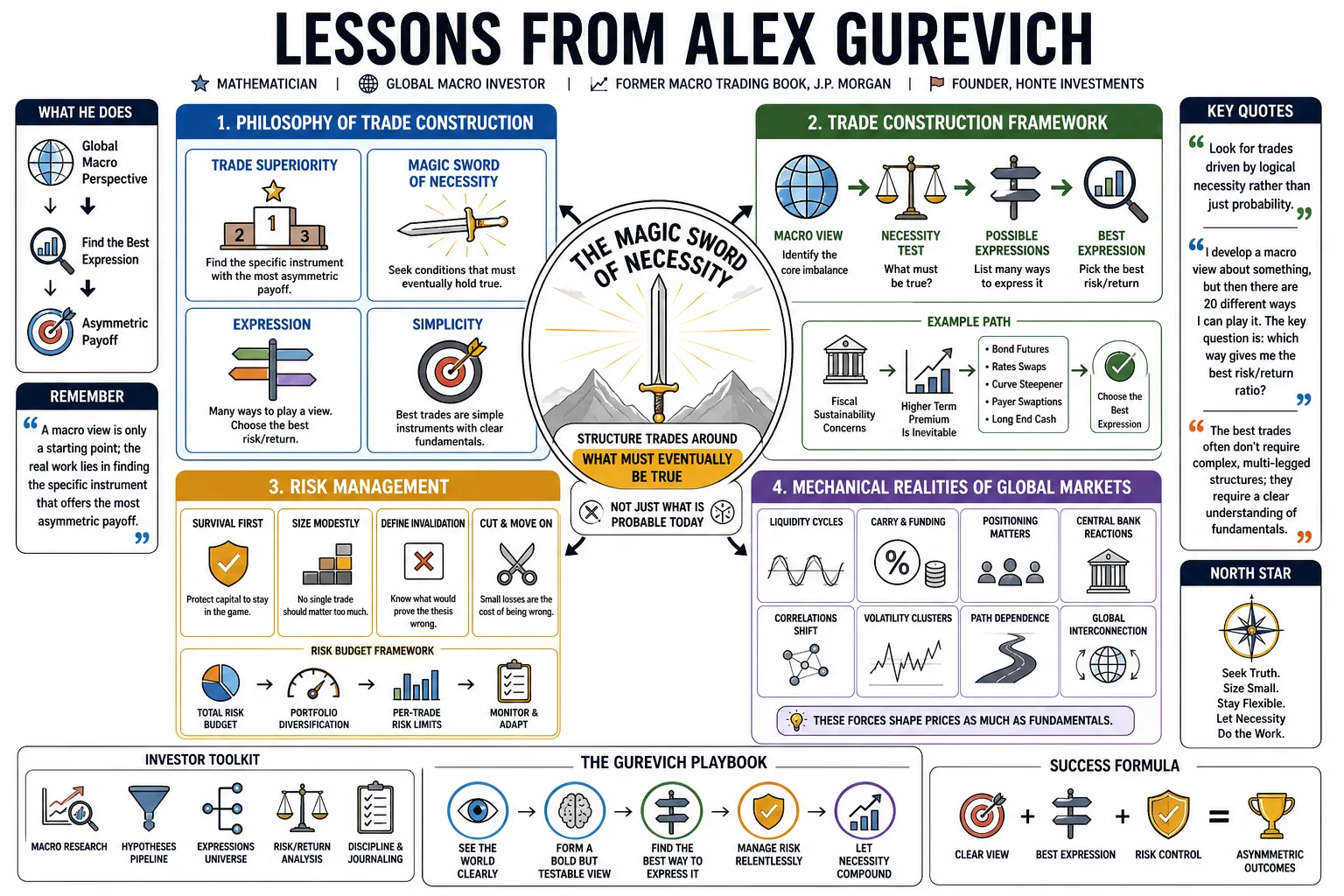
Part 1: The Philosophy of Trade Construction
- On Trade Superiority: A macro forecast is not the trade itself: Gurevich compares candidate positions and favors one that can succeed across more outcomes than a narrower alternative. — The Next Perfect Trade — Author Excerpts.
- On the Magic Sword: His “Magic Sword of Necessity” uses logical implication: when one outcome would imply another, the trade on the broader necessary outcome may dominate the narrower bet, subject to the assumptions of that market. — The Next Perfect Trade — Author Excerpts.
- On Expression: A view on rising yields need not be expressed by shorting a bond; Gurevich asks what causal thesis the trader holds and whether another instrument expresses it with fewer ways to lose. — Treasury Futures Trading Primer.
- On Simplicity: Adding a long-short spread to express a simple directional view can increase the number of things that must go right; a spread is justified when the view concerns that specific part of the yield curve. — Treasury Futures Trading Primer.
- On Patience in Setup: Rather than require the precise market path he predicted, Gurevich looks for positions that can work across several plausible policy and growth outcomes. — Superior Trades Aim for Wider Targets.
- On Necessary Conditions: A “dominant” trade, in Gurevich’s framework, is one supported by a necessary implication of another thesis; that relationship depends on the economic setting and is not a guarantee. — The Next Perfect Trade — Author Excerpts.
- On Directional Bias: In his 2014 example, long bonds and a long-dollar position expressed complementary scenarios, with positive carry and a causal relationship between policy, growth and currencies. — The Next Perfect Trade — Author Excerpts.
- On Intellectual Rigor: Gurevich frames investing as an intellectual battle requiring a plan and preparation before the market’s first adverse move. — The Next Perfect Trade, Second Edition.
- On Structural Edges: His stated goal is to construct positions with positive expectation even when the underlying economic forecast proves wrong, instead of relying solely on predicting the future. — MacroVoices: The Next Perfect Trade.
Part 2: Managing Risk and Survival
- On Preparation: The book’s armor-and-shield metaphor puts preparation and survival ahead of relying on a clever “magic sword” trade alone. — The Next Perfect Trade, Second Edition.
- On Drawdowns: Recounting March 2020, Gurevich says he feared mismanaging leverage, liquidity and risk space more than simply holding the wrong market view. — MacroVoices: The Trades of March 2020.
- On Uncertainty: His “shield against uncertainty” was a portfolio built around what he regarded as durable crisis responses while accepting that the pandemic and market path were unknowable in advance. — MacroVoices: The Trades of March 2020.
- On Leverage: During the March 2020 selloff, leverage and rising margin demands constrained what Gurevich could hold even when he still liked the longer-run thesis. — MacroVoices: The Trades of March 2020.
- On Reassessing a Thesis: Gurevich warns against choosing an arbitrary price floor: when a trade’s policy thesis still holds, a move against the position may call for reassessment rather than an automatic stop-out. — The Tale of Three Shorts, Part I.
- On Capital Preservation: After a drawdown, Gurevich reduced risk while retaining the logic of his core view; sizing a position to survive a correction still required active capital management. — William Faulkner’s Advice to Traders.
- On Correlation Risk: In a panic, diversification did not remove funding and liquidity pressure; Gurevich focused on whether the portfolio could survive margin calls and impaired exits. — MacroVoices: The Trades of March 2020.
- On Liquidity: He describes March 2020 as a period when liquidity disappeared and margin requirements rose, making it dangerous to assume an exit was available at a normal quoted price. — MacroVoices: The Trades of March 2020.
- On Asymmetry: An option limits the buyer’s loss to its premium, but Gurevich often preferred convex positions with positive carry because paying for protection can erode returns. — Top Traders Unplugged: Anatomy of a Trade.
Part 3: Interest Rates and Central Banking
- On the Fed's Playbook: Gurevich expected aggressive central-bank liquidity support during the pandemic, but his book account shows that surviving until that support reached markets was a separate risk problem. — MacroVoices: The Trades of March 2020.
- On Yield-Curve Causality: Gurevich cautions that a flat yield curve’s past association with recessions need not make it a robust independent forecast; he asks whether the relation has a causal basis in the current regime. — Flat Curves and Recessions.
- On Rate Cuts: In his 2020 rates analysis, Gurevich considered how a recession and central-bank easing could push short rates down and steepen the curve; this was a dated scenario, not a universal rule about every cutting cycle. — MacroVoices: Bond Yields, Dollar and Equities.
- On Inflation vs. Deflation: Gurevich weighs inflation pressures against disinflationary forces, including technology, while revisiting how those forces affect rates and portfolio choices in a given period. — MacroVoices: The Next Perfect Trade.
- On Fixed Income: He argued that long bonds could contribute capital appreciation and a counterweight to risk assets, not merely coupon yield, though their usefulness depends on the level and direction of rates. — MacroVoices: The Trades of March 2020.
- On Zero Bound: Negative rates challenged the assumption that a near-zero yield necessarily capped bond upside; Gurevich examined how that changed bond math and policy possibilities. — Negative in Perpetuity.
- On Forward Guidance: A Fed hike need not make long-dated bonds fall: expected future growth and inflation can move the long end in a different direction from the overnight policy rate. — Treasury Futures Trading Primer.
- On Real Rates: Gurevich analyzes real-rate tightening through its effects on borrowing, consumer cash buffers and final demand, rather than treating nominal policy rates alone as the whole story. — Real Rates Tsunami.
- On Monetary Policy Lags: He notes that higher real rates may affect wages and borrowers quickly while other effects take longer; the sequence and timing of economic stress remain uncertain. — Real Rates Tsunami.
- On Avoiding Exact Pivot Timing: Gurevich says he no longer needs to predict the exact first Fed hike to construct a trade; he instead seeks a portfolio that can work under more than one policy path. — Superior Trades Aim for Wider Targets.
Part 4: The Psychology of the Investor
- On Reconsidering Options: After finding options too easy to misuse as a buyer, Gurevich reconsidered when option prices fell enough to make a specific rate opportunity attractive. — Masters in Business: Alex Gurevich.
- On Conviction: Conviction in a thesis did not exempt Gurevich from reducing exposure when a drawdown tightened his risk budget. — William Faulkner’s Advice to Traders.
- On Ranking Trades: Gurevich describes ranking trades by their prospective structure rather than defending a position merely because it was his original idea. — Masters in Business: Alex Gurevich.
- On Panic: His March 2020 account describes fear and pressure, followed by a deliberate effort to distinguish what he knew, what remained uncertain and which risks the portfolio could still carry. — MacroVoices: The Trades of March 2020.
- On Flexibility: The 2026 edition of his strategy book revisits which earlier ideas worked, where he was wrong and where he failed to follow his own principles. — MacroVoices: The Next Perfect Trade.
- On Over-Trading: For an investor convinced stocks are overvalued but unable to time a decline, Gurevich presents staying flat as an alternative to a costly short or expiring put. — Patience, Bears!.
- On Mental Stamina: Reflecting on his trading career, Gurevich says recognizing it as a long game could have reduced the stress and short-term pressure he felt earlier. — Masters in Business: Alex Gurevich.
- On Auditing Old Ideas: He deliberately revisited old forecasts and trade principles in a second edition so readers could see failures as well as successes rather than only a survivor’s retrospective. — MacroVoices: The Next Perfect Trade.
- On Patience: Patience in his framework means waiting for a position whose causal logic and carry can withstand more than a narrow forecast, not merely waiting for a price signal. — Superior Trades Aim for Wider Targets.
Part 5: Navigating Crises and Black Swans
- On the March 2020 Crash: In March 2020, falling rates initially benefited his portfolio, but collapsing liquidity and rising margin demands then threatened positions before policy support reached markets. — MacroVoices: The Trades of March 2020.
- On Market Contagion: The crisis forced portfolio decisions under funding pressure: Gurevich describes reducing or reversing positions even when he had not abandoned their longer-run thesis. — MacroVoices: The Trades of March 2020.
- On Opportunity in Chaos: Gurevich took profits from falling-rate positions and bought selected assets into the March 2020 decline, while acknowledging that he did not catch the exact low. — MacroVoices: The Trades of March 2020.
- On Crisis Exposures: His 2020 crisis portfolio used falling-rate exposures as a source of gains and liquidity while risk assets sold off; he did not claim that one asset class is a guaranteed safe haven in every panic. — MacroVoices: The Trades of March 2020.
- On Government Intervention: Gurevich’s March 2020 thesis anticipated large central-bank liquidity additions, but the timing of that intervention mattered because margin and cash pressures worsened first. — MacroVoices: The Trades of March 2020.
- On Historical Precedents: He studies historical rate and asset patterns, but stresses that a pattern can shift probabilities without proving that the same event must recur. — MacroVoices: Bond Yields, Dollar and Equities.
- On Recovery: He describes a sharp rebound in the final week of March 2020 as Fed liquidity began to reach markets, after a difficult period of margin and cash stress. — MacroVoices: The Trades of March 2020.
Part 6: Options and Derivatives Strategy
- On Option Pricing: Gurevich treats options as bounded-premium exposures but cautions that a buyer can lose despite a correct broad directional view if the move arrives too late or too weakly. — Top Traders Unplugged: Anatomy of a Trade.
- On Implied Volatility: His experience as an option market maker taught him that implied volatility alone does not capture the full economics of holding or continuously hedging an option. — Top Traders Unplugged: Anatomy of a Trade.
- On Convexity and Carry: He seeks convex exposure that can protect a portfolio when needed, preferably with positive rather than persistently negative carry; paid options are only one possible implementation. — Top Traders Unplugged: Anatomy of a Trade.
- On Premium Decay: For an option buyer, direction is not enough: timing, speed and magnitude can determine whether the premium pays off before it decays. — Top Traders Unplugged: Anatomy of a Trade.
- On Implied vs. Realized Volatility: Gurevich distinguishes an option’s quoted implied volatility from what a holder earns after timing, hedging costs and the actual path of the underlying asset. — Top Traders Unplugged: Anatomy of a Trade.
- On Strategy Complexity: A complex spread can add extra failure points to a simple directional thesis; Gurevich recommends matching the structure to the specific part of the market being expressed. — Treasury Futures Trading Primer.
- On Using Options for Expression: Some rate options bought before March 2020 were inexpensive enough to gain sharply as emergency cuts arrived; Gurevich then harvested part of those gains to buy other assets. — MacroVoices: The Trades of March 2020.
Part 7: Portfolio Sizing and Timing
- On Sizing: Gurevich says he had sized his long-dollar and long-bond positions to withstand a correction, but still reduced exposure when the drawdown strained his risk budget. — William Faulkner’s Advice to Traders.
- On Scaling In: He sometimes added to a favored position on weakness when risk space allowed, but also described choosing not to add when a further decline could put the portfolio under undue pressure. — MacroVoices: Bond Yields, Dollar and Equities.
- On Timing Agnosticism: Gurevich does not rely on consistently timing macro events; his authored example sought a trade that could carry while waiting for the policy thesis to play out. — The Next Perfect Trade — Author Excerpts.
- On Cutting Losers: When a drawdown required lower risk, he cut positions he liked rather than keep them solely because their original thesis still appealed to him. — William Faulkner’s Advice to Traders.
- On Concentration vs. Diversification: His 2014 example paired long bonds and a long-dollar trade so that adverse conditions for one could support the other; that complementarity depended on the assumptions of the period. — The Next Perfect Trade — Author Excerpts.
- On Expected Value: His trade-selection goal is positive expectation across outcomes, not simply a bet on the single macro result he thinks most likely. — MacroVoices: The Next Perfect Trade.
- On the Cost of Carry: Paying negative carry for convexity can put a time limit on a thesis; Gurevich looks for ways to obtain useful convexity with positive carry when possible. — Top Traders Unplugged: Anatomy of a Trade.
Part 8: The Macro View of Asset Classes
- On Gold: Gurevich describes gold’s long-earned credibility as a monetary asset, while his interviews caution against reducing every gold move to a simple inflation-hedge story. — In Quest for Digital Gold.
- On Currencies: A currency position can express differences between policy paths: in his 2014 example, shorting the euro against the dollar was broader than a narrow bet on a faster Fed hike. — The Next Perfect Trade — Author Excerpts.
- On Rates and Equities: Gurevich cautions against assuming that Fed hikes themselves cause equities to rise; the historical overlap of hikes and equity gains can reflect an underlying growth regime. — Rising Stocks and Rising Rates.
- On Commodity Spillovers: His 2015 country review linked falling commodity prices to pressure on producer economies and currencies, while warning that policy and dollar funding also mattered. — Currency Values Amidst the Commotion.
- On Emerging Markets: He warned that a strong dollar pressures dollar-funded carry positions in emerging markets, making a high-growth narrative insufficient on its own. — Currency Values Amidst the Commotion.
- On the US Dollar: Gurevich treats the dollar as a relative expression of global policy and liquidity conditions, and he compared dollar positions with gold and emerging-market exposure in his 2020 discussion. — MacroVoices: Bond Yields, Dollar and Equities.
- On Technology: In his 2026 discussion he considered AI-driven productivity as a possible disinflationary force, but not as a settled law governing all prices. — MacroVoices: The Next Perfect Trade.
- On Fragile Correlations: Gurevich cautions against treating a historical gold-dollar inverse correlation as permanent; the apparent relationship can reflect the currency in which gold is quoted. — MacroVoices: Bond Yields, Dollar and Equities.