Alex Karp is the co-founder and CEO of Palantir Technologies, a software company that builds data analysis platforms for intelligence agencies and commercial enterprises. Known for his academic background in social theory, he frequently argues that the technology sector has a moral obligation to support national defense rather than focusing exclusively on consumer applications. This profile collects his views on the strategic role of software, geopolitical deterrence, and the ideological climate of Silicon Valley.
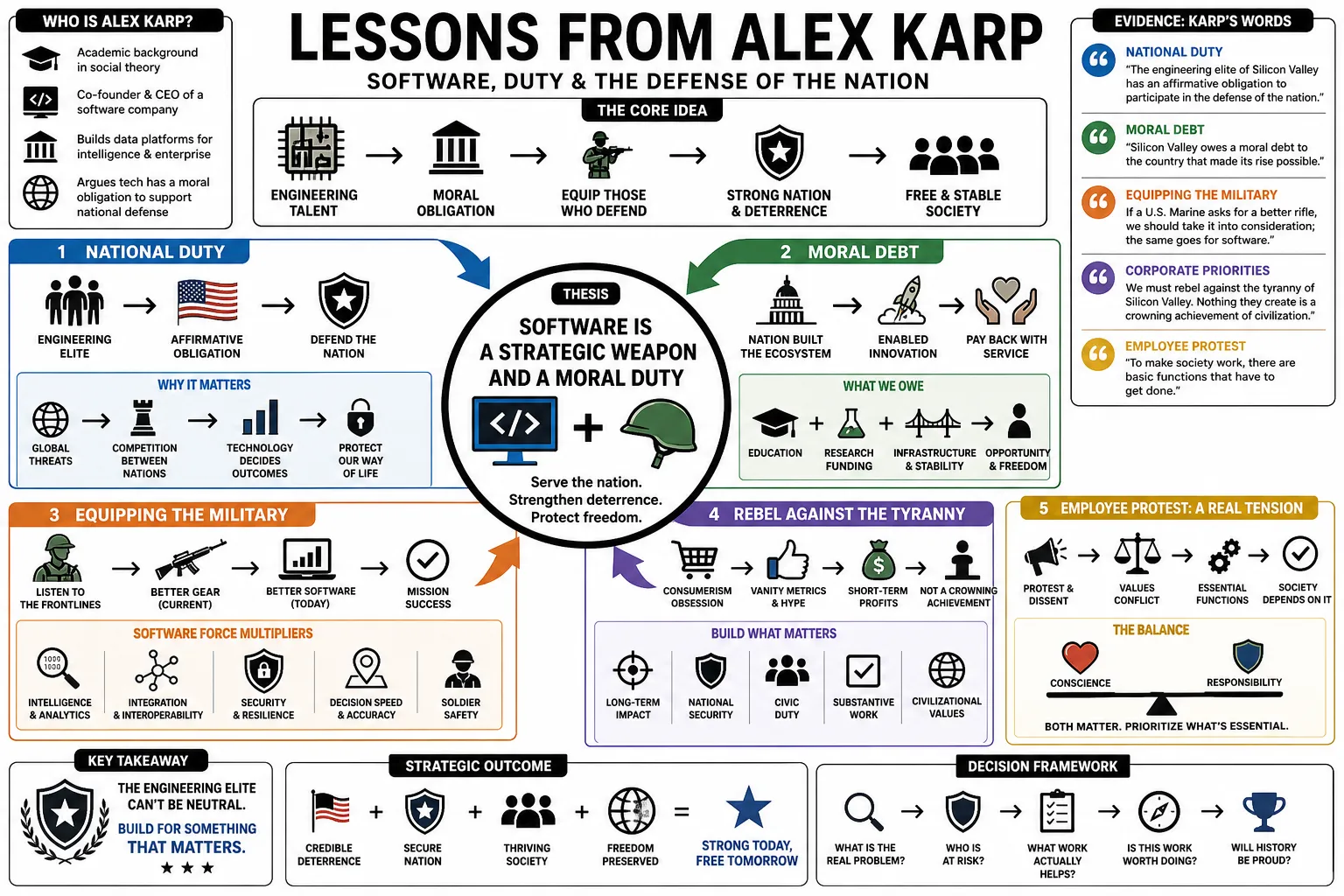
Part 1: The Obligation of the Engineering Elite
- On National Duty: "The engineering elite of Silicon Valley has an affirmative obligation to participate in the defense of the nation." — Source: [CNBC Feature Interview]
- On Moral Debt: "Silicon Valley owes a moral debt to the country that made its rise possible." — Source: [CNBC Feature Interview]
- On Equipping the Military: "If a U.S. Marine asks for a better rifle, we should take it into consideration; the same goes for software." — Source: [CNBC Feature Interview]
- On Corporate Priorities: "We must rebel against the tyranny of Silicon Valley. Nothing they create is a crowning achievement of civilization." — Source: [Palantir AIPCon Keynote]
- On Employee Protest: "To make society work, there are basic functions that have to work, one of which is the reduction of terrorism. You may not agree with that, and bless you. Don't work here." — Source: [CNBC Feature Interview]
- On Supporting the System: "No one in the world would tolerate us and all that we do if America didn't have the most powerful military in the world. Supporting the military is an obligation to those who benefit from our system." — Source: [All-In Podcast Interview]
- On Passivity: "The U.S. Marine serves; the Silicon Valley executives walk. This is wrong." — Source: [CNBC Feature Interview]
- On Defense Contracts: "We are not everyone's cup of tea. We may not be your cup of tea. But we are going to build software that protects the West." — Source: [CNBC Feature Interview]
- On Tech Sector Hypocrisy: "Companies are happy to profit from the stability of the country, yet they often refuse to support its government when political controversy arises." — Source: [CNBC Feature Interview]
- On Building Sharp Tools: "We must not shy away from building sharp tools for fear they may be turned against us." — Source: [CNBC Feature Interview]
Part 2: Hard Power and Deterrence
- On Creating Peace: "I want less war. You only stop war by having the best technology and by scaring the bejabers out of our adversaries." — Source: [CNBC Feature Interview]
- On The Purpose of Software: "Honestly, the most important thing Palantir does is prevent war." — Source: [CNBC Feature Interview]
- On Hard Power: "The ability of free and democratic societies to prevail requires something more than moral appeal. It requires hard power, and hard power in this century will be built on software." — Source: [CNBC Feature Interview]
- On Deterrence Strategy: "The primary way to create peace in this world is to scare our adversaries when they wake up, when they go to bed, while they're seeing their mistress. Whatever they're doing, they're scared." — Source: [CNBC Feature Interview]
- On Vulnerability: "If they are not scared, they will attack us. That is the historical reality of human nature." — Source: [CNBC Feature Interview]
- On Military Strength: "A nation's geopolitical strength is now inextricably linked to its software capabilities." — Source: [CNBC Feature Interview]
- On Winning: "We are in an arms race. There is no middle ground. This isn't about stock prices. It's about sovereignty." — Source: [CNBC Feature Interview]
- On Binary Outcomes: "Either we win, or China wins." — Source: [CNBC Feature Interview]
- On the Ground Truth: "The battlefield is the raw environment that exposes what genuinely works versus what merely demos well in enterprise settings." — Source: [Palantir AIPCon Keynote]
- On European Security: "The postwar neutering of military ambition in parts of Europe has left them reliant on American technological and military overmatch." — Source: [CNBC Feature Interview]
Part 3: The Philosophy of Software
- On Software Dominance: "Whoever has the upper hand when it comes to software will have the upper hand, period." — Source: [Palantir AIPCon Keynote]
- On the Market: "This is the software century, and we intend to take the entire market." — Source: [Palantir AIPCon Keynote]
- On Institutional Power: "Powerful ideas do not change the world unless they are backed by powerful institutions." — Source: [Palantir AIPCon Keynote]
- On Value Creation: "Whether on the battlefield or the commercial front, value creation determines survival. Without delivering outsized, irreplicable results, you disappear." — Source: [CNBC Feature Interview]
- On Deterministic Systems: "There is a massive distinction between probabilistic chatbots that guess the next word and deterministic systems that manage actual supply chains and military targeting." — Source: [Palantir AIPCon Keynote]
- On Enterprise Viability: "What makes you lethal on the battlefield, and what makes you commercially viable? From a non-moral perspective, they're exactly the same." — Source: [Palantir AIPCon Keynote]
- On the AI Divide: "The world will be divided between AI haves and have-nots, and it will happen faster than previous technological revolutions." — Source: [Palantir AIPCon Keynote]
- On Real-World Application: "Software that only works in a controlled demo environment is useless when the actual world introduces friction and chaos." — Source: [Palantir AIPCon Keynote]
- On Ambition: "We will be the most important software company in the world." — Source: [Palantir AIPCon Keynote]
- On Foundational Tech: "The integration of advanced technology into the core functions of the state is no longer optional; it is the baseline for survival." — Source: [CNBC Feature Interview]
Part 4: Silicon Valley Monoculture
- On Trivial Pursuits: "A massive amount of engineering talent has been redirected from meaningful technological advancement to baubles that merely help influencers or optimize click-through rates." — Source: [CNBC Feature Interview]
- On Industry Self-Awareness: "They don't understand how unlikeable they are. I told them this. I probably shouldn't have." — Source: [CNBC Feature Interview]
- On the Tech Bubble: "Most of them are chillaxing over their latte, reading a report about something that they don't understand." — Source: [CNBC Feature Interview]
- On Intolerance: "The increasing intolerance within the valley skewers anyone for their perceived transgressions, forcing people into a state of caution where they often say nothing much at all." — Source: [CNBC Feature Interview]
- On Ideological Conformity: "The tech sector has become an elite bubble with a stifling monoculture that actively discourages dissenting political thought." — Source: [CNBC Feature Interview]
- On Performative Ethics: "I have zero interest in the performative ethics of people who refuse to build tools for their own government while selling consumer data to the highest bidder." — Source: [CNBC Feature Interview]
- On Groupthink: "If you want to actually build something difficult, you have to leave the echo chamber where everyone agrees on what the acceptable thoughts are." — Source: [All-In Podcast Interview]
- On Shorting Tech: "The idea that chips and ontology is what you want to short is batshit crazy." — Source: [Palantir AIPCon Keynote]
- On the Tyranny of Apps: "We must move beyond the tyranny of the apps and focus on the hard-science challenges that software should actually be solving." — Source: [CNBC Feature Interview]
Part 5: Artificial Intelligence and the Future
- On the AI Arms Race: "The question is not whether A.I. weapons will be built; it is who will build them and for what purpose." — Source: [CNBC Feature Interview]
- On Adversarial Progress: "Our adversaries will not pause to indulge in theatrical debates about the merits of developing technologies with critical military applications. They will proceed." — Source: [CNBC Feature Interview]
- On Societal Shifts: "AI is a societal-scale shift, not a feature upgrade. The core question is whether institutions are prepared to apply it in ways that strengthen resilience." — Source: [Palantir AIPCon Keynote]
- On Overhyping LLMs: "Silicon Valley totally effed up in overhyping LLMs and promising artificial intelligence was right around the corner without doing the hard integration work." — Source: [Palantir AIPCon Keynote]
- On Glorified Chatbots: "Many companies are attempting to shortcut necessary, difficult technical infrastructure work by slapping a glorified chatbot on top of broken data." — Source: [Palantir AIPCon Keynote]
- On Global Diplomacy: "The question is not whether some fool will build A.I. weapons. The question is: who profits when we don't seek diplomatic solutions for global problems?" — Source: [All-In Podcast Interview]
- On Labor Disruption: "The AI revolution will significantly disrupt traditional power structures, potentially decreasing the leverage of humanities-trained professionals." — Source: [CNBC Feature Interview]
- On the Working Class: "Advanced AI might ironically increase the economic power of the vocationally trained working class, who deal with the physical world that software cannot easily replace." — Source: [CNBC Feature Interview]
- On AI Nationalization: "We are moving toward a world where AI infrastructure will be viewed as critical national infrastructure, and treated with the same regulatory severity." — Source: [CNBC Feature Interview]
Part 6: Authenticity and Human Connection
- On Sincerity: "You will never touch the hearts of others, if it does not emerge from your own." — Source: [CNBC Feature Interview]
- On Corporate Messaging: "Sincere communication is a critical tool for leadership. In a world of scripted corporate messaging, true impact only comes when words are backed by genuine personal conviction." — Source: [CNBC Feature Interview]
- On Normative Claims: "Modern society has withdrawn from making ethical and aesthetic judgments, which erodes our collective ability to distinguish truth." — Source: [CNBC Feature Interview]
- On Taking a Stand: "You have to be willing to make normative claims and take a stand, even when it is highly unpopular in your immediate social circle." — Source: [CNBC Feature Interview]
- On Ideological Agnosticism: "The worst thing a leader can be is completely agnostic on questions of right and wrong, hiding behind the guise of neutral platform mechanics." — Source: [CNBC Feature Interview]
- On Trust: "People do not trust executives who constantly shift their moral frameworks to appease the loudest voices on social media." — Source: [CNBC Feature Interview]
- On Public Backlash: "If you actually believe in what you are doing, the political backlash is just friction you have to walk through." — Source: [All-In Podcast Interview]
- On Human Nature: "Technology changes rapidly, but human nature and the realities of geopolitical conflict remain exactly as they were centuries ago." — Source: [CNBC Feature Interview]
- On Real Dialogue: "We need institutions that allow for aggressive, sincere intellectual combat, rather than polite, sterile consensus." — Source: [All-In Podcast Interview]
Part 7: Ambition and Personal Development
- On Finding Your Lane: "Find the thing you're uniquely good at, and then make sure your whole life is organized around allowing you to do it." — Source: [All-In Podcast Interview]
- On Social Sacrifices: "I've never met someone successful who had a great social life at 20. If that's what you want, that's great. But you're not going to be successful, and don't blame anyone else." — Source: [All-In Podcast Interview]
- On Dyslexia: "My struggle with dyslexia was a formative moment. Because I could not follow a standard playbook, I was forced to learn how to think freely." — Source: [CNBC Feature Interview]
- On Focus: "People claim they want to build massive, world-changing things, but their daily calendars reflect a desire to be comfortable and liked." — Source: [All-In Podcast Interview]
- On Serendipity: "You need an embrace of serendipity and psychological flexibility. Building a startup is like improvisational theater; you have to abandon theories for what actually works." — Source: [CNBC Feature Interview]
- On Contrarianism: "Being a contrarian isn't about just disagreeing with people; it's about seeing the fundamental reality that the crowd is ignoring because it's too uncomfortable." — Source: [All-In Podcast Interview]
- On Unconventional Talent: "We actively seek out unconventional talent—people who might be abrasive or unusual but who possess an irreplicable spike in technical ability." — Source: [All-In Podcast Interview]
- On Hard Work: "There is no substitute for the raw, compounding effort of doing the difficult thing over and over until you master it." — Source: [CNBC Feature Interview]
- On Self-Deception: "The biggest risk to a young ambitious person is self-deception—believing you are working hard when you are merely being busy." — Source: [All-In Podcast Interview]
Part 8: The Survival of the West
- On Western Superiority: "The superiority of the West in software production has made Western countries, especially America, healthier, wealthier, and stronger." — Source: [CNBC Feature Interview]
- On Late-Capitalist Hedonism: "We must reject late-capitalist hedonism in favor of a renewed commitment to national projects and security." — Source: [CNBC Feature Interview]
- On Ideological Warfare: "People want to live in peace. They want to go home. They do not want to hear your woke pagan ideology. They want to know they're safe." — Source: [CNBC Feature Interview]
- On the Future of the West: "Western civilization is at a crossroads where soft belief will no longer protect us against adversaries armed with hard technological power." — Source: [CNBC Feature Interview]
- On American Dominance: "The world is a much safer place when America is undeniably the strongest technological and military power." — Source: [CNBC Feature Interview]
- On National Service: "We should seriously consider moving away from all-volunteer forces in favor of universal national service to bind the country together." — Source: [CNBC Feature Interview]
- On Geopolitical Reality: "You cannot manage global power dynamics with press releases and moral posturing; you manage them with logistics, manufacturing, and code." — Source: [Palantir AIPCon Keynote]
- On Defending Democracy: "Democracy is a fragile anomaly in human history. It requires active, aggressive defense, not passive assumption of its permanence." — Source: [CNBC Feature Interview]
- On Software as Strategy: "Software is the only medium where the West currently retains an asymmetric advantage, and we must exploit that advantage relentlessly to survive." — Source: [CNBC Feature Interview]