Alex Komoroske is CEO and cofounder of Common Tools. After 13 years at Google and a corporate-strategy role at Stripe, he has written about product work in uncertain systems, organizational coordination, open ecosystems and user-directed software. — Why Aggregators Ate the Internet.
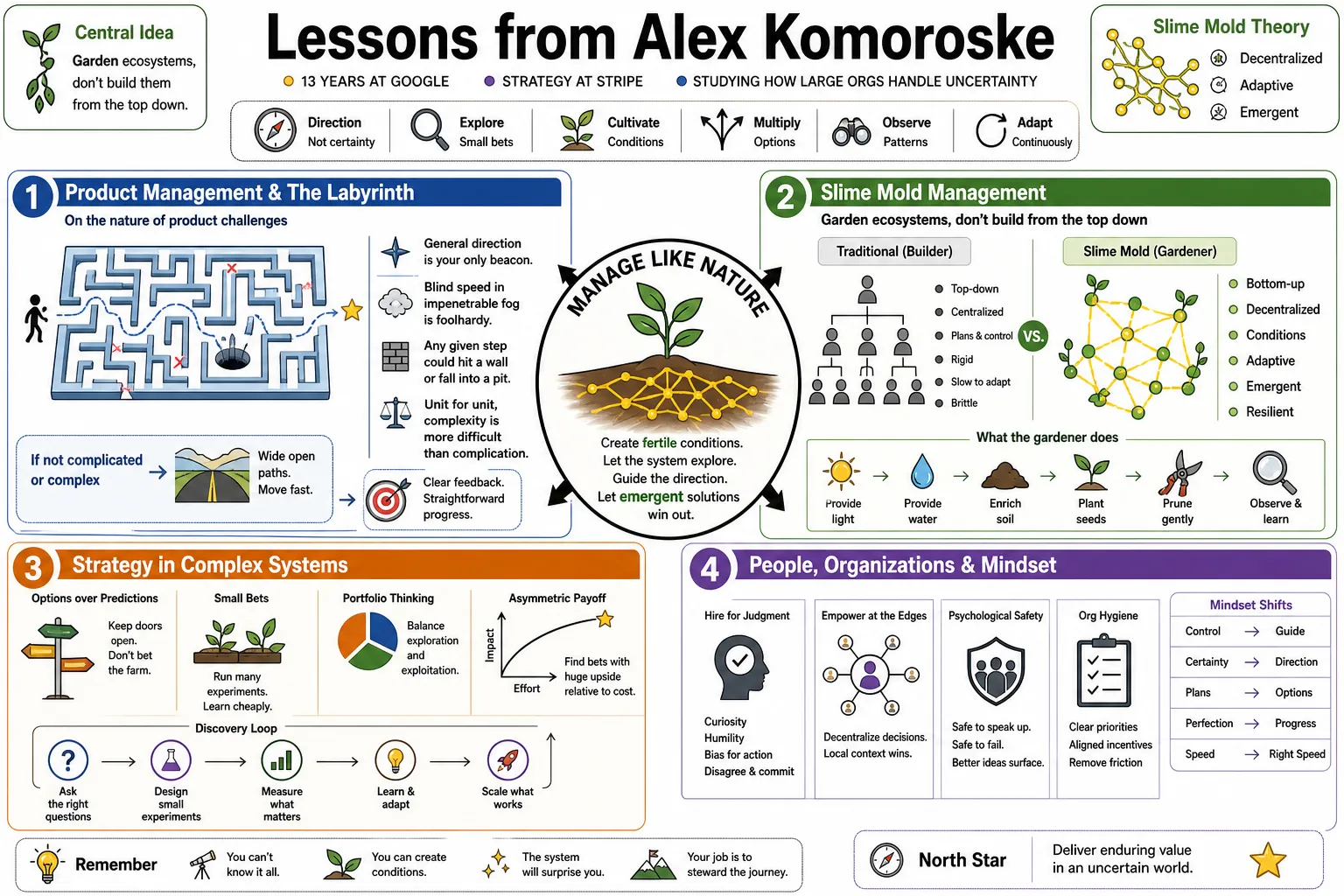
Part 1: Product Management & The Labyrinth
- On the nature of product challenges: Komoroske compares product work to navigating a labyrinth: the goal may be visible while the path is not. — Product Management and the Foggy Labyrinth.
- On blind speed: Moving quickly through an unfamiliar, foggy part of the labyrinth can be reckless even when the team knows its destination. — Product Management and the Foggy Labyrinth.
- On careful navigation: When hazards are hidden, each step should be tentative enough to allow a pause and change of course as new information appears. — Product Management and the Foggy Labyrinth.
- On finding direction: A rough direction toward the goal helps choose among branching paths when the exact route remains unknown. — Product Management and the Foggy Labyrinth.
- On the difficulty of ambiguity: He distinguishes complication, with many visible constraints, from complexity, where uncertainty hides important walls and hazards; the latter can be harder per unit of work. — Product Management and the Foggy Labyrinth.
- On clear problem spaces: For a genuinely simple, familiar and unobstructed problem, his advice is to move quickly instead of over-deliberating. — Product Management and the Foggy Labyrinth.
- On the origins of uncertainty: Novel problem spaces create complexity because relevant constraints have not yet been discovered. — Product Management and the Foggy Labyrinth.
- On decreasing friction: Exploration, guides and transferable prior experience can lift some of the fog, making later work more tractable. — Product Management and the Foggy Labyrinth.
- On practical PM skills: A team can turn some uncertainty into manageable complication by surfacing concrete constraints, while still recognizing that other constraints remain hidden or intangible. — Dinosaur Bones and Laser Beams.
- On adapting tactics: The right mode of action depends on the mix of complication and complexity: execution speed helps in known terrain, while careful judgment matters in unknown terrain. — Product Management and the Foggy Labyrinth.
Part 2: Slime Molds & Organizational Dynamics
- On corporate reality: Komoroske uses a slime-mold analogy for organizations with autonomous contributors and no single controller directing every local action; he treats it as an organizational model, not literal biology. — Clearer Thinking Interview.
- On embracing the organism: He argues that organizations with substantial autonomy are easier to work with when their emergent behavior is acknowledged rather than fought. — Smart Friends: Alex Komoroske.
- On coordination headwinds: Coordination costs rise as an organization grows, even when people are competent and collaborative, because priorities, dependencies and information are distributed. — Clearer Thinking Interview.
- On self-organization: When outcomes are uncertain, bottom-up experiments can find promising paths that a central plan would miss; leaders can then invest more in what begins to work. — Clearer Thinking Interview.
- On misdiagnosing issues: Treating an emergent organization as a fully controllable machine obscures the coordination dynamics produced by autonomous teams. — Clearer Thinking Interview.
- On organizational kayfabe: Komoroske uses “organizational kayfabe” for beliefs or plans that members know are imperfect yet act as if they are true; he cautions that this can support coordination or drift far from ground truth. — Smart Friends: Alex Komoroske.
- On centralized planning limits: Central plans can be less useful in uncertain environments than creating conditions for many local bets and amplifying the ones that gain traction. — Clearer Thinking Interview.
Part 3: Gardening vs. Building
- On distinct mindsets: His builder-and-gardener parable contrasts assembling inert materials through direct effort with tending living seeds whose growth can exceed the gardener’s own output. — The Magic of Acorns.
- On relinquishing control: Komoroske says gardening a system means influencing something alive, not controlling all of its outcomes. — Smart Friends: Alex Komoroske.
- On interacting with systems: He favors working with a system’s existing dynamics rather than assuming a leader can impose every outcome directly. — Smart Friends: Alex Komoroske.
- On the Saruman archetype: His Saruman archetype represents visible, forceful leadership that mobilizes people behind a confident plan; he presents it as powerful but distinct from gardening. — The Sarumans and the Radagasts.
- On the Radagast archetype: His Radagast archetype creates influence by seeing potential in others and helping it grow, often without taking visible credit for the result. — The Sarumans and the Radagasts.
- On platform coevolution: A platform and its ecosystem coevolve; Komoroske advises shaping the conditions in which participants can create value rather than treating the platform as a static top-down product. — Boundaryless Podcast.
- On farming miracles: He calls the gardener’s work “farming miracles”: repeatedly creating conditions in which valuable, hard-to-predict outcomes can emerge. — Smart Friends: Alex Komoroske.
Part 4: The Adjacent Possible
- On defining the concept: The “adjacent possible” is the limited set of next actions close enough to the current position that success is highly plausible. — The Iterative Adjacent Possible.
- On the constraints of reality: Current constraints and growing uncertainty restrict how far ahead a person or team can reliably plan. — The Iterative Adjacent Possible.
- On iterative hope: A small adjacent possible is not a one-time ceiling: after each viable step, new options come within reach. — The Iterative Adjacent Possible.
- On avoiding moonshots: A large heroic leap combines uncertainty about whether the distant target is right with uncertainty about whether it can be reached at all. — The Iterative Adjacent Possible.
- On incremental progress: Taking smaller steps lets a team learn and revise later choices as the fog clears, rather than locking in a long chain of guesses now. — The Iterative Adjacent Possible.
- On identifying bad plans: Komoroske questions plans that depend on a giant near-term leap; he favors steps that are actually available under present constraints. — Clearer Thinking Interview.
Part 5: Complexity vs. Complication
- On different rewards: When the route and hazards are known, a complicated problem can reward organization, velocity and execution. — Product Management and the Foggy Labyrinth.
- On thoughtful action: When important constraints remain hidden, a complex problem rewards judgment, thoughtfulness and willingness to reconsider. — Product Management and the Foggy Labyrinth.
- On problem framing errors: Pretending a novel, complex space is merely a known execution problem can lead a team to move fast into hidden obstacles. — Product Management and the Foggy Labyrinth.
- On distilling issues: Mapping concrete and initially hidden constraints can convert part of a complex challenge into a tractable constraint-satisfaction problem. — Dinosaur Bones and Laser Beams.
- On hazard assessment: In the labyrinth metaphor, complication counts visible twists and hazards; complexity describes the fog that conceals where they are. — Product Management and the Foggy Labyrinth.
- On managing ambiguity: Komoroske recommends tentative moves and reassessment where hazards are not yet visible, instead of irreversible speed through fog. — Product Management and the Foggy Labyrinth.
- On project management limits: Processes and top-down execution work well for repeatable problems, but cannot substitute for learning and local experimentation when the answer is not yet known. — Clearer Thinking Interview.
Part 6: Systems Thinking & Ecosystems
- On finding engines: He advises finding an existing source of intrinsic energy in people, teams or ecosystems and helping it compound, rather than depending indefinitely on heroic outside effort. — The Energy of Human-Scale Systems.
- On unintended consequences: Interventions in human-scale systems meet friction and feedback; before pushing harder, examine what energy and constraints are already operating. — The Energy of Human-Scale Systems.
- On open ecosystems: Open ecosystems can attract distributed participation when no single actor has arbitrary power over others; openness also brings messiness and limits to control. — The Meaning of Open.
- On tight feedback loops: In uncertain organizations, short feedback cycles help teams notice which local experiments are working and shift effort toward them. — Clearer Thinking Interview.
- On removing friction: Removing a recurring source of friction can let a system’s existing energy accomplish more than another one-off push. — The Energy of Human-Scale Systems.
- On observing actual behavior: To understand a large organization, Komoroske looks at actual coordination patterns and the gap between official plans and ground truth. — Smart Friends: Alex Komoroske.
- On local incentives: Ecosystem behavior emerges from participants’ incentives; a strategy should account for how each participant experiences the distribution of power and value. — The Meaning of Open.
- On sustainable growth: A durable ecosystem needs an intrinsic, self-reinforcing reason for participants to keep contributing; ongoing manual subsidy alone is not the same thing. — The Self-Sustaining Flame.
- On systemic inertia: Once an organization has optimized around a growing product, its processes can make it slow to explore the next opportunity as the original growth curve matures. — Clearer Thinking Interview.
Part 7: Intentional Technology & Artificial Intelligence
- On intention alignment: Komoroske argues for technology aligned with what a person intends to do over time, not simply what keeps them engaged in the moment. — Every AI & I Transcript.
- On new manifestos: The Resonant Computing Manifesto, which Komoroske helped draft, proposes private, dedicated, plural, adaptable and prosocial software as starting design principles. — Resonant Computing Manifesto.
- On avoiding enshittification: He argues that platform design should favor trust and user benefit over extracting ever more attention or value from locked-in users. — Riskgaming: Reverse Enshittification.
- On open vs closed networks: Komoroske favors ecosystems where participants can switch, interoperate and retain agency rather than depending on a single gatekeeper’s goodwill. — The Meaning of Open.
- On AI as a collaborator: He sees AI as a way to make personal tools more adaptive and open-ended when the software serves the user’s own context and goals. — Every AI & I Transcript.
- On digital spaces: He asks for digital environments that support attention, understanding and connection rather than optimizing only for clicks or time spent. — What Got Lost in the Optimization.
- On AI complexity: Komoroske expects experimentation within ecosystems to uncover new forms of value from general language models, rather than assuming one company can plan every useful application in advance. — Smart Friends: Alex Komoroske.
- On technological advantage: AI lowers the cost of making tailored software, potentially bringing previously uneconomic personal tools within reach; he cautions that existing app silos could still trap their value. — Why Aggregators Ate the Internet.
- On user agency: His proposed computing environment keeps personal context under the user’s control and lets tools adapt to a person’s specific needs. — Every AI & I Transcript.
- On resonant and hollow software: He distinguishes hollow experiences, which may gratify briefly but leave regret, from resonant experiences that remain nourishing when examined more closely. — Riskgaming: Reverse Enshittification.
Part 8: Mindset, Growth, & Iteration
- On public thinking benefits: Komoroske publishes “Bits and Bobs” as weekly reflections, sharing short observations distilled from his notes. — Komoroske Weekly Reflections.
- On updating mental models: An iterative plan preserves room to update later decisions when new information and circumstances change the available options. — The Iterative Adjacent Possible.
- On finding influence: He argues that influence in a complex organization requires understanding both its internal logic and how it looks from outside; being wholly captured by either view limits leverage. — Smart Friends: Alex Komoroske.
- On staying calm in ambiguity: Acknowledging uncertainty is uncomfortable, but Komoroske argues that it does not prevent a person from choosing useful near-term action. — The Iterative Adjacent Possible.