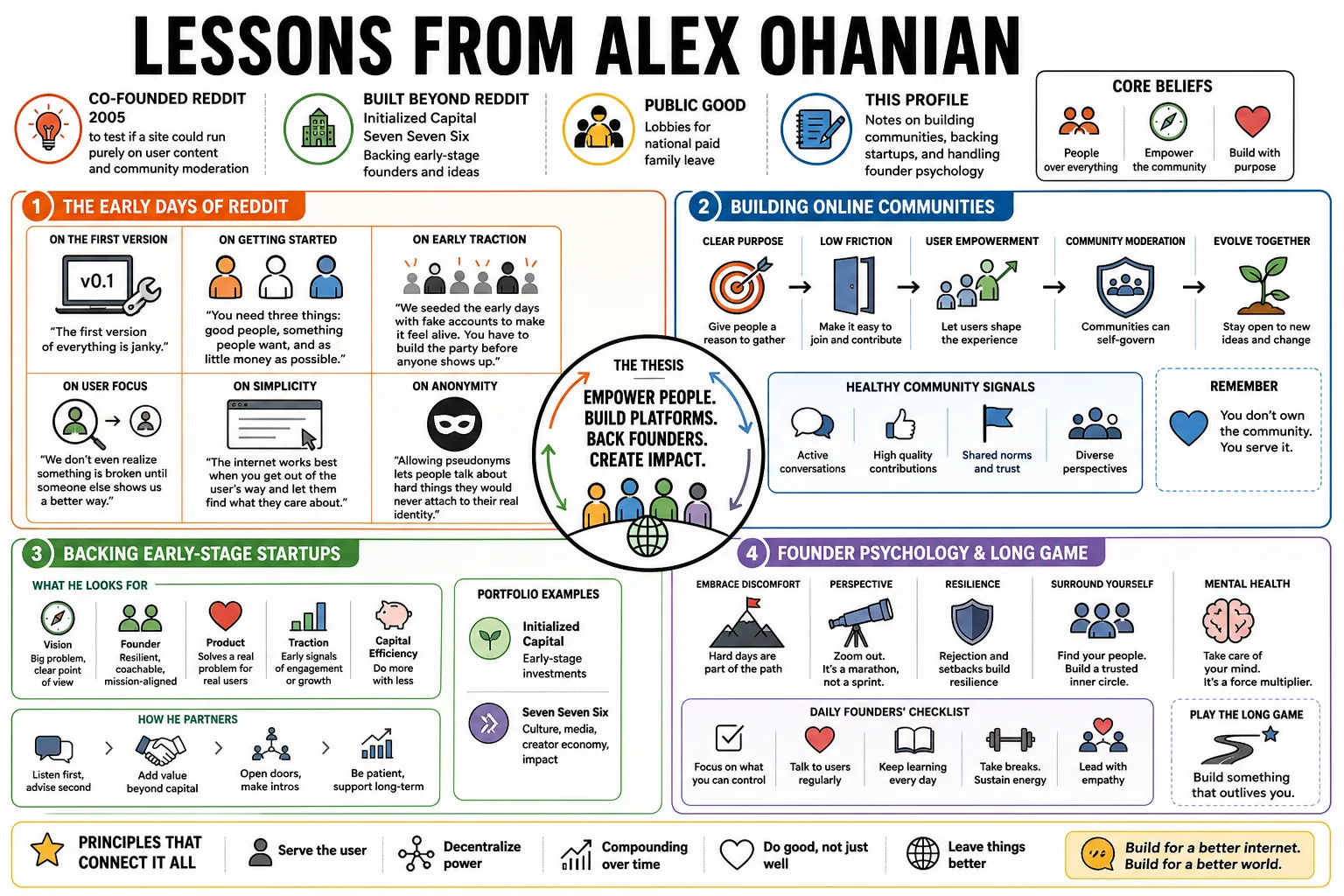
Lessons from Alex Ohanian
Alexis Ohanian co-founded Reddit with Steve Huffman in 2005. He later co-founded Initialized Capital and founded Seven Seven Six, while advocating paid family leave and investing in women’s sports. These lessons examine his directly documented views on communities, startups, investing and fatherhood. — Capital Allocators Interview.
Part 1: The Early Days of Reddit
- first versions: Launch a useful first version even if it is rough; real use reveals what to improve. — MasterClass: Nailing Execution.
- early traction: Before Reddit had an audience, its founders submitted links under different usernames so the site had something to show new visitors. — SXSW AMA Transcript.
- user focus: Ask founders for recent customer feedback and look at how they responded, not just at their headline growth numbers. — Tim Ferriss Show Transcript.
- simple curation: Reddit combined user-submitted links, voting, and comments so communities could surface what they found relevant. — YC Startup School Radio.
- pseudonymity: Allowing pseudonyms can make space for people to discuss subjects they cannot safely raise under their real names. — Walker Art Center Interview.
- competing for attention: Online users can move on quickly when a product fails to serve them; build something they actually want to return to. — Tim Ferriss Show Transcript.
- community voting: Ohanian saw voting as a way for Reddit users to help sort and surface links, not as a guarantee of truth. — YC Startup School Radio.
- rejection as motivation: After a Yahoo executive dismissed Reddit as a rounding error, Ohanian kept the remark as motivation while the company grew. — Tim Ferriss Show Transcript.
- manual growth: Ohanian cold-emailed bloggers and members of his earlier forum, then participated actively in Reddit comments to build an initial audience. — Capital Allocators Interview.
Part 2: Community Building
- hosting a community: Treat early online community-building like hosting a gathering: connect people and start useful conversations instead of talking only about the product. — Capital Allocators Interview.
- moderator tools: As Reddit grew beyond its founders’ ability to moderate a handful of communities, it had to build tools for community moderators. — Capital Allocators Interview.
- community norms: As a platform grows, explicit values and moderation practices become more important than relying on founders to judge every situation personally. — Capital Allocators Interview.
- platform governance: A privately run social platform must decide which communities it will host and enforce those boundaries as it scales. — Capital Allocators Interview.
- user-created culture: Reddit’s users developed behaviors and communities its founders could not have planned in advance; leave room for that emergence. — Bankless Interview.
- niche communities: Small interest communities can become durable places for people to share expertise and form connections; Ohanian drew on his own college forum when building Reddit. — Capital Allocators Interview.
- organic growth first: Do not rely on paid acquisition before showing that people want the product and return to use it. — Tim Ferriss Show Transcript.
- verifiably human spaces: As AI-generated content grows, Ohanian expects communities that can demonstrate real human participation to become more valuable. — Capital Allocators Interview.
Part 3: The Startup Hustle
- execution over secrecy: An idea by itself is not a moat; the work of turning it into a useful product matters more. — MasterClass: Nailing Execution.
- care in product work: Ohanian urges founders to care enough to respond to users and make even routine product touchpoints feel human. — Tim Ferriss Show Transcript.
- one life: Ohanian wrote “LIVES REMAINING: 0” on his teenage bedroom wall; later loss reinforced his focus on using finite time well. — Zero Lives Remaining.
- ideas into action: Ohanian defines entrepreneurship as having ideas and doing the work to bring them into the world. — MasterClass: Entrepreneurial Mindset.
- speed with learning: Move quickly enough to put work in users’ hands and adapt from what they do, without treating speed alone as proof of success. — MasterClass: Nailing Execution.
- press as a tool: Media coverage can help a startup, but it is not the goal; building a strong business matters more than yesterday’s press. — MasterClass: Networking and the Media.
- pivoting after failure: The first mobile-food idea he and Huffman pitched did not work at the time; they changed direction and built Reddit. — Capital Allocators Interview.
Part 4: Early Stage Investing
- founder evaluation: At the earliest stage, Ohanian puts substantial weight on a founder’s communication, resilience, and commitment to the problem. — Capital Allocators Interview.
- investor support: Seven Seven Six built software for introductions and founder support so its team could make help more timely and measurable. — Capital Allocators Interview.
- market timing: Even a capable team can be early: Ohanian cites his rejected mobile-food concept as a case where the technology and market timing were not ready. — Capital Allocators Interview.
- measurable investor value: Ohanian argues venture firms should show founders concrete service—response times, introductions, workshops and tools—instead of generic promises. — Capital Allocators Interview.
- community as a signal: Ohanian looks at engaged early communities when evaluating new markets, as he did with Reddit’s Bitcoin discussion before investing in Coinbase. — Bankless Interview.
- clear pitching: At least one founder should be able to explain the idea plainly and compellingly to investors, hires, and customers. — Capital Allocators Interview.
- women’s sports as a market: Ohanian invested in women’s sports because audience attention and athlete excellence suggested commercial demand that valuations had missed. — Capital Allocators Interview.
- live sports in the AI age: He expects live human sport to gain value as generated digital content becomes abundant because the performance cannot simply be made on demand. — iConnections Sports Interview.
Part 5: Leadership and Team Dynamics
- scaling values: Use explicit company values to scale founder judgment, then revisit those values as the organization changes. — Capital Allocators Interview.
- direct feedback: Give performance feedback promptly, specifically and compassionately instead of allowing problems to linger. — Capital Allocators Interview.
- building the team: Ohanian credits experienced operators with helping him build a stronger performance culture as the company scaled. — Capital Allocators Interview.
- diverse perspectives: Ohanian has argued that leadership should include perspectives absent from the original founding team, including when he asked for a Black replacement on Reddit’s board. — Capital Allocators Interview.
- board resignation: In 2020, Ohanian resigned from Reddit’s board in protest of its hosting hateful communities and asked the company to replace him with a Black director. — Capital Allocators Interview.
Part 6: Fatherhood and Paid Leave
- paid family leave: Ohanian has advocated paid family leave at company and federal-policy levels, drawing on his own experience taking leave after his daughter’s birth. — Fast Company Paternity-Leave Interview.
- leaders using leave: When executives take the parental leave their companies offer, they help make it normal for other employees to do the same. — Ohanian on Paternity Leave.
- changed priorities: Fatherhood changed how Ohanian allocates his time; he has said he schedules work around his family rather than treating family as an afterthought. — Fast Company Paternity-Leave Interview.
- against hustle culture: Ohanian rejects “hustle porn”: constant work at the expense of rest and family is not a sound model for founders. — Fast Company Paternity-Leave Interview.
- taking leave: He took months of paternity leave after his daughter’s birth and urges fathers to use the leave available to them. — Ohanian on Paternity Leave.
- advocating policy: Ohanian has pushed employers and lawmakers to expand paid family leave rather than leave access to an individual manager’s discretion. — Fast Company Paternity-Leave Interview.
- fatherhood and ambition: Ohanian says fatherhood changed his sense of legacy and increased his ambition to make a positive long-term impact. — Entrepreneur Work-Life Interview.
Part 7: Crypto and Digital Ownership
- digital ownership: Ohanian argues that online users should be able to own and transfer digital assets rather than merely rent access from platforms. — Bankless Interview.
- global crypto communities: The global, noncentralized community around Bitcoin attracted Ohanian before he made an early Coinbase investment. — Bankless Interview.
- mainstream usability: For web3 applications to reach ordinary users, Ohanian says the experience must be simple enough that they need not understand the underlying protocols. — Bankless Interview.
- portable digital receipts: Ohanian describes digital receipts as a way for people to carry evidence of what they own or have created across online services. — Bankless Interview.
- creator participation: Ohanian sees ownership tools as a way for online contributors to share in the value of communities and work they help create. — Bankless Interview.
Part 8: Mindset and Resilience
- founder mental health: Ohanian has written about depression while building Reddit and urges struggling founders to speak with someone instead of treating distress as a badge of commitment. — Zero Lives Remaining.
- open Internet access: Ohanian argues that an open Internet lowers traditional gatekeeping barriers and lets more people build and share ideas. — Without Their Permission Excerpt.
- optimism and building: Ohanian remains optimistic that people can build a better, more open Internet, while acknowledging that protecting it requires work. — Built In LA Interview.
- self-worth beyond a startup: Ohanian cautions founders not to equate their personal worth with a startup’s outcome; a failed company does not end their ability to build again. — Ohanian on Startup Failure.
- learning to program: Ohanian points to the ability to learn programming online without traditional credentials as one example of the Internet lowering barriers to creation. — Without Their Permission Excerpt.
- dynamic work-life balance: Ohanian describes work-life balance as a shifting allocation of attention, not a fixed 50/50 split every day. — Entrepreneur Work-Life Interview.