Alex Schultz is Meta’s Chief Marketing Officer and VP of Analytics. His earlier work included growth and analytics roles at Facebook and eBay; this profile focuses on his publicly stated lessons rather than treating later summaries as evidence. — Alex Schultz — About.
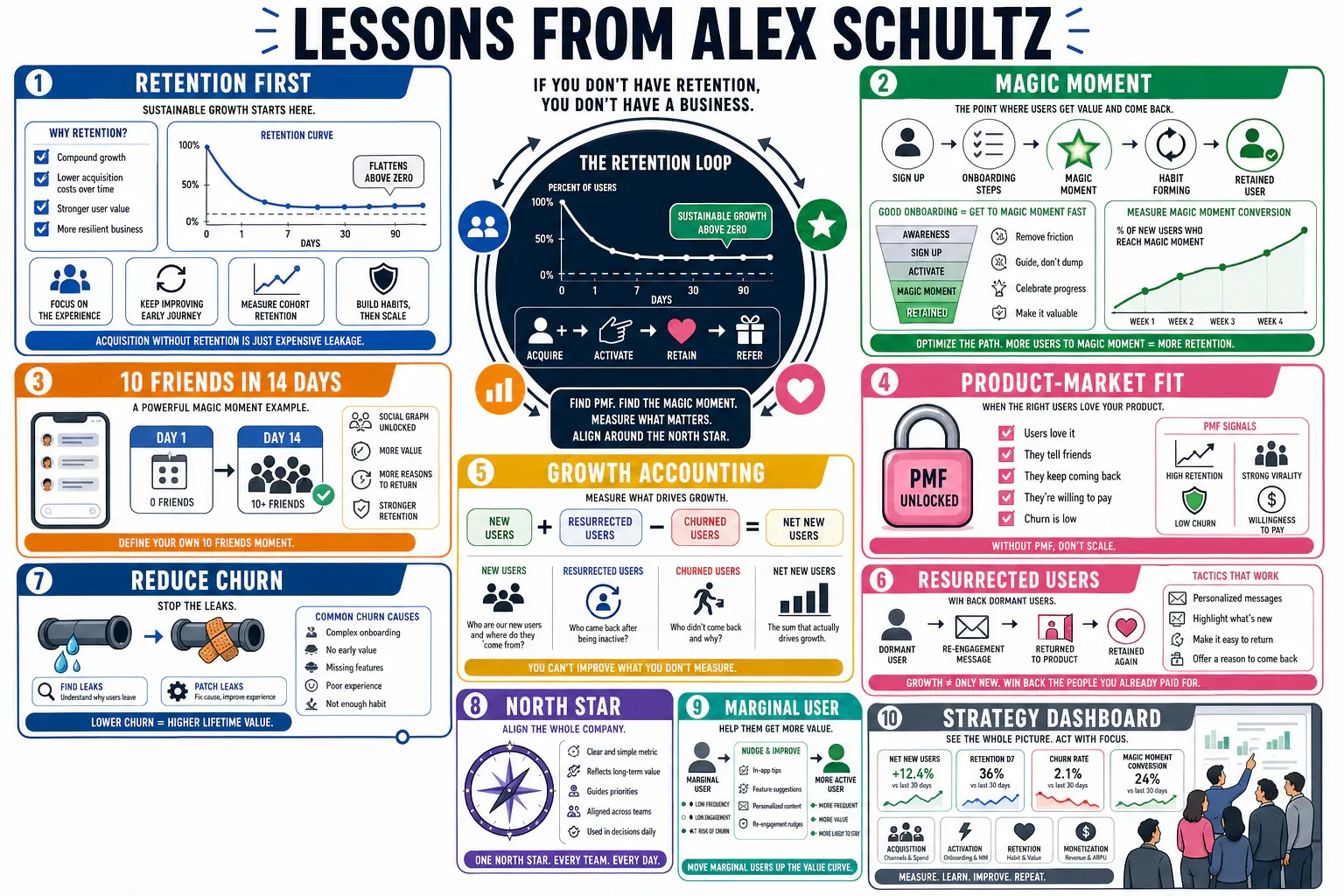
On Growth and Retention: The Bedrock of Success
Schultz treats retention as an early test of whether a product creates lasting value, before a company pours effort into acquisition. — Y Combinator Growth Lecture.
- Retention before acquisition: Schultz places retention ahead of acquisition because new users cannot sustain growth if existing users quickly leave. — Y Combinator Growth Lecture.
- A product worth returning to: Strong growth execution cannot compensate for a product that people do not want to keep using. — Y Combinator Growth Lecture.
- Look for a flattening retention curve: For a suitable product, a cohort-retention curve that levels off above zero can be evidence that a durable group of users finds value; the threshold depends on the market. — Y Combinator Growth Lecture.
- Do not mistake acquisition for fit: Schultz warns that startups can believe they have product-market fit before their retention evidence supports it. — Y Combinator Growth Lecture.
- Establish fit before growth tactics: He advises startups to focus on product-market fit before hiring for growth or pursuing virality tactics. — Y Combinator Growth Lecture.
- Account for churn and resurrection: Schultz credits Danny Ferrante with growth accounting, which directs attention not only to acquisition but also to users who leave and return. — Why Most Companies Get Conversion Wrong.
- Watch the large flows beneath net growth: Schultz recalls that at Facebook the churn and resurrection flows could each be about twice new acquisition, making net growth alone an incomplete picture. — Why Most Companies Get Conversion Wrong.
- Look beyond acquisition: His account of Facebook growth work says that reducing churn and bringing people back can be more consequential than an acquisition-only strategy. — Why Most Companies Get Conversion Wrong.
- Use the full growth equation: Schultz presents net growth as acquisitions minus churn plus resurrections and credits Danny Ferrante for the framework. — Why Most Companies Get Conversion Wrong.
- Retention benchmarks depend on the product: Schultz cautions that the terminal retention needed for a viable business differs by vertical; his 2014 examples are context, not universal current benchmarks. — Y Combinator Growth Lecture.
On the "Magic Moment" and User Experience
His growth lecture connects onboarding to the first experience that makes a product valuable for each kind of user. — Y Combinator Growth Lecture.
- Get users to the magic moment: Find the experience that demonstrates the product’s value to a user, then help new users reach it quickly. — Y Combinator Growth Lecture.
- Separate the moment from its proxy: For early Facebook, seeing friends’ faces was the meaningful experience; connecting to ten friends within fourteen days was an activation target used to help users reach it. — Y Combinator Growth Lecture.
- Define the moment for each side: Schultz uses Airbnb guests and hosts and eBay buyers and sellers to show that a product’s pivotal first experience can differ by user role. — Y Combinator Growth Lecture.
- Build differently for marginal users: Schultz distinguishes improving the product for committed power users from helping less-engaged or marginal users become active. — Y Combinator Growth Lecture.
- Do not confuse power users with the growth bottleneck: The most active users already return; for growth, Schultz directs attention to users who have not yet formed the habit. — Y Combinator Growth Lecture.
On Strategy, Data, and Metrics
Schultz distinguishes a company’s goal from the metric that tracks it: a north star should give teams a direction, while data helps test progress. — 20VC Growth Interview.
- Let data describe the goal: In a later interview Schultz distinguishes a company’s north-star goal from the metric used to monitor it: metrics inform strategy but are not the strategy itself. — 20VC Growth Interview.
- Leadership must set direction: Schultz argues that a company leader needs to give teams a clear north star rather than leave each group to infer the goal. — Y Combinator Growth Lecture.
- Choose a business-specific north star: The right growth measure depends on what the business creates for users, not a metric copied from another company. — Y Combinator Growth Lecture.
- Facebook’s monthly-active-user focus: Schultz recounts Zuckerberg’s use of monthly active users as a common internal and external measure at Facebook. — Y Combinator Growth Lecture.
- Alignment works through influence: As organizations grow, leaders cannot direct every action; a shared north star helps teams coordinate decisions. — Y Combinator Growth Lecture.
- Make priorities explicit: Schultz notes that what matters most is not automatically obvious to everyone in a company, so leaders must communicate priorities. — Y Combinator Growth Lecture.
- Measure behavior that represents value: Schultz’s eBay example shows why counting activated buyers or sellers can be more informative than counting registrations alone. — Why Most Companies Get Conversion Wrong.
- Explain what measurement can and cannot show: Schultz favors combining experimental evidence with broader marketing models, while being candid about the limits of each method. — The CEO’s Guide to Marketing Transcript.
- Make analytics useful for decisions: Schultz’s conversion examples show analytics serving product decisions by identifying where users actually become active or drop out. — Why Most Companies Get Conversion Wrong.
On Marketing: Performance, Brand, and Creative
Schultz resists treating brand and performance marketing as separate absolutes; impact depends on execution and on how it is measured. — The CEO’s Guide to Marketing Transcript.
- Performance is possible but difficult: Schultz says many kinds of marketing can produce results when executed well, although much marketing does not; the existing quotation incorrectly joins his words with host Seth Matlins’s. — The CEO’s Guide to Marketing Transcript.
- Marketing is a difficult craft: Schultz emphasizes that effective marketing requires hard choices about creative work and delivery, not just spending more. — The CEO’s Guide to Marketing Transcript.
- Creative and delivery both matter: He describes the challenge of making strong creative and showing the right message to the right person at the right time. — The CEO’s Guide to Marketing Transcript.
- Do not assume a linear customer funnel: Schultz questions whether an individual customer’s path was ever as linear as standard funnel diagrams imply. — The CEO’s Guide to Marketing Transcript.
- Calibrate media-mix models with experiments: He regards media-mix modeling as important at scale but stresses the need to ground and recalibrate it with experiments. — The CEO’s Guide to Marketing Transcript.
- Founders often understand marketing: Schultz says founder CEOs can be naturally good at marketing because they know the product and its purpose intimately. — The CEO’s Guide to Marketing Transcript.
- Start with the product: Host Seth Matlins says that product is where marketing starts; Schultz agrees and argues for a genuinely strong product. The phrase should not be quoted as Schultz’s own. — The CEO’s Guide to Marketing Transcript.
- The promise of relevant online advertising: When appointed Meta’s CMO in 2020, Schultz said he believed online marketing could economically empower businesses and make ads more relevant and less annoying; this is his stated belief, not a proven universal outcome. — The Drum CMO Appointment Report.
- Explain a new category: In 2021 Schultz described Meta’s marketing task as making the metaverse concept understandable and salient; this records an aim at the time, not the result. — Forbes Meta Rebrand Interview.
- A new name needs substance: Schultz argued that a rebrand needs a substantive idea behind its name; his point was about the rationale for Meta’s 2021 change. — Forbes Meta Rebrand Interview.
On Leadership, Team Structure, and Culture
His team-structure advice changes with company scale: early founders own growth, while a large multi-product company can combine central expertise with product-specific teams. — 20VC Growth Interview.
- Delegate growth at the right stage: Schultz describes specialist central and product growth teams at Meta while cautioning that early startups should not delegate company growth too soon. — 20VC Growth Interview.
- The startup is the growth team: For an early startup, Schultz says the whole company should work on growth and the CEO should lead it. — Y Combinator Growth Lecture.
- Run repeated growth experiments: Schultz emphasizes sustained experimentation and follow-through; the existing combative quotation is unnecessary to retain the principle. — Y Combinator Growth Lecture.
- Execution speed compounds learning: Looking back on his team, Schultz emphasizes hard work and fast execution more than exceptional cleverness. — Y Combinator Growth Lecture.
- Growth requires a deliberate choice: Schultz’s conclusion treats growth as something a company chooses to work for, not an automatic consequence of launching a product. — Y Combinator Growth Lecture.
On International Growth and Tactics
Schultz uses Facebook’s international expansion to explain why language support and reusable infrastructure matter when a product grows beyond its original market. — Y Combinator Growth Lecture.
- Build translation capacity for expansion: Schultz describes Facebook investing in scalable translation infrastructure to serve users across languages, as an account of that period. — Y Combinator Growth Lecture.
- Treat SEO advice as historical context: In his 2014 lecture Schultz emphasized useful pages, authoritative inbound links, and internal linking. Search practices change, so this should not be presented as a timeless ranking rule. — Y Combinator Growth Lecture.
- Target notifications to marginal users: Schultz advises segmenting email and other notifications so outreach helps less-engaged users return instead of merely messaging frequent users. — Y Combinator Growth Lecture.
- Repeated creative loses force: Schultz observes diminishing response when audiences repeatedly see the same message and recommends refreshing or testing creative. — Y Combinator Growth Lecture.
- State the 2021 rebrand rationale accurately: Schultz said in 2021 that Meta’s renaming was not an attempt to run away from Facebook; this is his stated intent, not proof of public perception. — Forbes Meta Rebrand Interview.
Learn more:
- Y Combinator Lecture 6: Growth with Alex Schultz
- Alex Schultz: Why Most Companies Get Conversion Wrong
- 20VC: Meta CMO Alex Schultz on Growth and Marketing in the AI Era
- Hachette UK: Click Here by Alex Schultz
- The CEO’s Guide to Marketing: Alex Schultz on Measuring for Incrementality and Impact (Transcript)
- Forbes: Alex Schultz on Facebook Becoming Meta
- The Drum: Who Is Facebook’s New Marketing Chief Alex Schultz?
- Alex Schultz: About