Alex Smola is a machine-learning researcher, co-founder and CEO of Boson AI. His work spans scalable learning systems, kernel methods and probabilistic modeling. He previously helped build AI and machine-learning tools at AWS and coauthored the Dive into Deep Learning textbook. — Alex Smola — Biography.
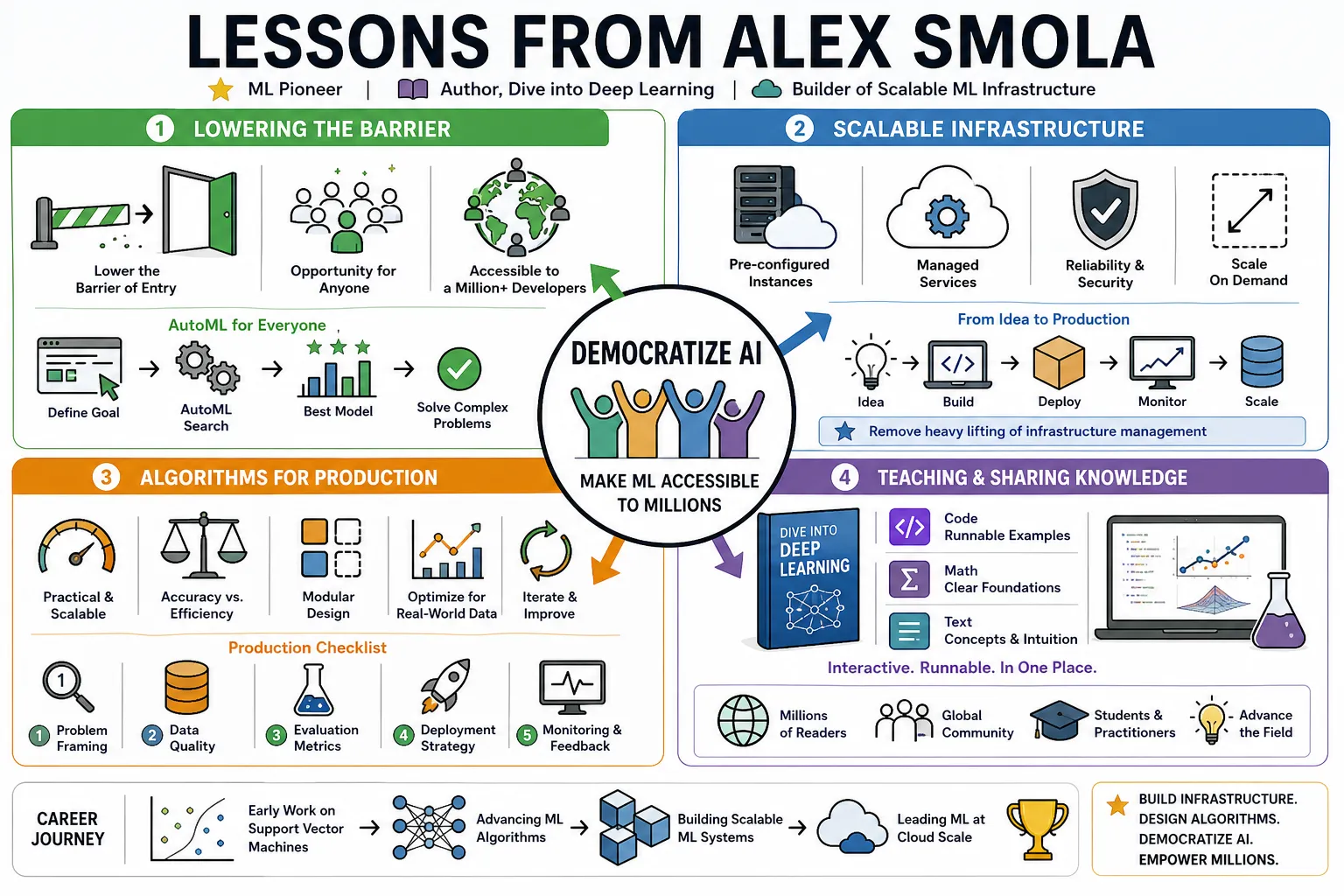
Part 1: The Democratization of AI
- On lowering the entry barrier: Smola saw a major opportunity in making machine learning accessible to people who wanted to use it, not only to specialist researchers. — AWS Research Spotlight: Alex Smola.
- On the million-developer goal: His stated AWS-era goal was to make machine learning available to more than a million developers through easier tools and training. — AWS Research Spotlight: Alex Smola.
- On managed tools: Smola distinguished tools for different skill levels, using a managed computer-vision service as an example of a lower-friction entry point. — AWS Research Spotlight: Alex Smola.
- On runnable teaching: The coauthored Dive into Deep Learning combines mathematical explanation with runnable notebooks so readers can test ideas rather than only read about them. — Dive into Deep Learning — Preface.
- On rented compute: Dive into Deep Learning explains how hosted notebooks and rented accelerators can let students experiment without owning a dedicated GPU machine. — Dive into Deep Learning — Tools for Deep Learning.
- On developer experience: Smola argued for tools that make experimentation easier and documentation that developers can understand. — AWS Research Spotlight: Alex Smola.
- On interactive learning: The book uses executable notebooks so readers can vary parameters and observe the result; the old claim that notebooks “revolutionized” all AI teaching is unnecessary. — Dive into Deep Learning — Preface.
- On matching the user’s level: Smola advocates different interfaces for different users, from managed services to tools that let data scientists experiment directly. — AWS Research Spotlight: Alex Smola.
- On cloud access: The textbook includes hosted and cloud-computing routes for running exercises, reducing the need to assemble local hardware first. — Dive into Deep Learning — Tools for Deep Learning.
Part 2: Systems for Scalable Machine Learning
- On the parameter server: Smola and coauthors describe workers updating shared parameters through server nodes that support asynchronous communication across a distributed ML system. — Scaling Distributed Machine Learning with the Parameter Server.
- On communication costs: In multi-GPU training, moving gradients or parameters between devices can limit scaling, so the system must account for transfer cost rather than count only arithmetic. — Dive into Deep Learning — Multi-GPU in Practice.
- On fault tolerance: The parameter-server framework explicitly supports continuous fault tolerance and elastic scale when training over many machines. — Scaling Distributed Machine Learning with the Parameter Server.
- On asynchronous updates: The paper allows flexible consistency and asynchronous communication; it does not claim such updates always improve convergence. — Scaling Distributed Machine Learning with the Parameter Server.
- On reducing communication: The parameter-server work includes compressed or selective communication to reduce expensive transfers in distributed training. — Scaling Distributed Machine Learning with the Parameter Server.
- On choosing parallelism: The coauthored performance chapter distinguishes splitting batches across devices from sharding a model that cannot fit on one accelerator. — Dive into Deep Learning — Computational Performance.
- On the memory hierarchy: Smola and coauthors emphasize that moving bytes through device memory and caches can dominate an operation even when arithmetic throughput is high. — Dive into Deep Learning — The Performance Model.
- On feeding accelerators: The performance model asks whether data movement or arithmetic is limiting a workload; a fast GPU cannot reach peak compute if bytes are the binding resource. — Dive into Deep Learning — The Performance Model.
- On graph-specific computation: Smola’s graph-learning work uses graph-centric abstractions because relational structure and message passing are not naturally expressed as one dense matrix operation. — Deep Graph Library: A Graph-Centric Package for Graph Neural Networks.
Part 3: Deep Learning and Frameworks
- On choosing useful tools: Smola’s AWS interview and later MXNet work prioritize making tools usable for developers; the old first-person “anything is OK” quotation was not verified. — AWS Research Spotlight: Alex Smola.
- On imperative debugging: MXNet documentation explains that imperative execution shows intermediate values immediately, making model iteration easier than a graph that must be run before inspection. — Apache MXNet — Why MXNet?.
- On hybrid execution: Smola’s Gluon tutorial presented hybridization as a way to combine an imperative research interface with symbolic execution for deployment. — MIT CSAIL — Smola’s MXNet Gluon Tutorial.
- On compiler-aware frameworks: The coauthored performance chapter shows how graph compilation can fuse operations and reduce dispatch and memory-transfer overhead. — Dive into Deep Learning — Compute Graphs and Compilation.
- On automatic differentiation: The coauthored textbook demonstrates automatic differentiation as a way to calculate gradients from a recorded computation instead of manually deriving each network’s backward pass. — Dive into Deep Learning — Automatic Differentiation.
- On reusable models: The textbook’s tools chapter points readers to model ecosystems and pretrained weights so experiments can start from existing components. — Dive into Deep Learning — Tools for Deep Learning.
- On flexible execution: MXNet’s original interface provided both imperative and symbolic execution, with hybridization to move between prototyping and optimized deployment. — Apache MXNet — Why MXNet?.
- On shape discipline: The textbook explicitly teaches tensor shape and broadcasting rules because mismatched dimensions can invalidate computation before model quality is relevant. — Dive into Deep Learning — Automatic Differentiation.
- On portable computation graphs: The coauthored compilation chapter treats a model graph as an optimization target that can be transformed for different hardware, without claiming one DSL alone solves portability. — Dive into Deep Learning — Compute Graphs and Compilation.
Part 4: Kernel Methods and Support Vector Machines
- On the kernel trick: A positive-definite kernel can let a learning algorithm use inner products in a high-dimensional feature space without explicitly constructing each feature vector. — Kernel Methods in Machine Learning.
- On large margins: Smola’s coauthored kernel review formulates support-vector classification around a separating decision boundary and margin, not just any separating hyperplane. — Kernel Methods in Machine Learning.
- On support vectors: In a support-vector model, selected training examples determine the kernel expansion used for prediction; not every example contributes equally. — Kernel Methods in Machine Learning.
- On RKHS structure: The reproducing-kernel Hilbert-space framework gives a mathematical setting for regularized learning with rich nonlinear functions; it is not a blanket guarantee that every kernel method generalizes. — Kernel Methods in Machine Learning.
- On kernels for discrete data: Smola and Vishwanathan construct efficient kernels for strings and trees, including applications to biological sequences and language structure. — Fast Kernels for String and Tree Matching.
- On regularization: The kernel review explains how regularization controls complexity when learning in very rich, sometimes infinite-dimensional feature spaces. — Kernel Methods in Machine Learning.
- On predictive uncertainty: The coauthored textbook presents Gaussian processes as probabilistic models that provide a distribution over possible functions and predictions, unlike a single point estimate. — Dive into Deep Learning — Introduction to Gaussian Processes.
- On scaling kernels: Smola’s course materials describe low-rank and randomized feature approximations as ways to make kernel methods more practical at larger scale; they are options, not universally necessary. — Alex Smola — Kernels Course.
- On kernel regression: The kernel review covers regression as well as classification through regularized kernel methods; the old unsupported claim that one regression formulation “often performs just as well” is removed. — Kernel Methods in Machine Learning.
Part 5: Graphs, Sequences, and Data Structures
- On graph neural networks: Smola’s coauthored DGL work gives graph-structured data dedicated graph operations and message-passing tools rather than treating every relation as a flat table. — Deep Graph Library: A Graph-Centric Package for Graph Neural Networks.
- On graph representations: The DGL paper describes learned node and edge representations that let graph models use relational information in prediction. — Deep Graph Library: A Graph-Centric Package for Graph Neural Networks.
- On attention: The coauthored textbook explains attention through queries, keys and values, letting a model weight relevant context differently for each query. — Dive into Deep Learning — Queries, Keys, and Values.
- On recurrence: The coauthored sequence-model chapter explains how recurrent networks carry state through a sequence and where long dependencies challenge simple recurrence. — Dive into Deep Learning — Recurrent Neural Networks.
- On transformers: The transformer chapter explains attention-based blocks that process a sequence without the same serial recurrent computation; the old universal speed claim is removed. — Dive into Deep Learning — The Transformer Block.
- On changing relationships: Smola lists temporal models among his application interests; the old categorical claim that all graph models must model temporal dynamics is replaced with the narrower observation that some relationships evolve over time. — Alex Smola — Biography.
- On feature hashing: Smola and coauthors show that hashing can map very large feature spaces into compact representations for large-scale multitask learning. — Feature Hashing for Large Scale Multitask Learning.
- On approximate similarity: Smola explains how random projections can support locality-sensitive hashing and efficient nearest-neighbor search; the old claim that LSH is essential for recommender systems is removed. — Random Projections, Three Ways.
Part 6: Probabilistic Models and Optimization
- On Bayesian computation: Bayesian learning combines prior assumptions with observations to reason about uncertain parameters; the coauthored textbook distinguishes posterior inference from a single point estimate. — Dive into Deep Learning — Bayesian Computation.
- On noisy gradients: The optimization chapter treats stochastic minibatch gradients as less expensive but noisier estimates than full gradients, and discusses their effect on training. — Dive into Deep Learning — Optimization Algorithms.
- On learning-rate schedules: Smola and coauthors show that changing the learning rate over training is a consequential optimization choice; the old “single most important” ranking was not sourced. — Dive into Deep Learning — Schedules.
- On convex foundations: Convexity supplies useful guarantees and vocabulary for optimization, but those guarantees do not automatically carry over to a non-convex deep-network objective. — Dive into Deep Learning — Convex Sets and Functions.
- On approximate inference: Smola’s course materials present variational methods as approximations for inference in large graphical models when exact inference is impractical. — Alex Smola — Large Scale Modeling.
- On hidden structure: His large-scale modeling course uses latent-variable templates for topics, clusters and recommender systems, where unobserved factors help explain observed data. — Alex Smola — Large Scale Modeling.
- On momentum: The coauthored optimization chapter presents momentum as a way to improve progress on ill-conditioned objectives, where one step size otherwise oscillates in steep directions. — Dive into Deep Learning — Optimization Algorithms.
- On second-order tradeoffs: Smola and coauthors note that curvature-aware methods can improve update directions, while memory and computation costs matter at large model scale; the old categorical Hessian-inverse claim is removed. — Dive into Deep Learning — Optimization Algorithms.
- On batch normalization: The coauthored normalization lesson describes standardizing minibatch activations and learned rescaling; it says higher learning rates are often possible without treating “internal covariate shift” as a complete explanation. — Dive into Deep Learning — Normalization Layers.
- On exploration and exploitation: Smola’s scalable-ML course teaches bandit and contextual-bandit methods as ways to trade off testing uncertain actions against using what has already worked. — Alex Smola — Scalable Machine Learning Syllabus.
Part 7: Human Accountability and AI Ethics
- On AI’s low barrier to entry: In the recorded discussion, Smola contrasts AI with nuclear technology: widely available models and inexpensive compute make access hard to restrict. The old “I am scared of people” line was spoken by Kara Swisher, not Smola. — Piers Morgan Uncensored — Alex Smola AI Discussion.
- On biased feedback loops: The coauthored textbook warns that deployment decisions can change the data later used for training, and that group-specific evaluation matters when errors affect people differently. — Dive into Deep Learning — Environment and Distribution Shift.
- On existing dual-use risks: Smola argues that machine perception and control were already relevant to weapons systems, so discussions of AI-enabled harm should include existing capabilities rather than only imagined future robots. — Piers Morgan Uncensored — Alex Smola AI Discussion.
- On limits of fairness checklists: Smola’s signed fairness essay argues that a finite set of scalar tests cannot certify every potential fairness violation; the old confidence-bounds advice was not verified. — The Pokémon Theorem.
- On evaluating affected groups: The coauthored textbook says deployed decision models should be tested on relevant populations and the costs of different errors, not just aggregate accuracy. — Dive into Deep Learning — Environment and Distribution Shift.
- On reproducible experiments: The coauthored computation chapter treats reproducibility and model inspection as engineering work that supports repeatable experiments; the old absolute publication requirement was not sourced. — Dive into Deep Learning — Computation.
- On learning from sensitive data: Smola and coauthors show that, under stated assumptions, posterior sampling can provide differential privacy for Bayesian learning on sensitive datasets; federated learning is not claimed by the paper. — Privacy for Free: Posterior Sampling and Stochastic Gradient Monte Carlo.
Part 8: Engineering Culture and Pragmatism
- On maintenance costs: Smola’s MXNet account shows how neglected tests and changing hardware/software dependencies can leave an ML framework that still compiles but returns incorrect results. — Raising MXNet from the Attic.
- On useful benchmark selection: Smola shows that correlated benchmark scores can permit a smaller, deliberately chosen test set to predict much of a larger suite, saving evaluation time and compute. — You Don’t Need All the Benchmarks.
- On starting with a baseline: The coauthored optimization chapter insists on matched, controlled comparisons before concluding that a more elaborate method is better; the old universal linear-model rule was not verified. — Dive into Deep Learning — Optimization Algorithms.
- On the systems behind ML: Smola’s MXNet repair account illustrates that compatibility, testing and real application checks can dominate the effort of making a model framework useful; the 10/90 statistic was not verified. — Raising MXNet from the Attic.
- On debugging real failures: In his MXNet repair, Smola re-enabled skipped tests, reran the suite after changes and exercised real D2L applications because unit tests alone missed regressions. — Raising MXNet from the Attic.
- On sustaining open tools: Smola describes reviving the retired open-source MXNet code for people whose existing courses and research still depend on it, while warning against using it for new projects. — Raising MXNet from the Attic.
- On combining disciplines: Smola’s scalable-ML syllabus explicitly brings together statistics, machine learning, systems and data mining for internet-scale applications. — Alex Smola — Scalable Machine Learning Syllabus.
- On profiling before optimization: The coauthored performance model distinguishes compute limits from bandwidth and launch overhead, giving a basis for measuring the bottleneck before attempting lower-level kernels. — Dive into Deep Learning — The Performance Model.
- On testing actual user needs: Smola’s ProactBench account builds an evaluation around user-relevant conversational behavior that standard benchmarks missed; the old universal “production is the true measure” quote was not verified. — ProactBench.